
Thought of the day. The meaning of helping others…
I have written a new version of this post today (September 4th, 2024). I have kept the old original version below (October 12th, 2017). I hope you can correspond with how different I think today, in comparison to 7 years ago. Publishing at Eleonora Escalante Strategy has transformed me, and I am thankful for it.
Helping others…
Helping others is the essence of our existence. It is why we are born, and the foundation of our formation and attainments in life. “Helping others” means giving ourselves or at least a part of ourselves with sincere love and appreciation to facilitate and/or relieve someone’s needs and wants, not only in times of necessity but also every time.
Helping others is the core of our being. Since the moment of our conception, we are entitled to stay on this planet for 70 to 80 years on average, to lend a helping hand to anyone who will cross our paths. Helping others means not only providing on monetary terms, or offering an economic contribution or a donation. It means to offer what you have, what you can, what you work, and more importantly what you are in terms of time, patience, erudition, skills, feelings, in-kind contribution, influence, advice, training, know-how for the “benefit” of others. There are many ways to help others as the stars in the sky.
The legacy of our ancestors in terms of helping others:
We come from a long history of warfare, slavery, and “first come-first serve competition”, in which the word “charity” was coined as a restoration strategy that was bringing some relief to those who were in need. We are historically devised as the children of the post-feudalism systems, in which the vast majority of the population required “charity projects” for survival. After World War II, the Baby Boomers (my parents´ generation) simply undertook the same model of helping others through charity work. It was the modus operandi of traditional charity. Their model of helping others was role modeled by the high-net-worth families of the world who were taught that charity stood to be conducted through a mechanism of setting up a Non-Government Organization (NGO), a charity foundation, a charitable trust, or an aid agency dedicated to supplying help through an institution with proper staff administrating their funds wisely. In the case of those NGOs without money, their goal was to fundraise the capital to help a community in need, under a certain “objective clearly set in place”.

Our parents’ generation, believed in that way of charity work to help others. This concept of a charity organization with a specific collective strategy was common and totally accepted all over the world. During the last 80 years, the dimension of charity expanded to a multiplicity of endeavors. The assortment of its objectives adjusted to different types of populations with a variety of troubles or needs. As a result, the charity NGO sector flourished, and the segmentation of its efforts got bigger. Here we can find as many targets in need as you wish to quote: pregnant women, babies, kids, single mothers, widows, elders, or retired seniors, teenagers, universities, convicts, drug addicts, disabled, sick, tribal communities, war veterans, dogs rescue, and so on. Moreover, the strategy to gather funds from the charitable foundations installed by the baby boomers evolved from the dancing ball or the charity social gathering to multiple platforms of options: from the traditional catholic Spanish colonial cofradías to door-to-door philanthropy monthly collections, to dinners or bingos for fundraising, to TELETON events for the disabled, to artistic-cultural occasions of every type, to inviting opulent people to participate in raffles of lavish voyages, etc. Most of the wives of the affluent wealthy were involved in the organization of the activities of the charitable NGOs. What started as volunteering their time in hospitals, elder houses, and orphanages, became a sophisticated administrative Robin Hood umbrella for collecting resources to give to the poor. There are countries in which the number of NGOs registered per year is greater than the registry of new enterprises… Somehow, if you observe meticulously, the model of the United Nations is the same as the one of our tiny charity local establishments but scaled at a supranational or global level. In consequence, every wealthy donor who provides, not only influences but is allowed to manage the objective of the NGO.
And here I am reflecting and analyzing what to do next. Consciously, I do not believe in undertaking charity as it has been done until today. Why? Because I believe in another ethical way of helping others. Lately, I have been reading the 36 miracles of Jesus Christ written in the New Testament. And I have understood several of his metiers.

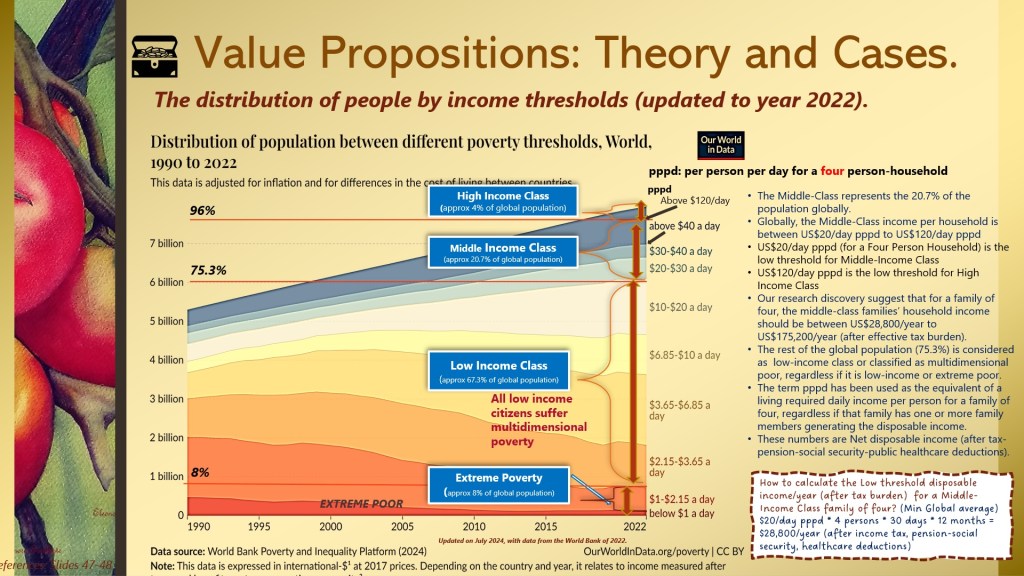
Regardless the variables of segmentation of the value proposition “Helping others” (age, area of need, type of sickness, racial groups, geographic region, countries, topics or themes of relief, climate-related issues, natural disasters, animal-flora protection, religious functions, artistic promotion, vocational or professional, sports, oceans, water cycle, SDG´s, etc.); there are certain aspects of the “Helping Others” value proposition that must be modified; because not every wealthy person can handle it all, and not every aid theme is a priority for more than 75.3% of the population in the world who belong to the low-income class and extreme poverty groups. The issue with the current charity model imbalance occurs because only 4% of the global population is considered high-income class. And with that social stratum, everyone in the charity philanthropy sector will always pursue them, begging for help to help others.
The vast universe of subjects or action themes of “helping others” only makes the “charity inefficiency” system under a momentum of worst codependence. To set up a charity fund to help others without money, at the expense of begging for money from the rich elite 4% of the world, is equivalent to establishing a philanthropy model under the YouTube digital begging model premises. Are you arguing with me about this reality check?
My definition of “helping others” is ampler and wider than “charity”. I believe in helping people to thrive in their beautiful essence. Each person on earth is born with the clear mandate to help others grow well, prosper, and create well-being opportunities for healthful families in the future. Since I am involved in corporate strategy, organically, I love the themes of business and economics, and I would like to give what I know to others by helping them to do integral corporate strategy based on values, based on ethics, established on fraternal love. That is who I am. That is what I can do for others too. Each of us has talents that can be used to help others. Each of us must discover what is his or her fortes, or natural gifts. Each person, with his/her competencies, is capable of helping others with what they do for a living.
Furthermore, no one has the right to judge how you wish to help others. Maybe your prayers can be more powerful than a million dollars for the recovery of one kid in the hospital. Maybe your prayers can move the hearts of people who can help in moments of natural disaster recovery… Maybe your prayers can change the minds of those who can do something. But what to do? How to help others without slipping into the typical NGO-begging codependence model?
I do not want to do charity like my parents. Their method of doing charity has constitutive deficiencies. The “charity” as usual, has separated the act of helping from the identity of the helper. When the meaning of your essence on the planet is divorced from your own identity, the consequence is fragmentation and reduction of the impact of helping others. Likewise, gathering money to assign to the poor is usually diluted in the administration expenses of the non-government organization; and what arrives to the poor is a minimum quantity and quality of the donation initially collected. The overhead percentage of any NGO in the world ranges from 6% up to 40% of the donations, regardless that we believe the average is only 20%. For those non familiar with the term overhead, these are the operational and administrative expenses required to run the NGO: salaries for staff, office rental, IT expenses, equipment, marketing campaigns, travel expenses, etc. Still, most of the NGO administration staff are starving, and I dare to state that most of its personnel wages do not get as far as a Low Middle-Income class status.

Helping others as a professional individual.
Is it possible to help others from our self, defined as what we are and what we do for a living?
Is it feasible to help others from each professional attainment? Let´s see it from my own personal case. Is it doable to help others with my passion for the discovery of new knowledge? Is it imaginable to help others by writing every week under the terms of a “state-of-the-art” corporate strategist for the new generations? From what I have learned during the 54 years of my life, I believe in helping others to ask themselves the right questions when they are exploring to reach their potential of humanity. I have confidence in helping others when they are setting their business models, by teaching them how to consider the tripartite essential considerations of Jesus Christ: Love God and love others as yourself. I trust my gut by opening new fields of knowledge that were barred during the last century. But regardless of my philosophical allure, I certainly believe that helping others must be done from each personal talent or gift that has been offered to each of us. Sadly, many of us are working or handling professional roadmaps that do not fit with our natural talents, creating a dichotomy that is popularly accepted: what you do for a living many times is not what you are. What you work to earn the bucks for paying the bills is not aligned with what makes you happy. Millions of people do not have the job of their dreams but are simply enrolled in the employment that keeps them floating economically. It is like surviving with a lie that brings money to the table while neglecting your call in life. In this context, what is the meaning of helping others, if we can´t help ourselves?
Helping others in the area that you like the most or helping others in the area that is needed the most? Who gets the benefit of our assistance? The person who receives our help. Why do we help others using the priorities of the helper, if the one who receives the help is not asking for that, or his/her needs and wants are not aligned with the goal of the one who helps? For years I thought, that helping others must be executed around the helper’s taste, look and feel. But that is not true. The assistance must be aligned with the needs and wants of the one who is receiving or will obtain our aid. The best support occurs when there is a strategic fit between the donors and the receivers of the help. In addition, every relief must be done “as it should be” in terms of integrity, quality, impact, and excellence. To help with mediocrity of service is worse than not helping at all.
Helping others to set excellent standards?
Time is changing and there are several “helping others” premises in different contexts. The Internet has allowed us to see the best standards of the planet in every single area that we wish. But what happens when these “best standards” are not technically and rightfully well-designed? What occurs when these “best standards” are ignoring the unevenness of our societies, and are firing up more troubles? What happens when technological advancements are being rolled out wrongly? As an analytical professional, I have to study, reflect, and bring those issues to the table. If I don´t do it, the rest of the erudites who have remained in silence for decades, will not express their concerns either. If what is considered the “best international standard” mounts rotten, it is our responsibility, as strategists to raise a warning sign about it.
Let´s see the case of the bankers. Conscious “well-grounded” bankers are also obliged to change their industries. Development financing institutions are responsible for teaching private bankers how to raise capital to help businesses “help others” with their projects. No private bank on earth will change the premises of its investments if they are not able to notice what is the true significance of helping others by going beyond the meaning of profits. It is wise to stop crooked investments and corrupted practices before another financial crisis which erased Lehman Brothers in 2008.
Helping Others is helping yourself.
As a Middle-Class citizen, you must be conscious of your belonging to the 20% of the population in the world who is living with a family annual disposable income between $28,800 to $175,200. If you turn your sight in any direction that you wish, you will find a situation where you can help, sometimes without investing a penny, and other times by reflecting on what to buy and why. For example, it is never too late to give a helping hand to women or men who have fallen because others punished their careers unjustly, using wrong judgments, envy, or misunderstandings. It is never too late to give a charitable hand to men or women who have finished their university studies and have been without a job in their career, begging for a change for more than 5, 10, or more years… It is never too late to give a generous hand by training people who have no idea of the meaning of integrity and have been doing things wrong in their roles as middle managers or executive directors of banks, governments, and private corporations… it is never too late to give a helping hand to people who are struggling by setting up their businesses and crashing many times with their families starving… it is never too late to refuse to buy art prints, and instead buy an original work of art to beautify your homes or offices to help the artist to live with dignity. It is never too late to talk about a good reference for someone who has been pushed off the limits of his/her stoicism. As a community resident, it is never too late to share your badge of cookies with your neighbors; that action also means helping others.
It is never too late to simply think about how much goodness impact can you hold in the power of your decision-making. But without love, any decision to help others is merely a dishonorable public performance.

***************************************************************************************************************************
Version of the original Article written on October 12th, 2017.
Helping others…
Today, I would like to write about my own concept of helping others.
I will like to share a very personal opinion, and I apologize if you don´t agree with me, but I have to write about it today. Tomorrow I will deliver what I wrote about the Bargaining Power of Buyers and I will start with Threats of Entry fifth force of Porter. I still have 9 days until the Volvo Ocean Race starting day in Alicante OK.
Helping others means to give something with sincere love (time, money, knowledge, in-kind contribution, influence, advise, etc..) for the benefit of others. There are many ways to help others as the stars in the sky.
The Baby Boomers generation (the generation of my mother) believe that helping others can be done just by setting up a foundation and dedicate your full time towards fundraising to help a group in need. Baby Boomers believe in charity as a way to help. Of course, there are as many groups in need as you wish to name: babies, kids, single mothers, widows, elders or retired seniors, youngsters, etc. Baby boomers have a very limited approach to helping others. They were raised in a world of charity, and organizing beneficial dinners or bingos to do fundraising, organizing balls inviting rich people requesting an expensive entrance to do fundraising, or volunteering their time in hospitals, elder houses, and orphanages… and with all my respect to the generation of my mother, I do not believe in doing charity as they have done it until today. Why? Because I believe in another value proposition of helping others. Do you get it?
The segments of your value proposition “Helping others”, can be classified into several groups. The segment groups you wish to help can be classified by several variables:
- Age: babies below 1-year-old, toddlers, kids, teenagers, seniors, etc.
- Area of need: peace in the world, health, education, food security, entrepreneurship, religious values, etc.
- In the case of health, by type of sickness: Heart diseases, HIV, diabetes, pediatric sicknesses, arthritis, mental health, etc.
- Race: Hispanics, Afro-Americans, African, Asian, etc…
- Region: Central America, South Cone, Nordic, southwest America, Caribbean, etc.
- Country or specific neighborhood in a country.
- Specific activity: supporting education to new political talents, fighting against corruption, shelter for homeless, activism to do social pressure, denunciation of injustice, human rights, etc.
- Natural disasters: Rescue after earthquakes, storms, flooding or fire.
- Climate-related: the rescue of the ocean, water recovery, climate change, Arctic and Antarctic protection, etc.
- Animal-related: species protection, animal rescue campaigns, health for animals, zoo conservation, etc.
- Religious: Teaching bible courses, praying, missionary camps to non-christian countries, etc.
- Artistic: supporting arts such as painting, orchestras, dancing groups, sculpture, etc.
- Vocational: helping people to find their profession and thrive as economic active participants.
- Sports oriented: preparing new athletes in each discipline-gymnastics, swimming, skating, dancing, etc…
- And the list goes on and on and on…
There are many fields or action themes of helping others. Moreover, no one has the right to judge how you wish to help others. Maybe your prayers can be more powerful than a million dollars for the recovery of one kid in the hospital. Maybe prayers can move the hearts of people who are able to help in moments of natural disaster recovery…
My definition of “helping others” is more ample and wide than “charity”. I believe in helping people to thrive in their own beauty. I love the themes of business and economics, and I would like to give what I know to others by helping them to do integral corporate strategy based on values, based on ethics. That is my aim.
I do not want to do charity as my mom and her friends have done it. Their method of doing charity is a bit obsolete, and I say it with all the respect of the world. Baby boomers separate the charity concept of your own identity… or they do it because their mothers helped as such, and it is a “charity heritage”… I do not mean to offend the baby boomers generation charity model, but I believe that is not the only way to help others. Time is changing… and there are several “helping others” models and purposes or concepts in different contexts.
I am a person who studied business because did not like civil engineering. I traveled the world trying to understand business through my studies. I love to see results. I love to see what good financing can do for the benefit of people. I love to see when teams have raised capital investments to build hospitals, or to create public kindergartens where there was no education available for the kids…. On the other hand, to find public-private funding to build parks and play structures for kids…. I believe in influencing raising capital investments from the point of view of impact development for society… I believe in doing impact investing. I believe in helping businesses to thrive in this business complex environment with ethics at the core. It is time to realize how important it is to do business with ethics, it is time to realize how important is to do funding and investing… and I wish to dedicate my life to helping people in these themes…
It is never late to give a helping hand to women or men who have fallen down because others punish their careers, it is never late to give a helping hand to men or women who have finished their studies and have been without a job for more than 5 years… it is never late to give a helping hand to people who have no idea of the meaning of integrity and have been doing things wrong in their roles as middle managers or executive directors of banks and corporations… it is never late to give a helping hand to people who are struggling by setting up their businesses and have crashed many times and do have their families starving… it is never late to advise people about when is the time to ask for a loan or a private equity investment for sustainable growth in their startups…
I believe in helping others from my own self. From who I am. In my career. From my passion for knowledge. From what I have learned all these 47 years of my life. I believe in helping others to be themselves and reach their potential of humanity. I believe in helping others with and next to the man I will marry, teaching our future kids how to help others as a living example of their own purpose in life, but more importantly helping WITH LOVE.
Helping others for me has to be done in the area that you like the most. Others cannot impose it. Each person knows what is in his or her heart, and how and when to help. Each person knows. It is in their heart. In addition, maybe as the world is changing, it is time to rethink about the concept of “charity” for the coming generations too… hmmm, what do you think?
Note: All the pictures shown on this blog do not belong to me. I do not own any of the lovely photos posted unless otherwise stated.
 Eleonora Escalante Strategy - Strategic Reflections Think Tank