

From the Enlightenment to Business Models. Season II. Episode 5. Rousseau Anti-Philosophes.
Again, here we are, trying with all our valent spirit to continue our crusade to finish our content before the last final In-Port-Race in the Hague. Additionally, we are looking forward to concluding the next three themes before the first of July. Today we are covering material about Rousseau. Then I will proceed with the next topic, which is about Voltaire, and without non-stop in any port, we will persist later with Diderot. Finally, our last episode will be to show you a reorganization of the Enlightenment chronology, that will surprise all of us, as much as I was astonished when I started to connect the dots between all the Enlightenment profiles of the countries that we have analyzed since January.
I request you to please do not judge me by not pairing exactly with the schedule that I have not been able to comply with during the last 2 legs. After my boat was dismasted, I am trying to keep on going, no matter what. I am simply trying to deliver by keeping outstanding the final deadline: July 1st. Since we moved into this new petit studio, we are sailing in difficult conditions, without any stopover, and we are praying to arrive in Genova on time. From today to July 1st, we will be publishing as soon as we finish every episode, regardless of the pre-established schedule for Leg 7 of the Ocean Race. I will not stop until we reach the harbor port in Genova. So let´s proceed.
Find below our frame of reference slides for today. You can print them or download them in PDF as you wish.




Rousseau´s origin.
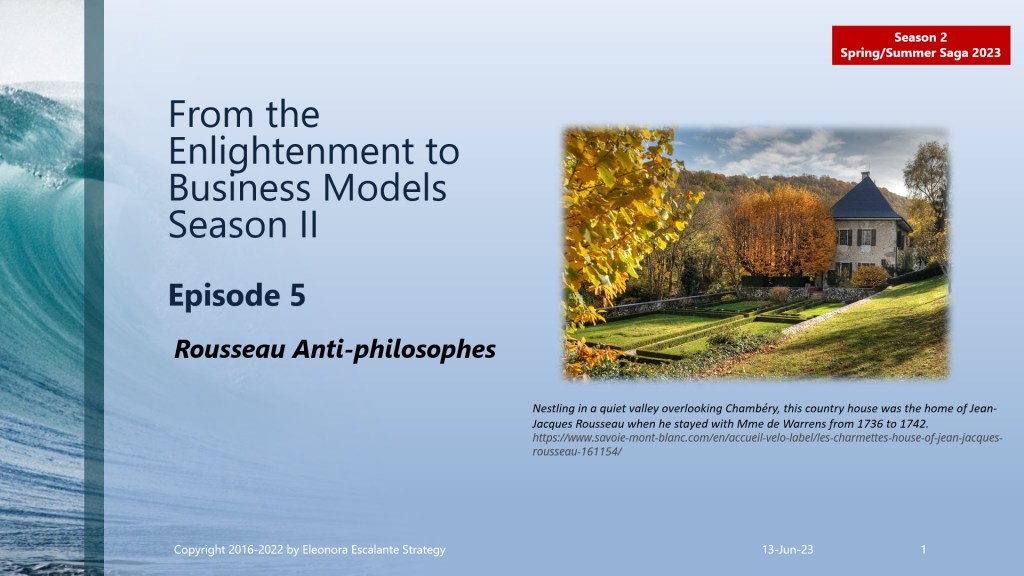
To understand the context of the life of Jean-Jacques Rousseau and his historical background, it was not easy for me to grasp it automatically. Rousseau was basically an orphan, that was lucky enough to be a smart good-looking man, who was informally adopted at the age of 15 by Francoise-Louise de la Tour (Baroness de Warens). Madame de Warens belonged to an aristocratic family who possessed Chatelard with its picturesque old castle on the hillside near Vevey. I mention Madame de Warens because she procured to Rousseau when his own family couldn´t continue supporting him.
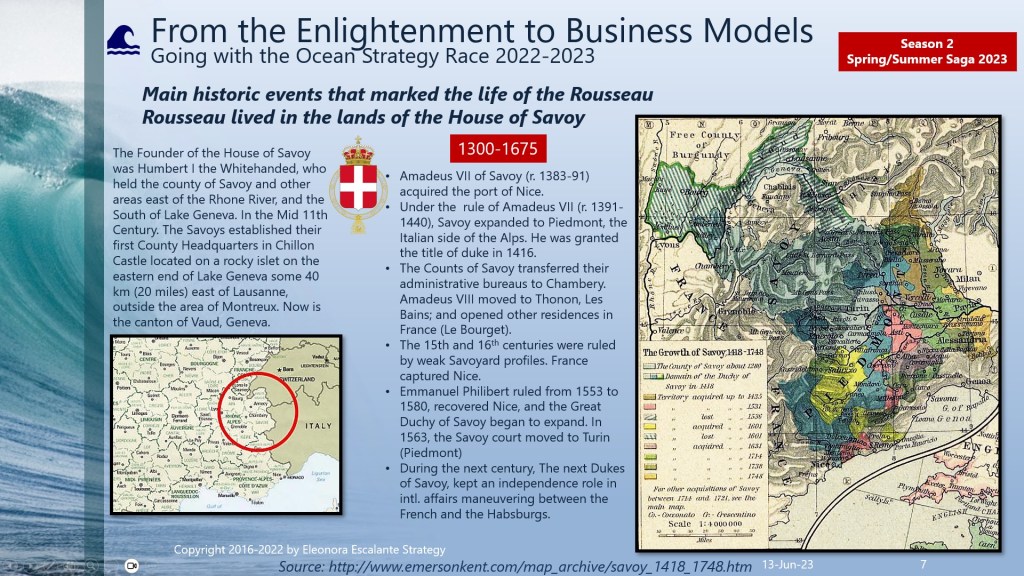
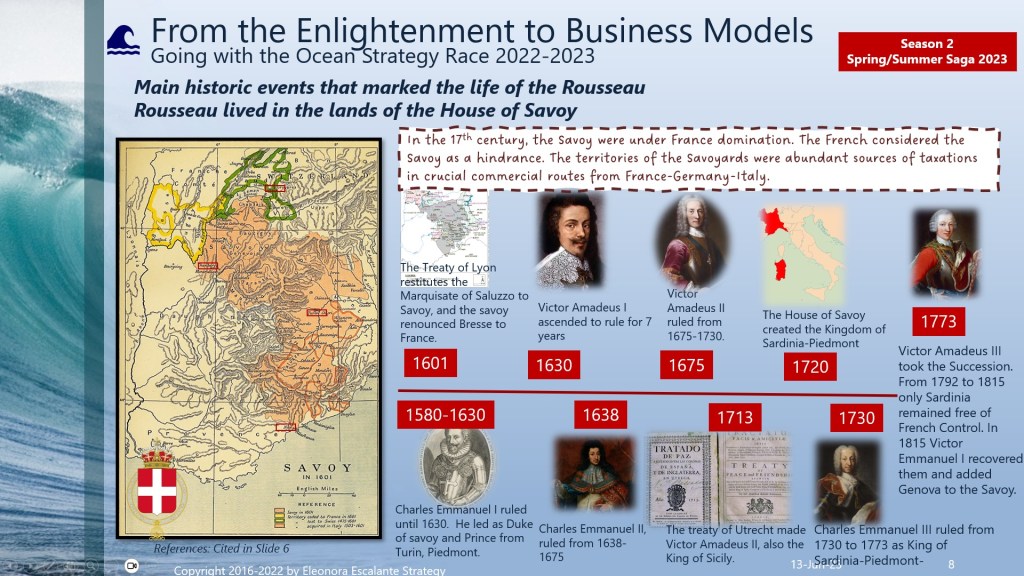
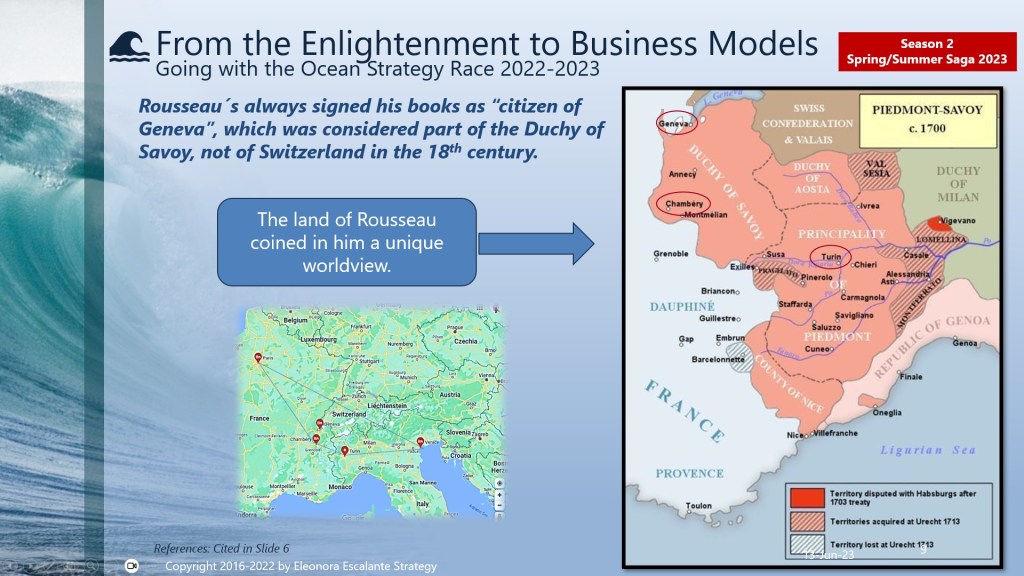
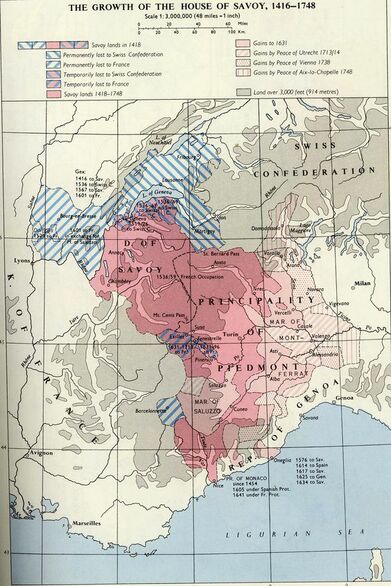
About Rousseau´s original nest in Geneva: In the 18th century, in terms of cultural and political exposure, Geneva was not really Swiss, but in soul and mettle, the Calvinist Geneva of Rousseau was under the terms of the Savoy Duchy, who established a strong domain in that area since the 11th century. See slides 6 and 7.
The Savoy land and Rousseau´s life.
We can´t understand Jean-Jacques Rousseau if we do not situate ourselves under the sovereigns of his time. Rousseau wasn´t the son of a commoner. Geneva Republic was a protestant location surrounded by catholic counties and duchies. Geneva was for centuries an independent part of Switzerland under the culture of the Duchy of Savoy. As I mentioned above, fortunate Rousseau was born there. Rousseau was a citizen of Geneva, a heritage title that came from his father, who lost his wife after Jean-Jacques’s birth in 1712. Rousseau´s mentality crib was coined by his dad, one of the best clockmakers in Geneva, someone who was educated enough to have the time to read to Jean-Jacques, a unique father with a profession that allowed him to reach clients in higher places. When Rousseau´s father couldn´t care for him anymore, at the age of 10, Rousseau was left under the care of a local religious minister. A few years later, in 1727, Rousseau was introduced to Madame de Warens, a Swiss baroness, who lived in Chambery, in the lands of the Duchy of Savoy, south-west of Geneva. This is the first turning point in Rousseau´s life, he left Geneva and moved to a key location, which was a historical headquarters zone of the Savoy dynasty. Rousseau spent 10 years with Madame de Warens, not just walking and admiring those valleys between Annecy, then Chambery, and finally the Valley of Les Charmettes. Madame de Warens (with the assistance of her own patrons and religious contacts), helped Rousseau to fulfill his education in philosophy and modern literature. The blessing of Madame de Warens in Rousseau was enormous: first acting as a protective mother, then as a lover, and as a guide for opening doors in the refined world of Savoy. The presence of Madame de Warens in Rousseau´s decision-making for the next 15 years was fundamental for whatever happened later in the philosopher’s life. Through Warens, Rousseau began his road trip to become international. First to Turin, the headquarters capital of the Savoy Family. It was in Turin where Rousseau converted to Catholicism in 1728, and where he also worked as a servant to a noble family. Then he tried to become a Catholic priest, without success. Next, his passion for music took him to try to be a musician, a music copyist, and even a music teacher. His travels from Turin to Chambery, under the domain of the Duchy of Savoy, created in Rousseau an understanding of what was the meaning of the beauty of the Alps, and the Enlightenment from the Savoyard point of view.
Rousseau wasn´t really a citizen of Geneva, he was a Savoyard citizen. He was exposed to the people of Savoy otherwise unattainable. By 1737, he had already sketched the oeuvre “Narcissus”. From the role of steward, he used his contacts in the high society of the Savoy places to initiate his career as a tutor of their children. After working as an educator for the Mably Family children in Lyon, he became acquainted with Condillac and d´Alembert. Every rich lady that he met, opened a new opportunity for him. Finally, his first voyage to Paris arrived, and with it, he introduced a new numerically based system of musical notation to the Academy of Sciences, a medium that allowed him to get acquainted with Denis Diderot. Rapidly, through his Parisian contacts with upper-class women (Madame Dupin and Madame Broglie), he continued making a living as a tutor, and finally as a public officer. He was appointed as secretary to the French Ambassador in Venice for a couple of years. Once he returned to Paris in 1744, he was already in the spotlight of the French Enlightenment coterie and stamina in the Paris Salons. At the same time, he got involved with his maid, Therese Levasseur, with whom he procreated children, all of them abandoned in a Parisian Foundling home.
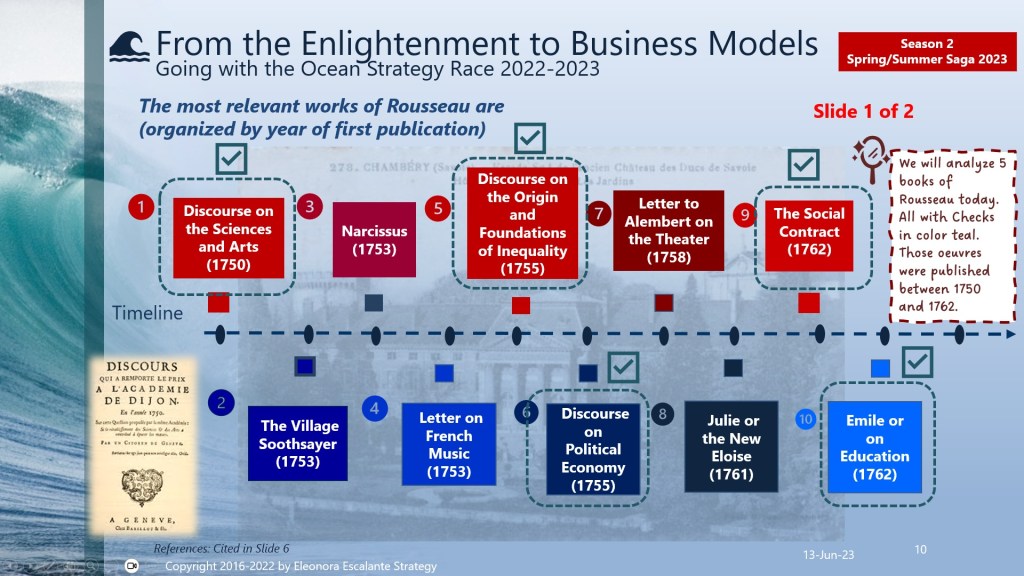
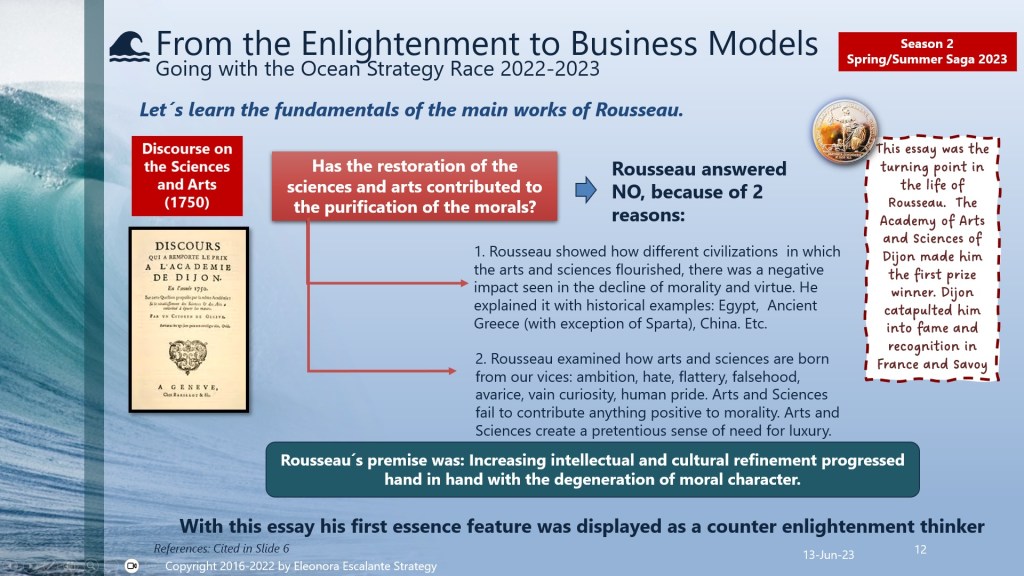
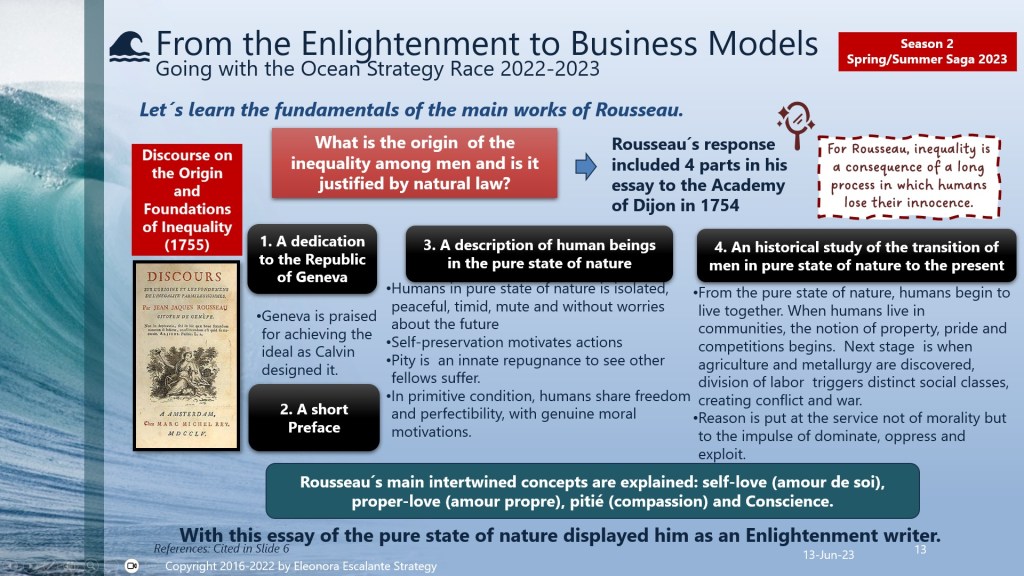
From 1749 to 1754, Rousseau was catapulted with fame and recognition, as the winner of the essay competition of The Académie des Sciences, Arts et Belles-Lettres de Dijon, with his “Discourse sur les sciences et les arts”. Subsequently, his work as an author of a diverse range of oeuvres was projected on a non-stop roller-coaster, but he also refused a lifelong pension from the king of France in 1752. Furthermore, he wrote two more discourses about inequality and political economy. In 1754 he returned to France to split up with his friends of the Encyclopedia (Diderot, Holbach, Helvetius, and later Voltaire). After that, he changed his residence to Montmorency. He moved to a cottage called L´Ermitage, upon an invitation from another aristocratic lady, Madame d´Epinay. His retreat to live in this place helped him to write, but as a womanizer, he got in trouble soon and had to move to another chateau, living under the protection of Charles II François Frédéric de Montmorency-Luxembourg (from 1759 to 1762).
When Rousseau finalized and published his next main works “Julie ou la nouvelle Heloise” “The Social Contract” and “Emile”, his peaceful days came to an end. The city of Geneva and the French authorities ordered his books to be burned, and his arrest was demanded. He escaped to Neuchatel and was forced to leave his home again because of his advocacy for freedom of religion in 1765. He tried to settle in Berne, but he was commanded to leave and search for asylum. He settled for some time with David Hume in England. He returned to France afterward. After 1767 Rousseau depended on friends, moving from house to house that allowed him to write, but he also returned to Paris for a few years (1770). Shortly after that, he accepted to retire to Ermenonville, where he perished in 1778.
Strategic Reflections about Rousseau´s Works.
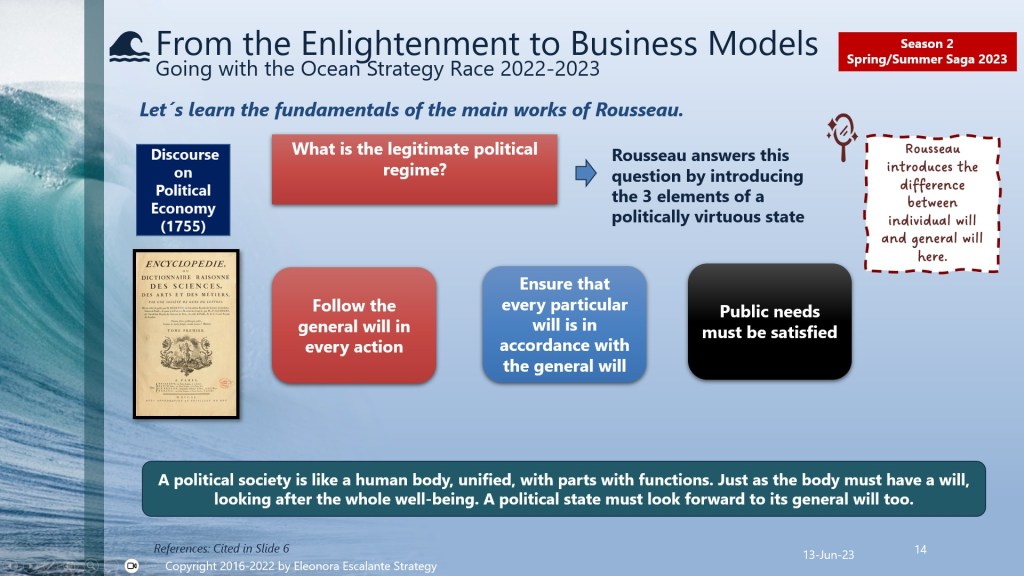
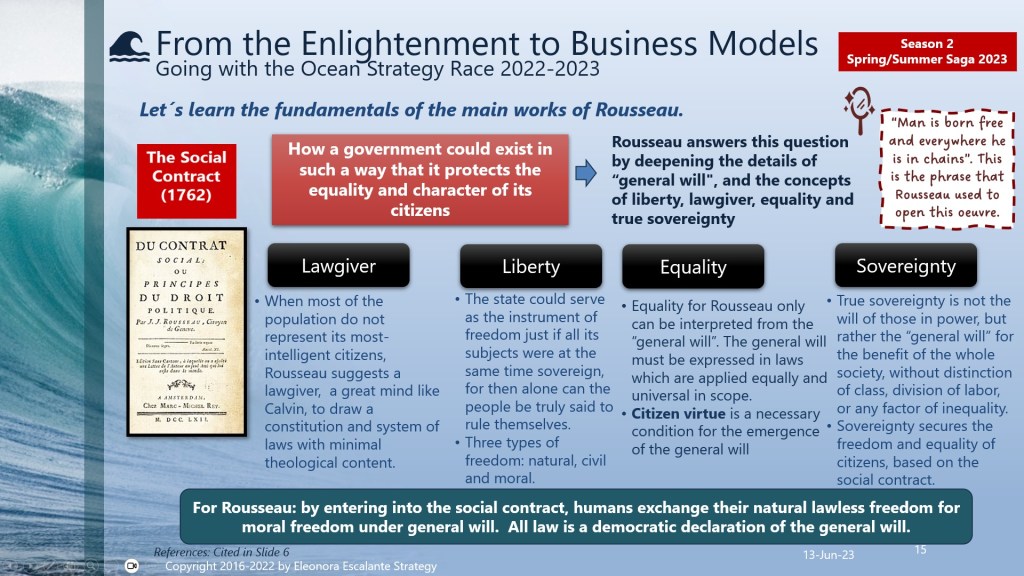
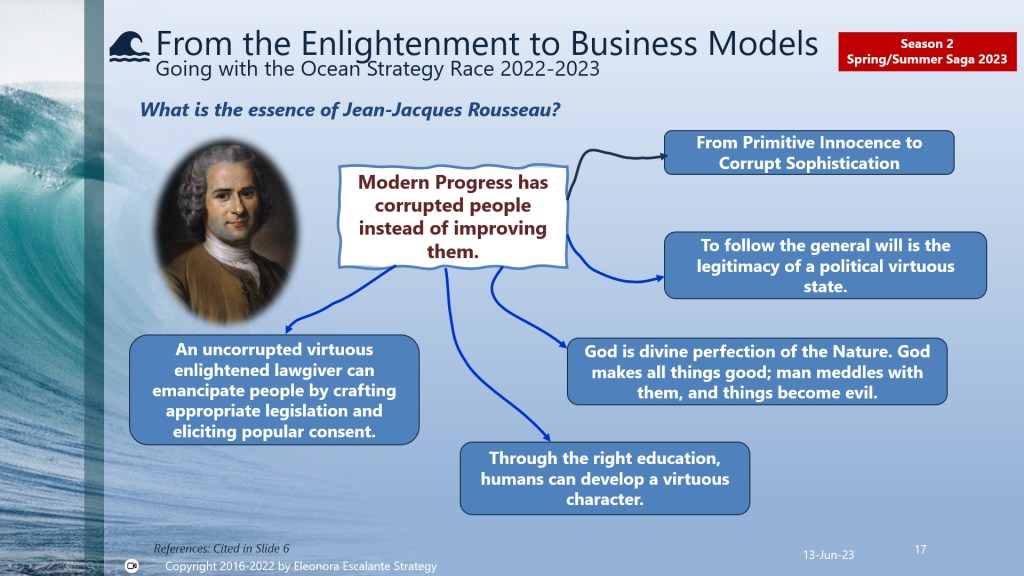
When Rousseau focused on writing about economic, political, and education philosophy, the first “Discourse about Arts and Sciences” launched him as a counter-enlightenment profile. But later, he wrote in similar terms to the rest of the freethinkers (some radical, and others moderate). Later, Rousseau broke up with his radical Encyclopedia friends. The religious elements in his books from 1762 were the cause of the official persecution that he suffered, but his rich-well-connected friends always gave him a helping hand. The essence of Rousseau isn´t probably as hard-core technical in physics, math, and geometry as the rest of the philosophers, but he mastered his ideas about democracy using the guideline of “general will”. Even when he was promoting the idea of a Geneva Republic, he was thinking in terms of what he saw in his voyages around Turin, Chambery, and the rest of the Savoyard locations. I can´t ignore expressing that Rousseau had the best location to develop his mindset: the Alps. His surroundings affected his ways of thinking. He was able to connect the dots between freedom, equality, and sovereignty, in such a way that the concept of “general will” was standing on these foundations. See slides 14 and 15. Rousseau´s last years of his life were difficult, but it was during this period that he provoked the origin of the word “democracy”. He wasn´t able to see what happened during the French Revolution, but clearly, his content was wrongly abused and misinterpreted for the bloody french revolutionary occasion.
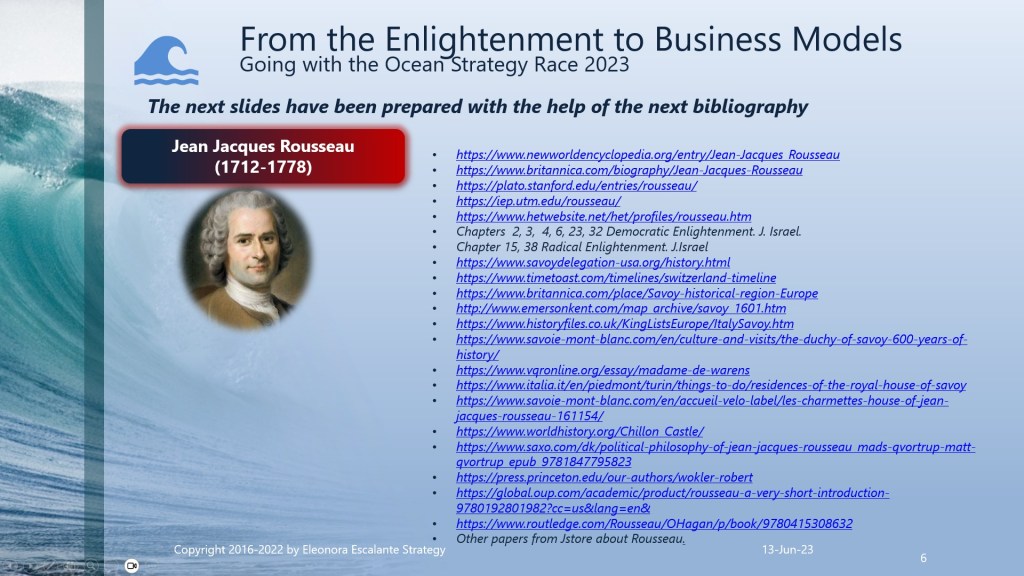
The political philosophy of Rousseau is well interconnected from one work to the other. I have tried only to provide the main elements from slides 12 to 17. But I encourage you to visit all the bibliographies that I took the time to read during the last week, which is mentioned in slide 6.
What I like about Rousseau is that he was able to mix all his passions under his books: music, theater, critiques, letters of debate, and theories about how to understand human development in terms of his motivations, virtues, and debacles. Every single one of his oeuvres spins around morals, virtues, and character. It doesn´t matter if he was writing about the state of nature of human evolution, or general will, or politically successful societies, or about the qualities of a government that is feasible to ignite equality in its citizens. All his work was influenced, not by others, but by his walks and houses in the Savoy lands. The beauty of the French-Italian-Swiss landscapes, places that he traveled back and forth so many times, is reflected in his books. Maybe because I was able to live in Switzerland, I can relate to the Savoyard territories, and I am convinced that all the literary work of Rousseau was an ode to the awe that his eyes saw while crossing those sceneries, which can only be understood by another human being that can see reality beyond the eyes. “It is only with the heart that one can see rightly; what is essential is invisible to the eyes” A. Exupery.

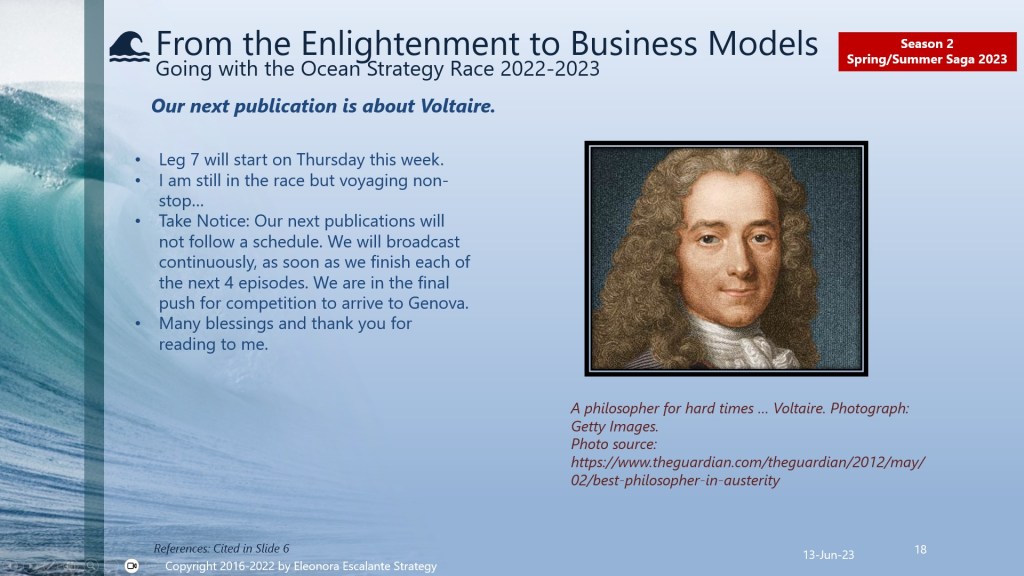
Announcement. Tomorrow I will start to prepare the material about Voltaire. As soon as I finish with my strategic reflections, I will proceed to publish. And that is how it will be as of today, until the 1st of July. Non-stop voyage!
Ocean Musical Section
From Aarhus to The Hague has been a piece of cake for all the teams.
I would like to show you a recap of Leg 6. All of us were headed out of Aarhus to The Hague via Fly-By in Kiel. Sometimes slowly, but in general it has been a piece of cake for all the teams. Again 11th Hour Racing Team won the first prize. Today, the in-port race took place at the Hague for the IMOCA class boats (the winner was Guyot Environment). Tomorrow there will be a new in-port race for the VO65 class teams. Let´s see which one will win.
The music that has been selected for you today covers the Alps of the Savoy Lands. The awe that all corporate strategists who want to build a cutting-edge philosophy of business are required to live. We will not be able to change our business-model frameworks and corporate strategy mental premises, meanwhile, we do not understand the miracles of God in the nature of the Savoyard territories (Swiss-Italian-French Alps) as much as the presence of God in the Oceans. The scenery of God´s artworks is on the table for us to remind us how beautiful but fragile is our planet when we do not think properly about it. If our thoughts do not respect the environment (the ocean, the Alps, the air, the rest of the living species, and the magnificence of our mother Earth), we will reap the consequences of our lack of organized mental priorities. Maybe Rousseau was telling us, 300 years ago, that humans without moral virtues were, are, and will be the source of corruption in our societies, and the cause of the destruction of our environment.
Thank you for reading to me. See you soon. Blessings

Leg 4 will take us from Itajai to Newport. Photo Source: https://gfycat.com/gifs/search/volvo+ocean+race+extreme
Sources of reference are utilized today. All are listed on the slides.
Disclaimer: Illustrations in Watercolor are painted by Eleonora Escalante. Other types of illustrations or videos (which are not mine) are used for educational purposes ONLY. All are used as Illustrative and non-commercial images. Utilized only informatively for the public good. Nevertheless, most of this blog’s pictures, images, or videos are not mine. I do not own any of the lovely photos or images posted unless otherwise stated.
 Eleonora Escalante Strategy Strategic Reflections Think Tank
Felicitaciones. Ardua y maravillosa tarea. Felicitaciones¡¡¡ Lo leeré despacio para entenderlo. Eres especial . Te queremos y admiramos. Vamos contigo como siempre¡¡¡¡
LikeLike