
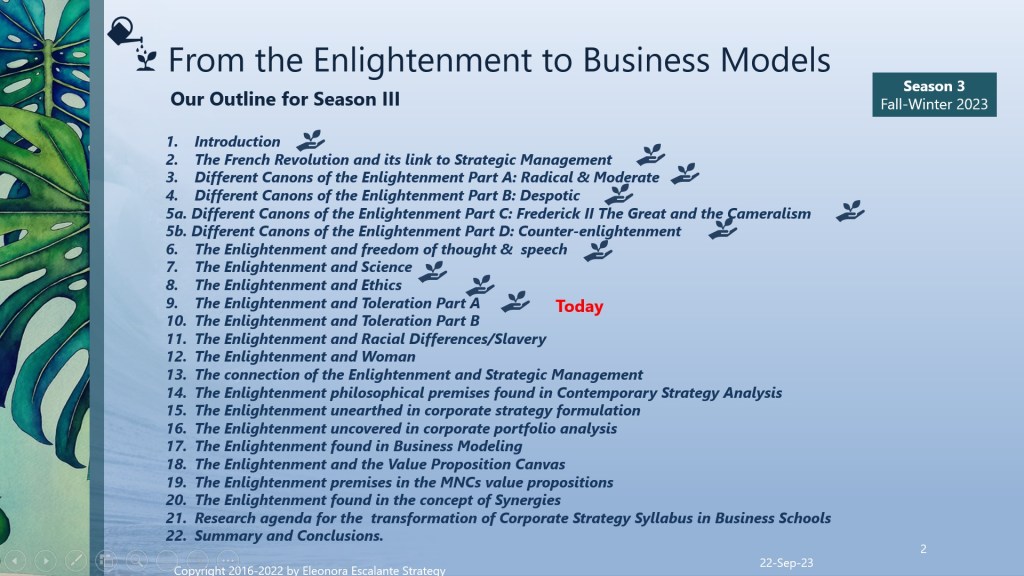
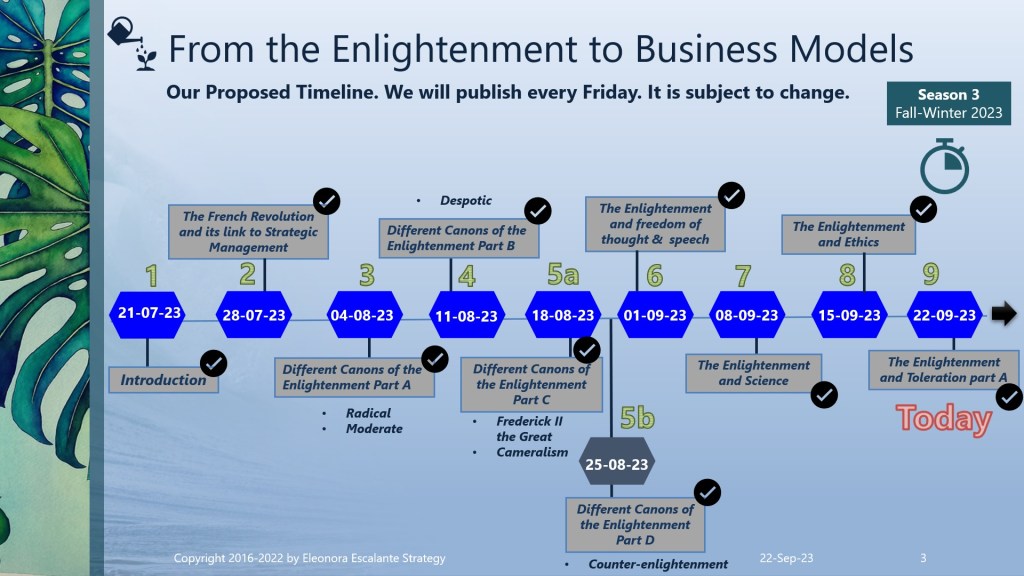
From the Enlightenment to Business Models. Season III. Episode 9. Enlightenment and Toleration Part A.
The First Day of Autumn. Today, September 22nd is Autumnal Equinox, the day that my favorite season begins. In a few weeks, once the temperature starts to drop, the wind and the lovely scenery of the autumnal palette will unfold with the pumpkin cinnamon lattes and roasted chestnut aromas. The fall palette of colors in nature is exquisite, between the warm auburn and reds, mixed with golden yellows that bloom from the trees. All these colors mingled with some delicate touches of Crimson Alizarins or Bordeaux. The enchanting season of Autumn is a gift from God for all of us.
What is tolerance now?
Let´s situate ourselves in the year 2023. We have decided to start with the present when it comes to the topic of tolerance and/or toleration. Systematically, it is reasonable to understand where we stand in terms of the philosophy of toleration today, so next week we will be able to perceive the rationale behind our most treasured Enlightenment message of toleration. Our civilization has a long history of cyclical periods of toleration and intolerance. Each of us has a definition of tolerance (from the popular conceptualization of it), but the definition of toleration of today has nothing to do with what was the meaning of tolerance for the freethinkers of the Enlightenment. Our notion of tolerance (in our present) has evolved decade after decade. The same applies to the circles of superior philosophers in the world, who debate about tolerance, and are doing their own analysis back and forth from their roots of high intellectual development. The experts on toleration have a complex map for the definition and learning of tolerance contexts, conceptions, issues, discrepancies, paradigms, paradoxes, and justifications.
In one phrase: what we conceive as toleration in the 21st century is not the term of toleration of the Middle Ages and the Enlightenment. And we must acknowledge this situation beforehand. Additionally, we can´t understand the complexity of the term “toleration” if we are not ready to open our minds to connect it with other definitions such as freedom. Moreover, there is no toleration (in whatever definition we could frame it) without the concept of freedom. Freedom is also an aggregated composite term that requires other concepts such as responsibility, respect, and boundaries. As a result, toleration is simply an aggregated term that is composed of other concepts such as freedom, respect, duty of civility, neutrality, emotional control, stress, justice, shared responsibility, empathy, coexistence, esteem, boundaries, restrain, negotiation, and contentment.
As much as the Enlightenment has shown us at least 4 canons: radical, moderate, enlightened despotism and counter-enlightenment; also the term toleration (and tolerance) has different doctrines/theories, or interpretations according to the ontological picture of our contextual reality. Each author (professor or researcher) that has investigated this topic, has a different analysis. Each analysis of toleration is circumscribed to the social-political-economic and personal circumstances of the expert. In consequence, let´s begin today to explore the present, and in our next episode we will go back to the past, to the Enlightenment that is our domain of pertinence.
Let´s visit our frame of reference prepared in the following slides. Feel free to print or download them at your convenience.




The definition of toleration.
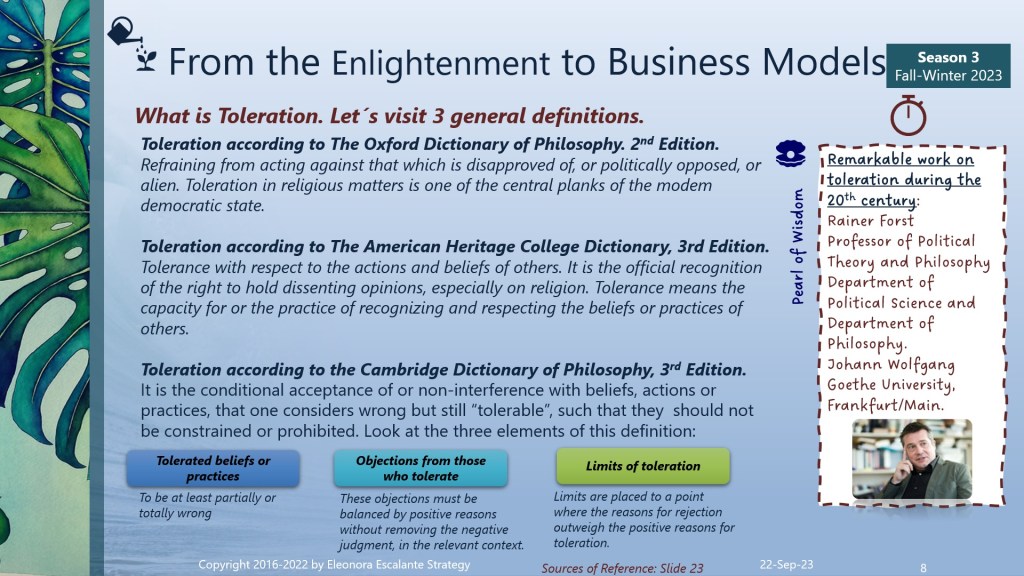
From slides 6 to 20, we share the different and varied definitions of the word “toleration”. On slide 6, we start defining it from the point of view of a general concept. The three definitions of this slide are not equivalent. But they share an element in common: refrain, desist, or hold back from acting against someone or something that bothers us. So, there is an element of distress in the individual or the group that tolerates the one that needs to be tolerated (for whatever the intolerable reason: religious, gender, ethnic, race, heritage of the past, lifestyle, opinion, etc.).
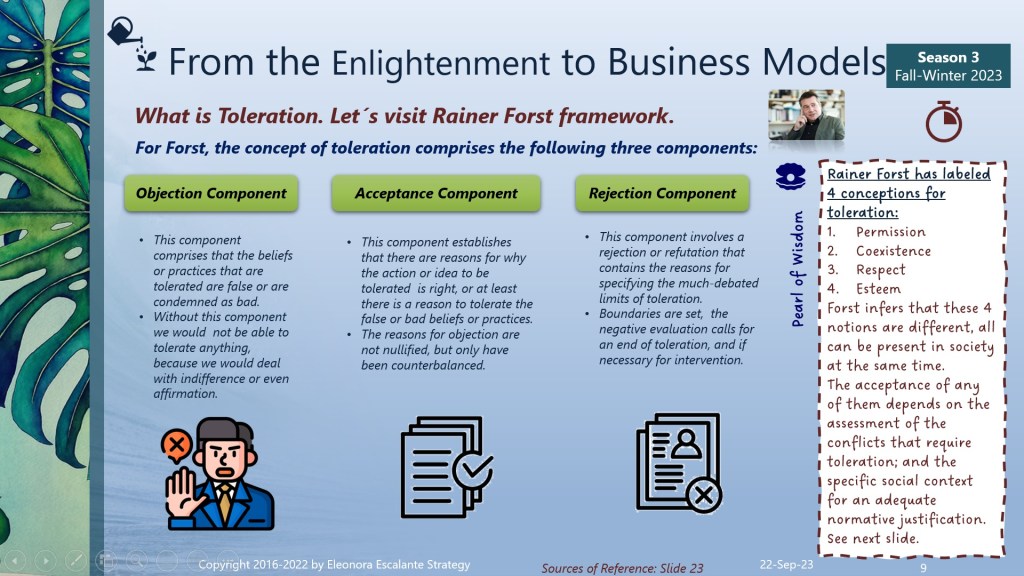
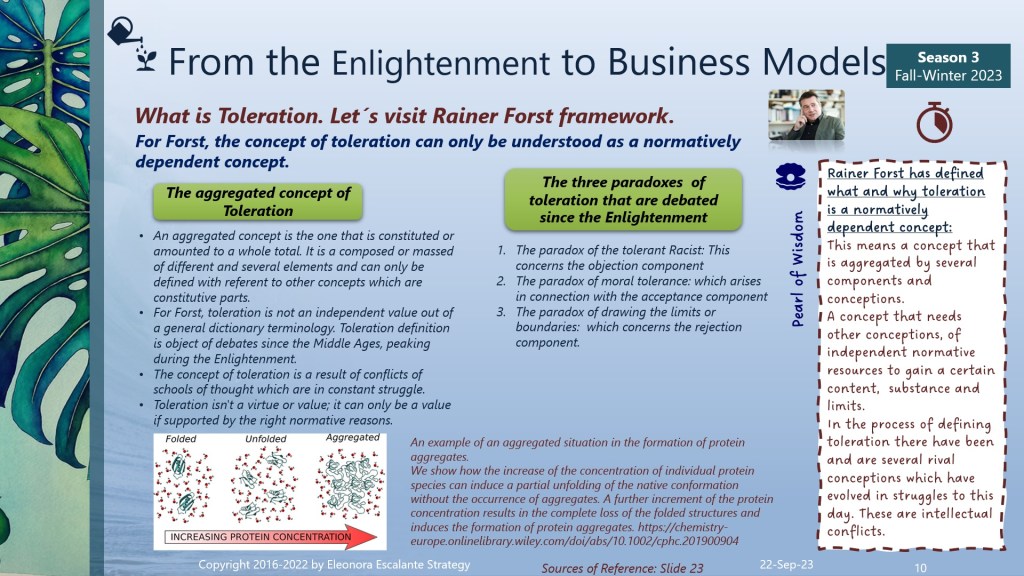
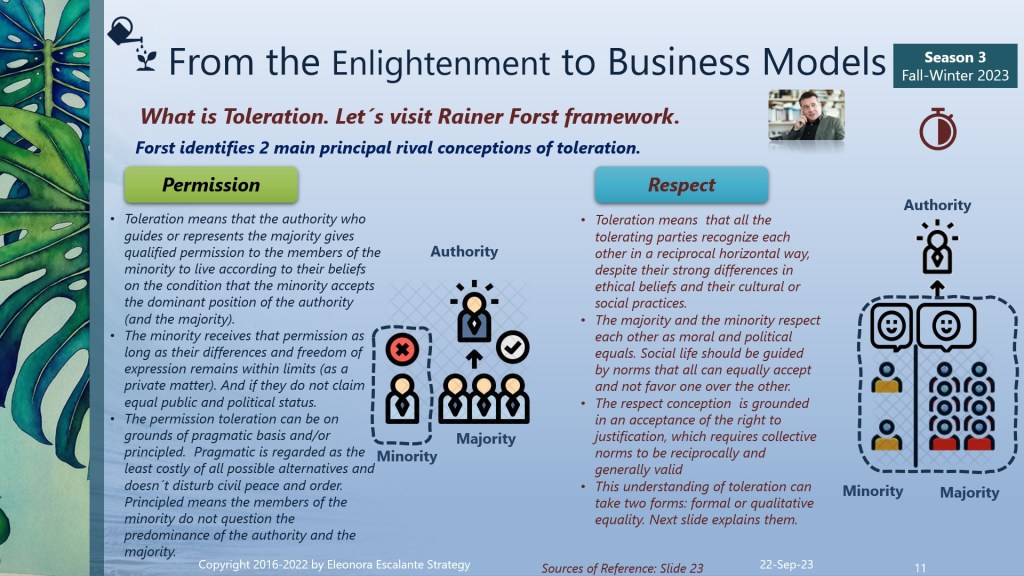
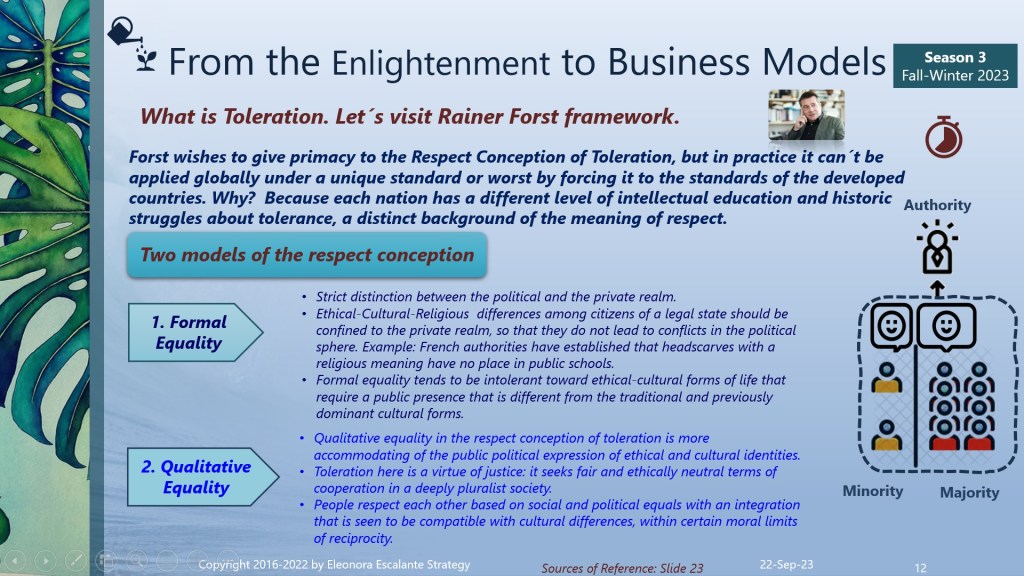
Rainer Forst. Rainer Forst, Professor from Goethe University in Frankfurt Am Main, is our main reference point in this discussion. Slides 7 to 15 are a summary of his most relevant discoveries about toleration. Initially, we show you the three components of the concept of toleration: (a) Objection component, (b) Acceptance component, and (c) Rejection Component. When understanding Forst’s whole picture of the term toleration, I tried to compare it with an aggregated situation in the formation of protein. Go to slide 10, and you will understand the metaphor of it. In addition, he explains the toleration paradoxes, which are associated with the term “toleration”, historically and particularly since the Enlightenment. Slide 11 shows us the 2 main principal rival conceptions of toleration that Forst has identified: The Permission Conception and the Respect Conception. We have tried to explain the differences between the two conceptions with an illustration. Slide 12 takes us to realize that Forst has a predilection for the Toleration Respect Conception, and he specifies two models of it: Formal equality and Qualitative Equality. All the details of these terms are in the slides.
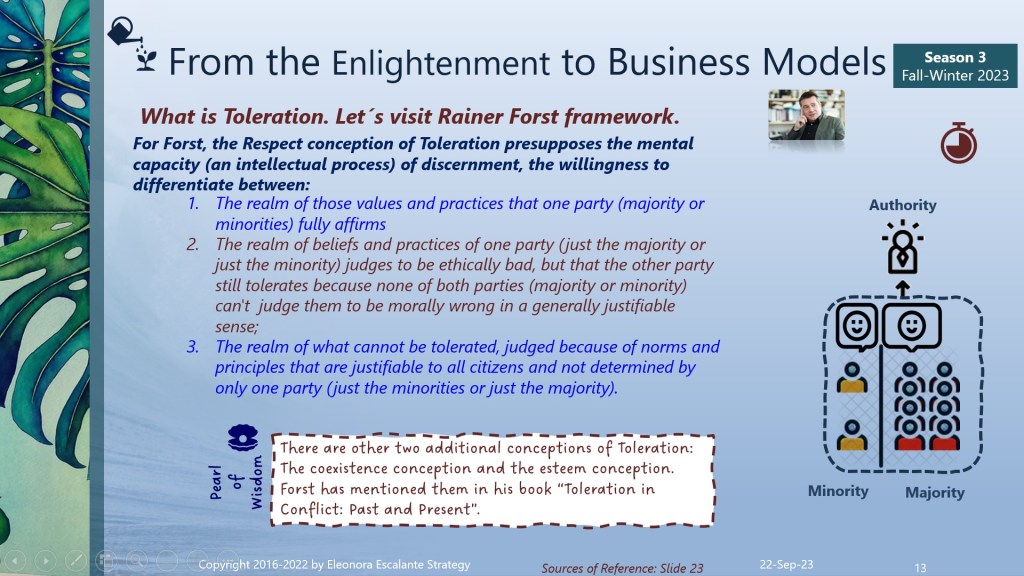
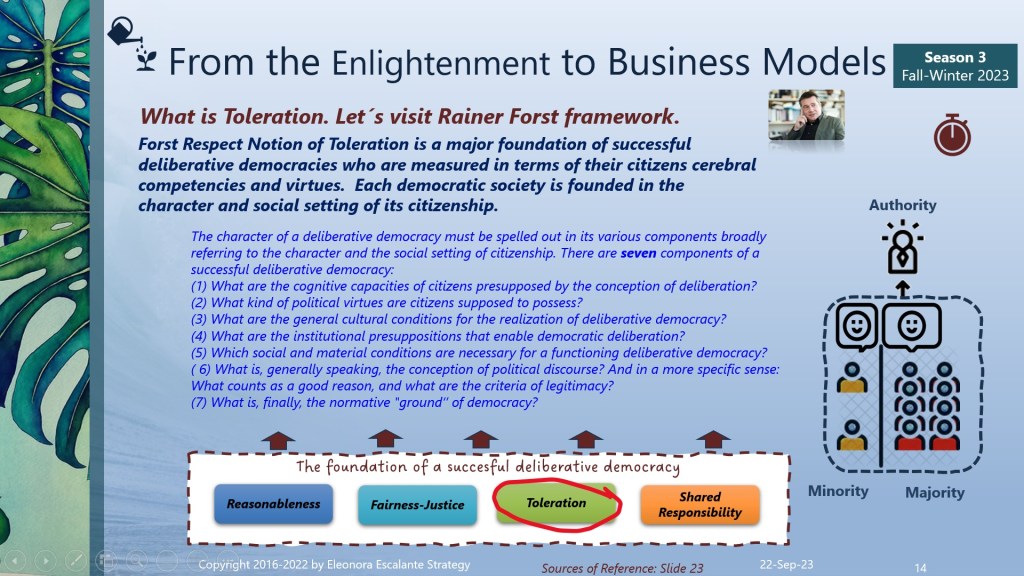
Now, let´s go to slide 13. Forst identifies that to implement toleration in the practice, under the theory of the respect conception of toleration, people must be trained in their mental capacities of discernment and rehearsal to react with respect and keep fairness, reasonableness, and shared responsibility for a successful democracy. Societies with respectful tolerant people are not an accident. Furthermore, these societies are a product of an advancement, a growth in intellectual capabilities, from generation to generation, a progress of humans who can use their cerebral competencies and ethical virtues to put the “respect toleration theory” in practice.
A successful deliberative democracy can only occur if the society is conformed by a critical mass of well-educated people who have been taught and are qualified to be respectfully tolerant. Moreover, the legitimacy of these democratic societies occurs because there are boundaries or limits between public and private matters, and in consequence, the normative ground of democracy is omnipresent not just for the majority but also for the minority. This is explained in slide 14.
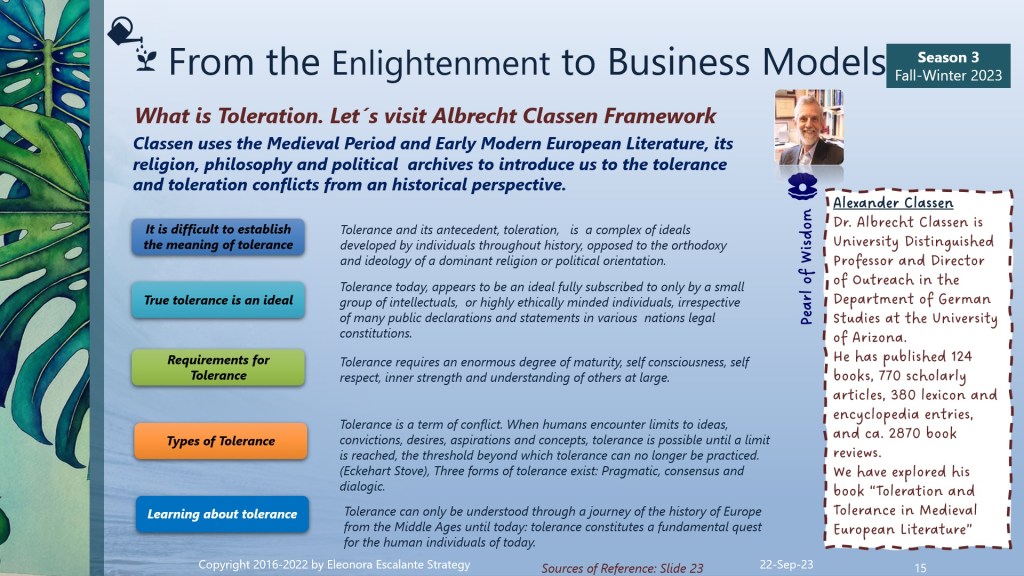
Albrecht Classen. We visited Classen´s studies on toleration of the Medieval Period and Early Modern History because it was fascinating for me to explore the different literature of events that triggered the cyclical evolution of the term “toleration”. See slide 15. Classen contribution is based on the historical perspective of “toleration”, with all its specific details, conflicts, and reasons.
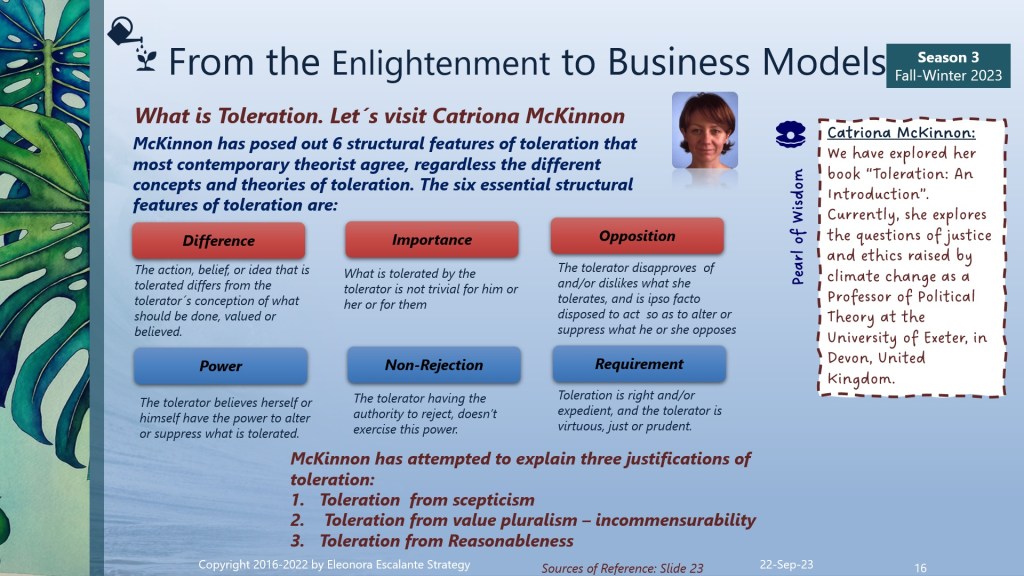
Catriona McKinnon. Her contribution to the aggregated definition of “toleration” is founded in the essential structural features of toleration: (a) Difference, (b) Importance, (c) Opposition, (d) Power, (e) Non-Rejection, and (f) Requirement. Please, to grasp the explanation of them, look at slide number 16.
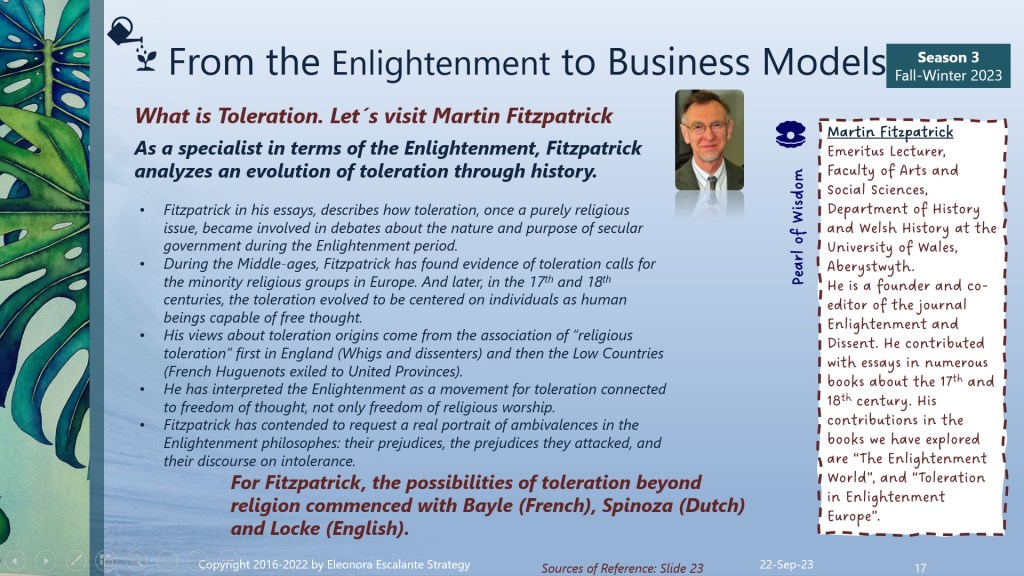
Martin Fitzpatrick. In the same line as Classen, Fitzpatrick analyzes with fidelity the evolution of toleration through history. His emphasis coincides with Jonathan Israel´s view about the origin of the new possibilities of toleration on three doctrines: Bayle (French), Spinoza (Dutch), and Locke (English). His contribution has been to remark that during the Enlightenment, toleration moved from “religious causes” to “thought causes”. Visit slide 17.
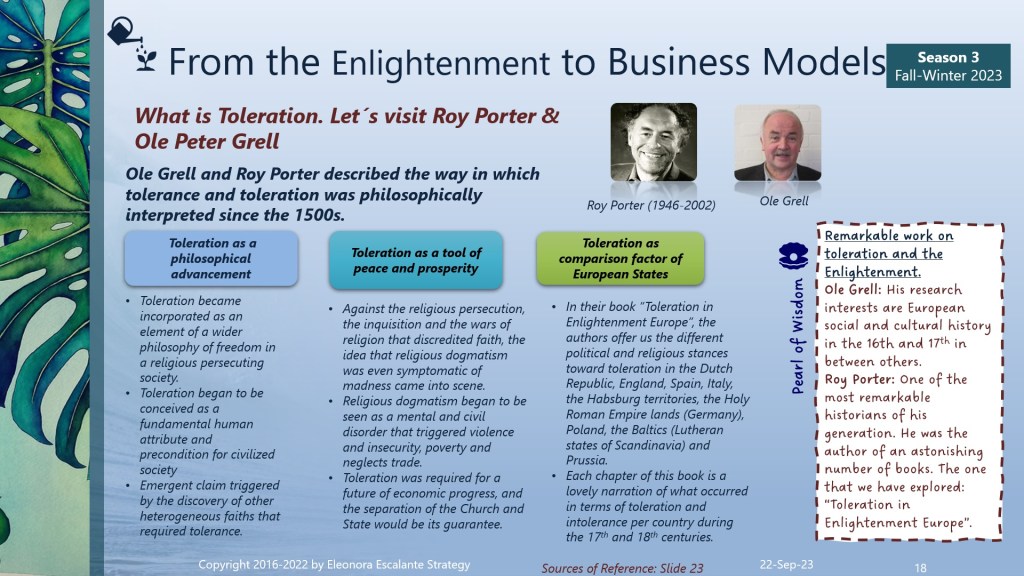
Roy Porter and Ole Peter Grell. The book “Toleration in Enlightenment Europe” was written in the year 2000. The legacy of these authors from the positive side frames the term “toleration” as a philosophical advancement, as a tool of peace and prosperity, and as a comparison factor of European States during the Enlightenment. On the negative side, we also can perceive a secret message hidden in the middle of its pages: toleration is fragile, it can end as quickly as it blows from the pain of keeping the emotions in a pressure cooker, ready to explode. When humans can´t tame emotions, toleration hangs on a fine thread that can be cut not just spontaneously, but at the same time with so much energy and force, under intolerable scenarios, as we have observed during the French Revolution, or the Huguenots expulsion from France, or the Jesuits Order temporary suppression, or violent crimes and horrendous wars. See slide 18.
Lars Tønder . We selected Tønder, because he has backtracked his analysis about toleration in terms of an exceptionally interesting approach “the ontological imaginary of reason”. He even inspects a new theory of toleration without tolerance, implying that tolerance is not the same as toleration. Look at slide 19. His attempt to acclimatize us to three imperatives when toleration occurs: neutrality, dispassionateness, and systematicity, only reaffirms to us our suggestion of the supremacy of emotions in times of conflict. For Tønder, tolerance is defined as a disposition to endure pain and suffering and toleration is the institutional framework that accommodates minority groups through principles of freedom (such as free exercise of religion, free exercise of thought or lifestyle) under certain limits.
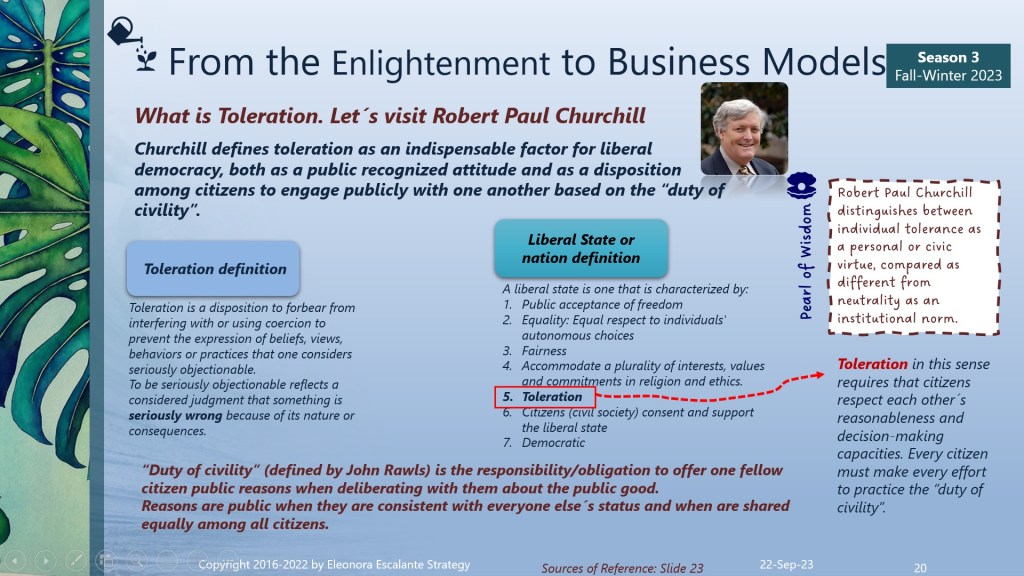
Robert Paul Churchill. Churchill perceives toleration and preconditions toleration as one of the indispensable factors for liberal democracies. He also considers the “duty of civility” of John Rawls as the foundation of respectful public engagement. Visit slide 20, please. The definition of toleration for Churchill teaches us to understand that toleration only occurs if the entity of toleration is seriously wrong. The entity of toleration can be expressions or actions ideas, beliefs, views, behaviors, practices, or cultural representations that are “seriously objectionable”. This aspect of Churchill´s toleration definition invites us to ask ourselves “What incidents are seriously objectionable?”. Reflecting on these clashes, we observe the stress of the one who tolerates when facing or coping with seriously objectionable situations. How to live as a stressful tolerant individual and not act to request certain boundaries that help citizens to reduce that unhappiness? We wonder if citizens´ peace of mind and spirit is a “must” requirement for a stable democracy, and how to practice toleration if people have not been trained for it since childhood.
Some reflections.
Toleration is not a unique definition. We expect that you can recognize how hard is to define an aggregated concept. Particularly when this concept involves our emotions and subjective pain caused by the objection to what is intolerable. The concept of toleration involves limits, boundaries that can´t be universal. Each society has different levels of education and intellectual development. Each community in developing economies is still learning the dichotomy between private and public matters. A tiny group of thinkers have learned to tame their emotions and practice tolerance, as the erudite who explained to us in the slides that I have prepared for you today. Even the most developed pluralist economies, which were the cradle for religious toleration in the Enlightenment (France, England, and the Low Countries), still bear situations of intolerant murders and extremist attacks every now and then.
Also, the developed intellectual gurus of tolerance can´t expect to release their theories in developing nations. Why? Because there are significant levels of intellectual development in quality and quantity in each nation. It is utopian to accept their premises of toleration automatically. It is also impossible for international supra organizations to impose agendas of toleration through cooperation entities in developing countries. Each nation has a history of toleration which is completely different than the European or American history of toleration. By imposing terms of unrealistic boundaries of specific issues of toleration on societies that do not convene to approve them (as a majority), then the principle of tolerance is broken at its roots. Each society has certain virtues, beliefs, and moral boundaries that can´t be fractured for the sake of other nation´s tolerance limits.
These limits are culturally embedded not just in religious or social matters, but also in technological affairs, and political manners. Global toleration is not possible under universal rules, because every nation has a degree of evolution in their toleration history. For Europe, it is a long process, a trajectory of rulers with a certain degree of sanity and/or madness, that triggered toleration and intolerance events throughout their history. To force an evolution in the limits of toleration without considering the emotions of the majority of every community is like becoming an intolerant totalitarian and abusive despot. Popper expressed it clearly: “Unlimited tolerance must lead to the disappearance of tolerance”(1). Each theory of toleration, coming from the most advanced universities, can´t dismiss the anthropological and historical aspects of toleration for each of the countries. Otherwise, the flags of authoritarian imposition of toleration are spread against the rights of the citizens of the developing economies. It is impossible to exercise respectful toleration in different levels of toleration nations without respect for each country´s sovereign social-economic-political-cultural-traditional boundaries.
Announcement.
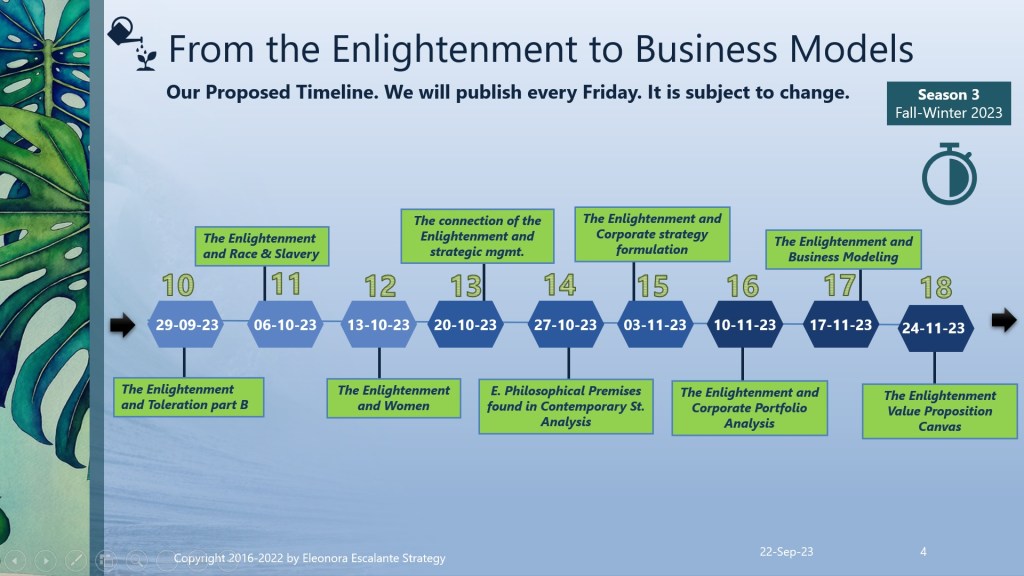
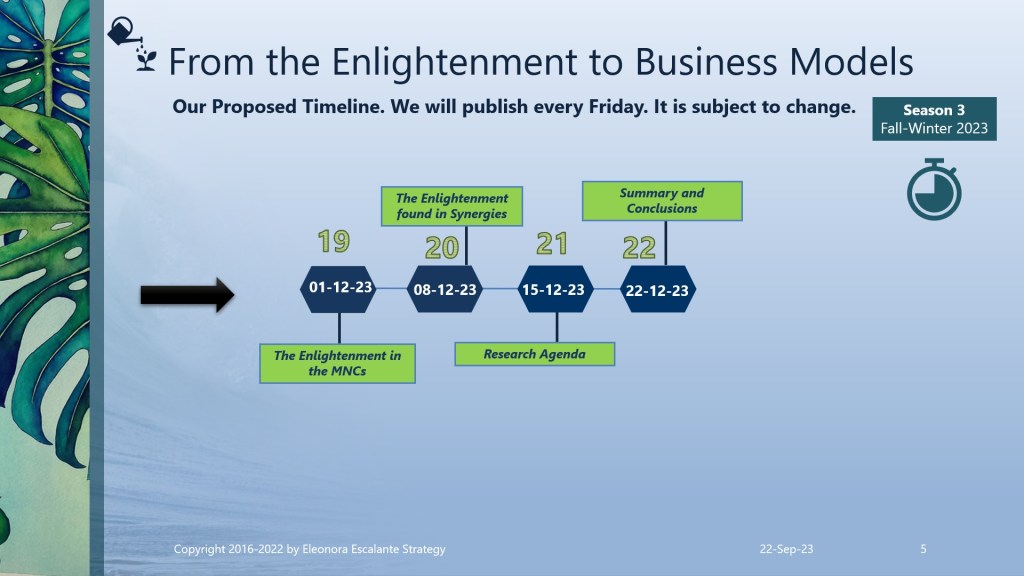
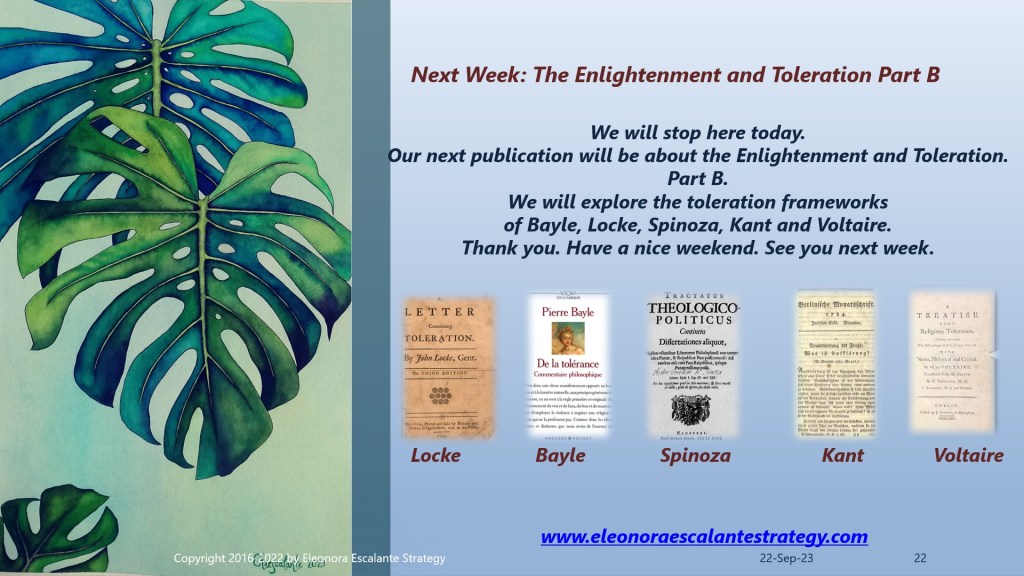
Our next publication will be next Friday 29th of September. We will continue our journey with the topic: “The Enlightenment and Toleration, Part B”. Blessings and thank you for reading our episodes.
Musical Section
We have decided to continue sharing classical flute magical music that was composed, released, or performed between the 17th and 18th centuries, to accompany your readings.
Today our musical video is music from the composer Bartolomeo Campagnoli, an Italian violin virtuoso (Cento, Ferrara 1751 – Neusterlitz 1827). This delicious musical oeuvre is “Sei qartetti per flauto ed archi”. The performers are Nicola Guidetti, flute · Marco Rogliano, violin · Tommaso Poggi, viola · Luca Paccagnella, cello. Experience the exquisiteness of this concert.
Thank you for reading http://www.eleonoraescalantestrategy.com

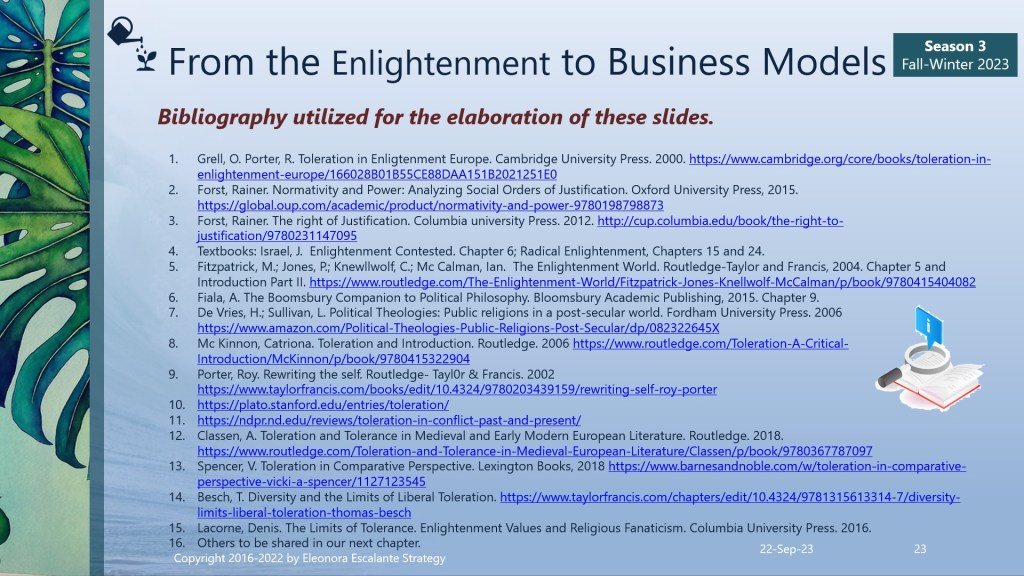
Sources of reference utilized today. All are listed in slide 23.
(1) https://papers.ssrn.com/sol3/papers.cfm?abstract_id=3631844
Disclaimer: Eleonora Escalante paints Illustrations in Watercolor. Other types of illustrations or videos (which are not mine) are used for educational purposes ONLY. All are used as Illustrative and non-commercial images. Utilized only informatively for the public good. Nevertheless, most of this blog’s pictures, images, or videos are not mine. I do not own any of the lovely photos or images posted unless otherwise stated.
 Eleonora Escalante Strategy - Strategic Reflections Think Tank