
From the Enlightenment to Business Models. Season III. Episode 12. Our main issue is not racism but slavery. Part B
Dear fantastic and amazing readers:
Today, we have uploaded the strategic reflections that emerge in conjunction with the slides, a resourceful pedagogical tool that we utilize for explaining the theoretical framework of our reflections. Every Monday, I will share the strategic reflections. Why? Several readers have expressed to me, that they treasure this interactive back-and-forth. The slides are made in a way that after reading them, can help you to exercise your own critical thought, which is our most beloved aim. By reading the slides first, you can work out your creative capacity to ask yourself questions and assemble your own reflections. Then, when I return after the weekend to post our own strategic reflections, you can compare yours and ours, and that is how we grow and learn. From now on, we will publish the slides on Friday, and we will come back on Monday to update the strategic reflections, to add any supplementary material that could be missing. This is a LIVE publication, so it is open to change. It is a work-in-progress perspective for our audiences.

Our main issue is not racism but slavery. And warfare. And our lack of caring for the environment.
We have been thinking tons about this statement. I am sure that the majority of the experts in race and racism issues of today, who have left us with a collection of amazing books concerning this field, will not only be surprised. And many will not agree with me. But as a corporate strategist, I am capitulating our analysis of the week with this statement: our main issue in history, and in consequence with our business modeling is the legacy of slavery, which has been ingrained in our mentality for over 6000 years. This is our discovery gift for all of you. Maybe today’s set of slides is the most crucial of all that I have written since January. This publication is one of the most serious, genuine, and profound that I have written. I do hope you can enjoy the reading, and positively from your own undertaking and stamina missions, I beg you to reflect and plan how to overcome any type of modern slavery that you can perceive in your life. With it, we must begin to see ourselves with compassion. We have a load of 6000 years of enslavement. To fix modern slavery commences with the will of wishing it. Repairing our societies with true love and kindness should be our call in life. Our business, economic models, and corporate strategy frameworks require tons of constant caring and investments for healing. Only love can mend and restore so much pain that we hold from our past times. Warfare only creates more warfare, and that is why we have not been cured yet. This is why our strategy structures of reference are inundated with barbarian and cruel competition, not with solidarity for the well-being of all of us. Remember that 6,000 years of slavery won´t be fixed automatically… it is a process of a continuum of generations working on it. We have nothing to worry about if we at least realize what are our urgent problems on top of climate change. One of them is the issue of slavery, which has been organically tied to our human spirit since ancient times.
We have prepared a journey on historical evidence for you. Feel free to print it, share it, and download the next set of slides. You will have all the weekend to create your reactions, strategic reflections, and questions. Feel free to contact me if you wish.






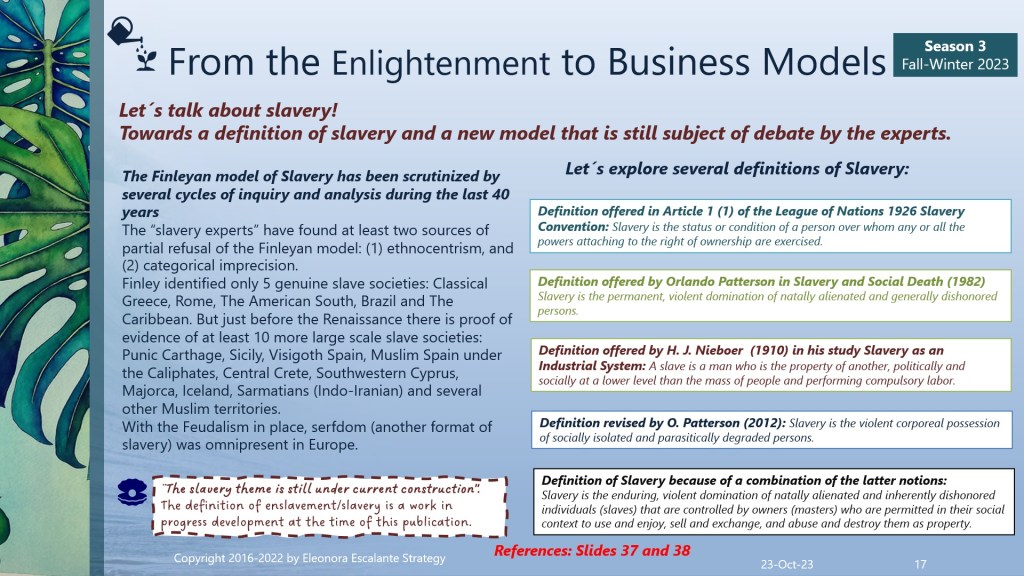
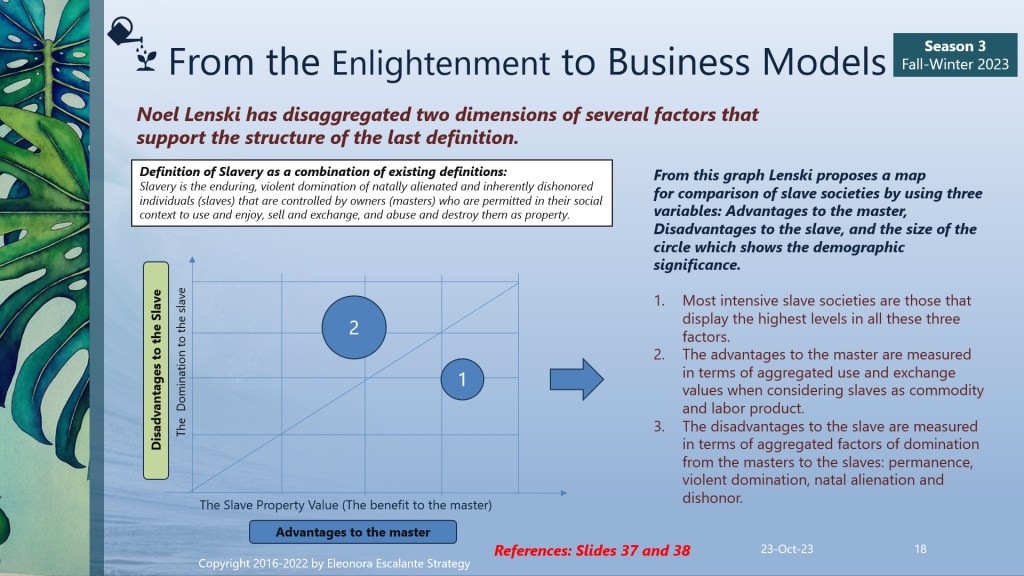
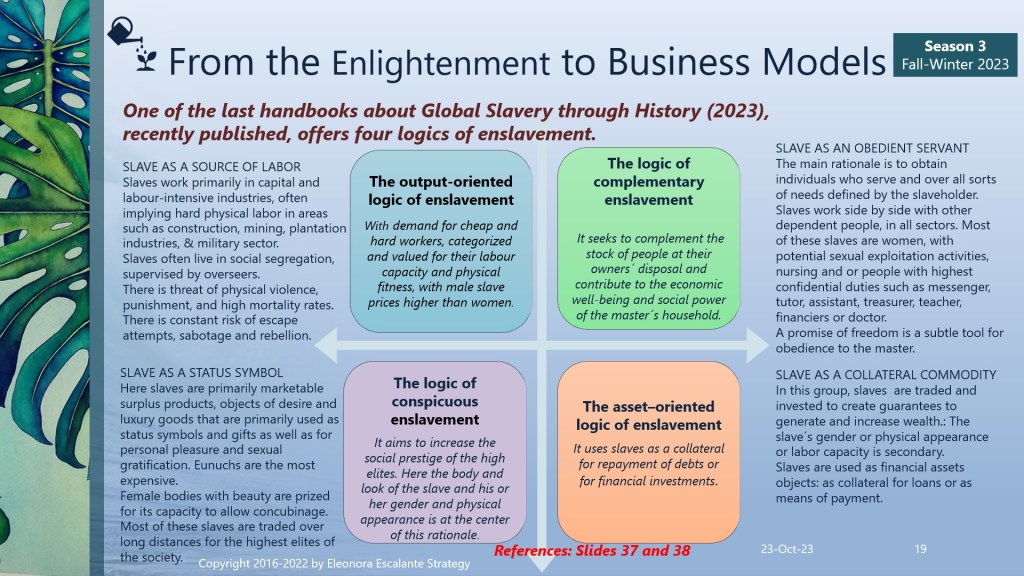


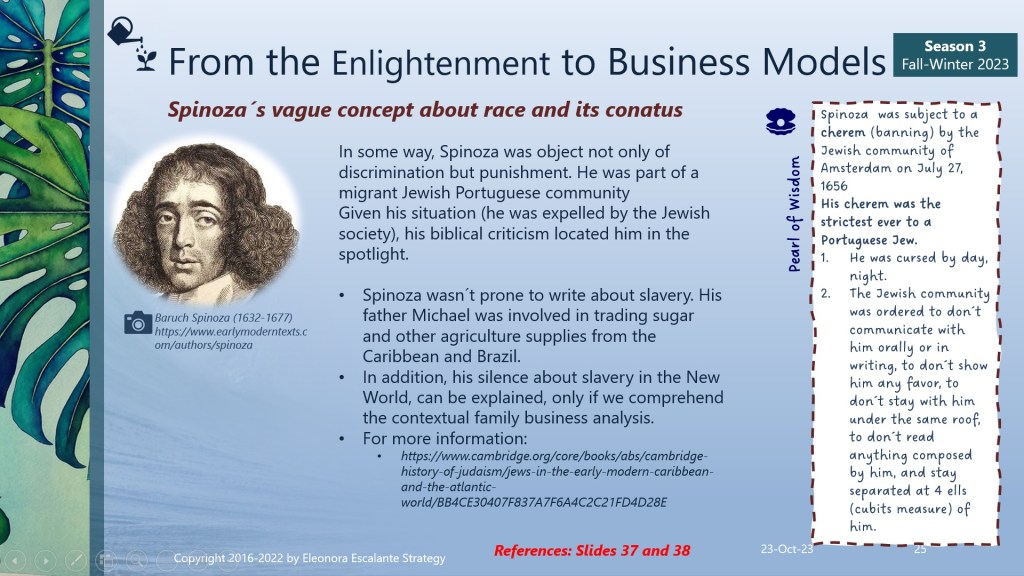

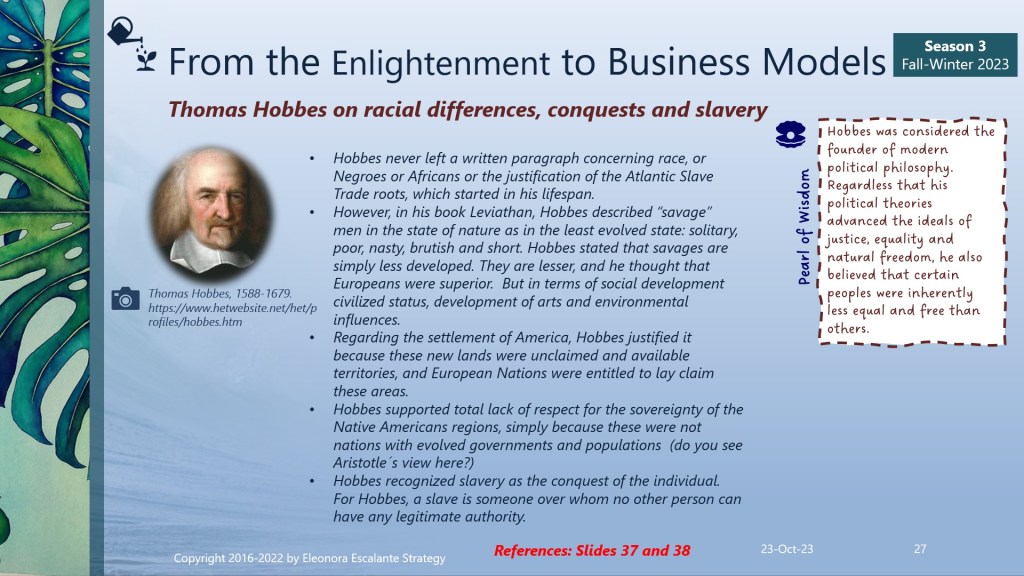


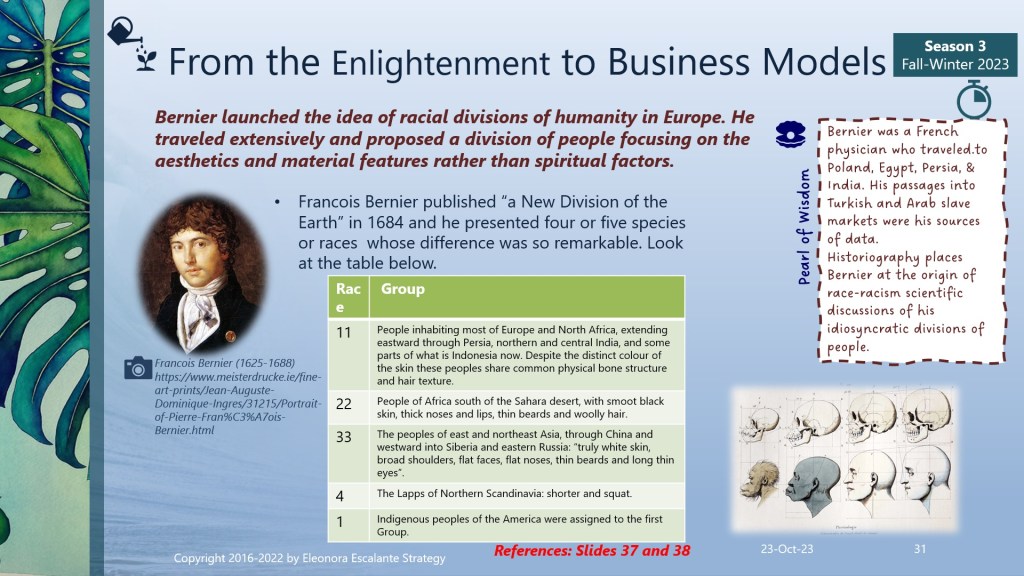


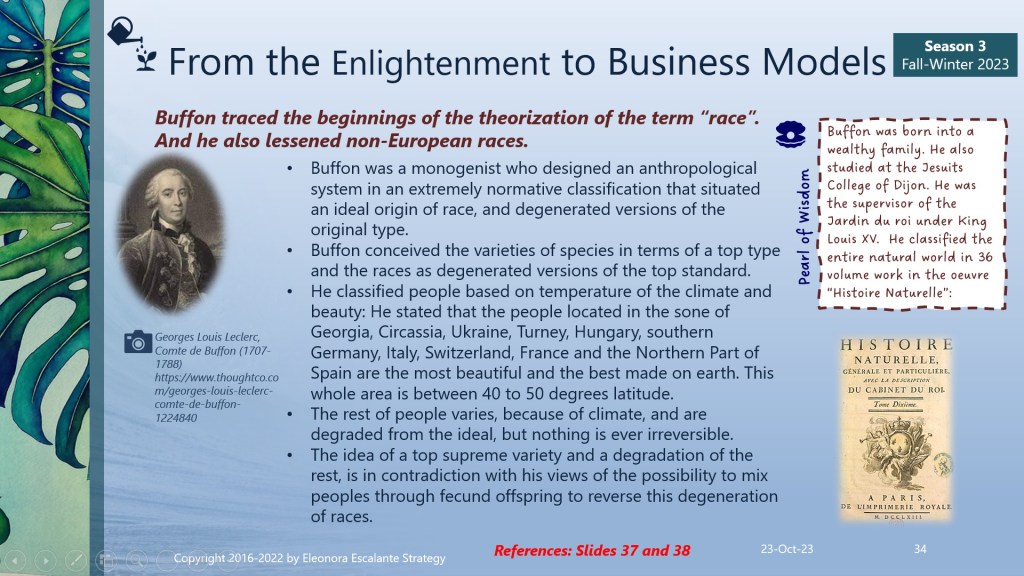
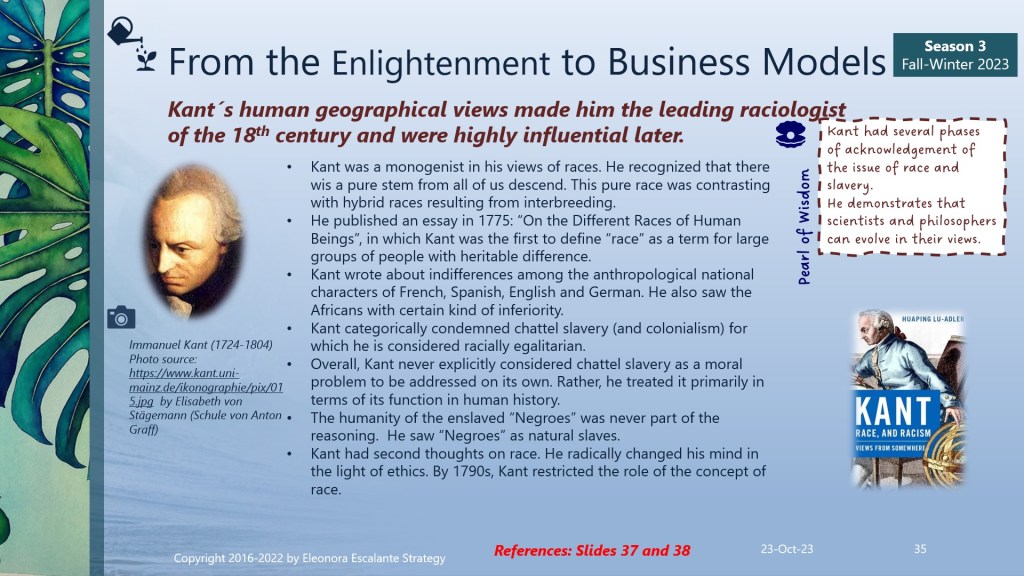
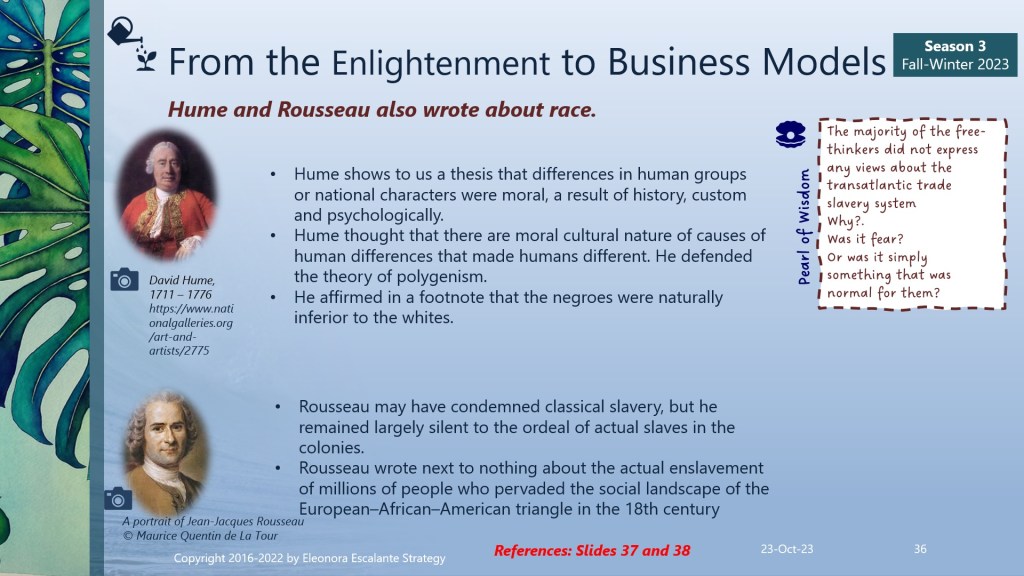


With the last slides, we expect you can understand why the issue of slavery & racism is so complex and ancient as our history.
Several times when I was preparing the presentation slides for you last week, I had to stop and reflect… and ask myself, “Why do people tend to try to force other people to perform works and activities that should be handled in freedom of choice with an adequate amount of income in return?”. The first case is to ask for help and pay in retrieval with a fair salary, accordingly to the quality of the worker´s capabilities. For example, there are millions of working parents who require a nanny to take care of their kids. The same goes for elderly people who require help from nurses. But nannies or nurses shouldn´t be hired without a certified professional credential. Experience and recommendations are, of course, core proof of evidence that nannies and nurses are capable in their occupations. With the last example, we all comprehend that a job, in our present time should be a free option based on vocation, education, and experience. But that is not the case.
Yet, a second situation is to force someone to do activities in exchange for a limited wage that does not permit him or her to afford a decent living for the well-being of their family. Likewise, another setting is the practice of modern slavery. You will be surprised to find modern slavery even in the premium richest societies on earth. So again, we land on the same question: why ancient slavery? why modern slavery?
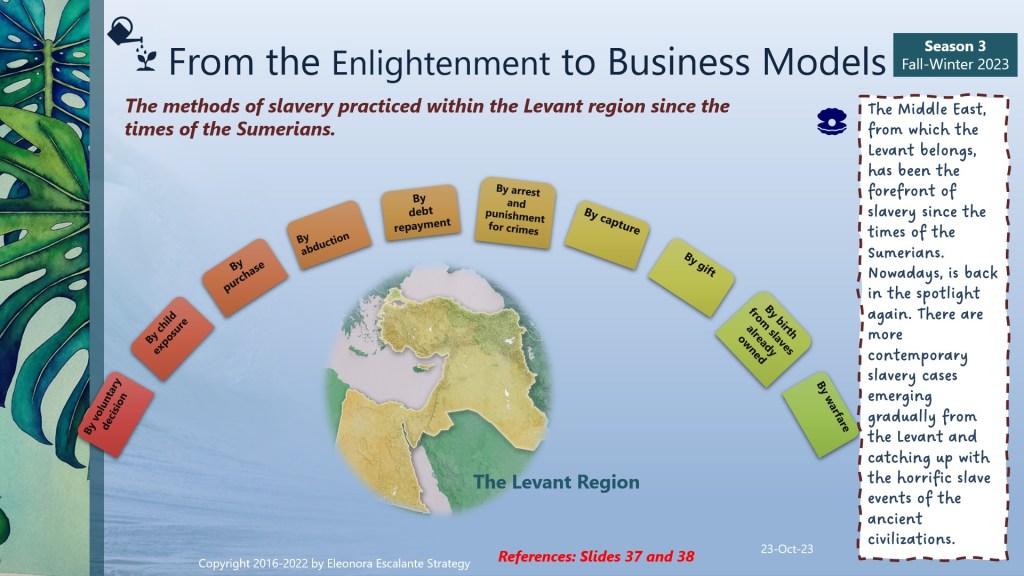
So many questions obliged me to leave the Enlightenment period and proceed to the first civilizations that practiced slavery (see slides 12 and 13). I had to go back to the Levant region, to all the old civilizations that were predecessors to the Greeks and the Romans. Then, when confronting the Mesopotamian cultures, and the whole area around the Mediterranean, I continued asking queries: From where on earth did humans start to practice slavery? Who taught that to them? Why did we accept slavery for thousands of years, as a standard, whatever the cause or the method of entry/exit to slavery? I wondered why? Beyond the readings of all the masters of knowledge; beyond the historians who have taught me the relationships between the masters and the slaves, or beyond the feuds (kings and the nobles) and their serfs during feudalism… Why did the rulers and leaders of those times believe that slavery was the business and operational strategy (in terms of a value chain) for the well-functioning warfare, construction, manufacturing, and functioning activities of the families, communities, societies, and economies? Why did the princes or the leaders of all ancient civilizations practice slavery? Why the most brainiac professions that required years of preparation as physicians, religious leaders, and teachers, were also part of the slavery value chain?. Why was slavery the rule of thumb in so many Levant societies (look at slides 12 to 14) around the Mediterranean and Black Seas? Why did these societies in each specific dynasty, continue and perpetuate the notion of slavery in private households, and public situations? Why? All the ancient main societies in Europe, the Levant, and the Middle East have practiced ancient slavery and continue to practice a modern one in which workers are not paid enough to make a dignified living. Furthermore, once we discovered that the term racism was simply a scientific absurd justification of an Atlantic Slave Trade between the 16th and 19th centuries; my mindset opened a door to a new topic that has not been considered with the huge implications on how we do business nowadays.
An old problem tied to our human standing since the Sumerians. According to Professor Vlassopoulos who is an expert in ancient slavery and the history of historiography and political thought, his views about the issue of slavery are not uncluttered to a specific school of interpretations of the situation. I do agree with him, in a way that he has stretched and influenced me to look for answers about slavery beyond Patterson, Finley, and other scholars who took a partial or biased turn when analyzing the topic by using the Marxism domination-dominated dialectic. Overcoming the political ideology of Marx when analyzing the problem of racism/slavery, is crucial for our conventional learning and current investigations. Why? An old problem that has an age of 6,000 years can´t be studied with the eyes of the 19th century but with the sight of the context of each period in history under each and all the kingdoms that practiced slavery. Each study of slavery in each civilization and society has specific insights that we must decipher. Even if we think that past researchers have done it, each new scholar has a novel and original look and feel. Some might be wrong, some might be repetitive, and some might be “eurekalist”, but that is the way to go. Tallying, correcting, and assuming the investigation and study for each and all the past societies who practiced enslavement. No scholar is the owner of the total truth, but an explorer of a little piece, a scout of a tiny element of the verity. But a good scholar always leaves a door open, a research agenda for more, for the next cohort of researchers to continue.
In addition, we must understand the dynamic mobility of the research journey passing the Millenniums, digging into the details of the specific historical centuries. Each researcher’s theoretical framework can expand or limit our knowledge. Each epoch of research since the Sumerians, then the Greek-Roman classics, passing through the times of Jesus, Roman imperialism, the Byzantine, etc. will always send us to visit the archives located in the chests of the guardians of the old knowledge, which probably have never been disclosed in our days. I am sure there were monks and friars in each monastery of the Medieval Age, there were librarians of rulers and principate masters, artistic hidden representations, and personal antiquaries that have kept things, and there are still so many pieces of our puzzle in slavery, who camouflage so many treasures behind the walls of our collective limitations. When the professors from the primogenial and ancient universities began to work in the 11th century, with the rise of the printing press, the Renaissance, the Enlightenment, and our modern era, a new wisdom panorama was disclosed, but there are things far back before the Renaissance, that require exploration.
Slavery is an old behemoth maze. The Enlightenment thinkers did what they were able to do and could display with the limitations of their brainiac frameworks, in the middle of a scientific revolution in parallel to intellectual persecution. The proof of evidence: The Atlantic Slave trade, the Inquisition, the history of the colonization of the New World, and its slavery value chain, as an operation that has been recorded by history.
Slavery scrutiny is a work in progress. Since the 1970s (the decade that I was born) scholars studying past slavery have been trying to understand the problem from different perspectives, in such a way that have been accumulating new evidence, new connections, and new paradigms. But it is still a work in progress.
The more I work in this saga the humbler I am learning to become. Because we all know too little about our most prioritized issues. And if we don´t study them (including slavery) with a strict sense of understanding from a multidisciplinary approach (from universities, research centers, and think tanks), little we will do to solve why our earth still holds 84% of families in the world earning an annual household income of less than US$30,000 per year. All our economic and business theories must embrace this reality because business is what creates wealth and helps us to overcome poverty.
It will be a different approach to developing ethical godly genius at the service of our communities. The next greatest minds on earth, those who will be capable of using reason properly, and deliberately enough to contain a critical thinking and problem-solving degree using excellent brainiac processes, should be groomed in each country to collectively search for answers, but with the highest ethical standards. Each nation on earth can create godly masterminds who will require studying hard to find the next piece of the puzzle of slavery, to propose ways to overcome it in the future. Our past has not been studied optimally, and not because the past and current researchers weren´t capable. It is just that each cohort of researchers is doing what must be done with their current limitations, to leave a legacy of research agenda for the next wave of academic and studious bookish scholars. Remember it is a process. It takes time. And it is not easy either.
Education to produce scholars of well-educated levels is compulsory in developing nations. Particularly from those regions that have been affected by slavery at one point in our time in history. All of us, who were born and are living in forgotten marginalized countries, can help to discover and deliver valuable research from our own culture. As a corporate strategist researcher, I do believe more and more that many solutions can come from what is considered “intellectually discriminated” researchers. Our local universities (in the New World) are required to enhance and invest in research (starting with the faculty professors and independent researchers, who could dedicate their full-time options to perform it under a decent American middle-class income). This is an undertaking that requires an abundance of resources coming from developed sponsors to our superior centers of knowledge.
Researchers must be free first to offer a premium free fountain of knowledge. The enlightenment freethinkers were not as free as you can read from our second part of the slides. A freethinker that enslaves others can´t offer freedom with their knowledge. What they offer is a political statement, an opinion, or a reaction to a partial problem. Freedom only comes with the responsibility of understanding and contributing to solving the issues of slavery. For that, a wise person in any discipline is required to become a philosopher too. The Ph.D. means Doctor of Philosophy programs. Now a Ph.D. program (even from the most outstanding universities on earth) is teaching doctors to be strict in their proof of evidence methodologies but it is not preparing students to think properly. Disruptive technologies are stupefying or sedating the new generations, in such a progressive and dramatic way, that the dignity and devotion of those who will dedicate themselves to academic research (in any discipline) have been lost and disregarded in the intent. Moreover, many prodigious children or brilliant virtuosos are lost in developing economies, because of the inherent multicausal poverty in which they live. Slavery is tied to poverty and lack of excellent education. Don´t forget it.
In summary, slavery is one of the most complex and old issues that humans retain. Slavery has its origins in the roots of humankind, in the Levant region. But at the same time, it has been practiced in each and all the main societies for 6,000 years. Slavery requires an integral and godly understanding, to prepare a godly and good plan for its solution in the future. Modern slavery still exists, it has camouflaged in other formats, but whenever you see a person working in something that he or she doesn’t have the vocation, the preparation, and experience, or this person is linked to any of the modern slavery aspects that I have mentioned in slides 21 and 22; then we are facing an issue to solve, a liberation that is required. Ignorance is one of the strong sources of slavery. Meanwhile, if people are not conscious of their own intellectual slavery, then people will continue in bondage, that is why the quality of education since kindergarten is imperative, and this studious difference doesn´t come with disruptive technologies. On the contrary, we are going back to more insensibility/indifference with our digital addictions. Undercovered slavery still exists. And warfare only causes more of it. Whenever there is a patron forcing another soul to do what he or she doesn´t want to do… Whenever we face people without at least a low-middle-class income in return (84% of the families globally suffer from at least a factor of multidimensional poverty), there is slavery to overcome.
Announcement. Our next publication will be on Friday 27th of October. We will resume our journey with the following topic: “The Enlightenment and Women”. Remember that when we stay more than one episode on something, it stands for your benefit. Unusually when I persist in thinking about a subject for several days, it is because I am trying to discern the truth behind the texts that support my inferences. Sometimes it is easy to find certain aspects, and sometimes I have to go back to different historical periods and maneuver more. From here, I can remark that only by healing the roots of slavery with love, we will be able to fix racism, and our business modeling of today. Warfare has caused us innumerable cycles of pain. If we don´t go to the original roots of our problems, it will be impossible for ALL of us to rectify them. It is a co-shared responsibility by all of us to repair our most challenging issues. Blessings and thank you for reading our episodes.
Musical Section
We have decided to continue sharing classical flute magical music from the Baroque. As of November, we will share more wind instrument concerts as oboes, clarinets, and saxophones.
Today our musical video has been uploaded to YouTube by Brilliant Classics. It is from the composer Michel Blavet, who was a fantastic French flute virtuoso in the 18th century. The artist is Jed Wentz who plays transverse (flute) accompanied by his ensemble Musica ad Rhenum. “Jed Wentz received a Bachelor of Music from the Oberlin Conservatory of Music, a Masters degree from the Royal Conservatory of the Hague, and his doctorate from the University of Leiden. He founded and has performed extensively, both as a flutist and operatic conductor, with the early music ensemble Musica ad Rhenum, with whom he has recorded more than 30 CDs of 18th-century repertoire. He currently teaches at the Conservatorium van Amsterdam”.
Thank you for reading http://www.eleonoraescalantestrategy.com. See you next week.

Sources of reference that were utilized today. Look at slides 37 and 38 in the package of slides above.
Disclaimer: Eleonora Escalante paints Illustrations in Watercolor. Other types of illustrations or videos (which are not mine) are used for educational purposes ONLY. All are used as Illustrative and non-commercial images. Utilized only informatively for the public good. Nevertheless, most of this blog’s pictures, images, or videos are not mine. I do not own any of the lovely photos or im
 Eleonora Escalante Strategy - Strategic Reflections Think Tank