
Central America: A quest for the progression of economic value. Episode 10. Charles V. Spanish Inquisition II
Have a beautiful evening.
Today with this episode, we have finalized a general overview of the Spanish Inquisition in its most crucial aspects. We kindly encourage you to read as much as you can about this topic, particularly, if you belong or were born in any country conquered and colonized with the stamp of Spanish America. After this episode, I am sure you will understand the legacy that we have been carrying for more than 500 years.
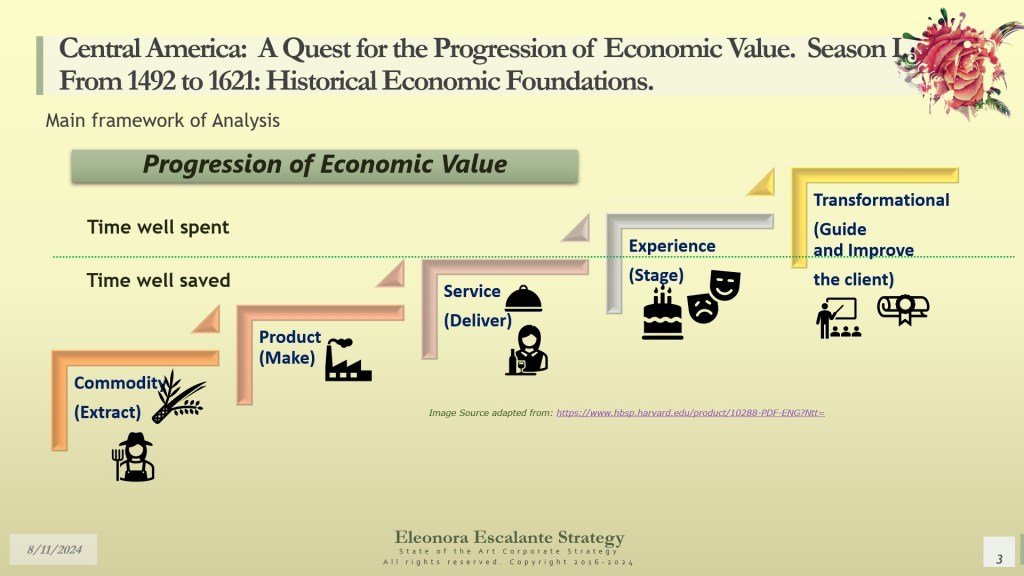
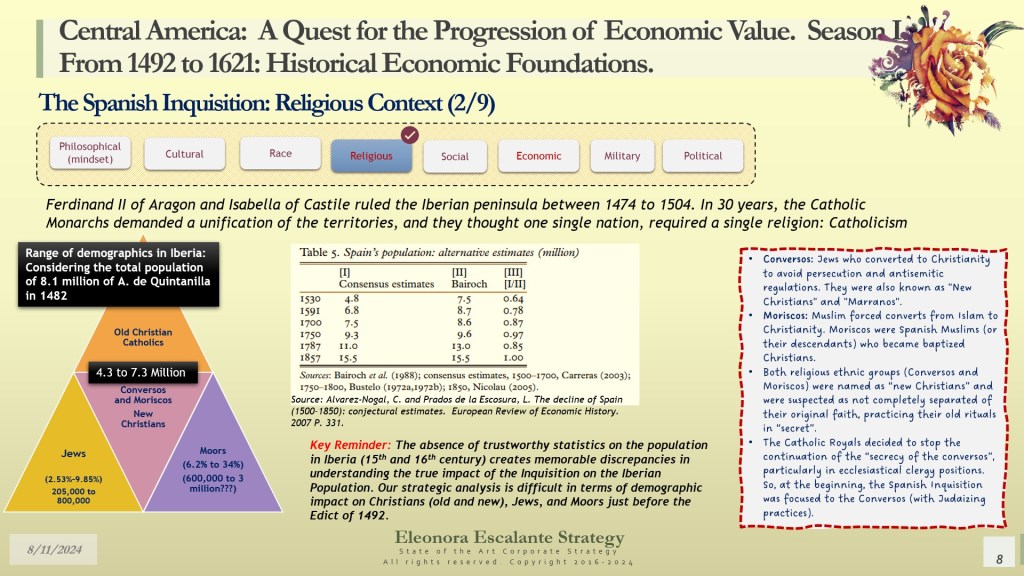
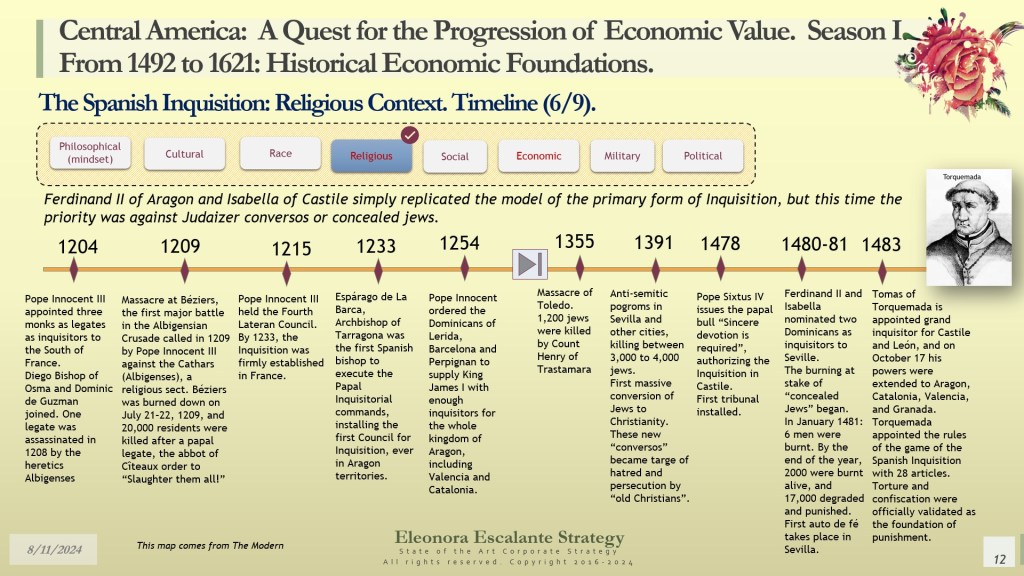
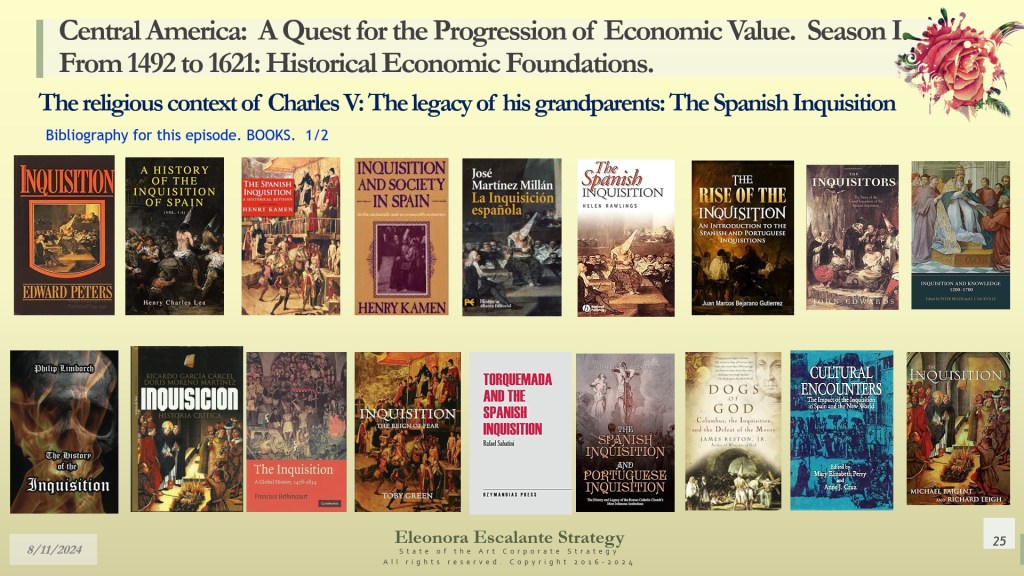
As usual, we are sharing our framework of reference in the following slides. Feel free to download, and share them with your friends, colleagues, or classmates. We always encourage you to print the material, read it consciously, and write notes or questions. Visit our bibliography listed on the last slides on the Internet.








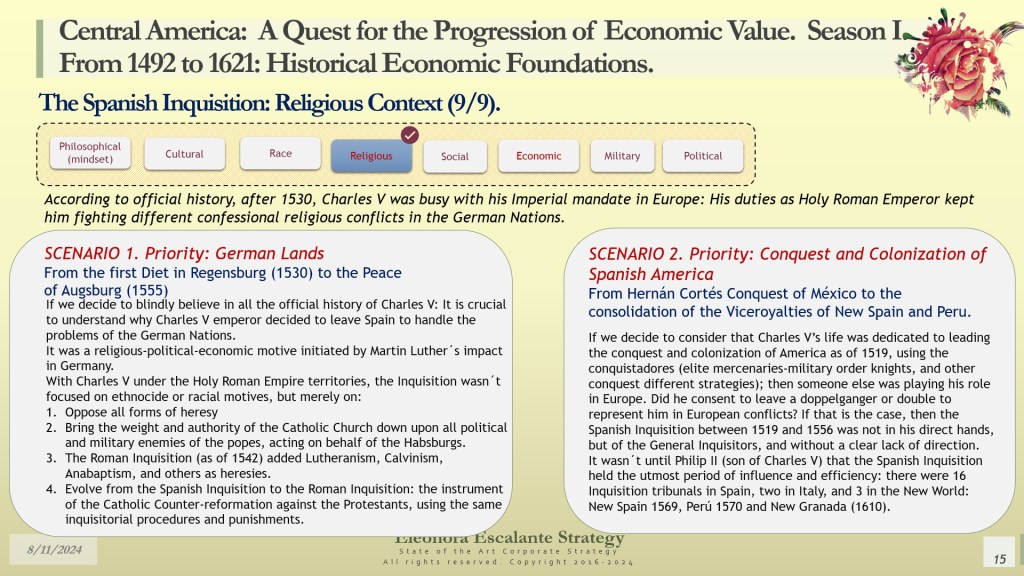




Our Strategic Reflections on the Spanish Inquisition
We intended to insert two episodes about the Spanish Inquisition, which was mandatory. It has been priceless. This subject is usually never analyzed, particularly because it is shameful, prickly, and blurry. Most of the information has been hidden for centuries. However, we can´t miss the chance to reflect on the Spanish Inquisition because when we are disclosing the life of Charles V Emperor, it is one of the key strategic councils in his corporate strategy expansion.
Before proceeding further, if you wish to recall the history of Hispania after the collapse of the Roman Empire to the French Revolution, we recommend visiting again one of our last year publications: https://eleonoraescalantestrategy.com/2023/03/31/from-the-enlightenment-to-business-models-episode-9a-who-moved-the-ways-of-the-enlightenment-la-hispania-iberica-su-historia/
Spanish Inquisition: Statistics.
We randomly reviewed and analyzed several books about the Inquisition. There are considerable discrepancies in Spain’s population numbers before the arrival of the Catholic Monarchs. We understand it given the chaotic context of the Iberian rulers between the 8th and 15th centuries. During this period, the Iberian peninsula was inhabited by Muslims of different groupings, unfolding more than 700 hundred years of conflicts, wars, oppression, proscriptions of minorities, restrictions of careers or professions, and a clear dearth of a united vision for all the populations living in Hispania. This shattering situation affected the accountability and the responsibility of gathering good data.

Hispania was under warfare. Where conflicts abound, only anarchy and disasters persist.
The medieval period of the Iberian Kingdoms was the cradle of persecuting societies, which fought in between because of religious motives, corruption, financing mercenaries, xenophobia, land occupation, economic prosperity, burning of cities, domination and control, and chivalry tied to honor. In conflictive societies, it is hard to know what has happened with certitude, particularly when we disembark on documents and registration of events. We only have fragments of information, excellent old books, and somehow, a determined group of history scholars who have tried to gather everything that was suppressed after the flames of the Inquisition destroyed the truth. It has been a remarkable odyssey for us to review and filter the most relevant sources available to our day. Slides 12 and 13 of the past publication, Spanish Inquisition I (broadcasted on December 6th) give us a hint of the landscape.
Basic data on the Iberian population and its numbers per ethnic group are dubious and debatable. The plague of the Black Death recurred in Europe for 130 years. At least one-third of Europe’s population died in the first outbreak (1347-1350). As a result of the “plague” and its combination of bubonic, pneumonia, and septicemic epidemic symptoms; the range of the European population numbers varies a lot. After our analysis, and by the end of the 15th century (and before the Edict of Alhambra), we believe that the total number of inhabitants in the Iberian Peninsula was around 8 million, with a 75% confidence interval (1). We also believe that the Jewish population in 1482 was between 205,000 to 800,000. Our best bet is the average: 502,500 Jews. When Ferdinand II of Aragon and Isabella of Castile proclaimed the edict of expulsion of Alhambra in March 1492, antisemitism was already a state policy in Spain, Turkey, Poland, Russia, the Holy Roman Empire, and the Berber Muslim States.
Antisemitism as a cultural habit expanded during the 12th century.
With the development of Christianism in Europe, the Jewish residents were victimized more or less depending on the rulers of the kingdoms. In Spain, antisemitism can be encountered in several consecutive efforts of the different crowns to separate Muslims from Christians and Jews. The first sign of repression against the Jews is observed when they were forced to live in “Jewish Quartiers or ghettos”. Then during the 13th century, several laws restricted their occupations and neighborhoods. In other regions, as in France, in 1235, the Church Council ordered all Jews to wear a yellow patch over their heart. When the Papacy stepped up to exclude the Jews across Europe, the Medieval Inquisition was already in full practice against heretics.
The concept of medieval heresy was defined by “Thomas Aquinas, to two extents: an intellectual function by which the authoritative statement of faith is denied or doubted; and a function of the will, by which this denial or doubt is stubbornly maintained despite correction” (2). So, heresy could be practiced by an individual or a community. In short, by the time of Pope Innocent III, anyone who denied even a minor item of the Catholic Church doctrine or the Bible teaching fell into heresy.
“Secret Judaizing Practices of the New Christian Conversos” were considered heresies. Time passed by, and the Medieval Papal Inquisition metamorphosed in Spain as a recipe for racism and ethnocide. The exclusion of the Jews (and Moors) from Iberia didn´t start with the period of the Catholic Sovereigns of Castile-Aragon (it was a long evolutionary result of the Reconquista against the Muslims and fanatic antisemitism against the Jews). Let´s remember that, in Iberia, the original purpose of the Spanish Inquisition under Ferdinand II and Isabella of Castile was to discover and punish insincere converted Jews or conversos who were part of the Cortes, the clergy, and who had access to develop prosperity and pay taxes. Most of the Muslim population resolved to become Moriscos (Moors who accepted Christianity) and represented at least around 10% to 30% of the total population, so the Castile-Aragon crowns did not quash them so harshly, at least at the beginning. However, the Spanish Inquisition was so severe, that not even St. Ignatius of Loyola and St. Teresa of Ávila escaped from it.
After the Edict of Alhambra in 1492, the Catholic Monarchs issued an expulsion order to all Jews or a choice of immediate conversion to Christianity. At least one-third of the Jewish and insincere New Conversos were left in exile for good. The Spanish Inquisition under the Grand Inquisitor Tomás de Torquemada established a paradigm of terror and persecution, not only to Judaizing conversos but against anyone else who was found guilty of whatever little sign or manifestation of heresy. The suffering of the families was beyond the worst imaginable scenario that you could visualize. Henry Charles Lea remarks: “The Spanish Inquisition owed its terrible efficiency to its combining the mysterious authority of the Church with the secular power of the Crown. It wielded both the spiritual and the temporal swords, and the combination produced a tyranny that characterizes authoritarian regimes”. This cruel style of punishment didn’t remain with the insincere Conversos (Marranos and Moriscos) but then extended to Protestants, the Alumbrados (Enlightenment authors), philosophers, and anyone else who was found reproachable of helping the heretics or of holding a forbidden book and other dissents by the Inquisition tribunals. The punishment included: cruel torture, ex-communication, expulsion, confiscation of property, prison, banning from exercising professions of public service, and burning to death at the public plaza.
Spanish Inquisition in 8 dimensions of analysis:
- Philosophical: The philosophy of the phenomenon was to racially clean and standardize the populations of Castile & Aragon under one religion. After 700 years of Reconquest, the rulers of Spain wished for a political-religious weapon system that could help them stabilize the peninsula, stop wars and conflicts, and avoid future problems within the communities.
- Cultural: The cultural elements of the Spanish Inquisition are summarized in slide 15 of last week’s episode. We have identified 6 new aspects that can be observed in songs, literature, paintings, and artistic expressions of the epoch: Dishonesty, Mistrust, Revenge, Terror, Abuse of Power, and Criminal impunity. Inquisitor Torquemada created a true mass terror that no Pope could even believe. This cultural factor of the Spanish Inquisition continued to be replicated in such a way that the slogans of terror and extermination of the opposition were ingrained in every single country with inquisitorial predecessor practices (including the new lands of Spanish America). Read Slide number 15 of Episode 9.
- Racial: Slides 16 to 18 from Episode 9 are self-explanatory.
- Economic: The Spanish Inquisition was the religious division of the High-Middle Age economic model of Iberia in its expansion to Spanish America. We can´t separate economics from the ecclesiastical. Land was the principal source and fountain of wealth. Feudalism was the answer to a prolonged security threat from the Muslims in Iberia, and it was also a “profound militarization on a land-for -military-service-system”. Slide number 19 of Episode 9 is a sketch of the corporate and business strategies (in terms of today) designed by the Councils of Finance of the Catholic Monarchs and Charles V.
- Religious: Today´s publication includes slides 7 to 15 to explain in detail every crucial aspect of the Spanish Inquisition. The timeline of the inquisitorial procedures is described from the year 1204 to the year 1558. But do not forget that the Inquisition continued until 1834. We encourage you to read each of these slides which will provide a good overview of the religious context that Charles V had to carry during his life. We also have unlocked a hypothetical scenario in which Charles V Emperor took as a priority the conquest and discovery of America (slide 15).
- Military: The Spanish Inquisition was designed as an organization of ecclesiastical inquisitors who provided a secular-clerical tribunal that portrayed the military essentials of the Austrian and Holy Roman Empire armies, under covered a thought-control clerical-military style repression. When reading about the procedures of the Spanish Inquisition, what comes to our mind are the mercenaries hired to exterminate heretics, as a political defense and fortification of the Catholic Spanish territories. Read the slides 16 to 18.
- Social: The medullar part of the Spanish Inquisition is pivotal to its social impact in the communities where the tribunals operated. The Spanish Inquisition triggered the establishment of persecuting societies which has continued to our day. “Any resemblance to current Latin American reality is not a pure coincidence”. Slide 19 shows us the 4 philosophical elements of a persecuting society; while slide 20 counts at least 6 of its characteristics: (a) Violent societies because of social exclusion and abysmal discrimination; (b) Persecution because of envy and social resentment from the economic elite towards the Brainiac educated minority of the intellectual class; (c) Massive migrations of the non-educated and brain-drain of the middle class. (d) Lack of any hope in high superior education as a tool for social advancement and mobility. (e) High levels of social distrust; and (f) Societies with high levels of poverty, inequality, and lack of worthy income opportunities. The terror caused by the Inquisitorial procedures affected the style of America Conquest Inc. and caused enormous repercussions in our societies.
- Political: The Spanish Inquisition was a political council of the Spanish Crown. It was kept under Charles V as a division to control rebellions and any type of dissent. It was expanded to the Netherlands, and it was a political repression tool against anything that was considered a cause of instability for the Empire. Slide number 21 shows this truth in the Government Organization of Charles V and his grandparents.
One of our goals with this saga is to open the thoughtful reflection of decision-makers and this world´s business rulers. Any strategic direction to pursue in this technologically interconnected planet has historically serious and significant consequences. Especially if these are taken by monopolies, nations, or international corporations that can inundate the globe with their products and services in a matter of months. If we launch the wrong goods into the market, we can mess up human civilization. Five hundred years ago, there were Catholic Monarchs who wanted to get rid of certain people in their domains. Their goal with the Spanish Inquisition was specifically designed for the Reconquista Spirit. The Spanish Inquisition was initially designed to expel the Judaizer conversos. With time it evolved into a terror secular-religious tribunal of ethnocide, racism punishments, unfair confiscation, expropriations, torture, deaths into flames, and expulsions. Then, the Spanish Inquisition was globalized with the conquest and colonization of America and it became the prototype for the next Holy Roman Inquisition which lasted until 1834. It was transferred to the Viceroyalties of Lima, New Spain (México), and New Granada. It touched Goa in India, and it extended its dominance to Asia. The Spanish Inquisition provoked and was part of 4 horrendous religious wars in Europe.
We wonder, what would have happened if Charles V had ended the Spanish Inquisition when he arrived into power as King of Spain in 1518? Why did he listen to his grandfather Maximilian advisors, instead of following his inner young voice about stopping the Inquisition forever?
Finally, we wish to stop here, just to open the door for next week’s publication: Charles V his Religious Agenda.
To be continued…
Announcement.
Next Friday 20th of December, we will continue with Episode 11 “Charles V: His Religious Agenda”, an episode that is linked with the Spanish and then Roman Inquisition against Protestants. In the meantime, we truly hope that you might commit to reading one book about the life of Charles V Emperor, and continue understanding the phenomenon of the Spanish-Roman Inquisition.
We are looking forward to finishing Season I on December 27th. Then we will take three weeks of vacation for our strategic mindset maintenance. Season II of the saga “Central America: A Quest for the Progression of Economic Value” will begin as of Friday 24th of January, 2025. Season II will be shaped first with 4 weeks about the topic “Spanish America with a Medieval Allure: Conquest and Colonization”. Then we will continue with the life of Philip II (the son of Charles V Emperor), followed by the relevant aspects of Philip III (Charles V´s grandson); and finally, we will show you how Central America’s economic development was initiated. I will share the new outline of Saga II before the end of this year. Do not lose sight, please! The roots of the strategic economics of the Habsburg-Castile/Aragon Economic Model for Central America can´t be understood, unless we dedicate enough time to all that we have been investigating during Season I. Stay tuned.
Musical Section.
Our selection of music during this saga will be fitted with songs and concerts that could have been listed on the most important Billboard during the 16th century. Today, we have chosen the Mellon Chansonnier (1450-1470), late Medieval French music of courtly love. Uploaded by Early Midi Music on YouTube.
Thank you for reading http://www.eleonoraescalantestrategy.com. It is a privilege to learn. Blessings.

Sources of reference and Bibliography utilized today. From this text are below. The rest are shown in the set of slides.
(1) Granville Edge, P. Pre-Census Population Records of Spain. Journal of the American Statistical Association. Vol. 26, No. 176 (Dec., 1931), pp. 416-423 (8 pages). https://www.jstor.org/stable/2277942
(2) Asad, Talal. Medieval Heresy: An Anthropological View. Source: Social History, Vol. 11, No. 3 (Oct. 1986), pp. 345-362 Published by: Taylor & Francis, Ltd. URL: http://www.jstor.org/stable/4285543
Disclaimer: Eleonora Escalante paints Illustrations in Watercolor. Other types of illustrations or videos (which are not mine) are used for educational purposes ONLY. All are used as Illustrative and non-commercial images. Utilized only informatively for the public good. Nevertheless, most of this blog’s pictures, images, or videos are not mine. I do not own any of the lovely photos or images unless otherwise stated.
 Eleonora Escalante Strategy - Strategic Reflections Think Tank