
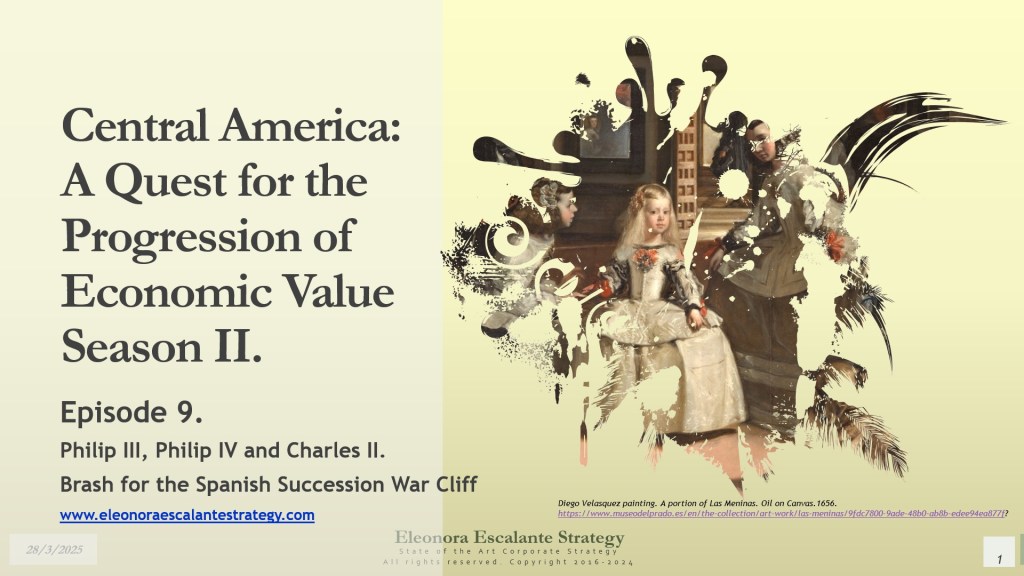
Central America:A Quest for the Progression of Economic ValueSeason II. Episode 9. Philip III, Philip IV and Charles II.
Dear Adorable readers:
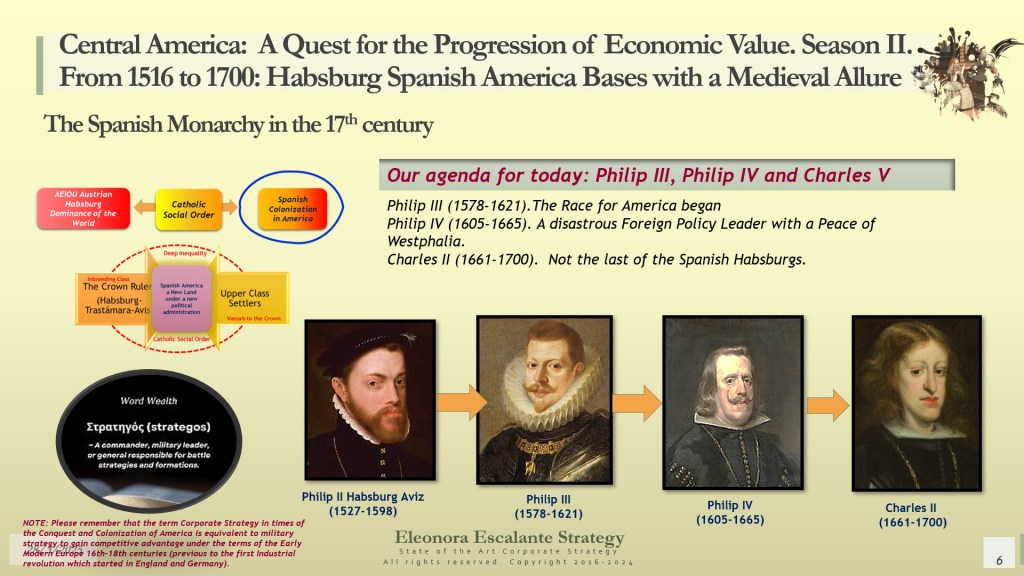
Here we are dispatching our slides prepared for you during the week. We are so glad that we have covered the main relevant aspects of the chronology of events of the Spanish Monarchy during the 17th century. We have tried to summarize the best we can, all the relevant situations of three kings: Philip III (1578-1621), Philip IV (1605-1665), and Charles II of Spain (1661-1700).
In one phrase, “the Spanish Monarchy was in a profound crisis after the death of Philip II in 1598.” According to official history, it was a mental, political, economic, financial, and social crisis at the corporate strategic level. Ironically, it was the century of the golden promotion of artists to a level never seen in Iberia before. We invite you to read our material. Feel free to print it, write your notes, and ask yourself questions.
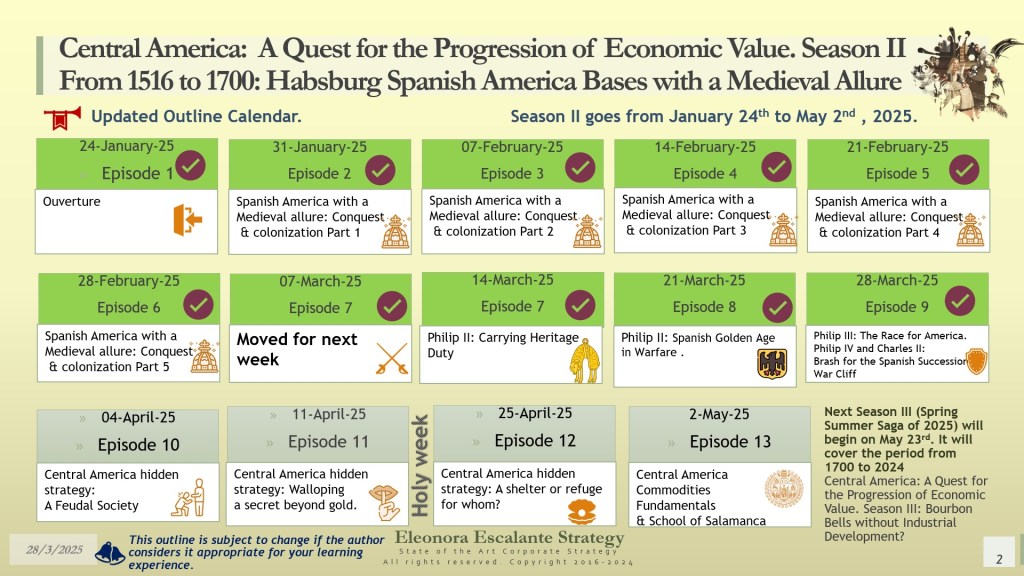
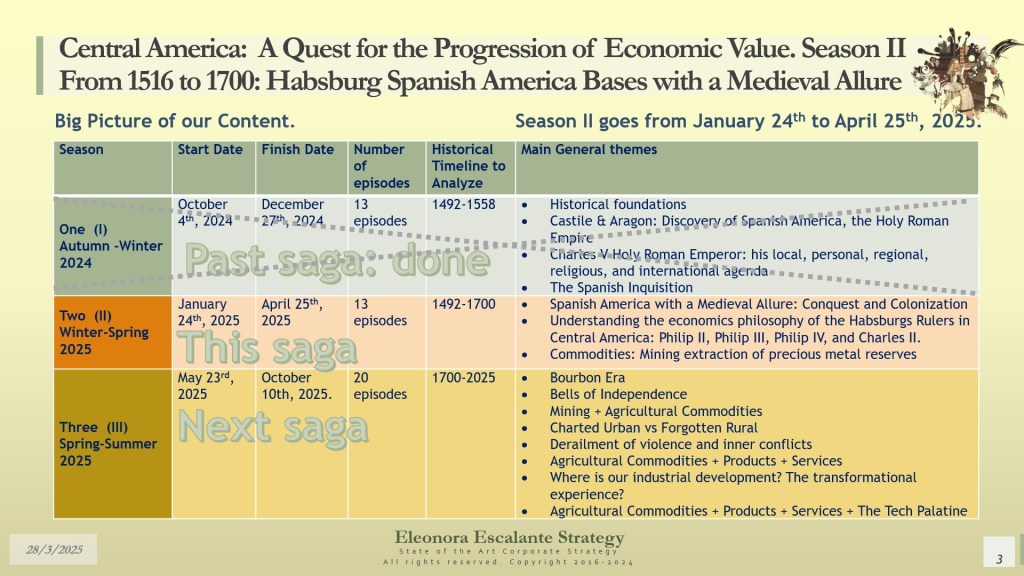





We invite you to return next Monday, March 31st, to read our additional strategic reflections on this chapter.
We encourage our readers to get acquainted with our Friday master class by reading the slides over the weekend. We expect you to create your own ideas that might be strategic reflections. Every Monday, we upload our strategic inferences. These appear in the paragraph below. Only then will you be able to compare your own reflections with ours.
Additional strategic reflections (added below on Monday, 31st of March).
- Politically, the 17th Century in the Iberian Peninsula was a waste of time. From the point of view of corporate strategy to lead the future of Imperial Spain, none of the kings between 1598 and 1700, did anything additional to what it was already in the realms of Spain, but to try to contain the Empire as it was received from the patriarch of Philip II, Habsburg Aviz. It was a dry century for the Spanish Kings. It was dry in their geopolitical matters, as much as in their financial administrative management. However, the Habsburg dynasty from Spain was not disconnected from the Habsburg line of Austria. They were working together in the counter-reformation, and they shared not only information through letters but also strategic transmission of knowledge that helped them understand the moves of the rest of the European countries. The successional political issue was a priority for Philip II Habsburg (1578-1621), and he left a role model (an example) that was followed by the rest of his descendants. The Peace of Westphalia was not aligned with the agenda of the Habsburgs from Spain, but with other European emerging royals who were also linked to the Habsburg Monarchy.
- Economically, the burden of the wars and conflicts of Spain during the 17th century was draining its finances. The sources of funds coming from the silver mining operations were minted in pesos and distributed by the Spanish Crown through different contracts (intermediaries, other monarchies), and Sevilla was the hub of trade, full of corruption and disorganization. Regardless that the Spanish Crown duplicated their costs to pay for control and supervision in Sevilla, warfare conflicts were overflowing all over their domains. The Thirty Years War was linked to the Eighty Years War against the Netherlands, the revolt of Catalonia, the Independence from Spain of Portugal, and the revolts in Italy, were keeping the Spanish armies busy in Europe, meanwhile, England and the Low Countries were moving ahead with their plans to enter North America. Sometimes we “feel” these wars were distractions to Spain, and tactics from Spain´s bankers to push the Spanish Habsburgs into bankruptcy, to obtain the silver used as collateral for the loan contracts. Additionally, by debilitating Imperial Spain, it was going to be easier to grab territories from Spanish America that weren´t populated by Spanish Colonies.
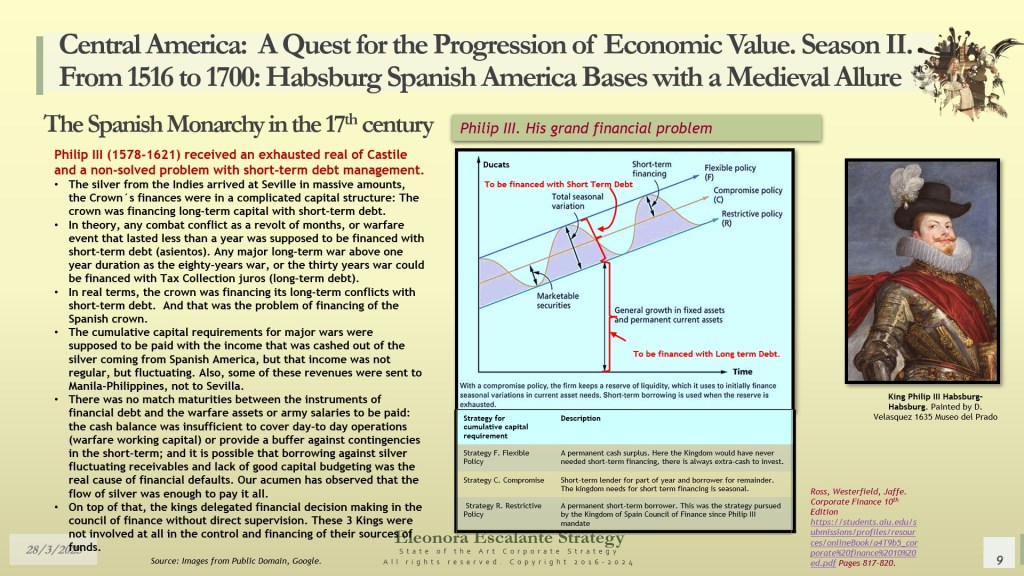
- The financial aspects of the Spanish Crown during the 17th century are still blurry. Our financial analysis (with the limited information available) has detected that the Spanish Crown had enough inflow of revenues from silver to pay to honor its debtors, but the financial structure was badly designed. The kingdom of Spain got into wars that lasted longer years, and these should have been financed with long-term debt from the start. For those petty conflicts of less than a year, the asientos were supposed to be used for short-term repayments. The Council of Finance was simply reconverting short-term instruments to long-term debt every time that they defaulted, and there wasn´t any anticipated planning about it. In an easy analogy, it is like if you decide to pay your house mortgage of 20 years duration with a credit card at an 85% annual interest rate, or in the same sense, it is like paying for a computer with a loan of 10 years period. See slide 9.
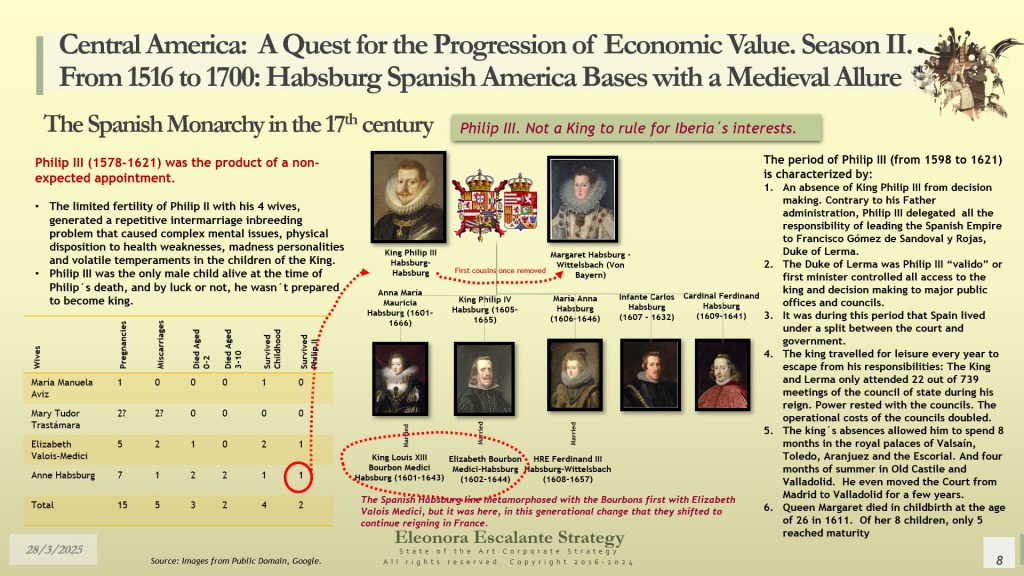
- Philip III (1578-1621) held a short-term mandate. He was an absent king. After his father passed away, Philip III’s main contributions to the Iberian realms were his children. While he married Margaret Habsburg-Wittelsbach of Bayern, the absence of the king for decision-making was evident. His Valido minister, Duke of Lerma (Francisco Gómez de Sandoval y Rojas), had total control of the corporate strategy of the king, particularly in terms of the Council of State, the Indies, and the Cortes. In this period, the Spanish Habsburg royals metamorphosed into the Bourbons-Valois from France. Two of Philip III´s children got married to two sibling Bourbons: King Louis XIII Bourbon Medici-Habsburg married Ana María Mauricia, transforming her into Queen of France; and Elizabeth Bourbon Medici-Habsburg married the heir to the throne, King Philip IV.
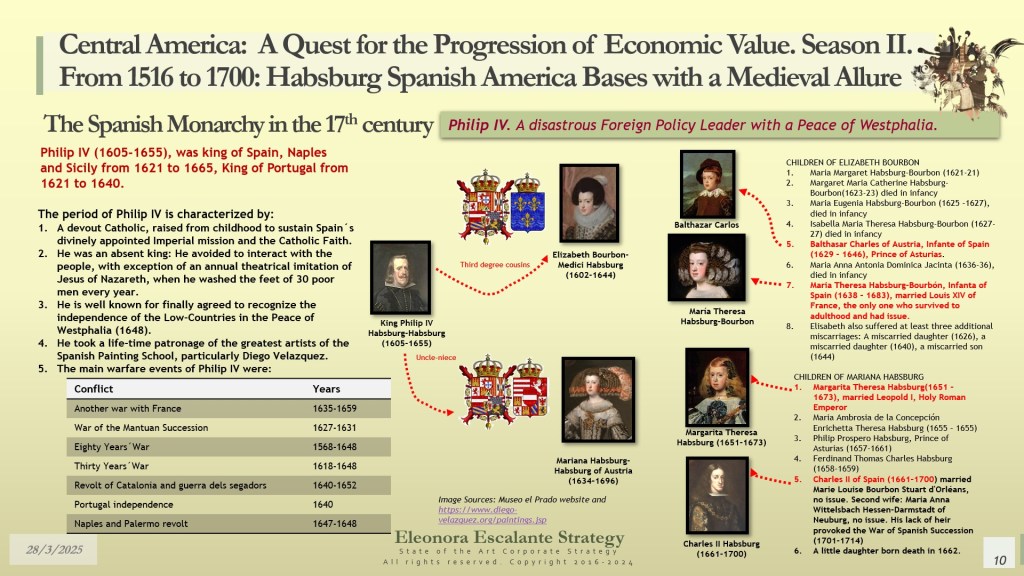
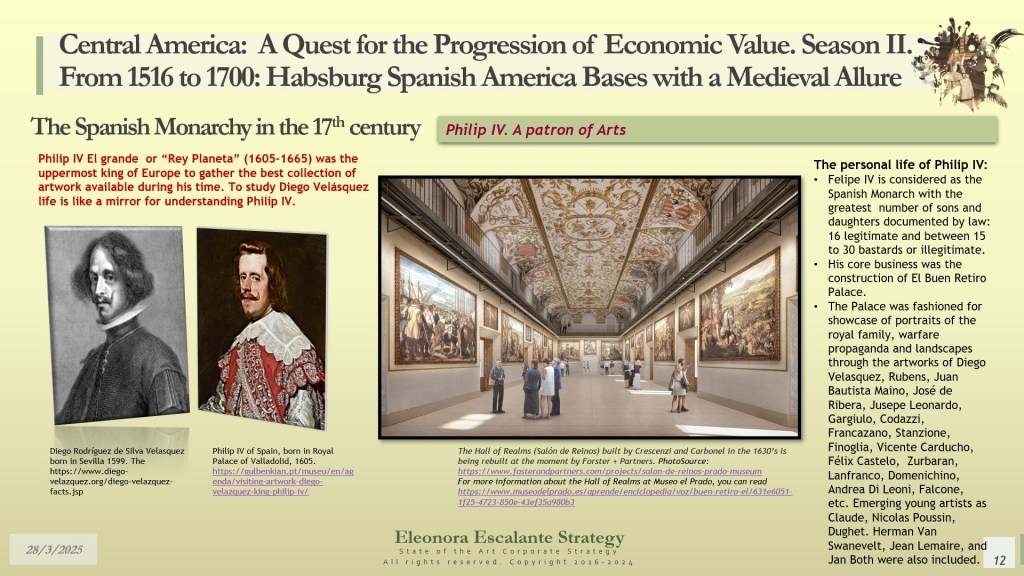
- Philip IV was a disaster in foreign policy but a formidable supporter of the arts. King Philip IV is a mysterious personage for us. He continued to be absent with his people, but he had a clear artistic agenda: for him, his priority was the construction of the Buen Retiro Palace, intending to transform it into a showcase hub for musical, theatrical, and visual painting exhibitions. It was in this palace that he spent his rest and recreation seasons, and it was in this place that he received diplomatic missions from all over the world. It was his palace where he installed a center for patronage of artworks in which painter Diego Velazquez´s work was the main protagonist. See slides 10 to 12.
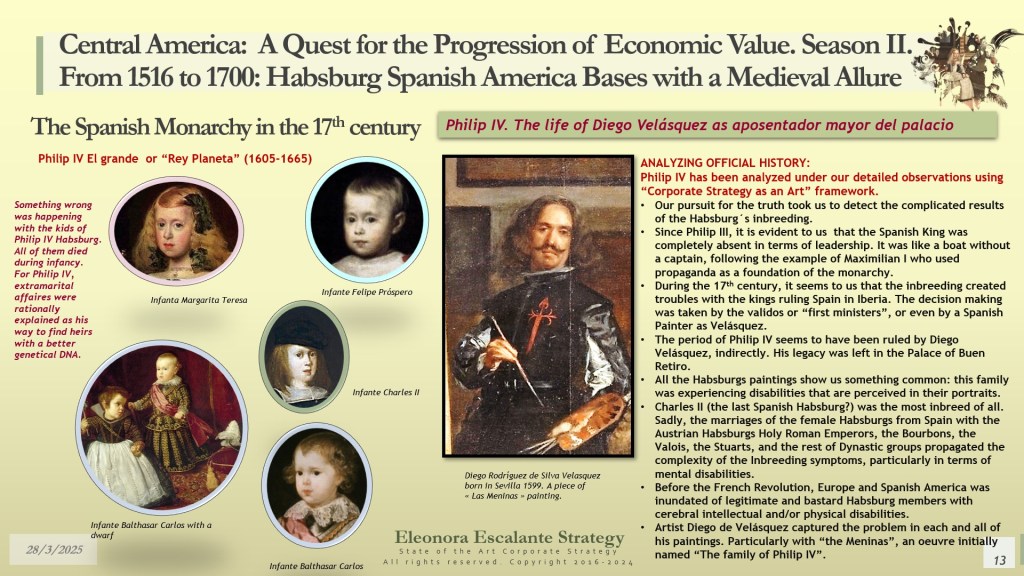
- Diego Velazquez was Philip IV’s official Court portrait painter. His destiny was tied to the needs of the artwork commissioned by the King. In an epoch where art was still seen as an exploitative occupation, Philip IV considered Velázquez as his pivotal art militia. The proof of evidence: Velazquez was named Knight of the Order of Santiago as a reward for his services to the king. Through the exquisite paintings of Velázquez and his successors (Martínez del Mazo and Carreño), we can infer more about the life of the royal family than what we read about them in history. We have taken several hours to observe in detail what was occurring with the kids of King Philip IV. See slide 13.
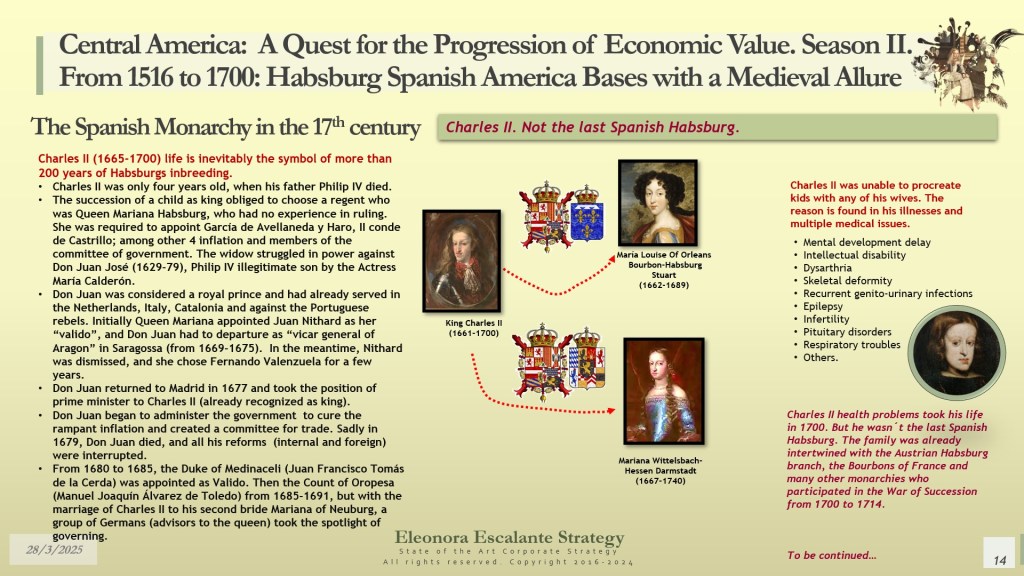
The accumulative inbreeding was visually introduced by Velázquez in such a subtle manner that we can perceive the tragedy of the Spanish Habsburg family because of their marriages among relatives. Most of the official history books end with Charles II as the ultimate heir to King Philip IV, who amassed the highest distinction of 250 years of inbred ancestors married in between. We have found several medical articles about Charles II (an invalid with numerous causes of disabilities). His several autopsies over time have confirmed the aftermath of such absurd dynastic practice: physical and brain defects such as lower intelligence quotient levels, mental issues, lack of capacity for decision making, reduced fertility both in litter size and sperm viability, and an augmentation of other genetic disorders for the next cohort of descendants. Thanks to God, Charles II wasn´t able to have children. - The case of Margarita Theresa Habsburg: See slides 15 to 19.
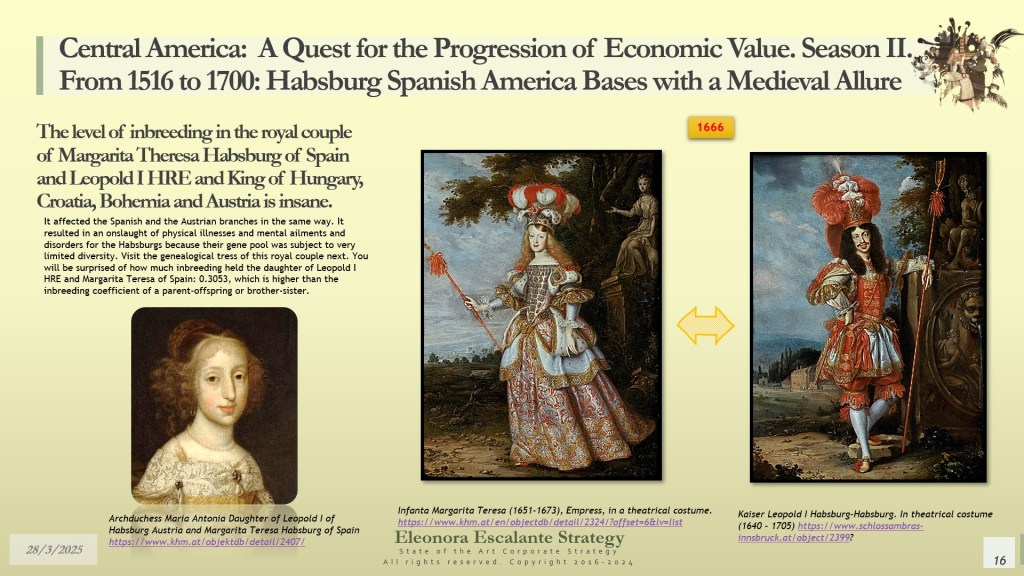
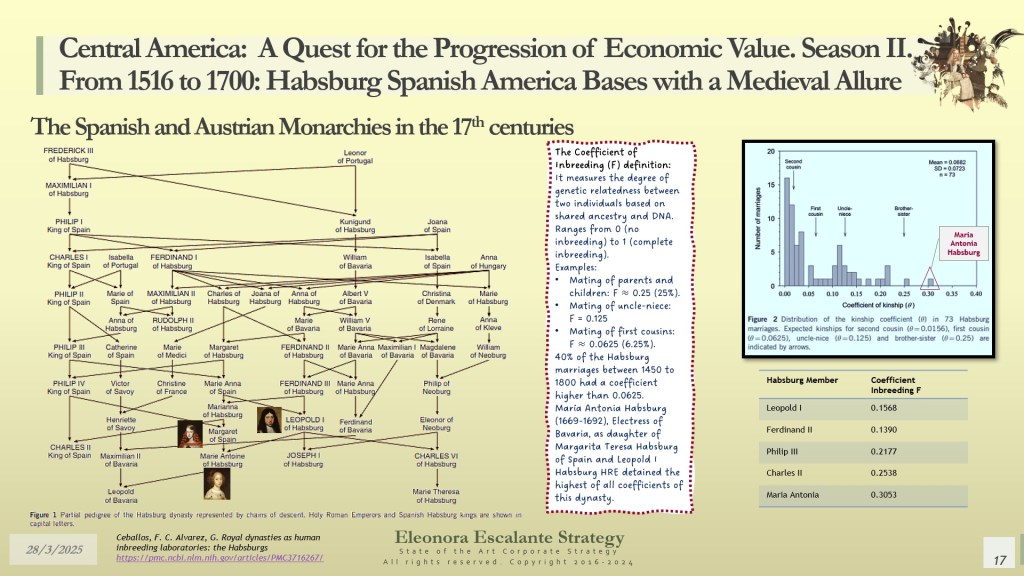
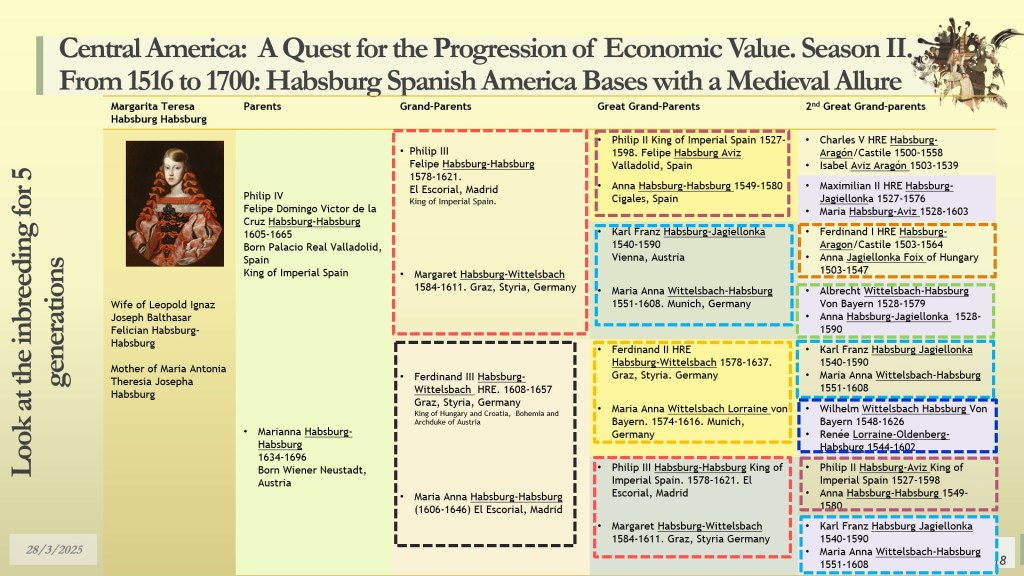
This is an analysis based on our methodology of “corporate strategy as an art”. If you observe the painting of “Margarita Theresa mourning in her black dress”, after the death of his father, Philip IV, who was delaying her departure to marry Leopold I, HRE in Vienna. The painter Juan Martinez del Mazo captured a background in which we can perceive the faces of those whom Margarita loved dearly in Spain: her brother Charles II, the dwarf Mari Barbola, her mother Queen Mariana in mourning clothing, and probably a menina or one of her maids-of-honors. Margarita Theresa is watching us with the gloomiest and miserable eyes of painful anguish, probably not because her father has left her, but because, without his father, she was going to be forced to marry her uncle Leopold I, and all her bliss was going to disappear abruptly. The stunning curly hair of her infant years has been replaced by two simple braids, as if her future years were going to be ruined from that precise moment with no point of return. Our analysis coincides with Rosa Chacel’s scrutiny (1) with one single difference. We dare to express the cause of Margarita´s sadness beyond her immediate mourning. It is the future ahead that triggers her despair. The disgrace of arranged successional marriages did not leave any option to the princesses but to accept their dreadful fate, overloaded with children who died as soon as they were born or a few years later. Margarita Teresa left Spain to marry Leopold I HRE, and their daughter María Antonia Habsburg was condemned to an accumulated inbreeding coefficient of 0.3053, the highest of all the genetic disasters of this family. - Look and the inbreeding of the Habsburgs for 5 generations. We have prepared slides 18 and 19 to show you the degree of cumulative rising inbreeding that was persistent for Margarita Teresa Habsburg and Leopold I HRE Habsburg. If you see the slides, the 15 couples of the genealogical tree of Margarita Theresa (parents, grandparents, great grandparents, and 2nd great grandparents) are almost a mirror to the genealogical tree of Leopold I. Except for one out of 15 couples in the case of the bride, and one out of 15 couples in the case of the groom. We face almost identical genealogical trees. It is unbelievable. The level of inbreeding was horrifically remarkable.
- Why does genealogical inbreeding matter in corporate strategy studies of the 16th and 17th centuries? It matters more than you can reckon. If we decide to trust the official version of history, the kings (male decision makers) of the Spanish Habsburgs and the Austrian Holy Roman Empire branch were a product of cumulative genetic inbreeding. Those arranged matrimonial and dynastic strategic alliances caused a mental and physical deterioration in the kings, generation after generation, and the capacity for decision making of each round of kings was feeble. The lack of smart, judicious, and fair-minded rulers for Spain and for Latin American nascent economies was null and void coming out of Iberia. The delegation of decision-making in the validos impacted the economic model of the Spanish American territories since then to this day.
If we decide to believe that half of the Habsburg children (those who did not die in Europe, legitimate or not), were transferred to America using the same strategy of Charles V Habsburg HRE, and these were mobilized with a new last-name under the figure of the new “landowners of haciendas”, what type of society where they building? The model of Styria, Bohemia, Croatia, Austria, or the Catholic German nations? The model of Burgundy-Brussels and the Low Countries? The model of Castile and Aragón? The model of the Italian territories as Naples, Florence (Medici influence), and the Savoy lands? How did they decide to share the loot? It was during the 17th century that Spanish America was “officially” partitioned between all the participants of the conquest and its royal “undercovered” descendants. - The economic development model for Spanish America was not clear until the Bourbons arrived in the
18th Century. Before the War of Spanish Succession, we perceive a medieval territorial building of the societies in Spanish America, and this is particularly strong in the Kingdom of Guatemala. We also perceive that a good percentage of the descendants of the Habsburg kings traveled to Spanish America during this century, while in Europe, the cruel wars were occurring. How did the offspring of the kings traveled to Spanish America is the motive of another saga, but for the time being, be aware of this possibility. Additionally, there is still our conjecture that the Habsburg kings of Iberia, as we read in history, were merely impersonators of the real descendants of Charles V HRE.
Announcement.
Our episode of today is our effort to cover the three kings of Spain who ruled the Spanish Empire between 1598 to 1700. Please do not lose sight of the fact that we are comprehending the corporate strategy of the Spanish Habsburgs from 1519 to 1700 in our quest to understand the economic foundations of the Kingdom of Guatemala, the lands that later were called the United Provinces of Central America.
Musical Section.
Our selection of music during this saga will continue to explore adorable music produced between the 16th and 17th centuries. Season II is dedicated to the lute. Our choice for today´s episode is a captivating album interpreted by Hopkinson Smith, who plays the composition of J.H. Kapsberger’s Libro Primo d’Intavolatura di Lauto (First Book of Lute Tablature), Roma, 1611. Year of album release: 1995. We invite you to read the bio of Hopkinson, who is a Swiss-American lutenist of excellence, here https://csem.org/concerts/hopkinson-smith/.
Thank you for reading http://www.eleonoraescalantestrategy.com. It is a privilege to learn. Blessings.

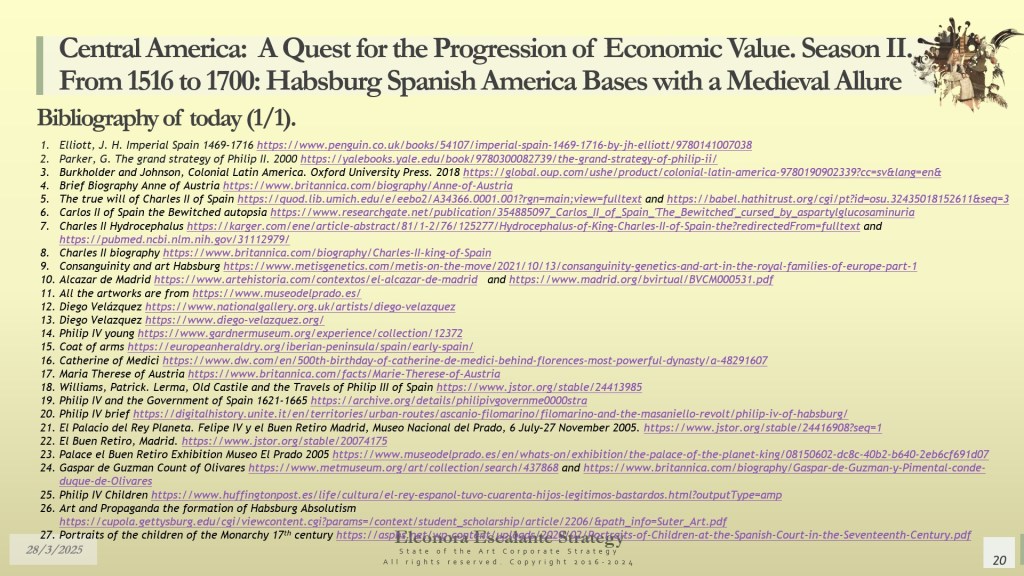
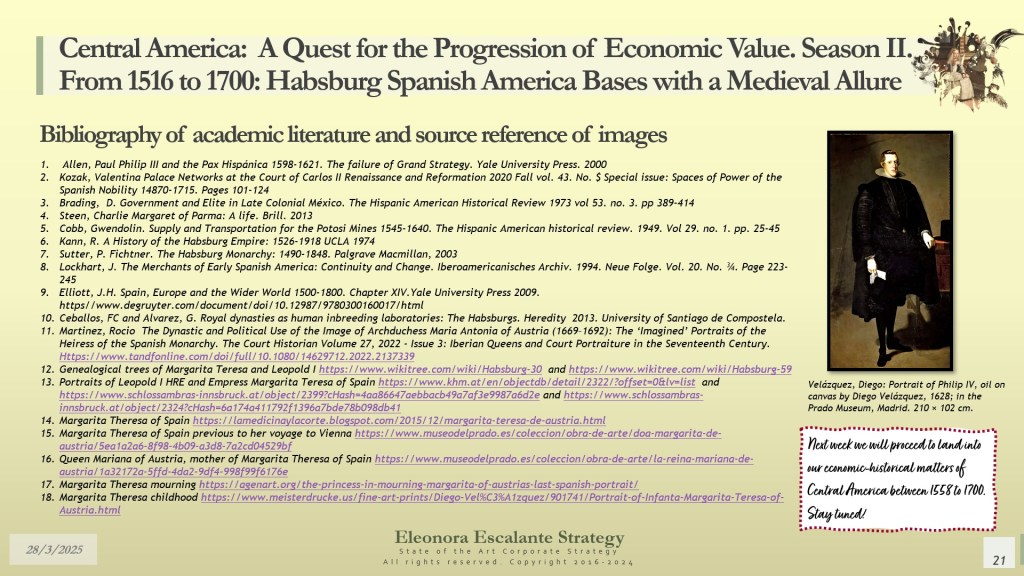
Sources of reference and Bibliography utilized today. All are listed in the document. If needed, we will add more over the weekend.
Disclaimer: Eleonora Escalante paints Illustrations in Watercolor. Other types of illustrations or videos (which are not mine) are used for educational purposes ONLY. All are used as Illustrative and non-commercial images. Utilized only informatively for the public good. Nevertheless, most of this blog’s pictures, images, and videos are not mine. I do not own any of the lovely photos or images unless otherwise stated.
 Eleonora Escalante Strategy - Strategic Reflections Think Tank