
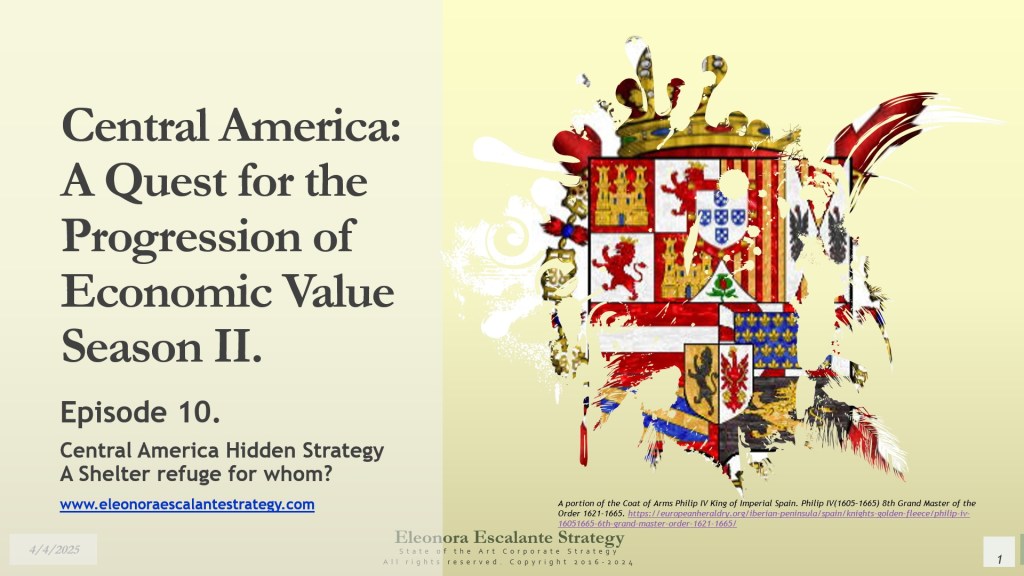
Central America: A Quest for the Progression of Economic Value. Season II. Episode 10. Central American Hidden strategy: A shelter refuge for whom?
Good night to all our fantastic readers on earth. Wishing you a stunning month of April, full of blessings and prosperity.
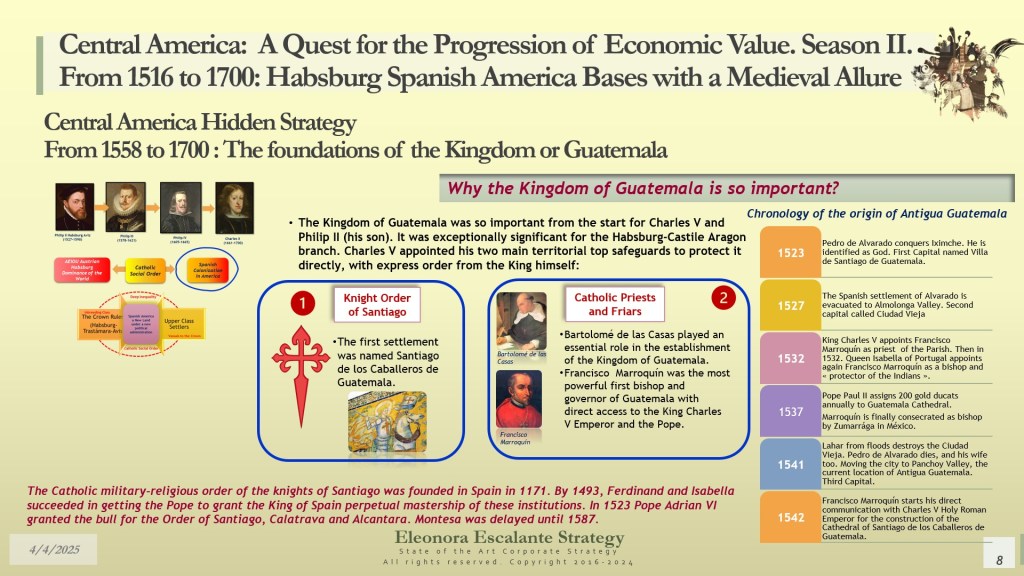
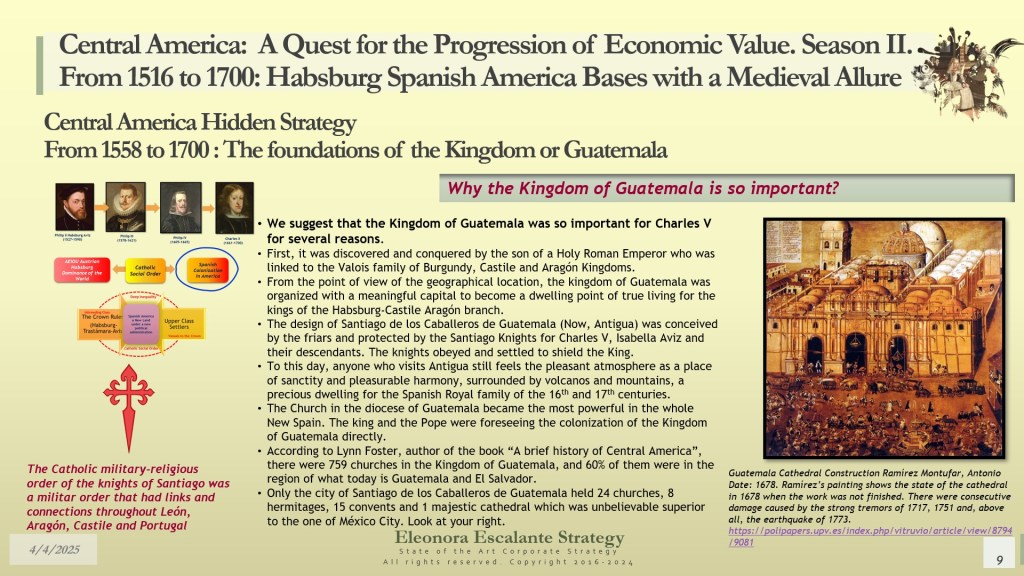
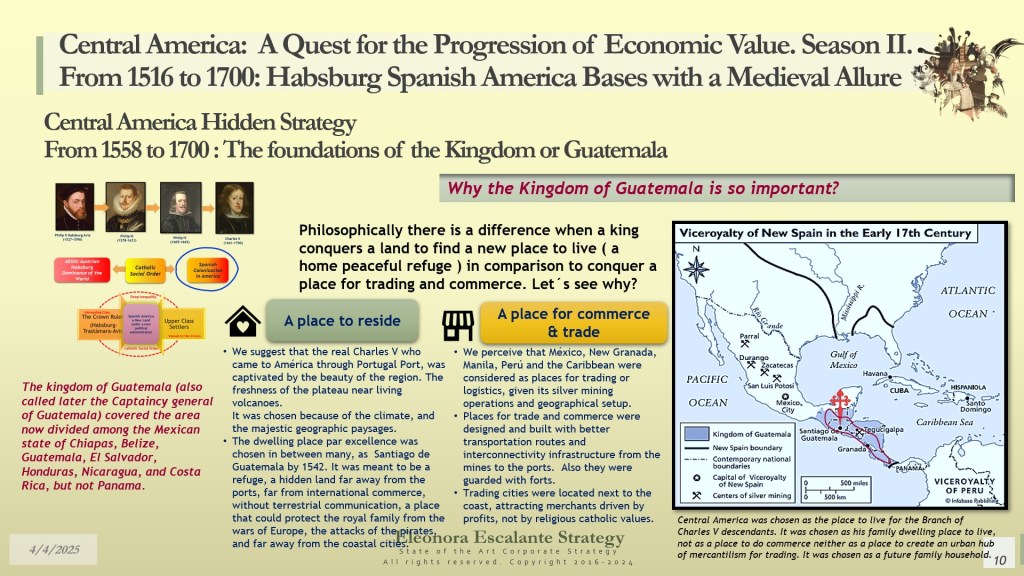
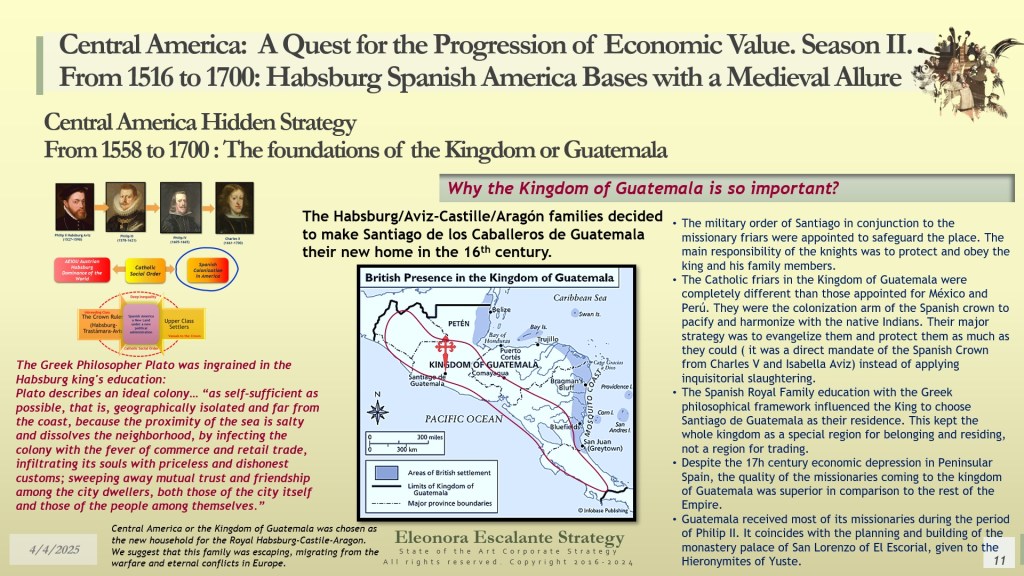
This week we have been reflecting on all the accumulated content that we have transmitted to you since January. It is our aim to understand why the Kingdom of Guatemala initiated its society founding, with the corporate strategy that we have described in the slides. We request you to go back in time to 1558. This is the year that Charles V passed away, according to official history. However, we are not so sure of that. Since we have provided several scenarios of alternative history about the discovery and conquest of Spanish America, we are also considering a new historical line about the Central America foundation.
Feel free to download, print, and read the document below. Pass it to your friends, colleagues, bosses, acquaintances, peers, students, teachers, and family. This chapter is the consequence of more than 70 days of analysis and strategic reflections, and despite that, we are on the right track with our suggestions, there is still a lot of work from historians to validate our hypothesis. Our “state of the art” reflexive strategic deliberation has performed the following document:
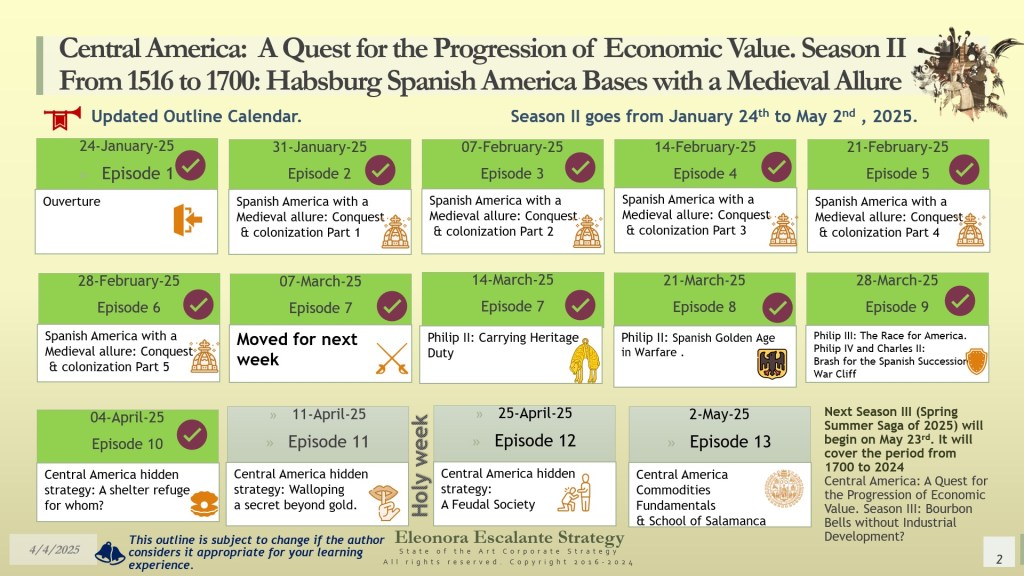
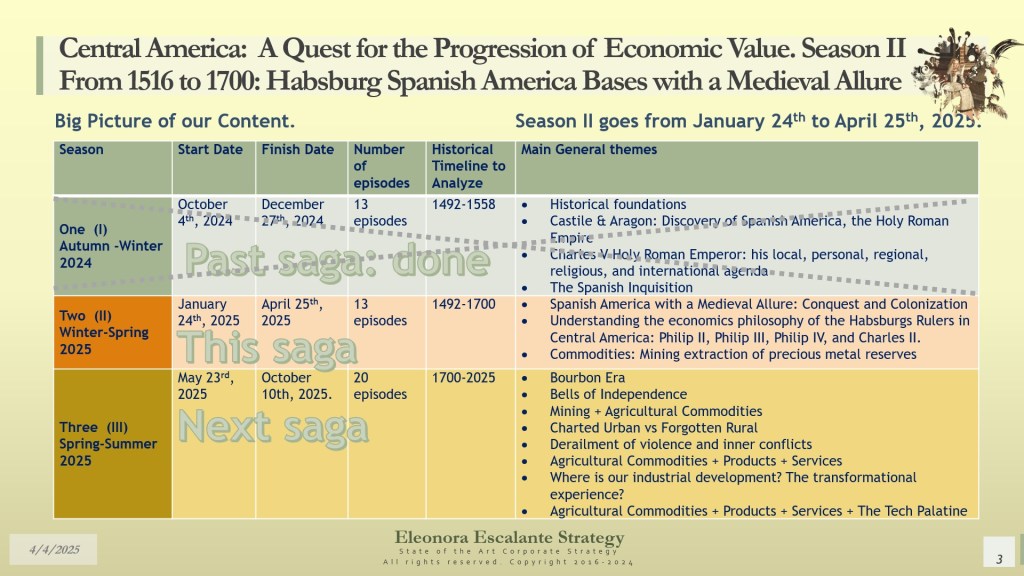
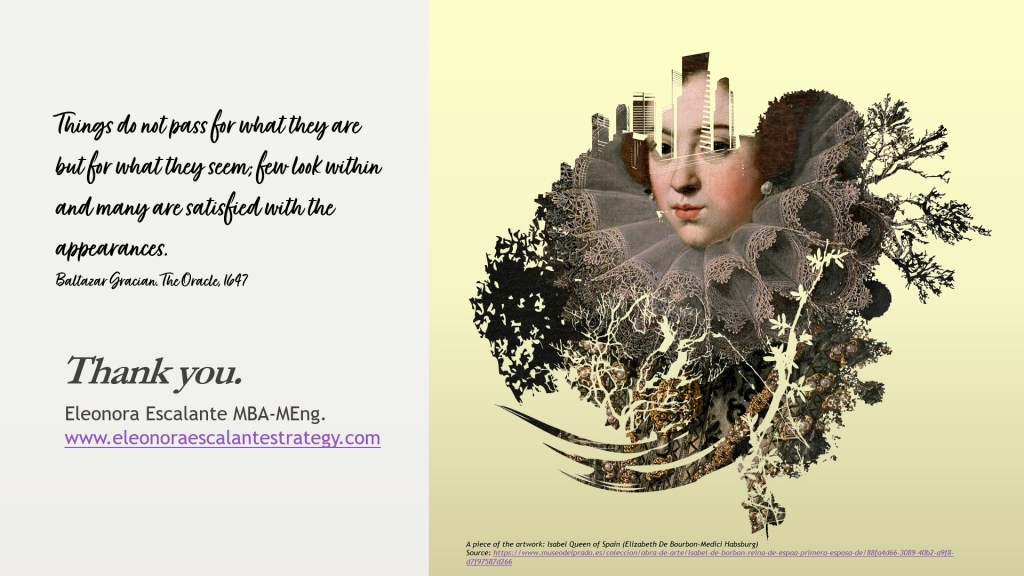
We invite you to return next Monday, April 7th, to read our additional strategic reflections on this chapter.
We encourage our readers to get acquainted with our Friday master class by reading the slides over the weekend. We expect you to create your own ideas that might be strategic reflections. Every Monday, we upload our strategic inferences. These appear in the paragraph below. Only then will you be able to compare your own reflections with ours.
Additional strategic reflections, added below on Monday, April 7th.
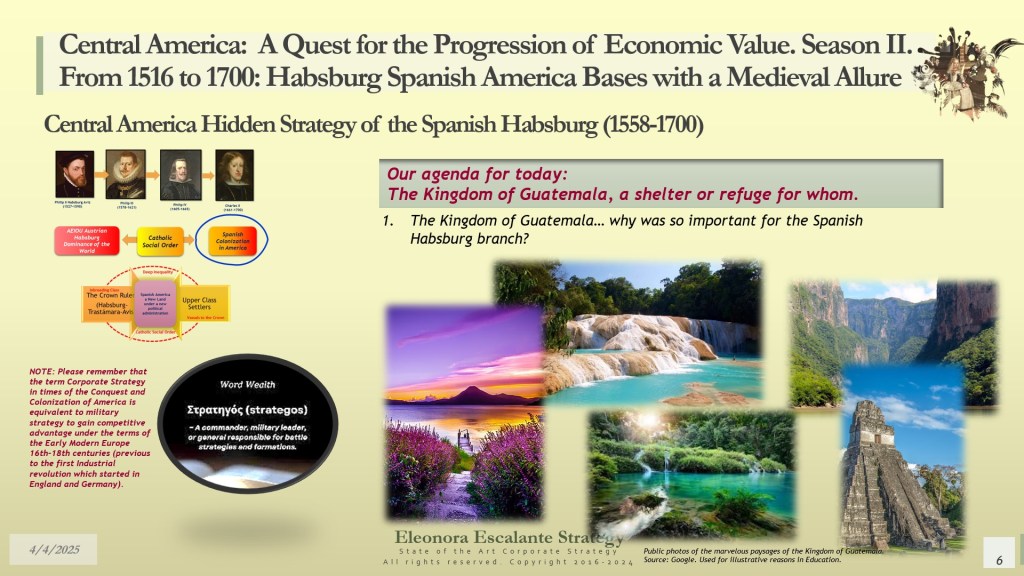
Why was the kingdom of Guatemala so important between 1521 and 1700?
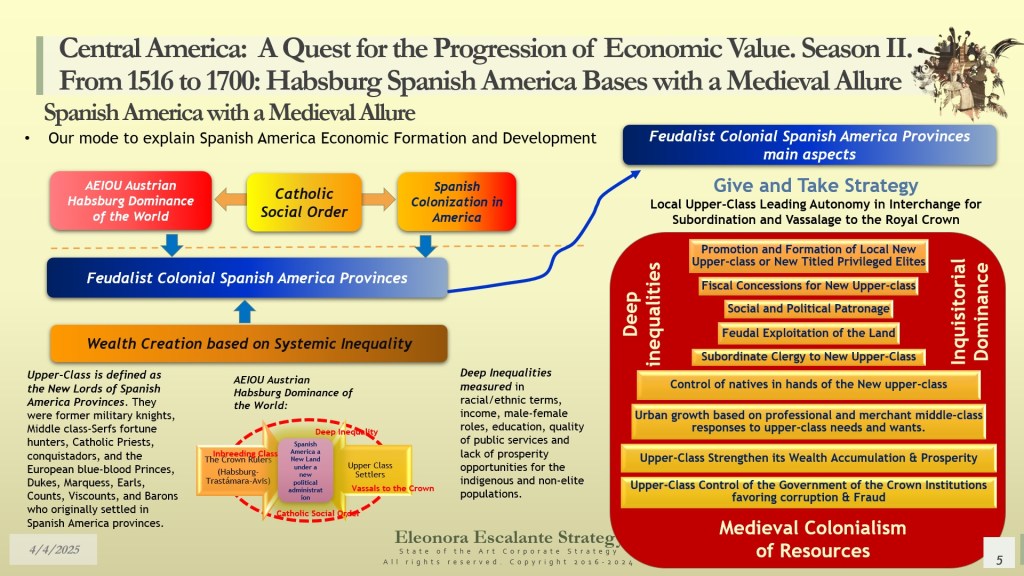
- Identifying a constellation of last names from the side of the Trastámara Dynasty: Let´s begin with our strategic reflections about the kingdom of Guatemala and its value for the family Habsburg-Valois/Castile-Aragón (we comprehend here the Castile Aragón dynasty as the heritors of Isabella of Castile and Ferdinand II Aragón, also called the Trastámaras). During our last publications, we have gathered and analyzed a lot of information about the Habsburgs, to the extreme that we have not only perceived, but also acknowledged their connection with the Byzantine empire. This was at the time of the crusades, before the century in which the House of the Habsburgs grabbed the Holy Roman Empire of the German Nations with Frederick III (1415-1493) (1). Nevertheless, we need to reminisce about the whereabouts of the last names of the Trastámara Dynasty. In consequence, when we think of the founders of Spain, we conceive them as a group of families represented in the Catholic Monarchs who held the following ancestor last names series. For more details, please see the genealogical trees (2) and (3):
Castile-Enriquez- Aragón-Peñafiel-Sicilia-Capet
Castile-Aviz-Nuñez de Guzmán-Ponce de León-Fernández Castro-Valadares
Enriquez de Mendoza-Fernández Córdova-Angulo-González-Gómez-Orozco-González-Ayala
Castile-Lancaster Plantagenet of Ghent in Flanders-Diaz-Hainaut-Valois
Aviz-Braganza-Lancaster Plantagenet of Ghent- Martínez de Praza-Pereira-Estévez-Beaumont-Alvarez-Alvim.
There is a clear blood connection between the royals of England (Lancaster-Plantagenet from Ghent- Flanders), Portugal (Aviz- Braganza), and the new establishment of the Spanish Crown in Isabella of Castile and Ferdinand II of Aragón. In consequence, Queen Isabella of Castile was clearly linked to two ancient royal families. Her daughter, Catalina of Aragón-Castile, was the link to the Tudor family of England, and Mary Tudor-Aragón was the result of that matrimonial strategic alliance, which ended in no heir afterward (at least that is what official history tells us). - What happened after Central America´s discovery and conquest?
The odyssey of the discovery of such a giant continent offered innumerable options to the kingdoms involved in the conquest. After the leaders of the native Mesoamerican populations of México and Central America were subjugated by Charles V and his relatives, the catholic friars began the establishment process in the new territories. The Indians had no other choice than to convert to Christianity, regardless of some revolts which ended badly. We have already demonstrated with several selected maps how the Spanish Catholic Social Order was established. We have also exhibited with extreme detail how the missionaries indirectly became the ethnographers, cartographers, urban designers, and builders of the new societies of the Habsburgs-Valois/Castile-Aragón descendants, including the Aviz of Portugal and the Plantagenet of Ghent & England. The Tudors were linked to the Yorks of England, too. - The Spanish Catholic Social Order in the Kingdom of Guatemala.
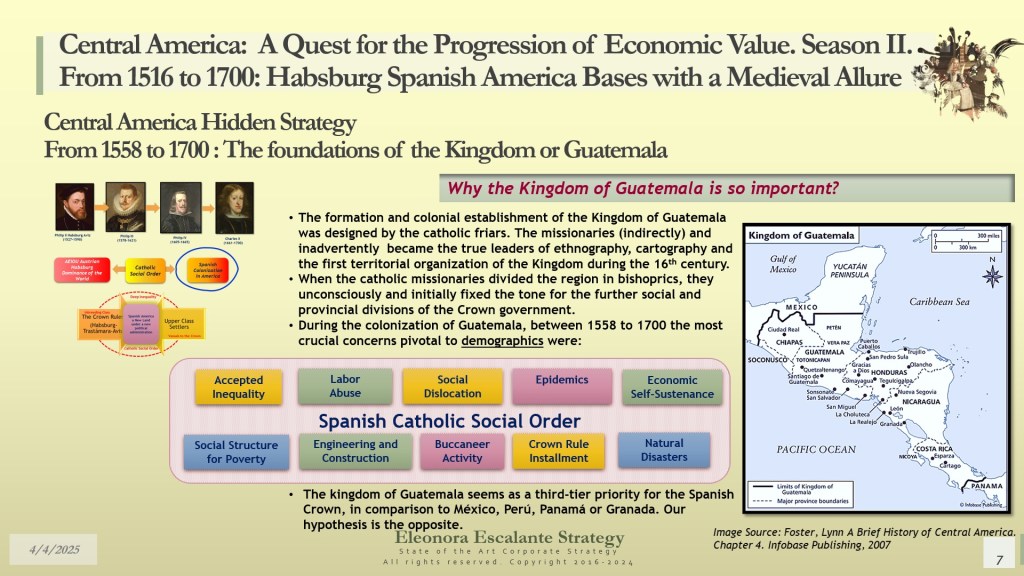
During the colonization of Guatemala, between 1558 to 1700, the most crucial concerns pivotal to demographics were eight (see slide 7):
a. Accepted inequality: The philosophical understanding of feudalism in Spain was clearly portrayed and enforced before the conquest. The royal Habsburg-Castile/Aragón-Aviz family was leading the conquest and colonization of a new land that was at least 30 times greater than the Peninsula. The Catholic Monarchs needed help; they couldn´t do it alone, and they already had blood genetic liaisons with the Aviz of Portugal, the Tudor-York, the Plantagenet of Ghent-Flanders, and the new Habsburg-Aviz of Austria-Burgundy. It is natural for a clan to look for resources within the family. Particularly in the context of Europe in the 16th century. The block of the families around the Habsburg-Castile/Aragón-Castile did not only retain its military dominance by using propaganda, but also by operating the land for a military service system, the basis of feudalism. Any feudalist society is characterized by a profound militarization on a “tenere in servitio” premise; maintained by a complex hierarchy of vassalage with a pivotal knightly social class in return for title to landed wealth (the fief: a grant of land to a knight or magnate, held in return for military service and political allegiance to a liege lord) (4). The philosophy of a feudal Spanish society of the 15th century is founded on inequality. It is an assumed and accepted inequality, in which the military armies were forming in several levels of the larger kingdoms, which used their armed knights to devour neighboring duchies, baronies, free cities, and sometimes entire kingdoms for a larger consolidation. The feudal system was a consequence of Medieval Warfare, in which most of the peasants were swept and pushed to accept that they were tightly bound (enslaved) to the land they worked and the lords who ruled them, who protected them in exchange when conflict arose. Any feudalist system is based on inequality; it was a practice in Europe, and it continued to be implemented in New Spain with the arrival of the Spaniards.
b. Labor abuse: Labor abuse in the new settlements of America not only contributed to the decline in the Native population. The Indians were utilized for transportation of heavy loads, to build towns, roads, ports, monasteries, churches, and any other crafting required by the Spaniards. With the discovery of the mines, the Indians were expected to accomplish all the work, but the epidemics had already taken a toll on them. Additionally, the indigenous were employed to perform household chores in the friaries, farms, or haciendas and public bureaus. The encomienda system was pure covered slavery. Initially, after Cortés and Alvarado’s conquest of the region, the Spanish did not pay any natives for their labor since the Indians were part of the Encomienda. When the Spanish Crown imposed limits to labor abuse, by 1570, for example; around 10,000 blacks and mulatos lived in the kingdom of Guatemala, but their numbers were insufficient to sustain the colony because of the costs: an African slave cost 200 pesos, a male Indian slave 15, and an encomienda Indian cost nothing (5).
c. Social Dislocation: “Social dislocation refers to the disruption of social structures and relationships within a community, often leading to feelings of isolation and fragmentation among individuals. This phenomenon can occur when people are forced to leave their homes or traditional ways of life, resulting in a loss of cultural identity and community cohesion. In the context of land loss, social dislocation becomes evident as communities struggle to adapt to new realities, facing challenges that impact on their social fabric and overall well-being.” (6)The Native Population of New Spain (including the Kingdom of Guatemala) was living in bursting social dislocation. The Indian communities were living in such suffering that most of them decided to escape to the mountains; others practiced sexual abstinence or infanticide rather than permit their children to live in the new Spaniard system. Others slowly starved to death. In 1542, Bishop Bartolomé de las Casas convinced the Spanish cortes to promulgate laws to protect the Indians by banning the Encomienda. But the encomenderos in New Spain didn´t want to comply with the laws. The Spanish Crown finally implemented the New Laws with Alonso Lopez de Cerrato in the Kingdom of Guatemala in 1548. Cerrato´s rigorous enforcement of the New Laws ended the extreme actions of labor abuse, but he couldn´t improve the living conditions for the Indians.
d. Epidemics: The arrival of Europeans to America shocked the Native populations with diseases never experienced before in the New World: smallpox, measles, mumps or chicken pox, pulmonary respiratory pestilence, bubonic plague, typhoid, and malaria. During the 16th century, several waves of plagues rampaged through the region repeatedly, decimating the Indian population. In less than a century, the number of Indians in Central America was reduced by as much as 90%. It has been categorized as one of the worst demographic disasters in world history. See the table below, please.
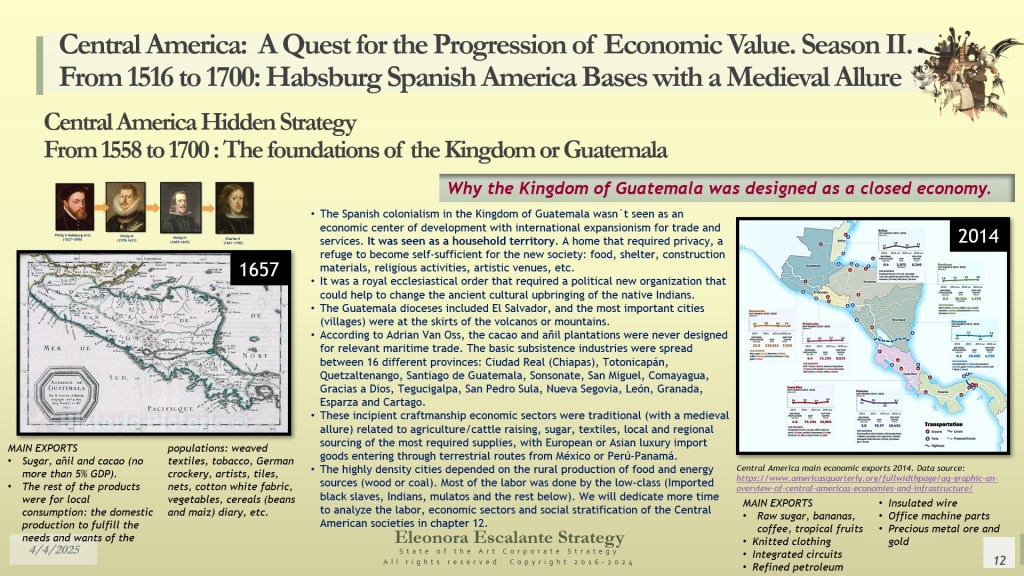
e. Economic Self-Sustenance: Life in the new Spanish Settlements pushed the Indians out of their traditional dwelling centers, but most of the time, the Spaniards selected the open valleys near the volcanoes and mountains, places where the Indians did not settle, probably because of previous natural disasters. To avoid troubles with the Indians, the Spanish immigrants usually started the colonies considering a Catholic Church infrastructure as a pivot, a new hermitage or convent, or a monastery to placate and conciliate with the Indians. Every community was conceived to produce its own food, and the Indians were in charge of farming it inside the Spanish new haciendas, or around them. The kingdom of Guatemala received imported expensive goods from México, and the stores of local products were in the hands of Spanish or Creole merchants. We will explore in detail the economy of the Kingdom of Guatemala in Episode 12.
f. Social Structure for Poverty: By the end of the 16th century, the Spanish governed completely, replacing the native chiefs at the top layers of society. The Indian labor was the basis for the Spanish incipient controlled cities. Indian former caciques collected taxes, Indian workers built town halls, roads, churches, water systems, decorated cathedrals, and supplied the markets with food for the colonies. The Native market economies functioned in an analogous way to the Spanish, so their commerce wasn´t too different from the Spaniards’. The pre-Spanish routes were used by them to transport their products as before the conquest. The introduction of the Spanish silver pesos as money created a different chaos than bartering, a structure designed for poverty to the Indians, because the labor was paid with low wages, and that system of low wages hasn´t changed since then to our days.
g. Engineering and Construction: The Spaniard colonies were founded to separate Indians from Peninsular Spanish, but this was almost impossible: the new Spaniard dwellings required Indian labor, and the Spanish haciendas were assembled with the Indian labor too. The new racial groups: mestizos, mulatos, ladinos, etc. were also serving the Spaniards, as much as the Indians, particularly in terms of cheap labor for the construction of the villages with the same pattern: a central squared plaza surrounded by a church, the public government bureaus and the new dwellers who were Spanish or Creoles. The urban model was originally imported from the south of France. The layout of the checkerboard, perfectly quadrangle neighborhood blocks around a main central plaza and the church (which always held a huge bell to ring the mass schedules and hours) was typical. Most of the streets were perpendicular, forming a grid plan for residential lots and stores. A market space was filled with the Indians who came from the suburbs to market their main foodstuffs, spun wool and traditional fabrics, salt, honey, fruits, pottery, and other local consumption items. The ecclesiastic works were always the greatest of all the villages. In 1740, just Santiago de los Caballeros of Guatemala (Antigua Guatemala) held the highest monastic community in all New Spain: around 600 religious citizens (priests, friars, nuns, novices, missionaries, choir members, the bishops, etc.).
h. Buccaneer activity: According to the official version of history, the rival European powers of Spain, which were initially embraced by family liaisons during the conquest, became the super foes on the Caribbean Coast of Central America. Britain, Holland, and France supported pirates who attacked the well-fortified Spanish ports and sacked the silver-laden galleons, stripping more than 10% of the merchandise shipped to Spain during the reign of Philip III. Pirates Knights as Francis Drake (knighted by Queen Elizabeth I) and Henry Morgan, organized frequent raids on the Atlantic Coast of Central America, with a base for attacks in the Caribbean. Belize was granted as a concession to England, in exchange for ceasing pirating. Smuggling became a substitute for Britain’s profits, instead of piracy, because whatever Spain manufactured, the Americas were obliged to import, including basic commodities. However, we put in doubt the buccaneer moves from Britain, Holland, and France, because there were lineage connections between all the blocks of kingdoms in Europe.
g. Crown Rule Installment: The Kingdom of Guatemala (Central America) wasn´t able to set up factories without the permission of the Spanish crown. Spain had to grant manufacturing on a limited scale, strictly for local consumption: textiles, shoes, soap, glass, houseware, cooking oil, etc. To survive, the residents of Central America learned to bypass those restrictive policies from Spain. How? By perfecting smuggling, tax evasion, and fraud. It was during the 17th century, while the Spanish Crown was in financial and leadership crisis, that the Central American colonies started to receive Iberian merchants and wealthy nobles who bought municipal offices, treasury positions, provincial and audiencias appointments. Additionally, some bought land and retreated to the countryside by building haciendas and keeping a mansion in the villages. Handling contraband was the norm, and the kingdom of Guatemala couldn’t join the industrialization waves of Europe. Not even the King of Spain was considering it in the Peninsula either. Spanish dwellers in the kingdom of Guatemala were city people, and they tried to replicate the Iberian model of living as much as they could. In terms of government structure, the capital of the Kingdom of Guatemala, Santiago, was one of the finest cities and top audiencias in the New World. Its importance was recognized by the architecture style in its edifices of authority, the Catholic facilities, the royal mint, the printing press, and later the Royal and Pontifical University of San Carlos, founded in 1676 (5). Once the encomenderos died out, the new upper classes were merchants, concealed smugglers, and large landowning families. The wealthiest were often Spaniards, Genovese, or Portuguese. Little political weight represented the Creoles, but they were also embodied in the villages.
h. Natural disasters: The kingdom of Guatemala was instituted because of a natural disaster, a flood that destroyed Ciudad Vieja. And several earthquakes accompanied their growth. The one that demolished Antigua occurred in 1773. Despite that Santiago de Guatemala is in a fertile valley, and it was rejoiced by fire flashing from the volcanoes around, that same delightful beauty, linked its essence to earthquakes.
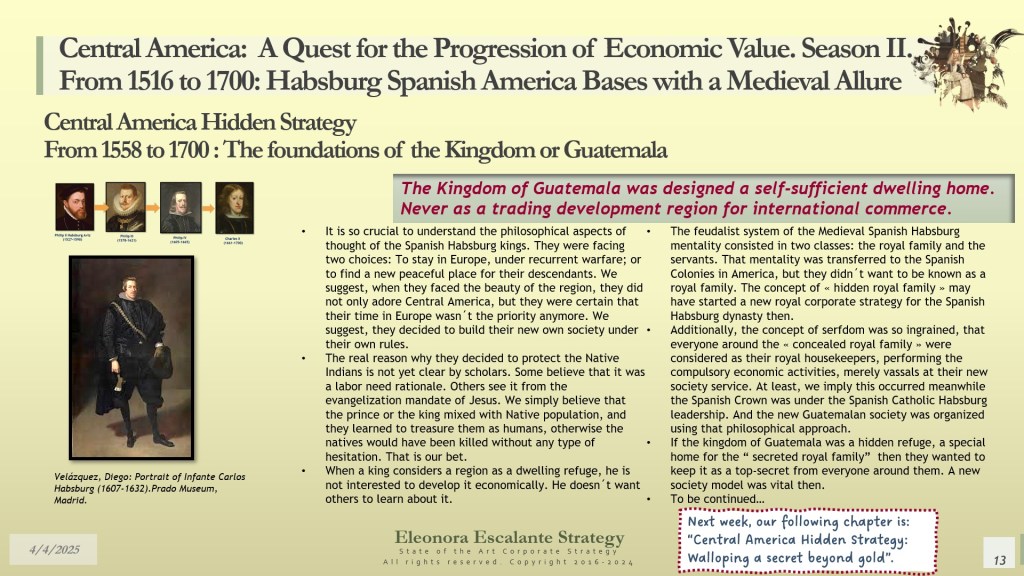
- Our hypothesis: The kingdom of Guatemala was being prepared as a dwelling place for the royal family of the Habsburg-Valois/Castile-Aragón-Aviz descendants, or at least it was being primed for it. We have explained our rationale in slides 8 to 13. The slides are self-explanatory. Additionally, our observations and inferences are positioned for the period of the Spanish Habsburg kings as of Charles V, passing through Philip II, Philip III, Philip IV, and Charles II. With the ascension of the Bourbons, priorities may have changed, because new lands were added and sold, and North America, all together with South America, offered novel places for dwelling as of the 18th century. Put special attention to slide 13. In conclusion, during the 16th and 17th centuries, the Kingdom of Guatemala was designed as a closed economy, a self-sufficient dwelling home for the descendants of Charles V Habsburg-Valois/Castile-Aragón-Aviz and all its liaisons. The Spanish Habsburg rulers of these two centuries were not interested in developing industrial or manufacturing kingdoms in America. They wanted a new home location, a new place to live for the new generations ahead.
To be continued.
Decline in Indian Population in Central America
(source, Foster, L. A brief history of Central America, 2nd Edition)
| Region/Year | 1500 | 1548 | 1570 |
| Central America | 5.65 million | n/a | 550,000 |
| Guatemala | 1.5 million | n/a | 180,000 |
| Nicaragua | 500,000 | 44,500 | 26,000 |
| Honduras | 800,000 | n/a | 40,000 |
| Quiche Towns | 50,000 | 5,000 | n/a |
Announcement.
Our day’s episode is the first of 4 dispatches that will provide all the fundamentals for understanding the beginning of Central America’s Hidden Strategy between 1598 and 1700. In fact, today, we have disclosed why and how Central America (or the Kingdom of Guatemala) was designed as a shelter or refuge for the royal Spanish Habsburg family, the descendants of Charles V Habsburg-Valois-Castile-Aragón dynasty. Without that piece of the puzzle, no one was right about the economic foundations of our region. The Kingdom of Guatemala of the 16th and 17th centuries was conceived, planned, and created as a refuge, hidden shelter, and paradise for a family that wanted to escape from the disaster of their entangled conflicts with the rest of the European monarchies. The corporate strategy of the Spanish Habsburgs was of survival and settlement, not of colonization. It was a creation of a new society under their own rules, far but so far away from Spain, Germany, France, Italy, England, and the rest of Europe. A Central America with a “Tierra de los Confines”, a place where no one could bother or reach them anymore. The Spanish Habsburg kings, as descendants of Charles V, wanted a new place to dwell. We suggest that they probably found it in Central America.
Musical Section.
Our selection of music during this saga will continue to explore adorable music produced between the 16th and 17th centuries. Season II is dedicated to the lute. Our choice for today´s episode is an awesome Lute concert: Ricercare sul liuto- Gli allievi dei Conservatori italiani in concerto, Milano 2022. The interpretation is
in the hands of Carlo D’Ariano, Stefan Sandru, Gabriele Spina, Marco Zuin, Benito Curcio, Davide Gazzato, and Riccardo Mistroni.
Thank you for reading http://www.eleonoraescalantestrategy.com. It is a privilege to learn. Blessings.

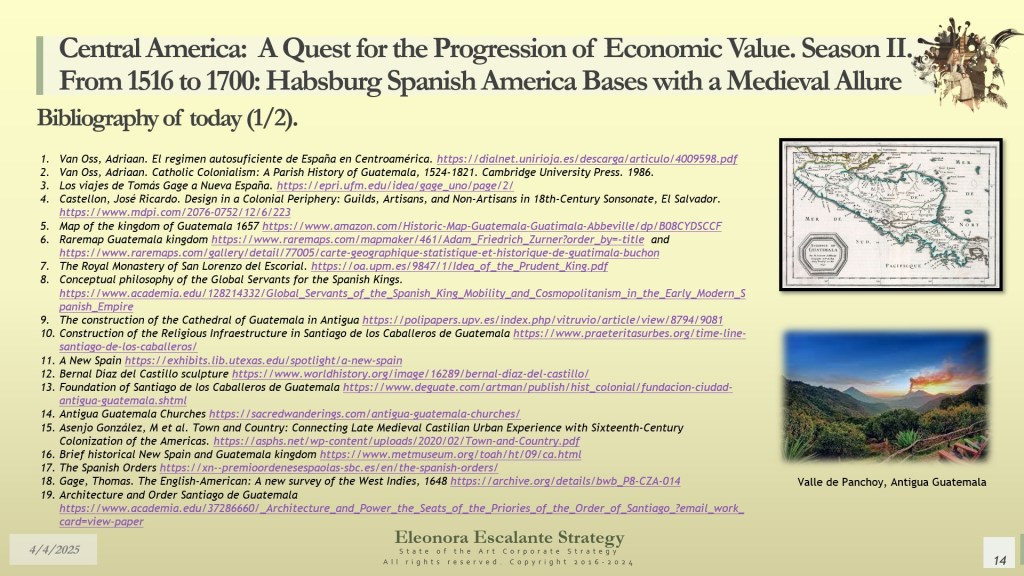
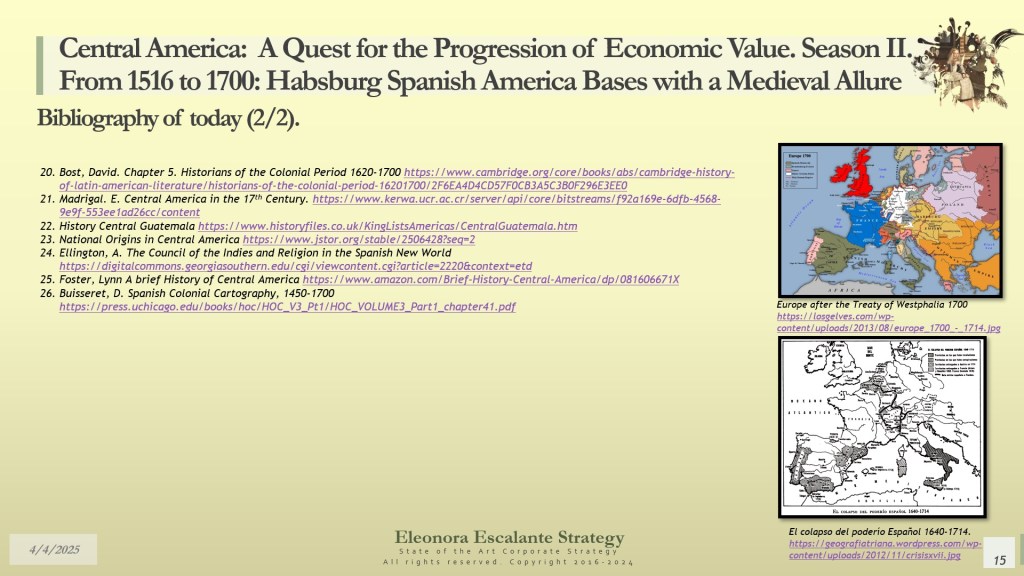
Sources of reference and Bibliography utilized today. All are listed in the document. For this text we have added the following references:
(1) Frederick III Habsburg, the first Holy Roman Emperor of the House of Habsburg. Father of Maximilian I. https://www.holyromanempireassociation.com/holy-roman-emperor-frederick-iii-.html
(2) Genealogical tree of Isabella Castile-Aviz https://www.wikitree.com/wiki/Castilla-121
(3) Genealogical tree of Ferdinand II of Castile-Enriquez of Aragón https://www.wikitree.com/wiki/Arag%C3%B3n-122
(4) Nolan, Cathal: The Age of Wars of Religions 1000-1650 https://preterhuman.net/docs/The_Age_of_Wars_of_Religion,_1000%E2%80%931650:_An_Encyclopedia_of_Global_Warfare_and_Civilization
(5) Foster, L. “Brief history of Guatemala.” Chapter 4. https://dl1.cuni.cz/pluginfile.php/912577/mod_resource/content/1/Lynn%20V.%20Foster%20-%20A%20brief%20history%20of%20Central%20America-Facts%20on%20File%20%282007%29.pdf
(6) https://library.fiveable.me/key-terms/introduction-to-native-american-studies/social-dislocation
Disclaimer: Eleonora Escalante paints Illustrations in Watercolor. Other types of illustrations or videos (which are not mine) are used for educational purposes ONLY. All are used as Illustrative and non-commercial images. Utilized only informatively for the public good. Nevertheless, most of this blog’s pictures, images, and videos are not mine. Unless otherwise stated, I do not own any lovely photos or images.
 Eleonora Escalante Strategy Strategic Reflections Think Tank