
Central America: A Quest for the Progression of Economic Value. Season II. Episode 11. Central American Hidden strategy: Walloping a secret beyond gold.

Adorable Readers:
We are so blessed to have a few days of vacation, which have landed in our lives as a precious gift. Next week is Easter in town, and we will enjoy some days off. Consequently, I wish to finish this publication as soon as possible.
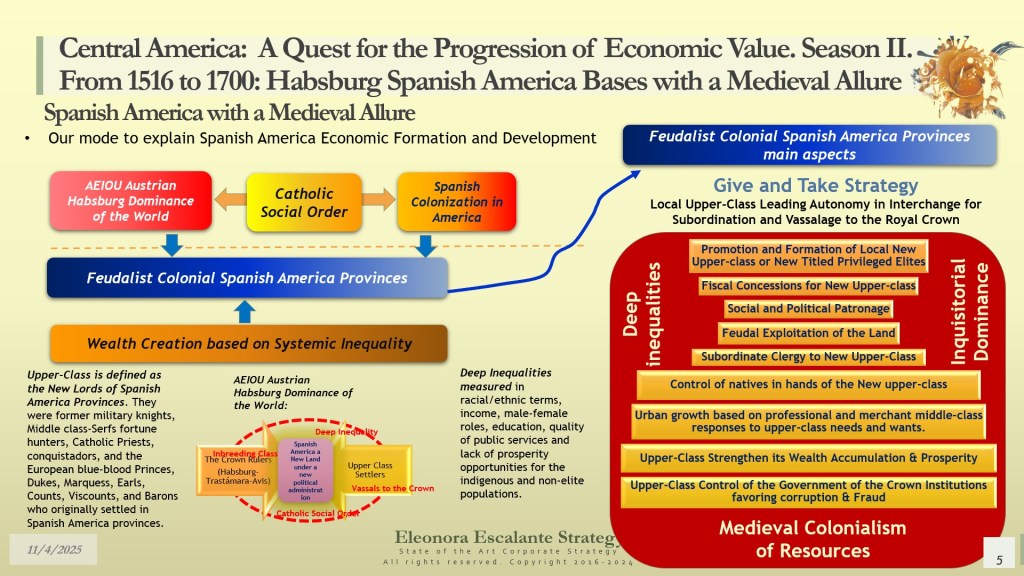
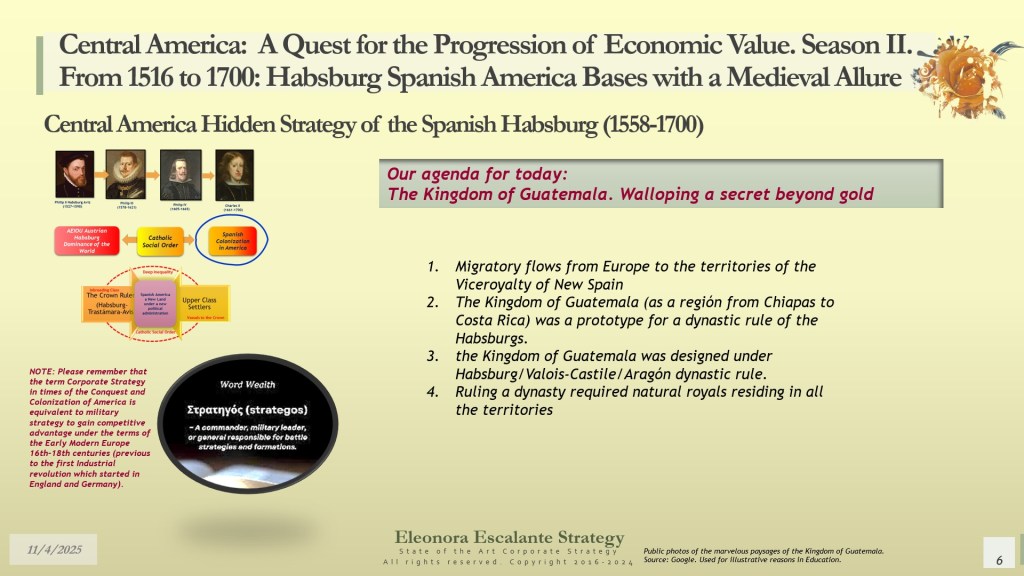
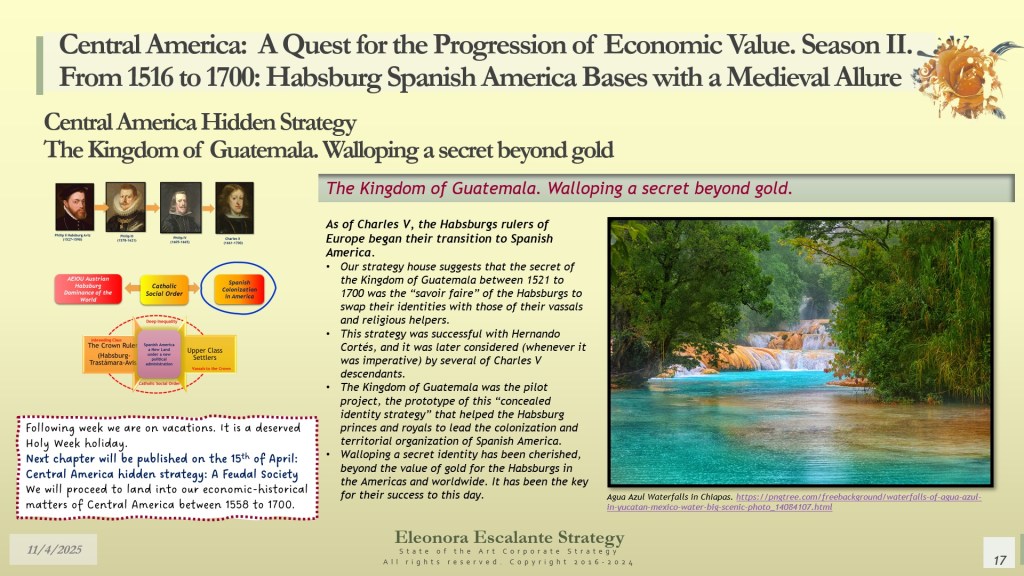
Let´s begin. Our strategic research is focused on the Kingdom of Guatemala, and its vital significance served two branches of the Habsburgs, in their pursuit of the AEIOU strategy (Austriae Est Imperare Orbi Universe). If the “what to do” was the AEIOU, then the Habsburg family was also entitled to find “how to do it”. And they were testing the waters in Spanish America. The first pilot project was the kingdom of Guatemala, despite that New Spain was larger in size and resources. When Charles V decided to set the Audiencia of Guatemala in Santiago de los Caballeros (today Antigua Guatemala), he was considering his family dwelling place. This place became a prototype (or pilot project) for the Spanish Habsburgs in their quest to find out the best formula available in the context of their understanding, not just to handle the native populations, but to learn how to settle safely in their newly conquered territories in Spanish America. Do you remember the model of Strategic Innovation from Professor Constantinos Markides, the framework of who, what, and how? Well, charming readers, this strategic framework was used by the Spanish Habsburgs 500 years ago!
Our investigation has been concentrated on analyzing the construction, evolution of thought, and mutation of the dynastic rule of the Spanish Habsburgs when they faced that Spanish America was at least 30 times bigger than their fragmented lands of Europe. It wasn´t a plan for Charles V. It was a succession agenda that required a long-term strategy. It was a block group strategy, a dynastic rule that was disrupted completely in America, and they were forced to change all their dynastic concepts. The paradigm of the Habsburgs’ leadership was broken as soon as they realized that if they wanted to be successful in Spanish America, they had to leave Europe and find a way to make a permanent residence in the New World. How did they make it? We invite you to explore the material of the slides.
Find our master class below. Feel free to download the document in PDF, as it is better for your clarity of reading. You can print it and write your ideas with a pen or pencil. Are you ready? Let´s see the dispatch that we have prepared for you with so much faithfulness and care. We invite you to click on each of our bibliography links (slide 18) for further exploration and complementary reading.





We request that you return next Monday, April 14th, to read our additional strategic reflections on this chapter.
We encourage our readers to get acquainted with our Friday master class by reading the slides over the weekend. We expect you to create ideas that might be strategic reflections or not. Every Monday, we upload our strategic inferences below. These will appear in the next paragraph. Only then will you be able to compare your own reflections with ours.
Additional strategic reflections. Posted on Monday, April 14th, 2025.
Today´s strategic reflections are a thoughtful acumen about the term dynastic rule. The walloping secret beyond gold of Central America is its foundation, its origin under the Habsburg-Valois-Castile-Aragón dynastic rule. Nothing is more important in our economic development than to understand why this region started its economic functioning as it did. When the Spaniards conquered the area that begins with Chiapas and ends in Costa Rica, there were native populations organized in a pre-Hispanic society that was conceptually different. The dynastic rule of the Aztecs, the Mayan tribes, and the rest of the indigenous peoples in the region was 180 degrees different than the recently formed Habsburg/Valois-Castile/Aragón-Aviz dynastic rule, which we will call the new prevailing foreign dynastic rule. Somehow, the new overriding colonizers needed to find a system (mental logic, method, techniques, savoir-faire) that should be accepted as the “new standard dynastic rule” in every single native village of the region, despite the differences that these villages had among between.
- The Social Catholic New Order: We have already identified how the new social catholic order was crucial for this to happen. The labor of the Franciscan, Jesuit, Dominican, Mercedarian, and Augustinian missionaries was the “key”. The native populations of the Kingdom of Guatemala accepted being ruled by the new foreign dynastic rule. They also converted themselves to Catholic Christianity to save themselves. And the Catholic value proposition of Europe was mixed and fraternized with their local traditions and culture. There was a difference between the missionaries and the secular colonizers. The missionaries were by far the most educated, and they held the medieval monastic life in their veins, so they truly believed that the conversion of the Indians was necessary and the raison d’être of their being. The conversion to Christ wasn´t seen by the “real” missionaries as a political tool for domination and exploitation. They were the global Christian servants of God trying to save the “pagan souls”. Most of the tiny villages that held their own language were a challenge for the friars, and they were committed to changing the pre-Columbian mentality of sacrificing people in the temples, as much as helping them to avoid a potential inquisition in the hands of the Spaniards´ authorities. Saving souls caused martyrdom. Many times, the friars protected the Natives from the Spaniards, and they were also attacked by the radical Indians who weren´t interested to convert into Christianity. The role of the Catholic missionaries was not easy. Some bishops perished in the intent, most of the time because of the Crown’s Spaniards attacks. The only way you can understand why the Indians accepted Christianization from the friars is that these Catholic missionaries intervened “as their fathers” to save their lives when facing the encomiendas and inquisitorial terror coming from the Spanish Authorities. There is no other explanation. Not all the missionaries were correct with the Indian populations, but a vast majority acted as fathers to protect them, and this action helped the Natives to survive.
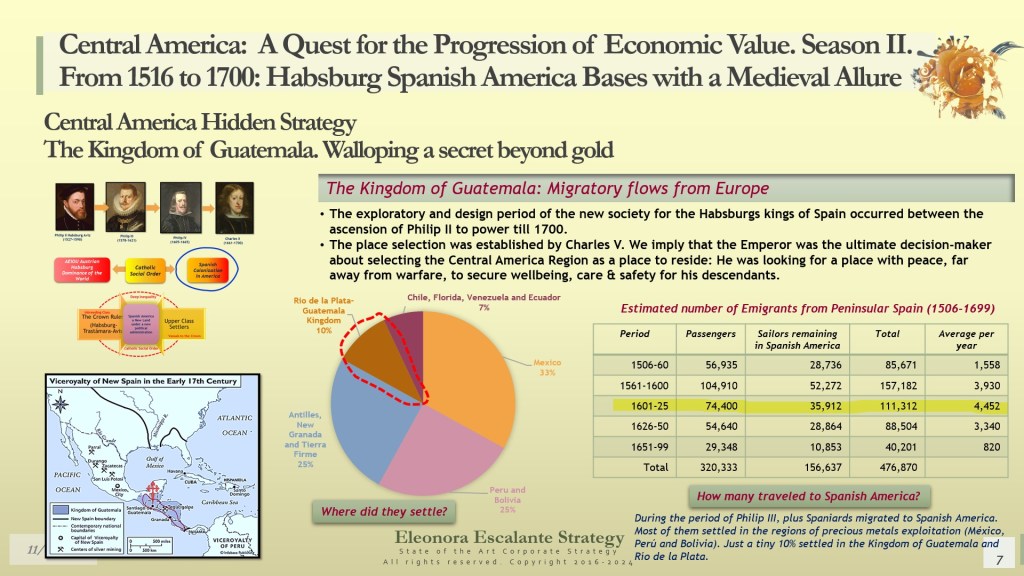
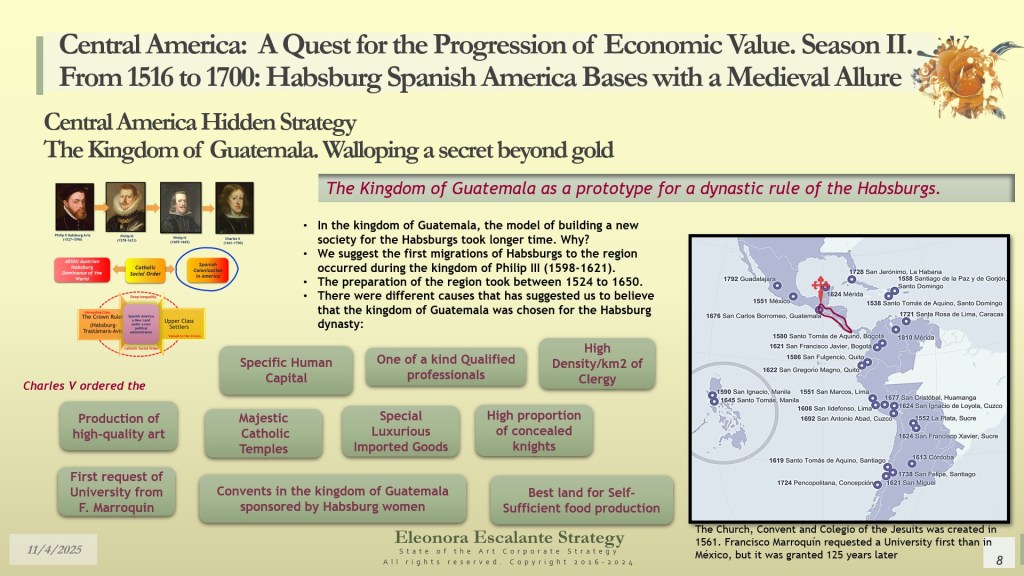
- Migratory flows from Europeans to the Kingdom of Guatemala during the 16th and 17th centuries.
Charles V hesitated to install the Audiencia of Guatemala. It took him several years to decide to leave it in Santiago de los Caballeros de Guatemala. However, he and his team of friars decided to leave it there some years before the death of the Emperor. The Audiencia and Chancellery Real de Santiago de Guatemala in la Nueva España was modified in matters of its border´s extent by royal decree in 1543, 1556, 1560, 1568, 1593, and 1596. This area wasn´t recognized as the Captaincy General of Guatemala until 1609.
The Audiencia of the kingdom of Guatemala became one of the richest of the New World capitals, without the extraction of gold or other precious metals. Why? Well, the answer is the type of people who arrived with the migratory flows that came to dwell in the city. Santiago de los Caballeros of Antigua Guatemala was filled with a higher proportion of members of the knightly military order of Santiago in comparison to the number of knights dwelling in other audiencias (among other orders). The chief of staff of the Military Orders was the King of Spain. It was also filled with the largest number of catholic temples per square kilometer. The architectural beauty of the catholic churches, monasteries, and convents was by far greater than what you found in Lima or Mexico City at that time (16th-17th centuries). Most of the best-qualified secular and religious professionals arriving in Guatemala were higher in eminence and superior human capital. Thomas Gage, a Catholic priest from England who lived and traveled in Central America from 1625 to 1637, published an account of his experiences in his book “The English-American his Travel by Sea and Land-A New Survey of the West-Indies”. Through his book, he was able to witness the finest premium condition of Antigua de Guatemala in comparison to the rest of the cities under Spaniard dominion. Visit slide 8. Despite that the Kingdom of Guatemala was populated less (only 25,000 Spaniards in 1770), the capital of its Audiencia was developed under higher-wealthy standards than the rest. (1) - If there were Habsburg Women sponsoring work in the Kingdom of Guatemala, Habsburg Men were doing it too. See slides 9 and 10. The organic philosophy of the Habsburgs was pivotal to Catholicism. Their connections with the Papacy were shined by the Habsburg monarchs of the Austrian Branch. During the 16th and 17th centuries, there is proof of evidence of convents in Antigua Guatemala that were medullary to the religious activities of several Empresses, Queens, Princesses, and Habsburg widows, who were foundresses of nunneries, female convents, and religious sisters´ houses in Iberia and in Guatemala. We don´t think it is a fortuitous accident to find the ruins of these dwellings in the capital of the Audiencia of Guatemala. Most of them were granted permission and money from the Spanish Crown and donations from the local Guatemalan Spaniards during the 17th century.
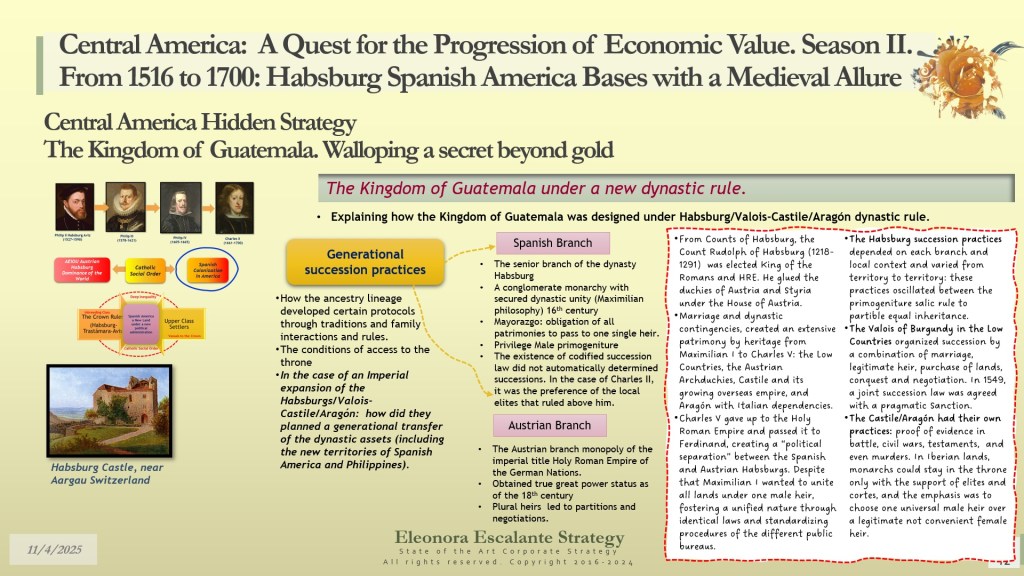
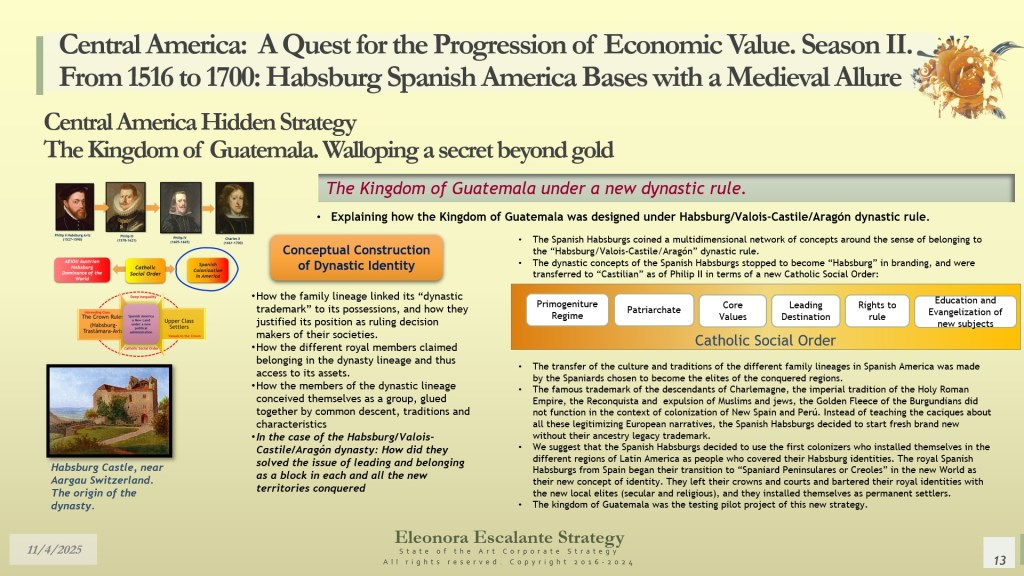
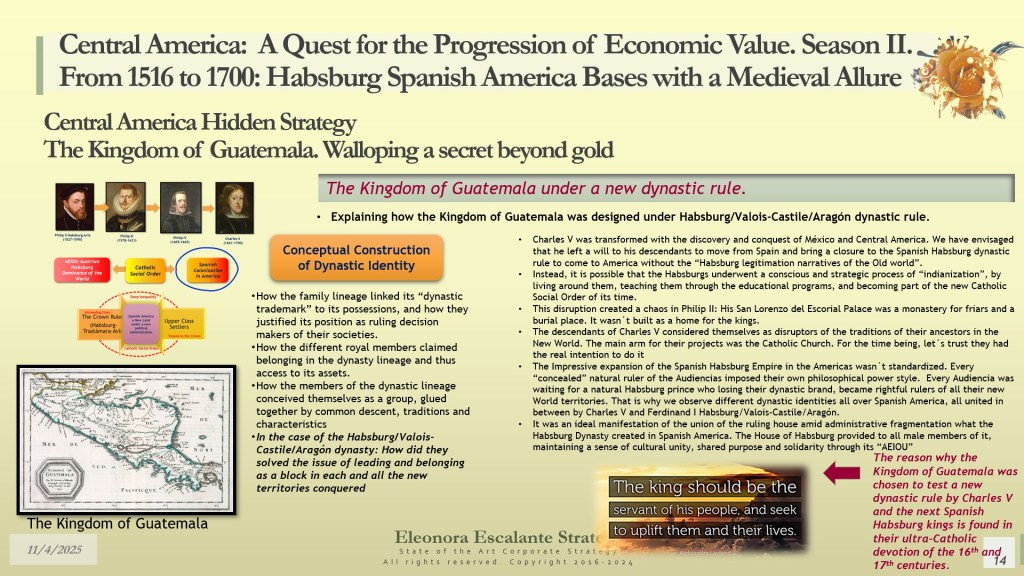
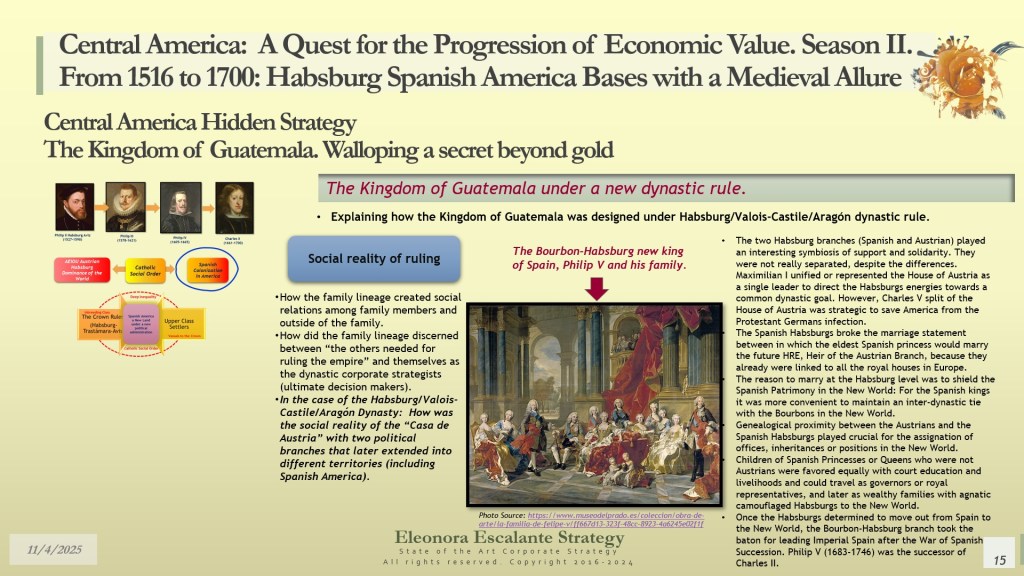
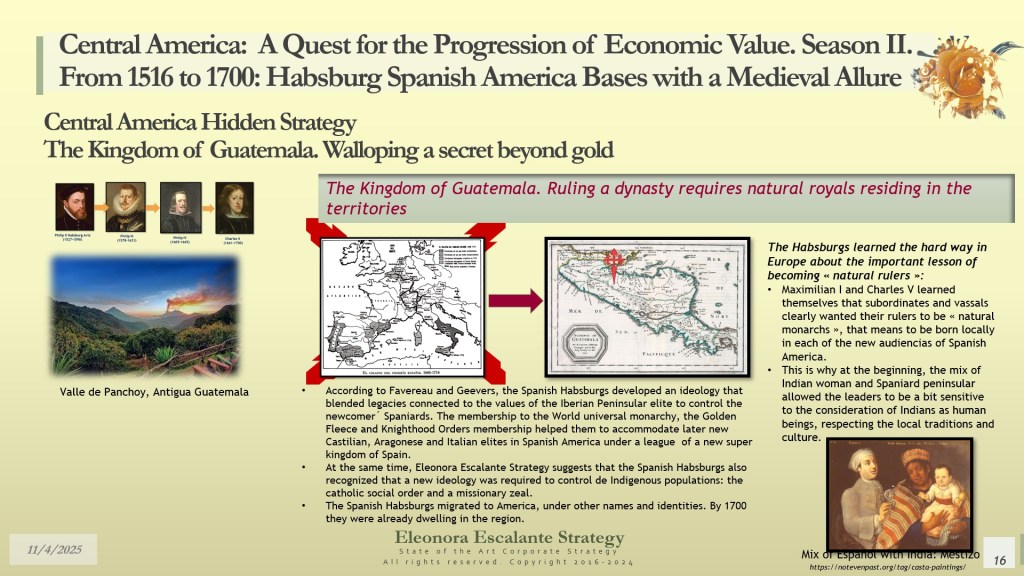
- Constructing a new dynastic rule. Slides 11 to 15. Marie Favereau Doumenjou (Professor of medieval history at Paris Nanterre University) and Liesbeth Geevers (Professor of Early-Modern History at Lund University) have been doing research about the construction of dynastic rules. We have brought to mind their framework of analysis. Doumenjou and Geevers have investigated the Habsburg Dynasty from the point of view of Europe only. We decided to take a step further. To analyze the Spanish Habsburg branch in the context of Spanish America. We pursued the question of how the new prevailing foreign dynastic rule of the Habsburg/Valois-Castile/Aragón emerged and prepared the way to settle in Spanish America. Doumenjou-Geevers (2) define dynastic rules as collective forms of authority and government with three main components:
a. Generational Succession Practices: The transfer of dynastic assets planned as a long-term succession, from one generation to the next. Slides 11 and 12.
b. Unique Conceptual Construction of a Dynastic Identity: The concepts of the Habsburgs’ dynastic identity were: primogeniture regime, patriarchate, core values, privilege of the culture of the leading destination, rights to rule, and evangelization to Catholic Christianity. Slides 13 and 14.
c. Social Reality of Ruling: The Habsburgs of Spain ruled under Castilian terms. But deep down, Charles V and his court camouflaged their Burgundian upbringing’s social values while in Spain. Several Austrian Habsburg branch royals were sent to study and work at the Spanish Court, because Ferdinand I HRE (brother of Charles V) was Castilian in his cultural understanding of the world. In consequence, the duality of Castile-Burgundy (Bruges-Ghent-Michelen) was seen in their decision-making. The least Burgundian of all was the Austrian Branch, a side of the family that began dynastic matrimonies with the different German Catholic houses of the region. Another interesting aspect that Doumenjou and Geevers have observed: The Spanish Habsburgs broke the marriage statement in which the eldest Spanish Princess had to marry the future Holy Roman Emperor of the Austrian Branch. This action was revolutionary at that time. Somehow, it can be explained because it could be that the inbreeding consequences were already observed in the son of Philip II, Don Carlos (3). Then the tragedy of the Spanish Infanta Margarita Theresa with her Austrian uncle Leopold HRE was a total mistake, and Charles II was the most destructive of the cases of genetic complications of the family. The Spanish Habsburg branch was required to move out of Spain imminently, if they wanted to outlive as a family.
The slides 11 to 15 are self-explanatory for each of these components. We have tried to identify the unique elements of the Habsburg/Valois-Castile/Aragon dynasty in the Kingdom of Guatemala. However, there is proof of evidence that the Spanish Branch of this dynasty was intertwined with the Austrian Branch of the German Nations. We also believe that some percentage of the silver from America was given to the Austrian Branch. Despite that the succession was theoretically designed to privilege male primogeniture, each of the families involved in the colonization of America had different practices. The Habsburgs of Maximilian I were linked to the Aviz of Portugal, so there is a solid block of Austrian traditions coming from the Patriarch that can´t be dismissed. Usually, we tend to think only of the practices of succession of the Austrian Habsburgs, but in reality, there were specific dynastic traditions when it comes to the Castilian royal families, and the same applies to the Aragón side with clear Italian Naples linkages. The Burgundy side of the family was cherished by Charles V, much more than Ferdinand I, who was raised in Spain and later transplanted to Austria. Charles V was raised with the mentality of the Low Countries, a place where he seems to have spent happy years of his life. We can´t speak of a unique homogeneous Habsburg dynastic succession practice at the time of the foundation of the Kingdom of Guatemala. Most of the Spanish elite vassals to Charles V and Philip II were Castilians and tied by the nature of the Order of the Golden Fleece, a Burgundian elite, whom they respected. But in Central America, that leadership narrative was out of any scope with the Indigenous caciques. And it was in Antigua Guatemala that a new prevailing foreign dynastic rule was originated; the rules of the game had to be reinvented around the Catholic mission of evangelization. In America, the Imperial tradition of power coming from the Roman Empire of the German Nations couldn´t be utilized. In America, the goal of expelling Muslims and Jews was not on the agenda. In America, the ancestry of Charlemagne, the crusades, and the fight against the Muslims was totally irrelevant. In consequence, the Catholic social order took the primacy of the new dynastic identity. Slide 14 explains it in detail. - The royals from the Habsburg/Valois-Castile/Aragón traveled to establish themselves in America. How? We assume they came concealed under the identities of their most cherished vassals in the Peninsula. They left their royal identities and crowns under their beds, and passed through Lisbon, Sevilla, or Cadiz as simple normal citizens (mostly religious), and they came to settle in the different audiencias of the region. Our research has shown us that the Kingdom of Guatemala was the pilot project of this strategy. After the War of Spanish Succession, all that was left of them was the Bourbon-Habsburg branch, while they were already dwelling in Spanish America. We can´t make sure at this stage of our investigation which of the chosen vassals were used by the Spanish Habsburg branch, which allowed them to use their family last names to be transferred to America. All we can perceive is the strategy. Probably these vassal families were the closest to them, who served the Habsburg-Valois-Castile-Aragón with a deep loyalty, to an extreme level: to give up their last names as a tool, as the hidden covert umbrella of the royals to come to America. It was a high secret of top gigantic responsibility. But, this wasn´t a thank you very much favor; possibly it was recompensed accordingly, with assets, silver, and land for beautiful castles in the Iberian Peninsula or haciendas in any of the audiencias of Latin America. We hint that some Spanish Habsburgs, under a new identity, settled first in the Kingdom of Guatemala, and tested the waters of their strategy. We also suggest, they later practiced the same formula in the rest of the audiencias, with the remnant of legitimate relatives or bastards (sons and daughters born out of the royal matrimony). This is a preliminary hypothesis that requires further study and analysis, maybe a series of doctoral theses, but this is our best bet after discovering the Hernando Cortés strategy in the conquest of México. How many of the Habsburg children who apparently died days after birth might have been alive and were transferred with substitute parents to America? How many illegitimate Habsburg kids were sent to America? How many of the concealed Spanish Habsburgs mingled with native Indigenous women, giving birth to a class of Habsburg Mestizos that were spread all over the region without their royal last names? How many creoles were coming from the original Habsburg-Valois-Castile-Aragon group in reality? How many bishops or priests were charged with royal blood, and they weren´t aware of their secret identity? Did they know they had Habsburg blood or not? We do not know. All we can perceive is that a new golden secret, a prevailing hidden dynastic rule, emerged in America, leaving everything behind when Charles II died in the year 1700.
Announcement.
Our day’s episode is the second of 4 dispatches about the fundamentals of leadership and corporate strategy of Central America’s Hidden Strategy between 1598 and 1700. In fact, today, we have disclosed the rationale of the secret plans of the Spanish Habsburgs to move from Europe to Spanish America. Last week, we explained why the Kingdom of Guatemala of the 16th and 17th centuries was conceived, planned, and created as a refuge, hidden shelter, and paradise for a family that wanted to escape from the disaster of their entangled conflicts with the rest of the European monarchies. Today, we have shown you how the Habsburgs decided to conceal their identities in their quest to become “natural” born leaders of each of the audiencias of the region.
We are on vacation next Friday 18th of April. Let´s see us again on April 25th with the penultimate episode of season II: “Central America hidden Strategy: A Unique Feudal society”.
Musical Section.
Our selection of music during this saga will continue to explore adorable music produced between the 16th and 17th centuries. Season II is dedicated to the lute. Our choice for today´s episode is the interpretation of the lutenist Robert Barto, who has specialized in the Baroque and Empfindsamkeit periods, in particular the oeuvres of Sylvius Leopold Weiss and Bernhard Joachim Hagen. He is a graduate of the University of California, San Diego. He has numerous recognitions and lute studies in Europe. For this occasion, he is interpreting the lutenist Sylvius Leopold Weiss (1687-1750).
Thank you for reading http://www.eleonoraescalantestrategy.com. It is a privilege to learn. Blessings.

Sources of reference and Bibliography utilized today. All are listed in the document.
- Foster, Lynda “ A brief history of Central America” https://www.historyisaweapon.com/defcon7/Lynn%20V.%20Foster-Brief%20History%20of%20Central%20America-Facts%20on%20File%20(2007).pdf pages 91-94
- In Prince, Pen and Sword. Favereau, M and Geevers, L. The Golden Horde, The Spanish Habsburg Monarchy and the Construction of Ruling Dynasties, Brill. 2018. https://brill.com/display/book/edcoll/9789004315716/BP000006.xml
- https://www.habsburger.net/en/chapter/don-carlos-tragedy-kings-son
Disclaimer: Eleonora Escalante paints Illustrations in Watercolor. Other types of illustrations or videos (which are not mine) are used for educational purposes ONLY. All are used as Illustrative and non-commercial images. Utilized only informatively for the public good. Nevertheless, most of this blog’s pictures, images, and videos are not mine. Unless otherwise stated, I do not own any lovely photos or images.
 Eleonora Escalante Strategy Strategic Reflections Think Tank