

Central America:A Quest for the Progression of Economic Value. Season III. Episode 4. The Role of the Bourbons and the War of Spanish Succession (1700-1714)
Dear magnificent readers:
Welcome to a new masterclass about the Bourbon-Habsburgs of the 18th century. Today, we will focus on explaining to you the main relevant purpose (at the corporate strategy level of his epoch) of King Louis XIV Bourbon-Habsburg. Louis XIV (1638-1715) was also raised as an orphan king. His queen mother, Anne María Mauricia Habsburg (1601-1666), was left as a widow when his father, Louis XIII, passed away in 1643. Another fatherless king who was raised at the expense of the appointed Chief Ministers of State of France. Queen Anne had an Italian-born adviser (some historians recorded him as his lover), named Cardinal Jules Mazarin (1602-1661), who acted as the head of France until Louis XIV came of age to rule.
The life of Louis XIV Bourbon Habsburg, is our first stopover today. We have analyzed him through the eyes of his military-political affairs. First, we have explored his ancestors and how the Bourbon family has accompanied the different kings of France since Charlemagne. Second, we cruised the adventure of wooing each of the wars that he lived, either as a prince (Frondes) or later as a leading king. Finally, we have dedicated the rest of our days to exploring the War of the Spanish Succession (1700-1714).
Find the following frame of reference to help you produce your strategic reflections over the weekend. We always post our slides on Friday, so you can study them and read the further bibliographical information tied to the last pages of the document. We encourage you to print the document, take notes, write with your pen or pencil on the paper, and delight yourself in your learning experience. Feel free to pass it to your family, friends, colleagues, supervisors, and acquaintances. So, let´s read.

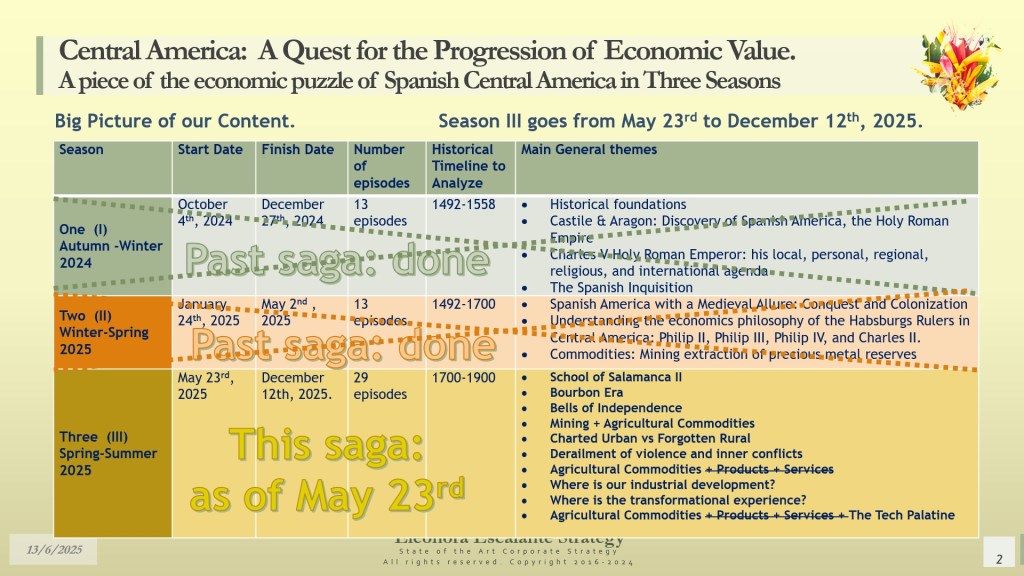


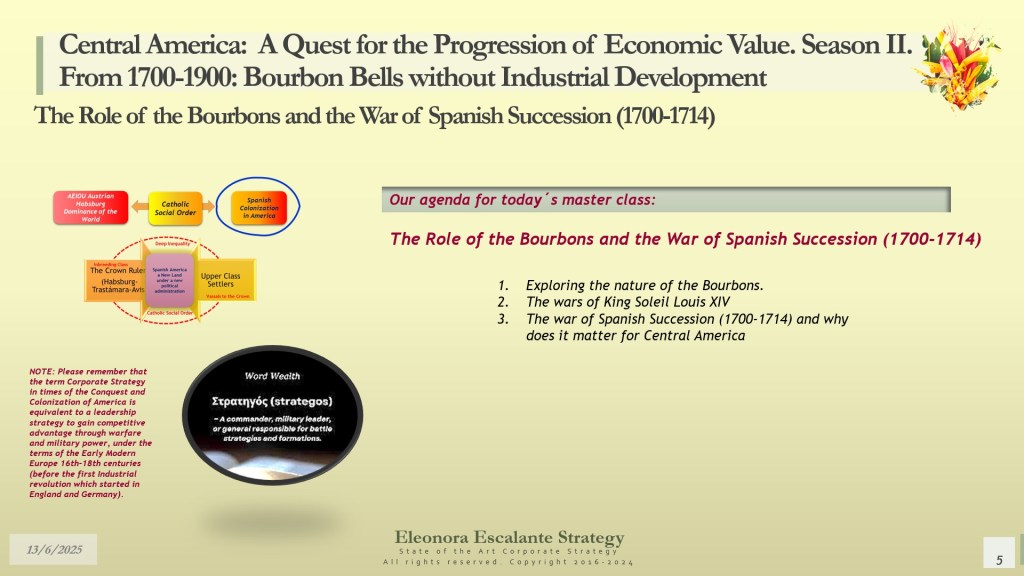








We request that you return next Monday, June 16th, to read our additional strategic reflections on this chapter.
We encourage our readers to get acquainted with our Friday master class by reading the slides over the weekend. We expect you to create ideas that might be strategic reflections or not. Every Monday, we upload our strategic inferences below. These will appear in the next paragraph. Only then will you be able to compare your own reflections with ours.
Additional strategic reflections after the weekend. These have been posted on Monday, the 16th of June, 2025.

Strategic reflections of Episode 4. The role of the Bourbons and the War of Spanish Succession (1700-1714).
Dynastic connections unplugged.
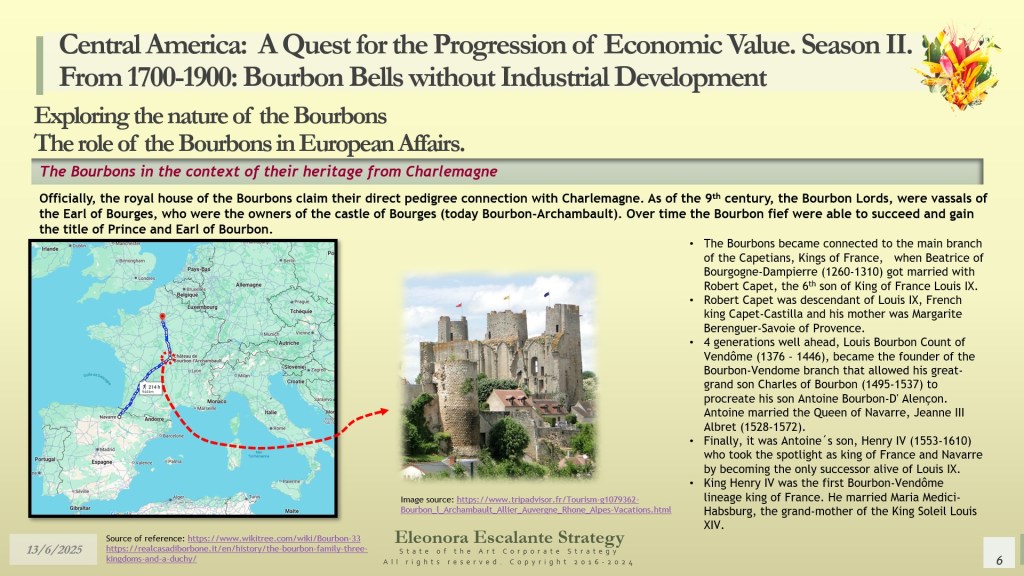
The strategy of the Bourbon-Habsburg Dynasty has been explicitly captured by historians through its territorial wars. It took more than 500 years for the Bourbon family to be ready to arrive in Paris. The prize to be crowned as the royal house of France. See slide 6. When analyzing the genealogical successors of the French King Louis IX Capet-Castile (1214-1270), their entrance to the monarchy red carpet was through their inter-dynastic nuptials with the kingdom of Navarre. The lucky Bourbon who ensued it, when the stars aligned, was Henry IV Bourbon, who married Jean III d’Albret (Queen of Navarre). In our quest to understand the chase of the Bourbons to rule the French Crown, we also discovered a link between the Bourbon family and the Royal House of England. Take notice that at the time of the Bourbon ascension to French power, the Stuarts governed the English people. However, there were several previous attempts by the Bourbons to be part of the royal house of England, Scotland, and Ireland. Merrily, Antoinette Bourbon-Vendôme (1493 – 1583) was able to procreate Mary Lorraine-Bourbon of Guise (1515-1560), who became the Queen of Scots when she married the king James V Stuart-Oldenburg/Tudor-York (1512-1542).
The most relevant Bourbon family member tied to the English Monarchy was Henriette-Marie (Bourbon-Medici), the sister of the French King Louis XIII, who reached England to marry Charles I Stuart-Oldenburg, king of England and Scotland.
By the last half of the 17th century, the French monarchs, King Henry IV of France-Navarra and Maria Medici-Habsburg, had begotten the three main successors of the main royal kingdoms in Europe:
- King Louis XIII Bourbon Medici: reigned over France (father of King Louis XIV).
- Queen Henriette Marie Bourbon-Medici, wife of the king of England, Scotland, and Lord of Ireland.
- Queen Elizabeth Bourbon-Medici, wife of Felipe IV, king of Spain.
- Additionally, a fourth daughter of King Henry IV, Christine Bourbon-Medici, became the wife of Victor Amadeus Savoy-Habsburg, Duke of Savoia.
From the latter paragraph, we can affirm that Louis XIV Dieudonne Bourbon Habsburg had powerful uncles and aunts everywhere: to the north (England, Scotland), to the west (Spain), to the south-east (Savoy), and to the east, the Austrian-German Habsburgs (the Habsburg line linked to the Holy Roman Empire of the German Nations). Overwhelmingly enough, King Louis XIV had an extra unblemished dynastic genealogical shield with the Baltic Oldenburg family.
During the 17th century, in the Holy Roman Empire of the German Nations, the Austrian Hungarian Habsburgs were already intermixed with at least a few principalities (or main duchies) of Germany. Let´s refresh what the domains of the Austrian Habsburg Territories and Titles were in the 1700s:
- Archduchy of Austria: The core of the Habsburg lands, encompassing Austria, Styria, Carinthia, Carniola, and Tyrol.
- Kingdom of Bohemia: Including Bohemia, Moravia, and Silesia.
- Kingdom of Hungary: Including parts of modern-day Hungary, Slovakia, Croatia, and Transylvania.
- Kingdom of Croatia: A separate kingdom under Habsburg rule, often associated with Hungary.
- Italian Territories: The Austrian Habsburgs won various Italian territories through inheritance and war, including the Duchy of Milan (as of 1707), the Kingdom of Naples (1713), and the Kingdom of Sicily (1713), which was transferred to Savoy.
- Austrian Netherlands: Consisting of modern-day Belgium and Luxembourg (this territorial shift occurred after the War of Spanish Succession).
The pedigree connections of the Habsburgs of Austria with the Wittelsbach (Bavarian and Palatinate branches), the Wittenberg, and the Hessen-Darmstadt had already taken place. And Louis XIV was aware of that. The Wettin and Hohenzollern roots were already part of the Spanish Habsburg family when Queen Mariana Habsburg of Pfalz-Neuburg joined the club. In the case of the Bourbons of France, Louis XIV knew in advance that the main noble families would take Versailles in short order, and he couldn´t do anything about that. The Spanish Silver was attracting everyone around. In consequence, if new top German relevant families were going to be married to the new Bourbon-Habsburg French dynasty, that was a clear sign that one leader of all those families was going to be required above all to reign over the conglomerate of all.
Why would the remaining Habsburgs of different branches decide to fight? It wasn´t the modus operandi of the family. Since Maximilian I HRE, the Habsburgs were educated to stay together for the AEIOU strategy “Austriae est imperare orbi universo” (it falls to Austria to rule over the whole globe). The only cause of conflict could have been that a new kingdom, an outsider monarchy, was already causing them some degree of fear, or it was approaching their American domains. The Habsburg marriages were planned to expand territories, as much as to defend them. But who was going to take the lead now that the sick Charles II was in trouble, weakening the Spanish leadership?
Not petty family quarrels.
Avoiding any embarrassment of a potential mistake, we dare to assess that the different wars that Louis XIV lived and led were not motivated by petty family quarrels. We have analyzed several scenarios. The first interpretation proceeds as such: These conflicts were the preceding preparation for something bigger outside of Europe. Let´s interpret the King Soleil wars as the training “warfare workouts” of King Louis XIV to fight the main battle of his life in North America, the expansion of New France to its highest possible grandeur in the New World. Louis XIV was not fighting against Spain or Scotland. He already has them under his domain. His goal was America; his aim was to keep and grow what Habsburg Spain couldn´t do but had already discovered and conquered before. In this scenario, Louis XIV’s major fears were not driven by the European lands, but the North American ones. The most beloved treasure was in North America, and those lands certainly could jolt and change the inherited balance of power with England and the Low Countries. The motif: the control and expansion of North American lands.

An additional second interpretation of the wars of Louis XIV could be a bit different. All the conflicts of Louis XIV were focused on defending and gaining former territories in its frontier with the Holy Roman Empire of the German Nations and the duchy of Milan. Coincidentally, Louis XIV’s main battleground was geographically located at the “Spanish Road”. This was the land path of silver to the Netherlands, a critical overland route from Milan through Savoy, Franche-Comté, Lorraine, and Luxembourg. Is this a fortuitous accident? For us, the answer is: not at all. Most of the battles of the King Soleil took place in that area of the road (see map). Imperial Spain was the supplier of silver for all the countries in Europe that were participating in global trade. With each French war of Louis XIV, all the territories of the Spanish Road passed to the French Bourbons. According to official history, the Spanish road was used for at least 150 years by Spanish troops and presumably mostly used for silver transport to Switzerland, Luxembourg, the Spanish Netherlands, Venice, and the Dutch Republic. That road was armored to the marrow of Spain’s bones. And Louis XIV knew it. Why fight 4 wars there? These were wars to protect the Spanish Road more than it was before. If you observe in detail, all these wars were hanging in the last segment of the silver delivery into Europe, the Netherlands, and maybe the Baltic countries. Remember that later, it was under Philip V (king of Spain) that silver was flowing from the Viceroyalty of Río de la Plata (today Argentina) to Sevilla or Cadiz, and then to Italy, just to arrive at the Spanish Road up to the north of Europe.
How Louis XIV saw himself before the War of Spanish Succession.
Louis XIV didn´t have a father; he became an orphan at the age of 4. But he was the fabricated king that the Habsburgs forged through arranged marriages with a very important purpose. Everything we have read gives us a taste that Louis XIV wanted to impose himself as the new leader of the French-Bourbon alliance with the Austrian and Spanish Habsburgs. For Eleonora Escalante Strategy, the “hypothetical” tensions between France and Spain were no longer outstanding after King Philip IV died (1665). The lack of a good, smart, thoughtful king in Spain obliged Queen Mariana Habsburg to be the regent of the Spanish Crown. But this context was not managed by King Louis XIV as the authentic cause to go into the 5 main wars. Louis XIV was raised in the context of his father’s advisor, mainly from the legacy of Cardinal Richelieu (1585-1542), and later, the advisors of his mother, Queen Anna Mauricia Habsburg, mainly Cardinal Mazarin (1602-1661). See slide 7. By 1700, after 4 wars around the Spanish Road of Silver in Europe, Louis XIV was confident and strong enough to put his grandson on the throne of Spain. Showing off that the French Bourbon-Habsburg branch was dominating in Europe from the Strait of Gibraltar to the Netherlands. This could have been the reason for the irritation of the Holy Roman Empire of the German Nations under Austria´s leadership, but we are not that convinced of that rationale of official history. If you follow the philosophy of the Habsburg family, in reality, they excelled in the AEIOU strategy. So we don´t conceive it as the main cause to start a Spanish Succession War under a constellation of family Habsburg kingdoms that were used to act all together when facing outsider enemies.
The Wars of Louis XIV.
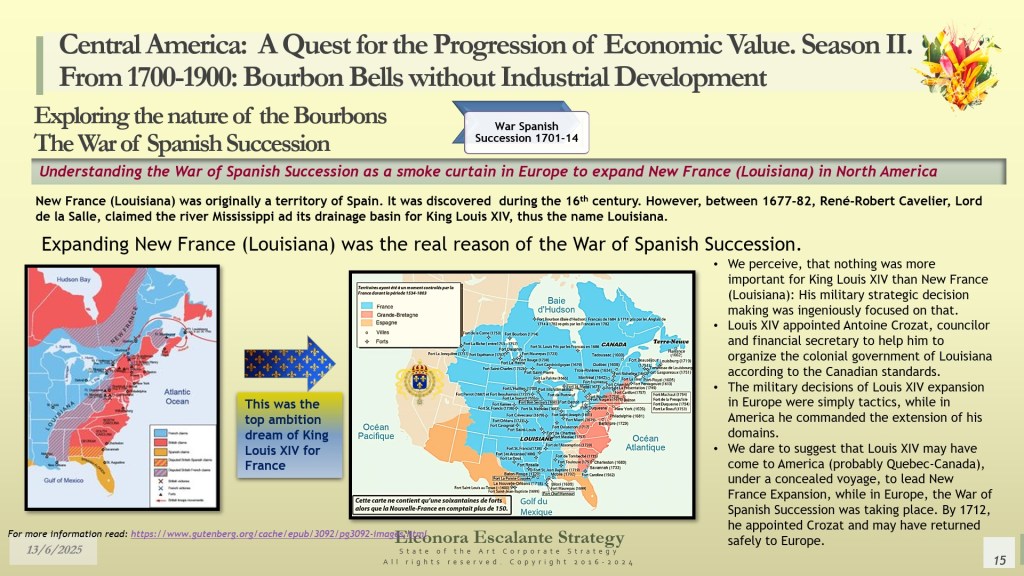
See slides 8 and 10. These two slides describe the 5 main wars of King Louis XIV. Each of the following wars: The War of Devolution (1667-68), the Dutch War (1672-78), the War of Reunions (1679-84), and the Nine Years War (1688-97) has the same pattern. France is attacking the East of its frontier. France is recovering lands that originally belonged to France. However, how could it be that a Bourbon-Habsburg member was fighting against the same family?. They all belonged to the same family. Louis XIV was repeating the same pattern as Charles V, but 150 years later. It is bizarre and unusual for us to comprehend these wars as a conflict between France and Spain Habsburg road. We bet there was something new in the Holy Roman Empire of Austria that was bugging the Habsburgs. Were these wars enacted as “training workouts for Louis XIV” to prepare him to expand New France in America? What was the real fear of the Habsburgs? The Hohenzollerns of Brandenburg-Prussia? or England’s expansion in America?. Were these wars a series of “smoke curtain” conflicts, to keep the maritime powers busy in Europe, while France was expanding its territories from Louisiana to Canada? See slides 14 and 15, please.
The War of the Spanish Succession
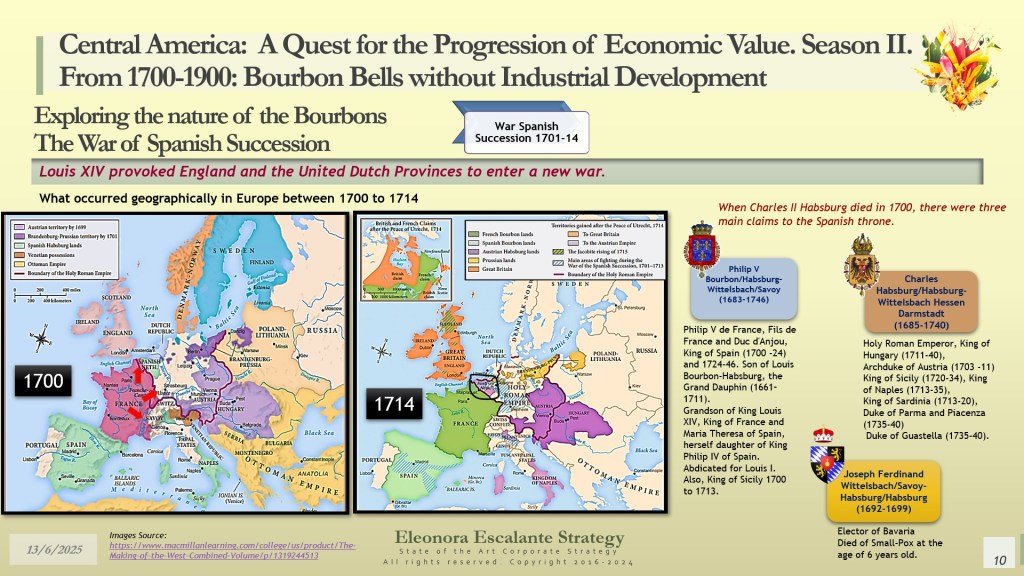
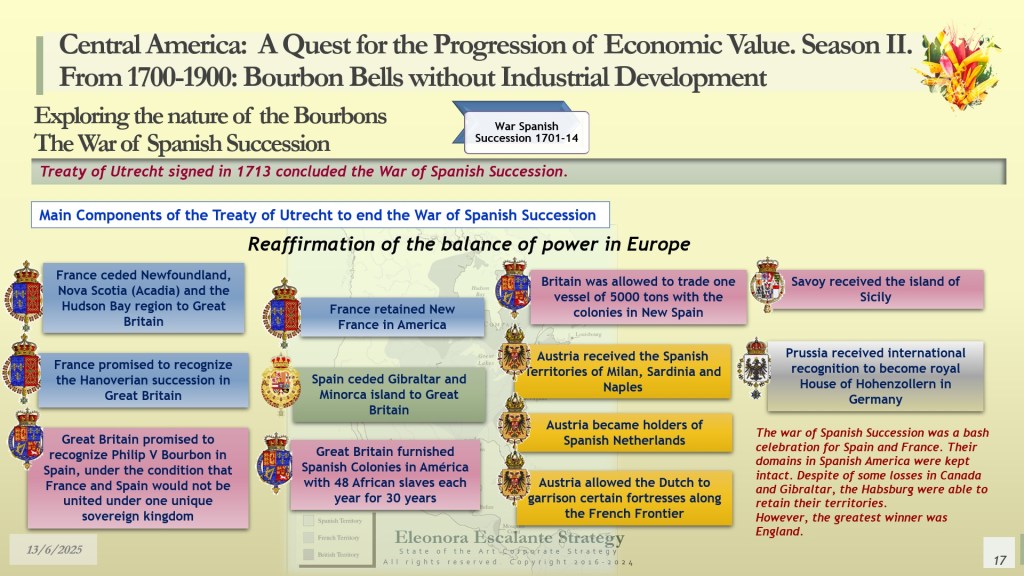
Slides 10 to 17. Most of these slides are self-explanatory. Slide 10 shows us two snapshots of the territorial modification of Europe, before and after the last war of Louis XIV. If you see it in detail, there are no significant changes between the map of 1700 and the map of 1714. France took certain tiny territories around the Spanish Road areas. However, the real change was in terms of England: the German Hanoverian nobility became the new Kings of Britain, and that happened exactly after William III of Orange and Mary II Stuart were gone.
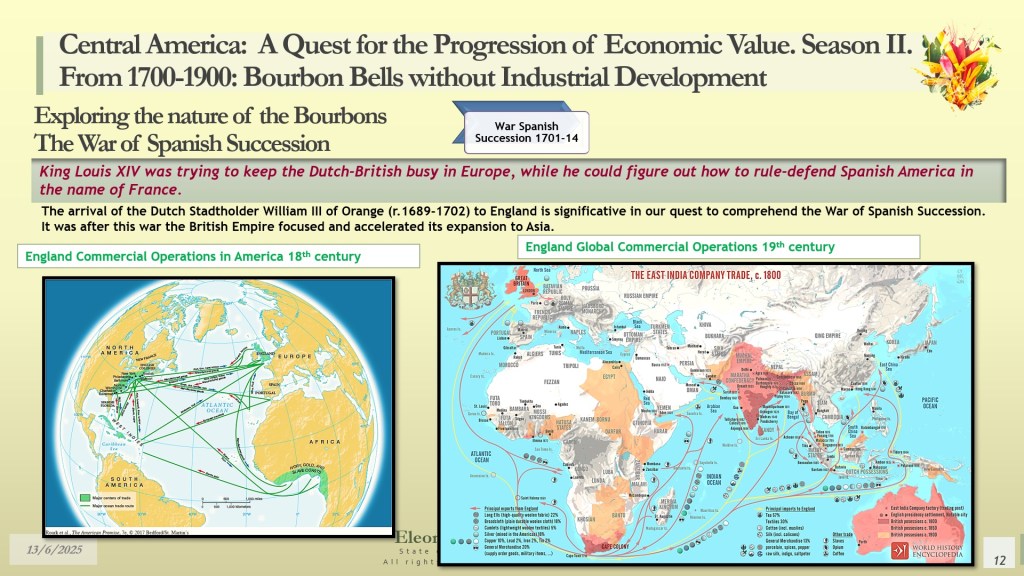
Slides 11, 12, and 13 describe the context of the trade and commerce routes of the three main maritime powers of the 18th century: England, Spain, and the Netherlands. Little do we see shining from France, if anything at all. The only way that France could not be left behind was by using another maritime power as its servile subservient or camouflaging itself within the family. We think that Louis XIV’s primary plan was to use Spain’s silver maritime power to battle it all in the New World to retain his territories in America. As mentioned previously, between 1667 to 1697, he was doing training workouts of warfare by over-imposing himself, attacking the lands around the Spanish road. Next, when Queen Mariana of Spain passed away in 1696, he continued with the War of Spanish Succession. But we believe that Louis XIV was using a smoke curtain strategy. His eyes were in the New World. Louis XIV’s new lands were named Louisiana (it was his name stamped there). His most important dream was to expand New France (see slides 14 and 15). While in Europe, the War of Spanish Succession was taking place, his armies were building forts everywhere they could to win territories from the Native Americans and from the pre-established British colonies. Slides 14-15 explain it in detail. Currently, there are at least 50 existing French fort structures that anyone can visit in the USA. The French forts were more in the 18th century, but many of them were destroyed later. These forts were located in the land of Louisiana-New France in the United States and were part of a series of forts built from the Great Lakes to the Mississippi delta, as far west as Kansas, as far east as Maine. When were the French forts built? During the time of Louis XIV and Louis XV. Eureka!. The fact that there are still archaeological fort remains of the presence of France in North America makes us believe that in the absolutist French regime, New France was at the top of the priorities. Not only for King Louis XIV, but also for Philip V, the new Bourbon Spanish king to be.
Reaffirmation of the balance of Power in Europe.
Undoubtedly, after explaining to you in detail, we dare to reaffirm that Louis XIV’s priority was New France in America. Louis XIV was not interested in fighting in Europe. Unfortunately, Louis XIV was not able to foresee and leave a clear line of defense for his new land in America. Louis XIV couldn´t see the coming king of Great Britain, the German Hanoverian Georg August Guelph von Braunschweig-Lüneburg (1683 – 1760), a protestant who suited England in their quest for their new role of expansionism. Where? In America.
To be continued…
Announcement:
With this episode, we continue exploring the foundations of Season III. Today, we have aspired to connect the dots between what was occurring with the Bourbons in Europe while New France was expanded in America. The role of the Bourbons from France was always associated with the Habsburgs and Valois. We are in the process of guiding you in what was driving the Economics and Foreign Policy of the Spanish Empire during the 18th century, but there is still a long voyage to learn. Our next chapter will be about Jean Baptiste Colbert (1619-1683). Colbert was the head of royal finance, public works, and foreign policy for King Louis XIV. We will provide a mapping of the foreign economic policy of the Bourbons, through Colbert´s life, and we will wrap up what the Bourbon-Habsburg did as soon as they came into power in Spain with Philip V. See you then.
Musical Section.
Season III of “Central America: A Quest for the Progression of Economic Value” has assigned a new instrument for the rest of the year. It is the guitar!. Our selection of music during Season III will continue to explore adorable music produced between the 17th and 19th centuries with interpretations of virtuoso guitarists. We will embark on the selection of the top 29 loveliest guitarists from the last 5 generations, playing music composed during the time of this saga. Our choice for today is Xuefei Yang, with a full concert at Zhizhu Temple, Beijing. Yang has held the pioneer merit of being the first Chinese guitar student to be awarded an ABRSM international scholarship to undertake her postgraduate studies at the Royal Academy of Music, London, England. Enjoy this beautiful concert from the Omni Foundation YouTube channel.
Thank you for reading http://www.eleonoraescalantestrategy.com. It is a privilege to learn. Blessings.

Sources of reference and Bibliography utilized today. All are listed in the slide document. Additional material will be added when we upload the strategic reflections.
Disclaimer: Eleonora Escalante paints Illustrations in Watercolor. Other types of illustrations or videos (which are not mine) are used for educational purposes ONLY. All are used as Illustrative and non-commercial images. Utilized only informatively for the public good. Nevertheless, most of this blog’s pictures, images, and videos are not mine. Unless otherwise stated, I do not own any lovely photos or images.
 Eleonora Escalante Strategy - Strategic Reflections Think Tank