
Central America: A Quest for the Progression of Economic Value. Season III. Episode 10. The Impact of the French Revolution in Spanish America.
My dear adorable readers:
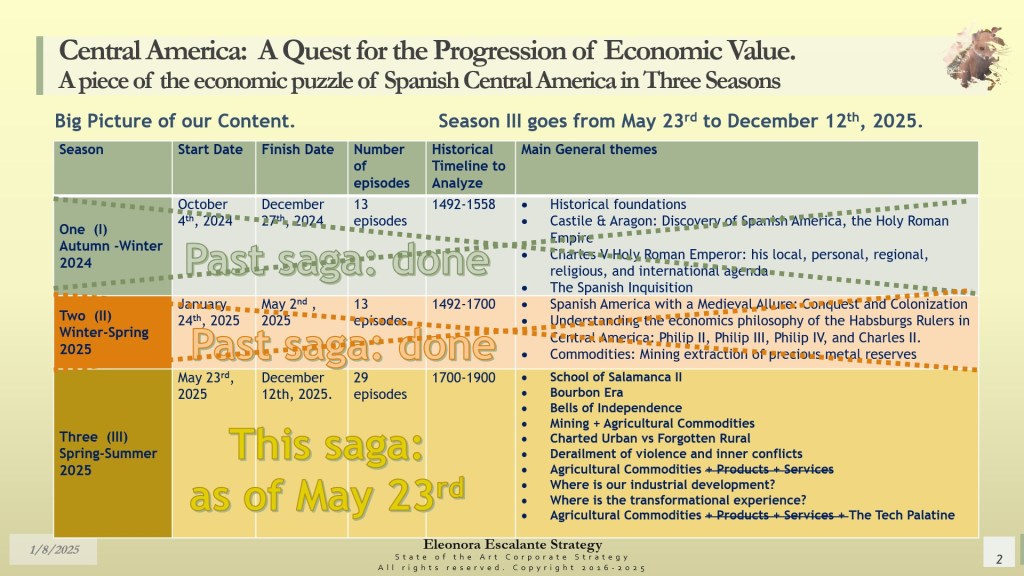
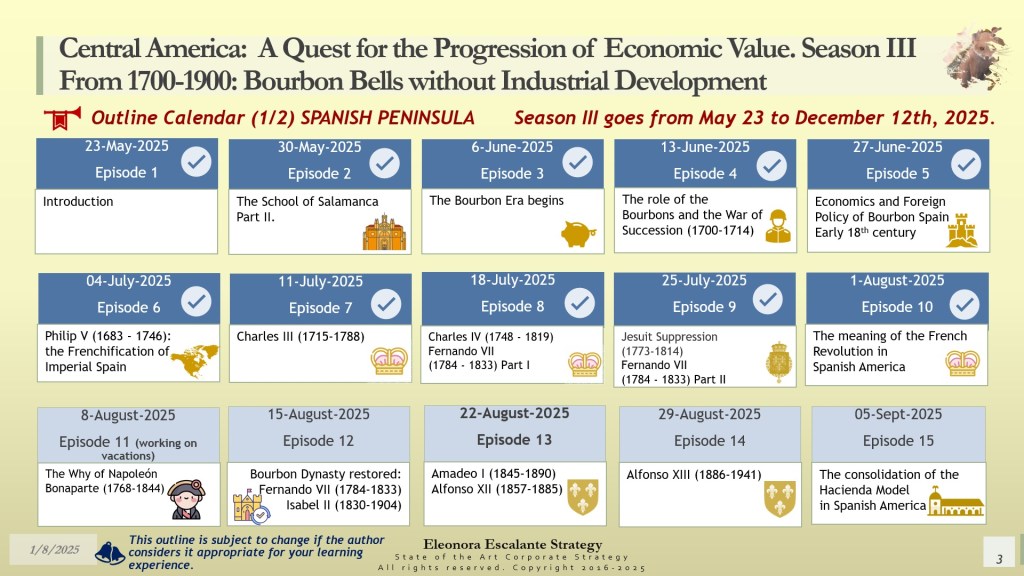
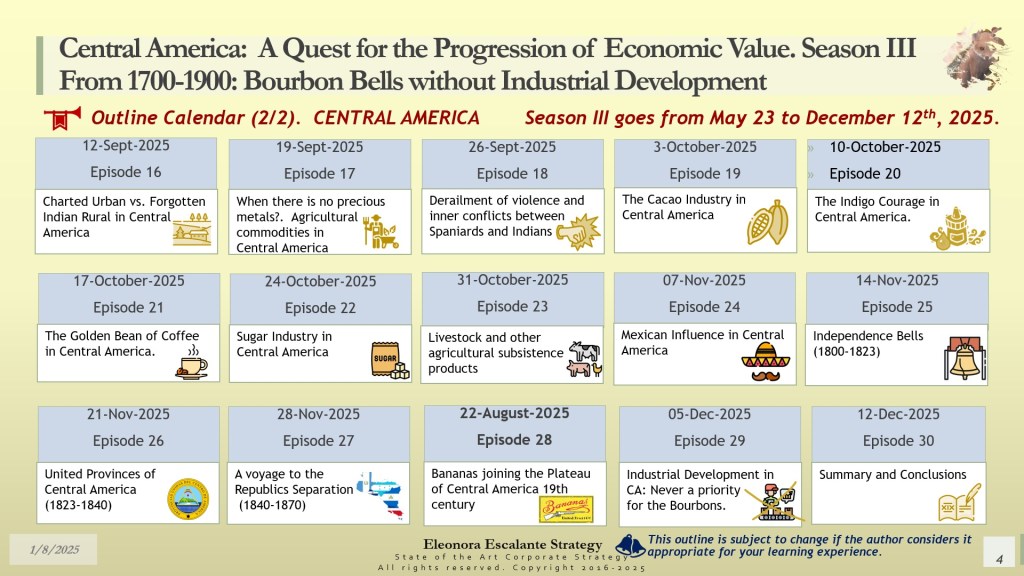
Today marks the beginning of the vacation period in honor of Jesus Christ, the Divine Savior of the World. San Salvador city inhabitants have around 6 to 7 days off to relax and attend the religious traditional celebrations that are usually held in the Historical Center of the village. Students truly benefit from this brief period of rest. But the Master teacher will not stop working next week. I will be analyzing the case of Napoleon Bonaparte from a distinct perspective, which you will begin to perceive today.
Our aim is to present various perspectives on the French Revolution. We are taking the risk to review and provide an aggregate notion or insight into what the most influential political economists have stated regarding this event. Foremost, the French Revolution is not defined in one day or season. It is a period between 1788 to 1799 or so. During the decade of the French Revolution, many situations were occurring abroad, and simultaneously in the local French historiography. However, our heart’s desire is not to go through the minute description of facts after the Bastille capture, but to remark on certain features that could have been unnoticed.
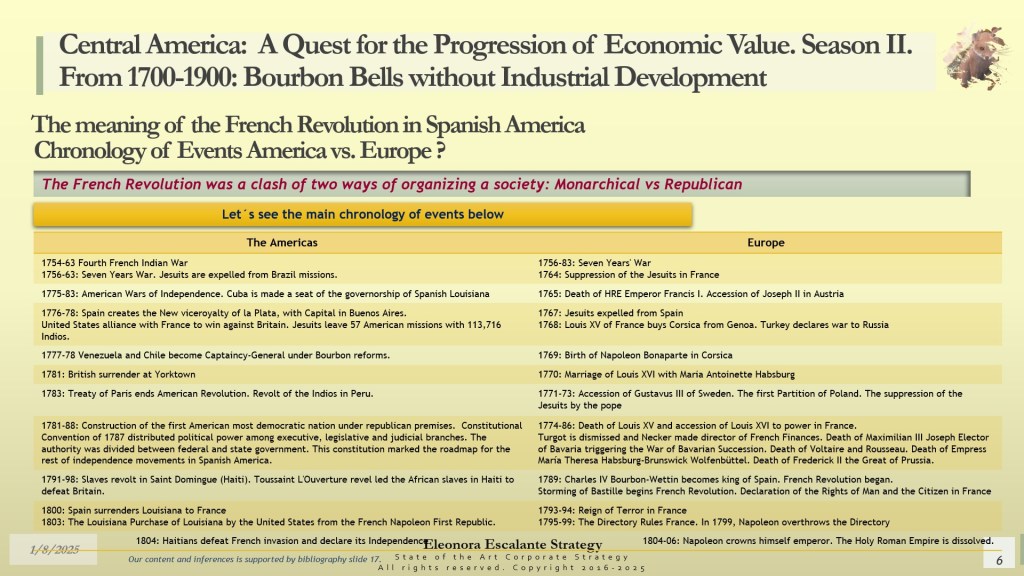
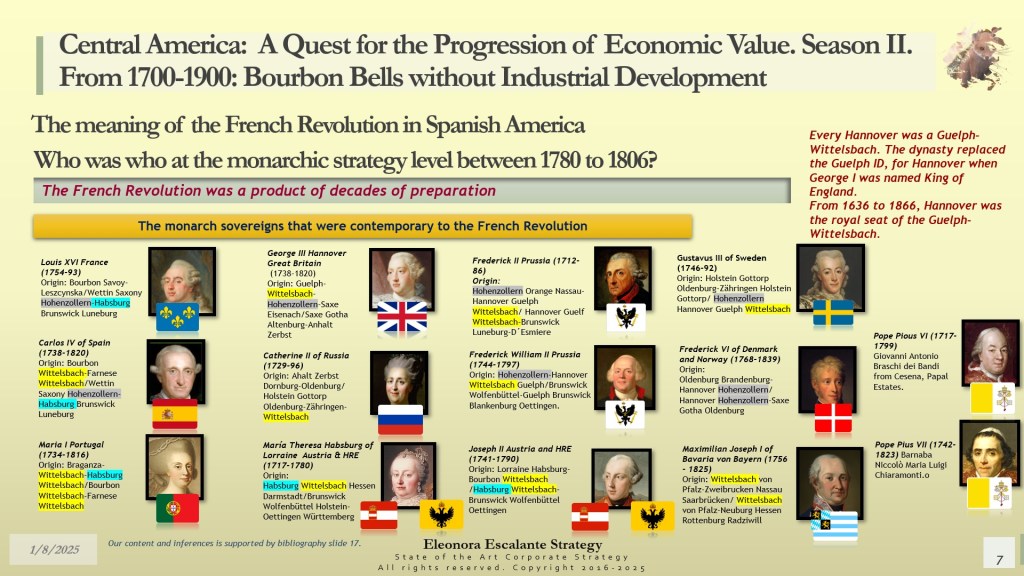
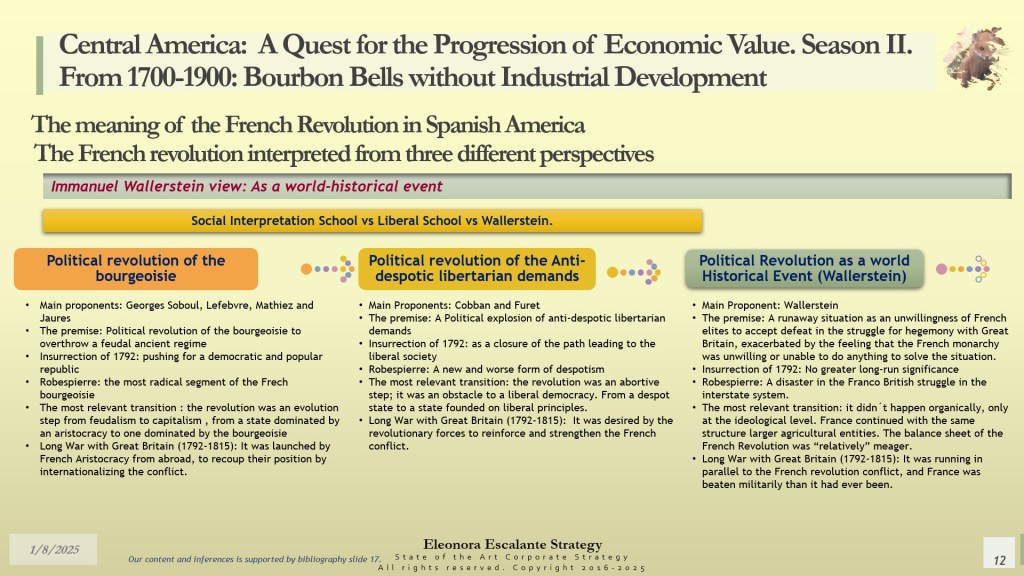
As an introductory step, our frame of reference starts with a parallel of a chronology of main events for the last half of the 18th century. We present a comparison of America and Europe. Second, we have gathered a snapshot of each of the main European monarchs who were key players some years before and during the French Revolution period. Third, we alert all our readers to the chaotic implications of the Reign of Terror under Robespierre, which targeted French Royalists following the regicide of King Louis XVI and Marie Antoinette. After that terrorist felony of more than 35,000 assassinations, nothing good could have reached up well for France. An interesting fact: The felony against the King of France and the Archduchess of Austria entouraged more than 15 royal families of Europe. The offense was not only against the French rulers, but against 15 royal families of Europe. In consequence, the reaction was not going to be wimpy either. We perceive that the French protests became a Revolution because the King of France wasn´t able to shift his ruling strategy. None of this would have happened if he had honored his mission to serve the poorest of his country. Yet, he didn´t. Fourth: Simultaneously with the French Revolution, there was a transition from the Habsburg predominance in Europe to the Guelph-Wittelsbach dynasty, and the Confederation of the Rhine is a symbol of that new alignment of power with Great Britain. The fifth topic of our material shows you the three main interpretations of the French Revolution: the social interpretation school, the liberal school, and the view of Immanuel Wallerstein, a remarkable sociologist and historian. Later, we show you our own interpretation of how the French Revolution had a domino effect in all the regions where the Habsburgs had expanded previously. Great Britain (as representative of the Protestant Germans) was eager to take over those lands, and we have demonstrated with maps and facts how Spanish America defended itself from it. We suggest that the French Revolution activated a series of circumstances and situations in the viceroyalties of New Spain, Central America, New Granada, Peru, and Rio de la Plata. These situations were designed to protect the Habsburg lands from the imminent possibility of losing them in the hands of the German protestants. Finally, we show you the win-win solution for Imperial Spain: The British German protestants resettled in North America, after the American Independence, and after Louisiana was bought by the United States of America (we see the USA as the new little daughter of Great Britain).
We encourage you to download the PDF document and print the set of slides. Visit the bibliography offered at the end of the presentation. Read the document. Take notes. Ask yourself questions. Discuss your ideas with all the members of your family who are reading this. Converse with your professors, colleagues, and friends.







We request that you return next Monday, August 4th, to read our additional strategic reflections on this chapter.
We encourage our readers to familiarize themselves with our Friday master class by reviewing the slides over the weekend. We expect you to create ideas that might be strategic reflections or not. Every Monday, we upload our strategic inferences below. These will appear in the next paragraph. Only then will you be able to compare your own reflections with our introspections.
Additional strategic reflections on this episode. These will appear below on Monday, August 4th, 2025.

Many historians, political economists, sociologists, politicians, military strategists, policy makers, and novelists have developed thousands of books about the French Revolution. Each of them has followed the facts and coined similar or different interpretations of the situations that occurred, as of King Louis XVI’s promise to call the Estates General elections in November of 1787. However, the French Revolution (as the period defined by historians between 1789 to 1899) was not activated by fiscal troubles or rebellions from the poor, or hungry peasants. It was certainly one factor, but not the big picture. Most of us have been wrongly taught that the French Revolution was the convergence of 4 overlapping movements (1):
- An aristocratic revolution from the nobility and the Catholic clergy (of robe and tradition) that built a parliamentary context to thwart the French king’s plans for a tax reform.
- A bourgeois (reformers, bureaucrats of the state without nobility, merchant and commercial middle-class without nobility title) revolution that wanted to limit aristocratic control of high government offices.
- A peasant revolution craving land in a better structure than feudalism, aspiring for better conditions of life, and wishing emotional revenge.
- An urban working-class revolution that turned the fury of the masses into escalating a particular vengeance, uprooted with violence against the Monarchs and their royalist group.
If you observe the latter 4 overlapping slices of the society, the nobility (aristocracy and clergy), the bourgeoisie, the peasants, and the urban working-class, these 4 sectors “joined” together against the monarchs. It wasn´t a revolution coming only from the poor; it was a rebellion that linked the “common people” from the bottom of the social pyramid with the emergent middle-class and the aristocratic nobility. The dissatisfaction against the rulers of France was not because the poor peasants and farmers were hungry (bread riots) or because the recession and unemployment were overwhelming. The French Revolution was a systemic accumulation of fury of many generations before, who did not want the Bourbonic Reforms and did not want the Bourbon king’s new plans. It was a national and international movement against the territorial hegemonic position of Imperial Bourbon Spain and France. In consequence, this was the first time in history that a king was left alone without the support of the aristocrats and clergy. Physically, most of the nobility escaped or ran away from France to other nations (England, Canada, border towns as Koblenz, and Spanish America). And that made the French Revolution a possibility. Because the Jesuits were expelled from France, the Catholic clergy was already weakened, and on top of that, all lands from the Church were the first to be confiscated. As we explained it last week, when the Jesuits left, this opened the door to the Masonic Lodge organizations (with ideas coming from England and Bavaria), all together with other influential local Parisian religious clubs as the Cordeliers, the Girondins, and the Jacobins (2). These anti-king groups radicalized their participation in the first National Assembly (1789-91) and then later in the Legislative Assembly (1791-92). The influential position of these radical clubs was predominant in the legislative decision-making. Let´s not ignore that only in Paris, the Jacobins grew enormously among most Parisian professionals and small business owners. The Radical clubs pushed for a revolutionary agenda. And, there was an undeniable manipulation from international anti-Bourbons coming from foreign influence of these “clubs”. Here, we will proceed to give you a general overview of what is behind our slide 9.
This is a summary of what occurred during the French Revolution (3):
- Reorganization of the local government by abolishing the former royal parliaments (1789-90)
- Declaration of the Rights of Man (1789)
- Civil equality of Protestants and ex-Slaves (1789-91)
- Confiscation of all land of the Catholic Church (1789). Abolition of monasteries and most religious orders (1790)
- Utilization of the lands of the Catholic Church for the assignats (interest-bearing bonds, circulated as revolutionary paper money. This financial instrument proved to be a total disaster (1790).
- The Civil Constitution of the Clergy converted priests into state employees to replace the aristocratic nobles and clergy (1791). Look at this interesting fact.
- Abolition of internal tax tariffs (1790)
- Nationalization of royal land (1790)
- Creation of land tax (1790)
- The Chapelier law abolished the guilds and outlawed trade unions (1791)
- The National Assembly produced the first written constitution in French history (1791)
- The domiciliary arrest of King Louis XVI and his family at Varennes (1791) occurred after he was trying to escape to the eastern frontier.
- Finally, Louis XVI called for elections for a new Legislative Assembly in the aftermath of the Brunswick Manifesto from the Austrian King Leopold II and the King Frederick William II of Prussia (1792). An interesting fact: Most rulers of Europe were unwilling to invade France directly, but were against the anarchy of the revolutionaries. However, the only one who was in favor of Revolutionary France was King George III of England.
- The new Legislative assembly was formed with 3 main parties: The Feuillant Club, as the royalist Right. The radical members of the Jacobins and Cordeliers clubs on the Left, and the middle, less militant revolutionaries called the Girondins at the Center of the semicircular amphitheatre.
- The assembly seized the property of the émigrés (called conspirators) in 1792.
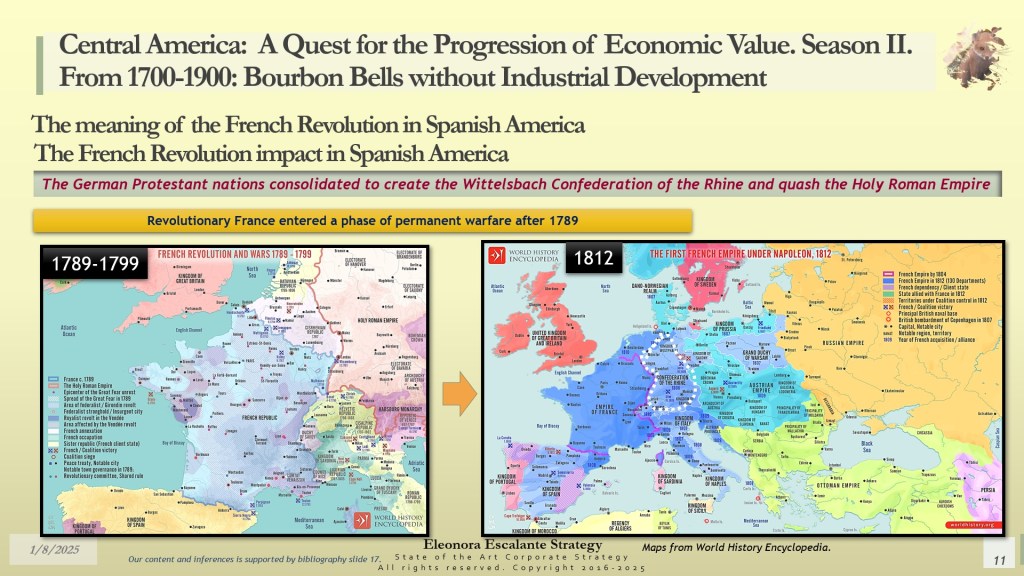
- King Francis II (HRE-Austria) declared War against France. Prussia invaded eastern France in August 1792. And the War of 1792 evolved to the War of the First Coalition (1793-95) when Britain, Spain, and Russia joined Prussia and Austria against the French revolutionaries. By coincidence, the French army occupied the lowlands of the German Rhineland and Northern Italy.
- The legislative assembly suspended King Louis XVI’s monarchical powers, moved him into prison, and urged the Convention to create the First Republic.
- During the summer of 1792, the assembly could not control the masses´ rage: the most radical Jacobins, supported revolutionaries, and decided to massacre everyone who was seen as royalist (these were the first 65 lynching cases around France), and in Paris, the mobs slaughtered hundreds of non-political prisoners. The Convention (in the hands of the most radical Girondins and Jacobins) invented a new calendar, created the first Republic, and submitted a new constitution.
- In 1793, King Louis XVI and his wife were beheaded on the guillotine, convicted of treason for conspiring with the foreign powers that invaded France.
- The life of the Convention (1792-95) was characterized by War. Robespierre (5) (a radical Jacobin) pushed for the approval of the Constitution in 1793.
- The Reign of Terror began (1793): Thousands of people were publicly executed, and a bloody civil war started between pro-revolutionaries and royalists. The men of the Reign of Terror Convention chose authoritarianism, and they persecuted freedom of the press. Advocacy for monarch restoration and hoarding were considered crimes. The Law of Suspects expanded the arrest to anyone who seemed to be an enemy of the revolutionary liberty.
- The Committee of Public Safety was created in 1793. Robespierre dominated it. The Reign of Terror lasted from June 1793 to July 1794. During 13 months, the tribunals ordered between 14,000 to 17,000 guillotined executions. However, it has been calculated that the double of this number perished in total, because not all the cases were taken to the Official Tribunals. All the victims were considered spies, traitors, counterrevolutionaries, Members of the Royal Families, pro-royalists, leaders of the Old Regime (called Malesherbes), famous scholars, professors, feminists, former moderate Girondins as Brissot, profiteers, hoarders, Catholic priests, reformers, corrupt officials, scientists and authors who were indifferent to the cause of the Jacobins or Girondins. If you see it in detail, the Committee of Public Safety was acting with the same Inquisitorial terror of the past, but this time against the royalists.
- The Civil War during the Reign of Terror was running in parallel to the executions of the Committee of Public Safety in locations as the Vendée and Lyons. Just in Vendée, a minimum of 80,000 Vendéens died.
- The Thermidorean Reaction and the Directory (1794-99). The Reign of Terror swallowed its own creators. The Thermidorean reaction against the perpetrators of the Reign of Terror arrested and killed Robespierre after one of the Cordelier’s founders and leaders, Danton, was executed. Between 1794-95, the Convention removed the Jacobin members of the dictatorship by abolishing all the Jacobin clubs. Most of the wrong measures of the Legislative and National Assembly were overturned.
- France remained a Republic, but it was constituted with safeguards, with a clear separation of powers: A bicameral legislature with a Lower House that introduced all legislation, and an Upper House with the power to block it. The Upper House was a Council of Ancients. The new government was called the Directory.
- The Directory had five members chosen by the legislative power from among its own members. The Directory preserved the model of a moderate republic by using the army against royalists, executing Jacobin extremists, and rejecting more national debt. The Directory tried to stay in the political center. It was formed with individuals who went into hiding or were émigrés. However, the culture of conspiracies and lack of faith in the Directory triggered a military coup d´état in 1799.
- The rise of Napoleon Bonaparte: Napoleon was the leader of the Coup d´état in Brumaire of 1799. We will explore Bonaparte´s life on our next episode.
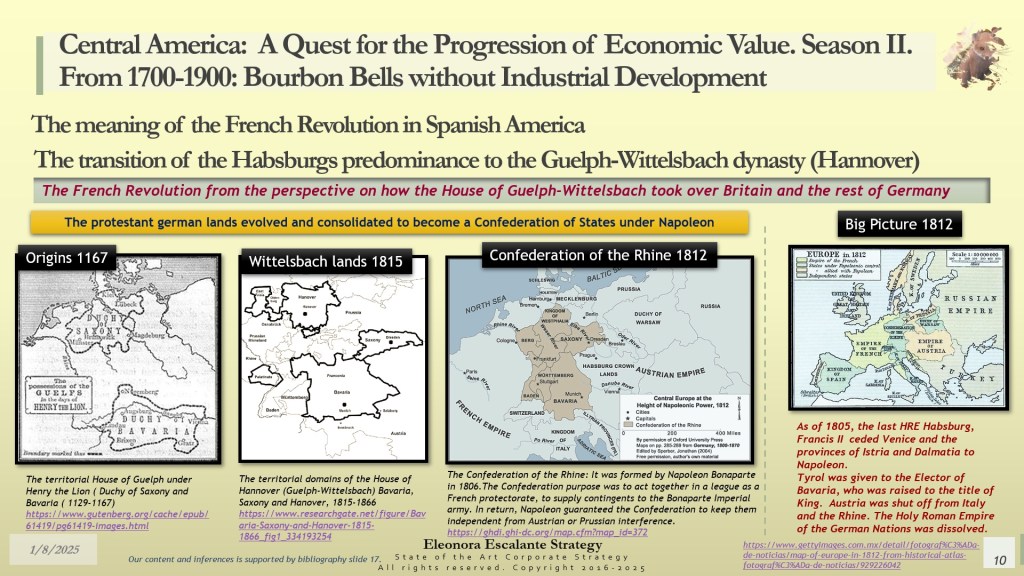
The French Revolution from the perspective of how the German House of Guelph-Wittelsbach took over Britain and the rest of Germany (slides 7, 10-11).
If you read our last section with an introspective regard, you will find a subtle line of action that seems to be too pale or superficial. But it is not. Slide 7 shows the dynastic origins of each of the monarchical dynasties that were reigning in Europe. The catastrophe of the Imperial Bourbon dynasty started when the Bourbons, with a Brunswick German and Polish pedigree, were represented in the figure of King Louis XVI. If you explore the dynastic roots of this king, you can immediately perceive that he was an outlier to the Wittelsbach. The rest of the monarchs were clearly linked to the Wittelsbach (see slide 10). The only connection that we find in Louis XVI with the Wittelsbach is through his great-great-grandmother Eleonore Magdalene Therese Wittelsbach von der Pfalz (1655 – 1720). In consequence, we can suggest that King Louis XVI was not linked with the power agenda of the Bavarians or the Saxons. The rest of the monarchies were clearly aligned with George III Hannover of Great Britain, who was a Guelph Wittelsbach, affiliated directly with Maximilian Joseph I of Bavaria (1756-1825).
Slides 10 and 11 are a refreshed evolution image of the German lands under the Wittelsbachs (Catholics and Protestants). Look that there is no relevant difference between the geographic extension and location of the duchy of Saxony and the duchy of Bavaria of 1167 (all under the Guelphs-Wittelsbach) and the territorial domains of 1815. Even the confederation of the Rhine, allowed by Napoleon Bonaparte in 1806, implies a clear vindication of the Wittelsbachs against the Habsburgs. It seems to us that the house of Guelph Wittelsbach was moving its influential buff through the new Freemasonry fraternity clubs of France (Gerondins, Jacobins, Masonic lodges, Illuminati, etc.). This only happened because the Jesuits and the Catholic priests were the first ones to be eliminated in France. The first steps to destabilize the French Regime were taken to debilitate the Catholic clergy with a specific purpose: to take America back. King George III of Britain thought that the Revolution against the Bourbon dynasty was a “divine retribution for the French Intervention in the American Revolution”. Great Britain did nothing to stop the French Revolution because King George III (a pure German Protestant Guelph-Wittelsbach-Saxe Gotha) knew that France was going to be weakened by it. For King George III, a damaged France meant a possibility to find a new path to recover its lands in North America.
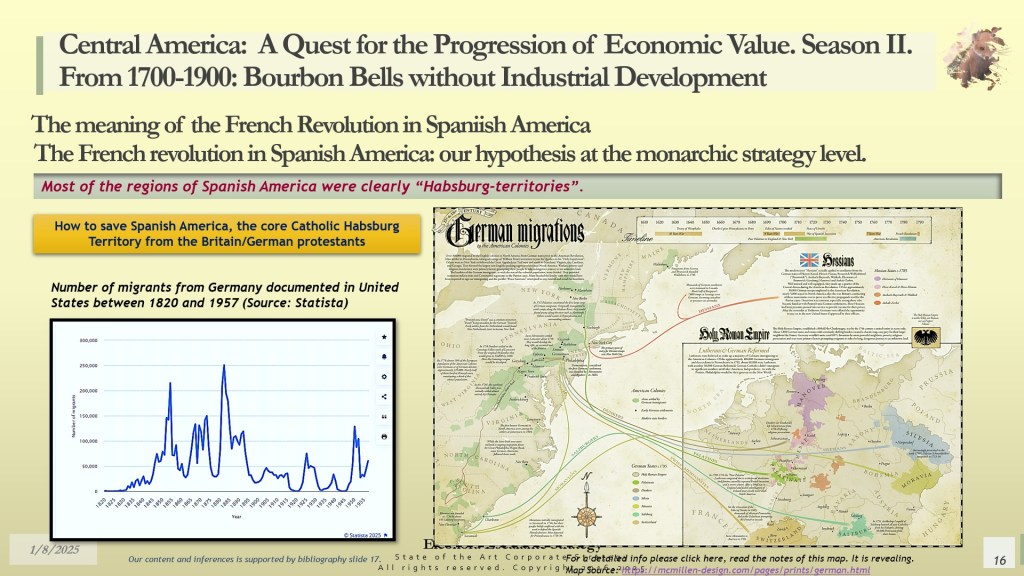
The French Revolution in Spanish America: Our hypothesis at the monarchic strategy level. Slides 15 and 16.
Britain was expanding with the Hannover (Guelph-Wittelsbach and Saxony rulers) dynastic monarchy. But Britain was in reality all the Wittelsbach territories of the Confederation of the Rhine, in consequence despite that the American Revolution had already taken place, we are convinced that the German culture of the settlers in America allowed the acceptance of the massive immigrations of the Non-Habsburg Germans who were not only welcomed in the new territories of North America, but it was a renewed tacit “conquest” of the North American territorial domains by the German citizens of the Guelph-Wittelsbach, Brunswick Luneburg, Wettin-Saxony, Palatinate, Hessen-Darmstadt, etc. who easily relocated following a free path to emigrate.
The aftermath of the French Revolution was the geopolitical mechanism used by the Catholic Habsburgs to divert that inflow of immigrants out of Spanish America, keeping their traditional Habsburg philosophical structure intact and free from German protestants coming over. A few Germans or Italians from the Wittelsbach-Farnese territories who were genuinely Catholic were accepted in South America: mainly in Venezuela, Paraguay, Uruguay, Buenos Aires, and some areas of the south of Brazil.
The impact and the meaning of the French Revolution in Spanish America (slides 13-14).
The French Revolution was the triggering event of all the political instability that we have lived in Spanish America since the 19th century. The independence movements were part of a defensive big plan that had its roots in the reaction of the Austrian-Castile Aragon Habsburgs already dwelling in America, against the Protestant Anglo-Saxons of the Guelph-Wittelsbach dynasties. The defensive reaction from the double eagle Spanish Austrian-Habsburgs, who came to America before the French Revolution, was beyond our present outlook. The Spanish American Habsburgs (in concealed Creole format) were not going to cede one meter to German Britain, the Hannover-Guelph-Wittelsbach-Saxons. Afterward, the instability and political chaos from Mexico to Argentina: independence moves, most of the local civil wars, repressive dictatorships, violent mobs, riots, racist disaggregation of the Native indigenous, etc. All ensued as a slow domino effect that unfolded after the French Revolution emerged.
Once we understand the international geopolitical issues of the European dynasties in Europe, our view of the problems in Latin America will never be the same.
The big picture of understanding the main European family dynastic strategic plans is totally revealing. It gives you a unique interpretation above anything that has been explained to you in “Spanish America official history”. And only when we all comprehend and cognize this, will it be easier for all of us to discern from where this new technological feudalism is coming.
Nowadays, while in Western Europe, the borders are closed to those who don´t belong to their supremacy levels, the below-zero demographics, and the lack of people are driving the Artificial Intelligence (AI) era. However, Europe has poverty. Believe it or not. But it is a fact. And their artisan over the top quality economic sectors have been hit by the low-cost imports from the East. European artisans of luxury goods are slowly being annihilated. The artists have bet on the “Patreon” model or YouTube digital begging platforms, but that won´t provide any solution for the long run either. It is a digital mendicancy system that has no difference from the homeless that you see begging in the streets.
Our strategy house considers it an offensive sin to use and accept the same AI (digital begging) strategic economy in Spanish America, where the majority of the population is not well-instructed in reading, interpreting difficult texts, writing, analyzing, and critical thinking. The digital begging technologies thrown to a massive number of uncultivated people without employment and without a good education will only transform the Latin-American youth into ill-advised and thoughtless GPT users. The GPT “generative pre-trained transformer” users are blocking human own possibilities to be trained to do one of the activities that should be the most well-paid on the planet: To think correctly. Once our rational thinking is given to the computers, little is left to build a relevant and honored intellectual or scientific middle-class with salaries of $200,000 or more per year. According to Microsoft (3), the jobs that the AI won´t destroy for the time being are listed below. We wonder if any of the parents of my generation want their kids to end up working as such.
| LIST OF OCCUPATIONS THAT AI IS UNLIKELY TO TOUCH (by Microsoft 2025) |
|---|
| Dredge operators Bridge and lock tenders Water treatment plant and system operators Foundry mold and coremakers Rail-track laying and maintenance equipment operators Pile driver operators Floor sanders and finishers Orderlies Motorboat operators Logging equipment operators Paving, surfacing, and tamping equipment operators Maids and housekeeping cleaners Roustabouts (oil and gas) Roofers Gas compressor and gas pumping station operators Helpers–roofers Tire builders Surgical assistants Massage therapists Ophthalmic medical technicians |
| Other jobs that are in the safety zone include industrial truck and tractor operators, highway maintenance workers, dishwashers, automotive glass installers, embalmers and phlebotomists. |
To be continued…
Final Statement and Announcements:
This episode is a different interpretation of the French Revolution from the perspective of the necessity of the German Protestant territories of the Holy Roman Empire to expand into America. Great Britain was ruled by a German king who identified himself as from Hannover. However, King George III of England agglutinated all the following german protestant dynasties: Guelph-Wittelsbach-Hohenzollern-Saxe Eisenach/Saxe Gotha-Altenburg and Anhalt Zerbst. In consequence, the German Protestant nations were going to take the world by storm. The Spanish Habsburg successors (who traveled concealed to America and transformed themselves into new Creoles) had to defend their beloved Spanish America. If we see the French Revolution as a kindling or detonating period for the further independent movements of Spanish America, then and just then, we can comprehend why the German Protestant migrations were diverted to North America. Of course, there are some Wittelsbach (catholic) who migrated to America. Why is this fact important? Because the economic model of Latin America was planned following the philosophy of the immigrant rulers (creoles or not) who were leading the new governments to come. In Spanish America, most of her regions persisted with clear signs of thought (nation strategy decision making) with philosophical roots ingrained in the former traditional Catholic Habsburg administration. We believe that the Bourbons probably had no idea of this. Next week, we will land in the Why of Napoleon Bonaparte. There is a lot to learn during the following weeks. See you in our next episode. Thank you.
Musical Section.
Season III of “Central America: A Quest for the Progression of Economic Value” has assigned a new instrument for the rest of the year. It is the guitar!. Our selection of music during Season III will continue to explore the delightful music produced between the 17th and 19th centuries, featuring interpretations by virtuoso guitarists. We will embark on selecting the top 29 loveliest guitarists from the last five generations, who played music composed during the time of this saga. We have selected a Belarusian guitarist. Her name is Tatyana Ryzhkova. Her biography is here https://www.tatyana-guitar.com/. Tatyana plays for us a composition of the virtuoso Fernando Sor (1778 – 1839). Enjoy.
Thank you for reading http://www.eleonoraescalantestrategy.com. It is a privilege to learn. Blessings.

Illustrative and non-commercial GIF image. Used for educational purposes. Utilized only informatively for the public good. Source: Public Domain
Sources of reference and Bibliography utilized today. All are listed in the slide document. Additional material will be added when we upload the strategic reflections.
(1) Von Hause, S. and Maltby, W. Western Civilization, A History of European Society. 2nd. Edition. Chapter 21. https://www.saxbooks.ch/detail/ISBN-9780534621643/Hause-Steven/Cengage-Advantage-Books-Western-Civilization
(2) https://www.ebsco.com/research-starters/history/jacobins, https://www.encyclopedia.com/history/encyclopedias-almanacs-transcripts-and-maps/girondins, https://www.worldhistory.org/image/16890/the-cordeliers-convent, https://www.worldhistory.org/Georges_Danton/
(3) Von Hause, S. and Maltby, W. Western Civilization, A History of European Society. 2nd. Edition. Chapter 21. https://www.saxbooks.ch/detail/ISBN-9780534621643/Hause-Steven/Cengage-Advantage-Books-Western-Civilization
(4) https://fortune.com/2025/07/31/jobs-careers-unlikely-to-be-impacted-by-ai-microsoft/
(5) https://www.ebsco.com/research-starters/history/robespierre
Disclaimer: Eleonora Escalante paints Illustrations in Watercolor. Other types of illustrations or videos (which are not mine) are used for educational purposes ONLY. All are used as Illustrative and non-commercial images. Utilized only informatively for the public good. Nevertheless, most of this blog’s pictures, images, and videos are not mine. Unless otherwise stated, I do not own any lovely photos or images.
 Eleonora Escalante Strategy - Strategic Reflections Think Tank