
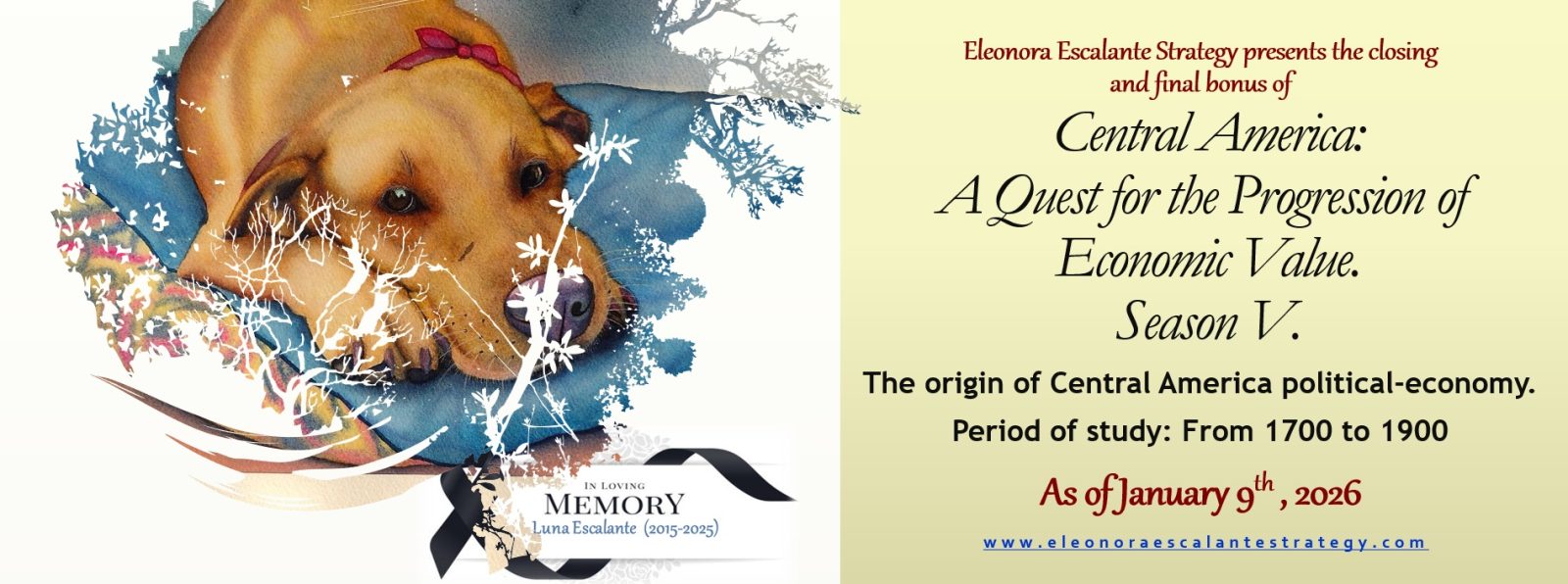
Central America: A Quest for the Progression of Economic Value.Season III. Episode 14. Bourbon Dynasty Restored: Alfonso XIII.
Dear magnificent and amazing readers of this era:
Today is the last episode of season III. We are closing this saga with the most stunning reflection of the year: The economic development of Latin America can´t be studied without recognizing that our history is tied to the Habsburg-Valois/Castile-Aragon dynasties, as of Joanna Aragon-Henríquez /Castille-Aviz of the Spanish Trastámara House, daughter of the Catholic Kings, Isabella and Ferdinand II; with Philip the Beau Habsburg-Avis/Valois-Bourbon-Wittelsbach, son of the Holy Roman Emperor Maximilian I Habsburg. More than studying Imperial Spain, it is our duty to re-study all the wherabouts of the dynastic networks of these families since 1492.
To analyze the economic development of Central America, hauled our strategy house to the year in which Christopher Columbus discovered America. And we decided to take the mogul challenge around a year ago. However, just today we have finished with the overview of the “monarchical decision making” of the rulers of Imperial Spain. With King Alfonso XIII Bourbon-Bourbon, we have completed the cycle time between 1492 to 1900. From now until the end of the year 2025, we will dedicate all our energy to completing the historical economic development of our tropical Central American Region (formerly baptised as the Kingdom of Guatemala) from the year 1700 to 1900.
Our framework of reference agenda for today includes not only the family historical tree of King Alfonso XIII and her mother, María Cristina Habsburg Lorraine, but also we have dedicated several days to understanding the theories behind the political clientelism and caciquism, two linked phenomena that were intrinsically intertwined as crucial factors of the period called Restoration of Spain between 1876 to 1923. We are closing our episode with the Spanish-American War of 1898. Feel free to share our material with your friends, acquaintances, professors, family members, bosses, and colleagues. All our slides of this saga are of indispensable significance for anyone who wants to work or is related to Latin American prosperity and economic improvement. We can´t walk in this life without these analytical, strategic reflections about our history. If you do it, it is as if you are in a dark funnel without a strategic compass. In my personal case, I have a different new perspective about how to implement the correct frameworks for Latin America corporate strategy now than what I had before the year 2023.
Don´t forget to print the slides on paper, take your notes, and explore the book bibliography shared at the end of the document. We are coming on Monday with our strategic reflections.









We request that you return next Monday, September 1st, to read our additional strategic reflections on this chapter.
We encourage our readers to familiarize themselves with our Friday master class by reviewing the slides over the weekend. We expect you to create ideas that might be strategic reflections or not. Every Monday, we upload our strategic inferences below. These will appear in the next paragraph. Only then will you be able to compare your own reflections with our introspections.
Additional strategic reflections on this episode. These will appear below on Monday, September 1st, 2025.

Bourbon-Habsburg Monarchy again?.
Alfonso XII Bourbon-Bourbon was afflicted with illness in 1885, and he passed away. His wife, born in Austria, Queen María Cristina Habsburg-Lorraine Bourbon, his recent widow, was made regent of the new Spanish Bourbon restored regime, while she was still pregnant. María Cristina was coming from a solid line of non-Habsburg females from lands of the former Holy Roman Empire of the German Nations. But these lands were not any type of domains. These territories were relevant enough, but were kept out of the Habsburgs’ rule for centuries. Suddenly, in the 19th century, Napoleon Bonaparte assembled them under the Confederation of the Rhine. In parallel, the main German Nassau dukes consolidated their lands, gaining a spotlight momentum. The Western Rhineland frontier with France was important for everyone in Europe. Even the Prussian king William II moved his residence near there (Konstanz). There must have been something extremely important in Nassau that became special to the Austrians, to the French, to the Wittelsbachs of Bavaria, and to the Würtembergs, too.

Maria Cristina’s royal female ancestors were originally from Nassau-Weilburg, Württemberg, and from the Hohenzollern territories. See slide 8. Why does this matter? It matters more than you can imagine in the context of the Bourbon restoration at the end of the 19th century. During this period, most European government models were compelled to transition from absolutist to constitutional monarchies in their quest to avoid the democratic republic model. However, the presence of Maria Cristina Habsburg-Lorraine in the land of Spain had a significant impact. First, it was the return of the Habsburgs to the Spanish Crown after approximately 200 years of the ascension of the French Bourbons with Wittelsbach and Italian Farnese background. Second, the symbol of Maria Cristina in “regency authority,” regardless of her limited involvement, allowed some kind of distant nexus with the Nassau family, which was also struggling in its government model. The Nassau-Orange princes were stadtholders of a Dutch Republic Model agglutinated against the Spanish Habsburg rulers (Holland, Zeeland, Utrecht, Gelderland, Overijssel, Friesland, and Groningen). But the Orange Nassau were simply stadtholders of 7 provinces then. This Republic model was successful (with ups and downs) between 1590 to 1795, but then after Napoleon, the Dutch left the republic model and became a Constitutional monarchy too. Additionally, at the time of Maria Christina as Queen Regent of Spain, the duchy of Nassau was directly attached to the British-German-Prussian monarchy. So, what was happening in the Rhineland that it was so relevant then? In the figure of María Cristina Habsburg Lorraine, her identity embraced a Prussian Württemberg-Wettin origin in times of a Prussian trendy rise. And she was in Madrid, which was a game-changer for the broken Bourbons. We also have observed that the dynasties represented in the Dutch king William III Orange-Nassau (1817-1890) were of core Prussian and Russian royal origin too. In summary, María Cristina’s dynastic pedigree was a drop of hope water in the Bourbon Spanish chaotic disaster of the 19th century.
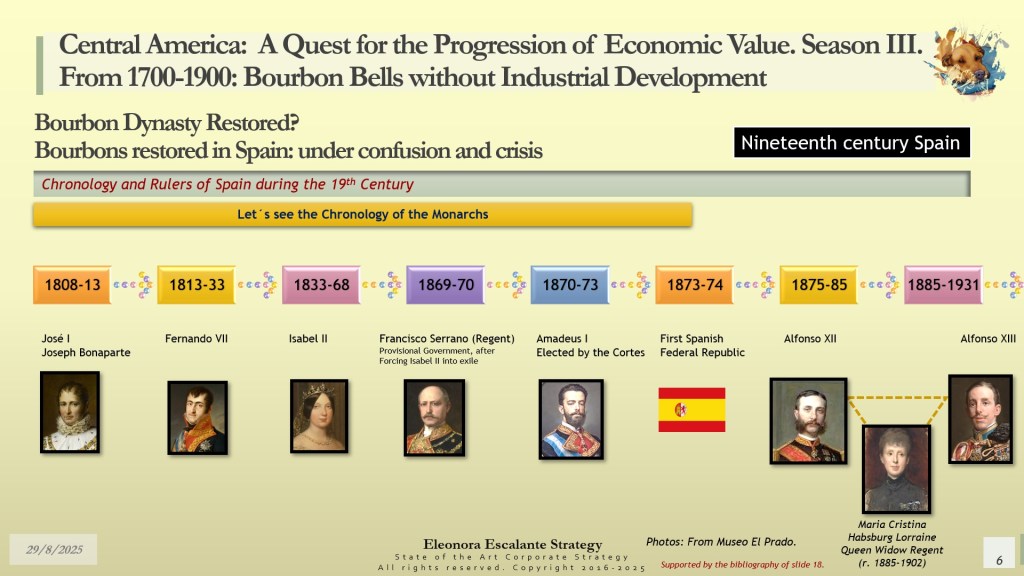
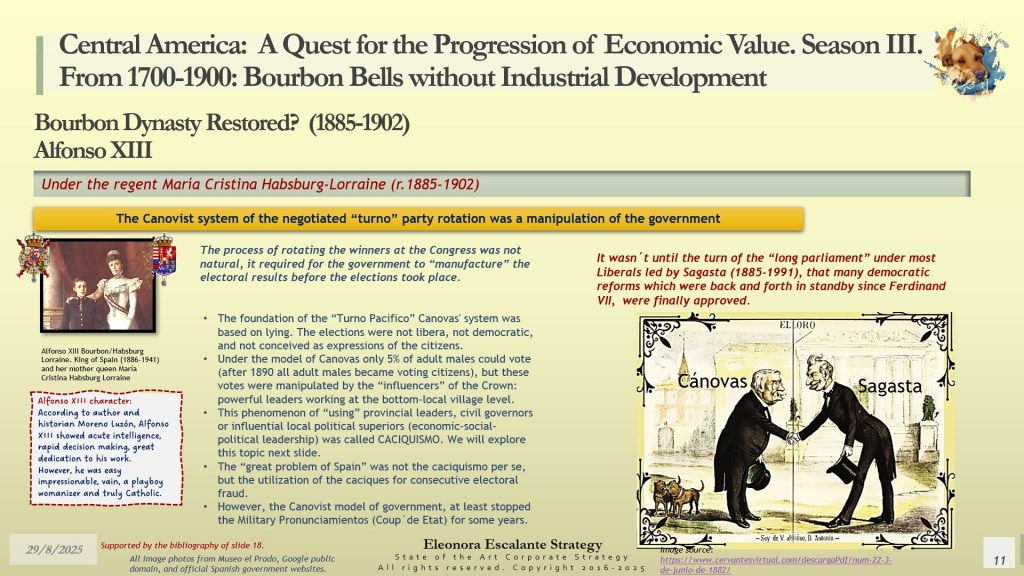
Alfonso XIII was a little youngster between 1882-1902. (Slides 10 to 12). His mother’s presence permitted the stabilization strategy for the restoration of Spain with the Conservative plan of Antonio Cánovas del Castillo and his alter ego, the liberal Práxedes Mateo Sagasta. The confidence and conviction of Cánovas in the constitutional monarchic model of Britain-Germany-Prussia was the strategic foundation that he encountered to oversee and control the chaos of all the social-political forces that were sickening Spain. As we have analyzed in our two previous episodes, most of the revolts, violent rebellions and military pronunciamientos were political tools to dissolve or keep the Bourbons in Spain, and a consequence of a lack of consideration for the needs and wants of all the political forces of Spain who required prompt solutions in the context of a long hereditary conflict of the Crown between Carlistas and Alfonsistas Isabelinos. The consolidation of the acceptance of a Constitutional Monarchy at the political superstructure level was the barrier wall used to tame the new Marxist-socialist ideology that was not adding solutions to the existing anarchy, but expanding the existing problems. Let me explain it simply: After Joseph Bonaparte, Spain was in an absolutist anarchistic state of no consensus about how to manage the Government. Spanish America was not part of Imperial Spain anymore. The new ideology of Marx was adopted by the professionals, intellectuals, and the new industry workers of Catalunya, Valencia, Aragón, and Navarra. The liberals were an ample range of political groups, while the conservatives were pro-royalists at their core. The first Spanish Republic during the Democratic Sexennial period ended in disaster, and here we are on the verge of 1886, with a Bourbon king who died, leaving his wife with the future orphan king in abandonment. Cánovas and Sagasta took the empty room left by the king, and with Maria Cristina’s baton, Cánovas was engaged to consolidate what Alfonso XII started. Cánovas and Sagasta agreed to solve all these Spanish Iberian problems. Alfonso XIII did not rule until 1904, the year of his coronation as king.
Lessons from the alternate “turno Pacifico” regime of Cánovas-Sagasta.
- Lesson 1: Socio-political changes take time. Slide 10. The consolidation of new government regimes takes decades of time. It is a back-and-forth, a stretch and shrink negotiation, several rounds of foolish mistakes from one side, and multiple cycles of trial and error on the other side. In the case of the Spanish conflictive nation, it apparently took them around 35 years to arrive at a minimum consensus on how to work by rotative turns of Parliaments (our moral judgement on how they did it will be depicted in lesson 2 below). After the death of the king Alfonso XII, the liberal Sagasta initiated the long Parliament turn (1885-91), in which the decisive key democratic reforms were approved: see slide 10. Once the leaders of this “turno pacifico” solution disappeared, the challenge was to keep the continuity. In the case of Cánovas-Sagasta, there was no will to keep their model once Alfonso XIII arrived at power.
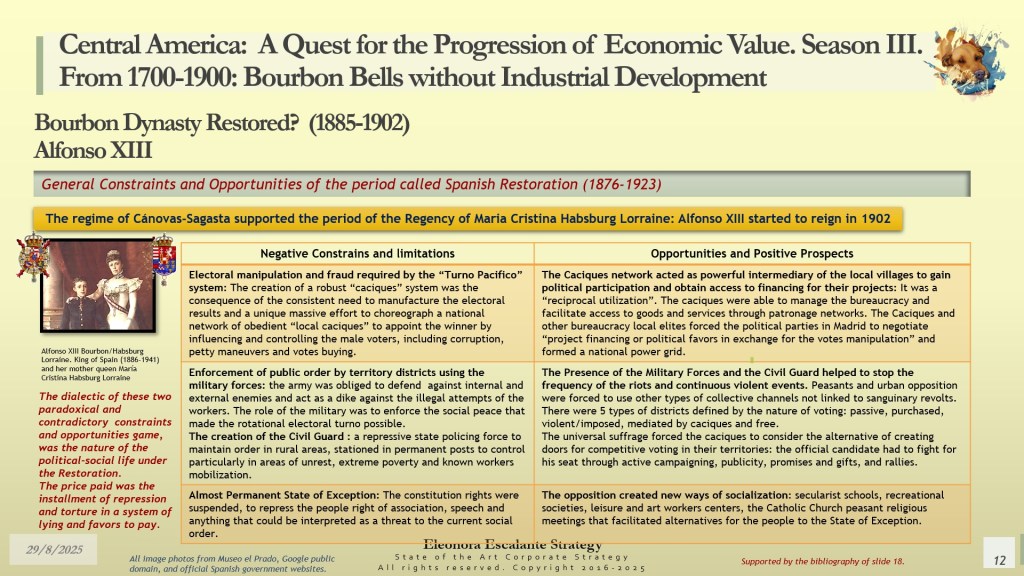
- Lesson 2: Rigged elections caused the “Turno Pacífico” system to fall. Slide 11. The election results of the rotative parliaments were a lie. The results were negotiated and convened before each election, and there was a continuous, systematic electoral manipulation and fraud. The caciquism was the arm utilized for it. The caciquism will be explained below in detail. For those who are aligned to educate moral values to forge character, this methodology goes beyond healthy influencing. Lying and manipulating the votes of the population is non-ethical. Installing a stable, rotating political system based on cheating was the termination of any good intentions from Cánovas. While he was alive, technically, the scheme of lying was repressively enforced with the military, Guardia Rural, and the caciques, but once he departed (he was murdered) in 1898, the whole structure began to crumble from its roots.
- Lesson 3: Imbalanced economic change through modern technologies is not enough to glue an incipient system. The industrialization of certain development pilot projects in Catalunya and the Basque Country (particularly in cotton textiles and minerals extraction) using new manufacturing technologies was out of question during this period. In the energy industry, its value chain was wasteful (Spain imported coal mainly from Britain at the end of the 19th century). The existence of associated workers is proof of evidence that Spain was moving forward following the industrial Britain-German economic model. However, 2/3 of the active population worked in agriculture using medieval harvest technologies. The agriculture sector did not modernize and did not solve the summer drought issues until 1936. At the time of Alfonso XIII, urban centers held only 10% of the total population, and around 48% of all inhabitants were illiterate. Finally, during this time, the inefficient transport system kept the logistics costs high in comparison to other European competitors.
So, what happened next? Which was the main reason for Spain’s backwardness and slow growth, if all the countries in Europe were living the same political transformation? The answer is simple: the main economic sector in which most of the population was employed (2/3 were working in agriculture) did not receive any robust welfare measures, nor any investment priority for its improvement and prosperity. The possibility of the Spanish agriculture to raise productivity or improve the highest yields of return for domestic and international demand was not on the agenda of Cánovas and Sagasta. There was an organic structural imbalance in where and how to spend the modernization investment of the government, which focused more on other projects. Additionally, the deficient performance of agriculture in Spain at the end of the 19th century had a tripartite cause: poor resource endowments, inefficient property rights, and the distortion of factor markets because of higher tariff protection (1). - Lesson 4: Caciquism as a source of future problems. Slide 12. Despite that the Caciques network helped to build the “turno Pacifico” regime, the creation of this unscrupulous and corrupt maneuvering was based on an unethical foundation. The caciquism corruption methods for electoral manipulation were beyond the exchange of favors or illegal “in-kind” transactions. Most of the public sector troubles of Spanish America today come from what Spain did during the 19th century, where public authority was installed by abuse of power, in which the ”caciques” also obtained undue benefits in exchange for electoral votes or other concessions. We encourage you to read slide 12, which shows a table of the negative limitations and opportunities of the Caciquism situation.
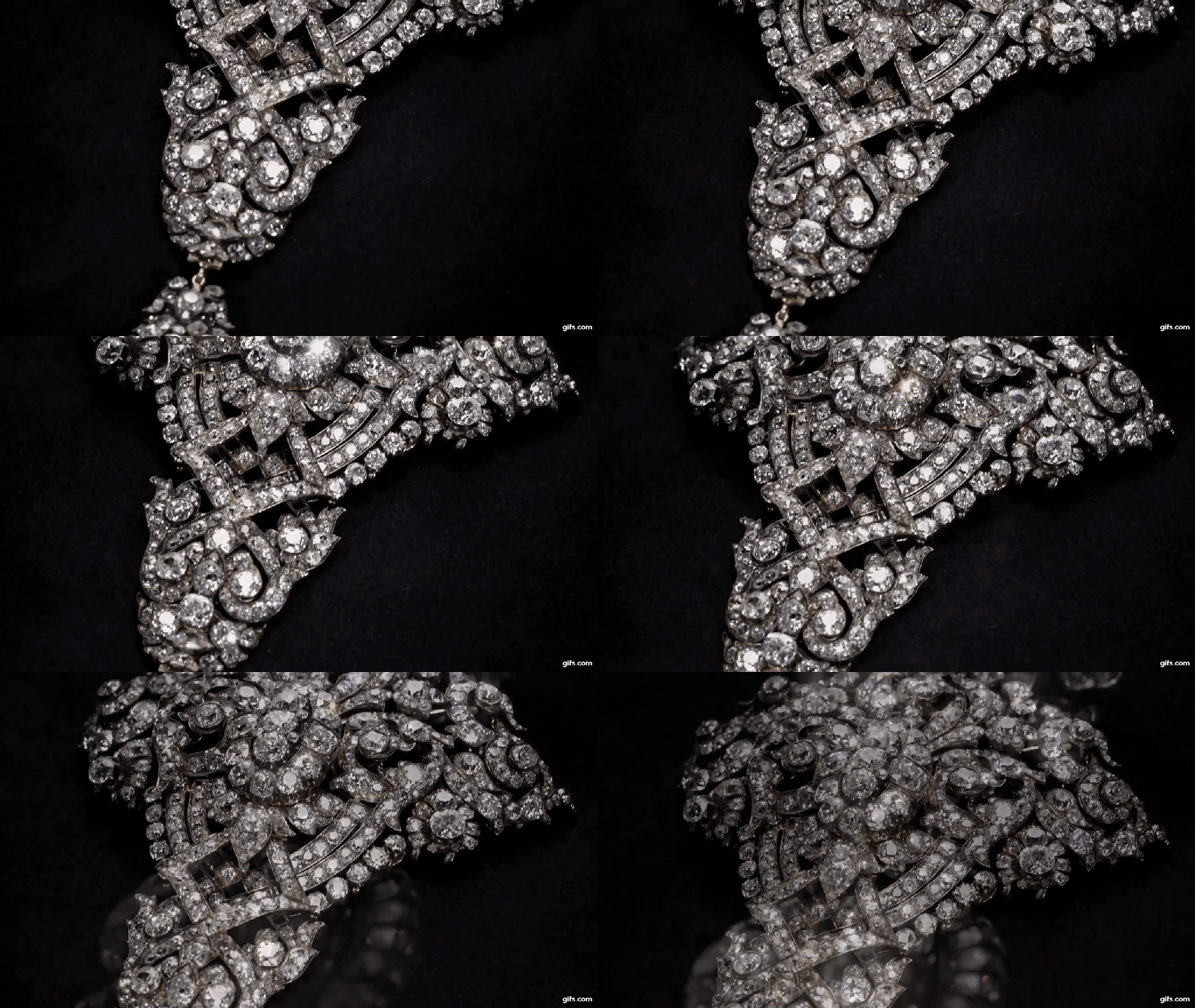
https://royalwatcherblog.com/2022/07/21/queen-maria-cristinas-diamond-corsage/ Illustrative and non-commercial GIF image. Used for educational purposes. Utilized only informatively for the public good. Source: Public Domain
Spanish Caciquism and Political Clientelism. Slides 13-14.
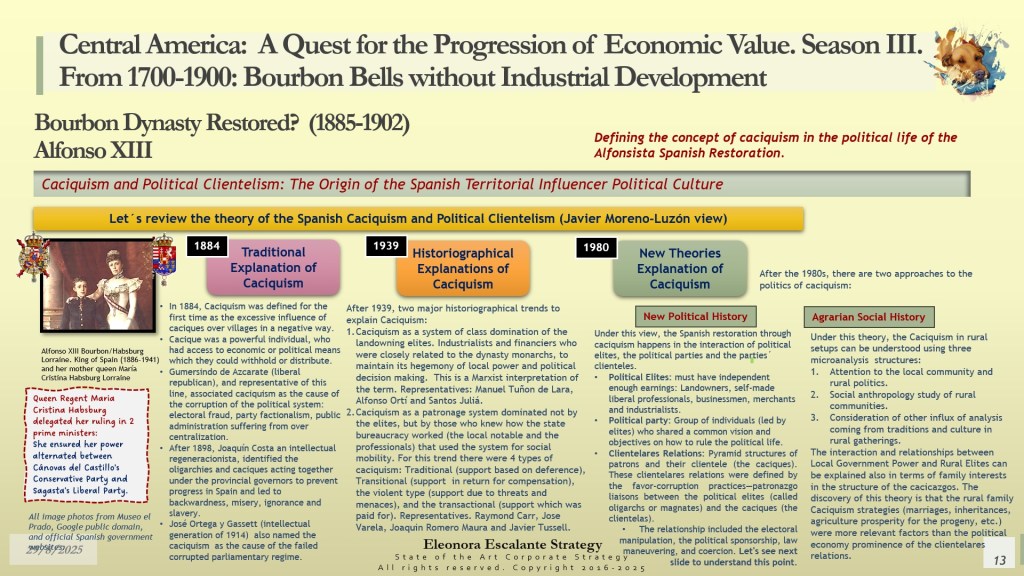
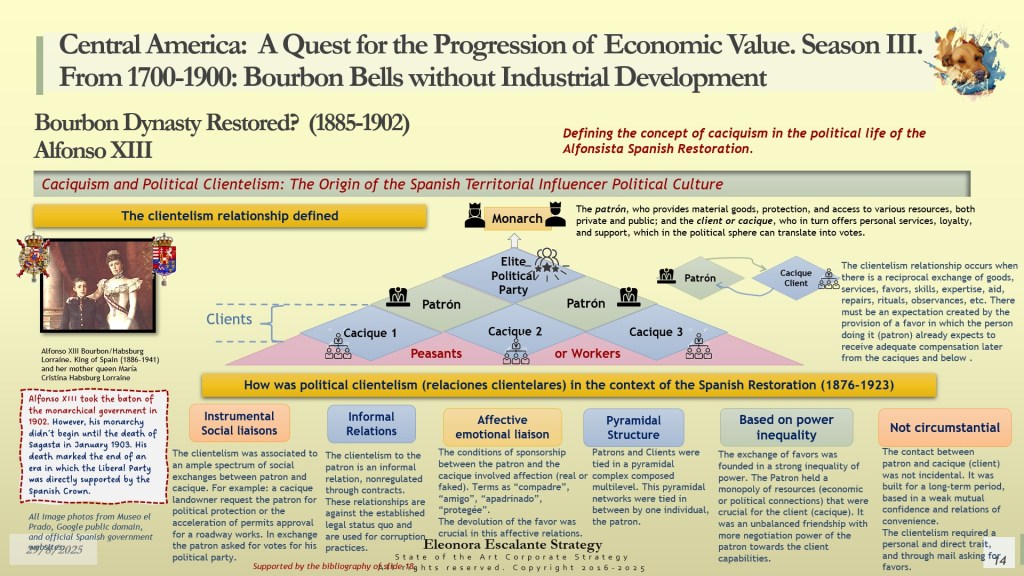
To prepare this publication, we dedicated several days to this subject. Why? Because this is a problem of every nation, including the most advanced ones as the USA, Britain, France, Germany, or the emerging BRICs. Most of the political-economic systems are showing a “regression” to caciquism, or at least, a heavy recrudescence of the political clientelism that was lessening by the adoption of Christian religious moral values under freedom during the 20th century. Nowadays, it seems that Christianity from the West is not curing the disease of social Caciquism anymore. It is a matter of another future saga to understand why our substantially interconnected and Internet social media is not helping the new generations to improve the conscious embrace of actions using moral values. It seems to us that the Spanish Caciquism and political Clientelism are also ruling Christian nations (no matter the denomination). We are clear about the legacy of the Inquisition on Spain and its realms; it is a weighty heritage of more than 500 years, and it is obvious that political clientelism is a result of the informal ways of survival that Spaniards taught the world then. However, let´s look at slide 14. What can we infer from it?
- Message 1: The pyramidal structure of caciquism and political clientelism. We designed the pyramid of this slide with only one level of Caciques. Though there are numerous levels of caciquism below, until you touch the bottom of the majority, the peasants or manufacturing workers, or small entrepreneurs. The interesting thing about this pyramid is the way in which the superior levels are intertwined with the inferior levels of command. The diamond figure arrangement of the Patrons or caciques allows them to have direct contact with distinct levels. The Patrons can move directly down to get acquainted with more caciques who are connected directly to the base of the populations. These caciques can also permeate through direct contact with the top. The relationship was based on power inequality, while there was an affective emotional liaison among all the participants in the system that was not circumstantial, but it was designed for long-term political participation. The system at the top reported to the Monarchs, who were the ultimate benefactors and harvesters of the status quo. The exchange of the citizens’ vote for compensation was the corruption model of the system, which degenerated over time. How can a regeneration of a constitutional monarchy be based on a political clientelism of degeneration? It is completely irrational if you see it from a philosophical point of view. However, at the time of Alfonso XIII’s infancy, political clientelism was also linked with traditions, culture, social relationships, and the foundation of undertaking families. The current system of “commissions” is derived from political clientelism. For example, the phrase “there is no free lunch in business” is tangible in every segment of the value chain and business modeling: The business owner shares or distributes innumerable portions of percentages of profits in his/her quest to access clients. And this is corruption too.
- Message 2: The theory of Spanish Caciquism. Slide 13. The phenomena of caciquism and political clientelism hold the “auto-destruction” of the system that applies it. The term has been evolving in its definition since the year 1884. The common element of all these explanations (traditional, historiographical, new political theory, and agrarian social history) is the corruption that is caused by their implementation. The corruption of the patronage can´t sustain a society in its long run. Nowadays, most of the AI digital business models use corruption and lying, cheating, and dishonoring fraud as the foundation of their operational premises. And most of us are absurdly paying for it.
Cuba, a problem for Spain? Slides 15-16.
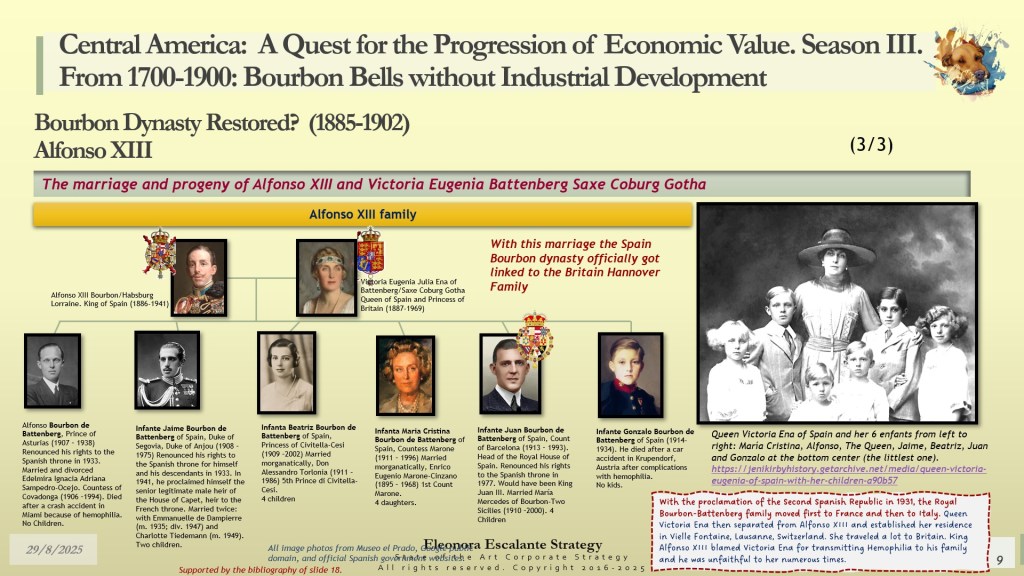
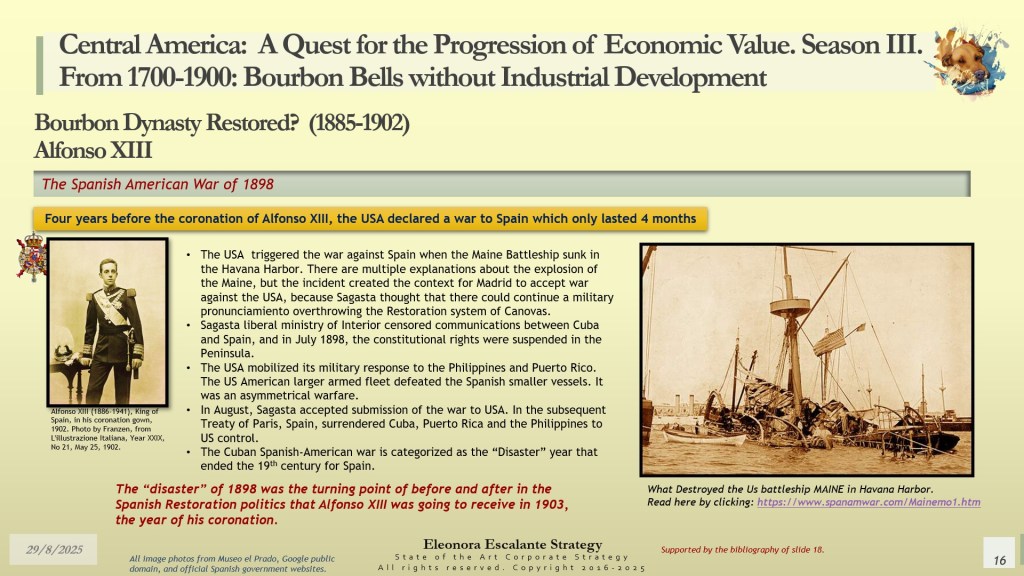
The conflict between the USA and Spain (1895-98), on behalf of keeping Cuba under the control of Spain, is probably one of the surprising events of the end of our period of analysis. Cuba held African slaves in the highest proportions. The real problem in Cuba was racial, and the Spanish Troops could not manage it. The explosion of the US battleship Maine in Havana Harbor might have represented a “smoke curtain” to attract USA to solve the issues of Cuba, or it could have been the price paid by Spain (sacrificing Cuba, Philippines and Puerto Rico) to the real US Britain rulers, in exchange for the future marriage contract of Alfonso XIII with the British-German Victoria Eugenia Battenberg/Saxe Coburg Gotha, the British grand-daughter of Queen Victoria who became bride of Alfonso a few years later.
Closing season III.
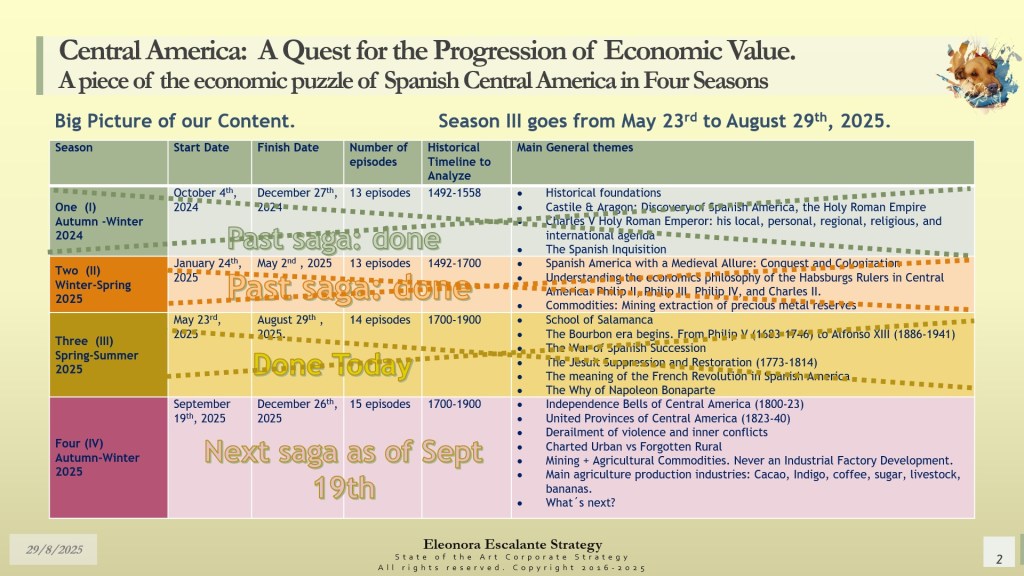
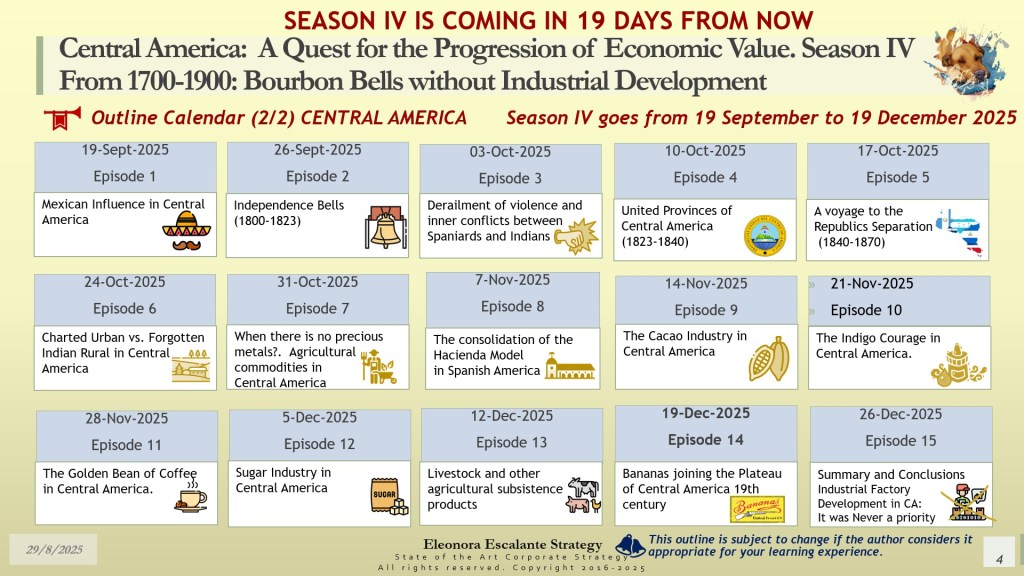
We are done with all the material for Season III. Dear readers, we appreciate your fantastic devotion to reading us during this trimester. We will continue as of September 19th, but for then, we will jump the Atlantic Ocean to radiate our light in the Central America of the 18th and 19th centuries, the land known as the Kingdom of Guatemala, which was established by Hernan Cortés as from Chiapas to Costa Rica. See you again, then, with a renewed spirit after this coming short vacation, an oasis well-deserved recess. Cheers!
To be continued…
Final Statement and Announcements:
This master class is the last episode of season III. We are only closing our strategic interpretation of the history of the Iberian monarchical decision-making between 1700 top 1900. There is much coming with season IV. Our next season IV, which starts next Sept 19th, will be about the political strategic economy situation in Central America, and we will cover all the main economic sectors (incipient agro-export industries). We are so content with the production of the last three months, and we are looking forward to Season IV, outlined below. Thank you so much for your patience and for your attention to this saga. The best is yet to come…
Musical Section.
Season III of “Central America: A Quest for the Progression of Economic Value” has assigned a new instrument for the rest of the year. It is the guitar!. Our selection of music during Season III will continue to explore the delightful music produced between the 17th and 19th centuries, featuring interpretations by virtuoso guitarists. We will embark on selecting the top 29 loveliest guitarists from the last five generations, who played music composed during the time of this saga. Our choice for today is the 14th one. We will continue Season IV with the rest of the guitarists. We try to select highly skilled and exceptionally talented guitar interpreters, but we will also choose not well-known, younger players who belong to the new talented generation.
For this episode, we decided to show you a compilation of the Best of Isaac Albeniz (1860-1909). Albeniz lived during the period of the Restoration, and his compositions, played by the ten performers of Siccas Guitar Video below, tell us what Spain was like during the time of María Cristina Habsburg Lorraine and Alfonso XIII. The virtuosos of today are Jessica Kaiser, Ana Vidovic, Gruber & Maklar Guitar Duo, Benjamin Čaušević, Oguzhan Kayali, Gvaneta Betaneli, Andreas Großmann, Marcel Wollny, Duo Golz & Danilov, and Duo Amythis. Enjoy.
Thank you for reading http://www.eleonoraescalantestrategy.com. It is a privilege to learn. Blessings.

Sources of reference and Bibliography utilized today. All are listed in the slide document. Additional material will be added when we upload the strategic reflections.
(1) Simpson, James. “Economic Development in Spain, 1850-1936.” The Economic History Review 50, no. 2 (1997): 348–59. http://www.jstor.org/stable/2599064
Disclaimer: Eleonora Escalante paints Illustrations in Watercolor. Other types of illustrations or videos (which are not mine) are used for educational purposes ONLY. All are used as Illustrative and non-commercial images. Utilized only informatively for the public good. Nevertheless, most of this blog’s pictures, images, and videos are not mine. Unless otherwise stated, I do not own any lovely photos or images
 Eleonora Escalante Strategy - Strategic Reflections Think Tank