
Central America: A Quest for the Progression of Economic Value. Season IV. Episode1: Introduction. Mexican Influence in the Kingdom of Guatemala.
Dear beautiful readers:
Welcome to the last and fourth season of the saga “Central America: A Quest for the Progression of Economic Value”. Fourteen further episodes await us until Christmas. It is our aim to kick off this season with love and consideration for all the peoples of what was the Kingdom of Guatemala (from Chiapas-Soconusco to Costa Rica). Our period of analysis is the 18th and 19th centuries.
Our introductory chapter includes a detailed voyage through a vocabulary glossary of the main terms that we all should manage properly. We encourage all our readers to visit previous chapters that we have already disclosed in season 11. See slide 7. And finally, we have proceeded to define the main elements and contextual factors that led us to consider the Audiencia of Guatemala originally planned as a Court and a Royal Household of the Spanish Royals. You will be surprised by our inferences under this scenario, which we suggest as a possible answer to all our questions of the year.
Please find attached our package of slides, which includes the material that needs to be read before presenting the strategic inferences next Monday. Feel free to share them with your friends, family, professors, and colleagues. Print the material, please. Use a pen or pencil, write notes, and do not forget to ask yourself additional questions. Search for supplementary information related to our bibliography.




We request that you return next Monday, September 22nd, to read our additional strategic reflections on this chapter.
We encourage our readers to familiarize themselves with our Friday master class by reviewing the slides over the weekend. We expect you to create ideas that might be strategic reflections or not. Every Monday, we upload our strategic inferences below. These will appear in the next paragraph. Only then will you be able to compare your own reflections with our introspection.
Additional strategic reflections on this episode. These will appear below on Monday, September 22nd, 2025.

The Maya´ treasure of the Southern Lowlands of Guatemala.
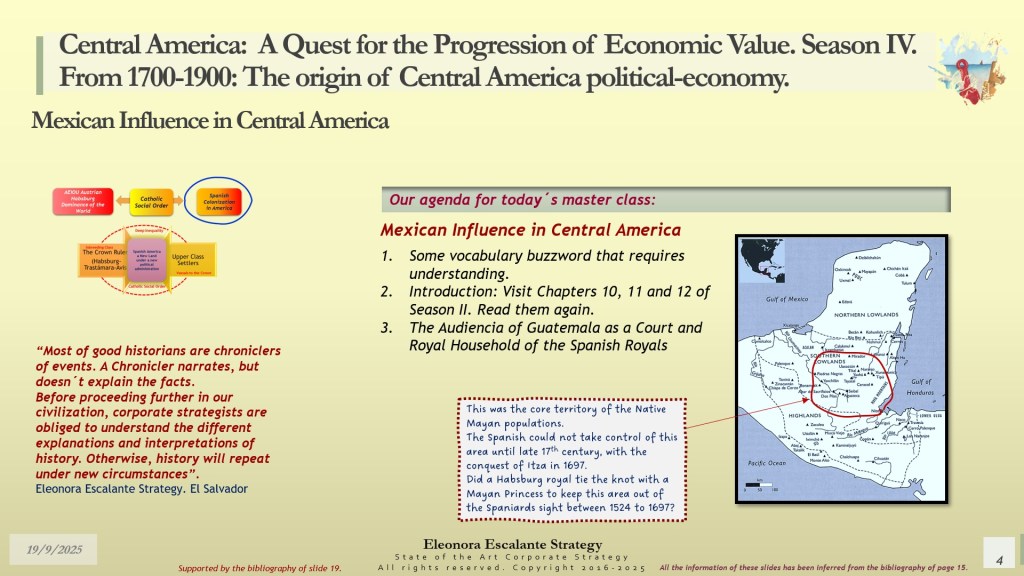
According to official history, the Maya civilization declined around 900 CE. This was around the same period when Charlemagne and his descendants adopted the formula “Renovatio Imperii Romanorum” (“Renewal of the Roman Empire”). The Mayan Civilization did not perish or disappear as it was taught to us in social sciences. It evolved into different, fragmented societies (or communities), each with similar dialects and cultural backgrounds. These communities established themselves on, around, and near the lands of the mountainous cordillera (several rows of mountains) that crosses the Middle of what is now the Current Guatemala Nation, and the south of the Yucatán Peninsula (Petén). Concretely, we are speaking about the lowland tropical forests of eastern Chiapas, the department of Peten of Guatemala, and parts of Alta Verapaz. This area is called the Southern Lowlands (see map of slide 4). This area is well protected by the natural geography of the highest mountains and surrounding rivers. Since the first encounter of the Spaniard conquistadores with this land, the area left the expeditions speechless. It was described by every single visitor, researcher, spy or chronicler as a place of “breathtaking physical exquisiteness, birthplace to lush green hills and mountains, pristine lakes and rivers, cascading waterfalls, abundant fish, exotic flowers, jungle wild virgin fauna, veridian rainforests, spectacular birds, and rolling valleys buffeted by volcanic peaks in mountainous strings” (1). Currently, this region holds the ensemble of the most extraordinary virgin natural reserves on earth: The National Park of the Sierra of Lacandon, Montes Azules Biosphere Reserve, Mayan Biosphere Reserve, National Park of the Laguna del Tigre, National Park El Mirador, Río Bravo Conservation Area, Reserve Machaquila, Santa Cruz Park and Lake Izabal Reserve, Natural Park Bosques del Polochic, National Reserve Visis Cabá, the natural parks of the Sierra de Cuchumatanes, Sierra de las Minas National Park, and others.
This region, which is now called “The Montaña” (slides 13 and 14), was the beloved essence of the Post-Mayan communities. This is the place where the continuing migrants of Spaniards of Castilla, Aragón, and León were restricted from even touching after Pedro de Alvarado’s invasion. No one could penetrate or conquer it until 1697. Why? This is the place that the Itzas protected with all their soul against other Spanish conquest expeditions entering from Yucatán and Belize. This spectacular region did not belong to the Aztecs, but to the fragmented post-Mayan societies that were preserving it as their most beloved and crucial jewel. The Mayan communities not only adored their land, but they also cared for it and kept it as a hidden paragon for hundreds of years. This is the land where we believe that some Habsburgs, descendants of Charles V HRE, in conjunction to the Mayan societies, were defending from the British advancements coming from Belize. This is the land that made the Spanish Habsburgs drop Grandfather Maximilian’s plans in Europe. This is the territory that caused Charles V HRE to split the Holy Roman Empire, leaving his brother Ferdinand with everything else in Europe. And this is the reason why the Audiencia-Captaincy General of Guatemala was cherished by the Spanish Habsburgs with all their spirit since then. This zone altered the world and the mindset of the descendants of Charles V Habsburg in such a way that no other part of Spanish America became ever so important for the Habsburg subsequent kings.
We must acknowledge how powerfully beautiful this region was (and still is!). The golden green nature of the region changed the paradigms of the Spanish Habsburgs so much that Bartolomé de las Casas was able to defend it against Sepulveda. We bet that it was this spot that inspired the arguments for the defense of the Indigenous Peoples that moved the Council of the Indies at Valladolid debates at the beginning of the second half of the 16th century. And no historian or studious researcher can see it lightly. The magnificence of “The Montaña” Mayan Southern lowlands represents the core, the essence of why the kingdom of Guatemala turned the world upside-down to the Habsburgs. We also conceive a possible love history between a Habsburg and a Post-Mayan Princess of that epoch as the reason why the Spanish Crown invested so heavily in their priority for the Christian evangelization and protection.
But what occurred during the 18th Century?
Between 1523 and 1714, the construction of the Santiago de Guatemala Capital was so important for the Habsburgs (it was the motive of their existence), that anyone who can walk today over the cobbled streets of Antigua Guatemala, can experience the ruins’ splendor and harmonious musical design order of this city. Most of the existing church and convent ruins speak of this legacy to our hearts. So much more than 1000 of my words. Moreover, there is evidence of migration of the best architects and engineers coming to Santiago de Guatemala. These were the descendants of the constructors of the palaces of Philip II Habsburg-Aviz.
In 1714, when the Bourbons-Wittelsbach-Farnese took the baton of leading Spain, the Habsburgs lost the monarchical corporate direction in Europe; however, the presence of the Habsburg-Castilian administration continued for several decades, and this is why Philip V was negatively problematized to act with his new strategy. When the Jesuits were expelled (1767) and Charles III arrived with his Bourbonic Reforms plans, the concealed Guatemalan Habsburg dynasty (already dwelling in the region in camouflaged terms) knew that something horrible was coming against “La Montaña” and against the lands of the Mayans. Suddenly, the Habsburg original plan to organize the kingdom of Guatemala, protecting the verdant golden treasure of the Mayans, was going to be totally disrupted by the Bourbons. The Bourbons’ commercial philosophy of making money by extracting resources from their lands seemed not only like the worst crazy nightmare, but it was crushing the way of the Habsburgs. Probably, the Bourbonic reforms were going to change the immeasurable beauty of the Montaña Guatemalan Lands, and this wasn´t favored at all. Nor by the Mayan societies, nor by the Habsburg descendants already dwelling there.
The plans of the Bourbon officials were so immensely far away from what the Habsburgs began to develop since Charles V HRE. So we can only imagine the level of apprehensive worry about what to do to stop the Bourbons…
To be continued…
Announcement.
With this episode, we have introduced the content of what is coming. A fresh and unique new perspective on how we interpret the history of the Kingdom of Guatemala. And this is only the beginning. We apologize for writing what we conceive as the real history of Central America, in different terms than what has been written by historians. However, we couldn’t arrive here without reading to them. My appreciation and thankful recognition to all of them. All the historians guided me, with all I have read since August last year. All of them were so kind to have left me bits and pieces of secrets that I have collected with dedication. Mil gracias por todo. Still, this is only our first chapter, and there is a lot to learn. Our next episode is “Derrailment of violence and inner conflicts between Spaniards and Indians in the Kingdom of Guatemala”.
Musical Section.
During season IV of “Central America: A Quest for the Progression of Economic Value” we will continue displaying prominent virtuosos who play the guitar beautifully. However, we will select younger interpreters who promise to become the new cohort of classical guitarists in the future.
For this episode, as a gala opening of the season, we have selected Vera Danilina from Russia. A 25-year-old artist. https://www.wfimc.org/artists/vera-danilina. One of her most recent participations was in the Barcelona International Guitar Contest Miquel Llobet, in its 21st edition, where she earned the third prize. Danilina has developed a magnificent technique and has released several albums. She has been trained at the Paris Regional Conservatory with Jérémy Jouve. Let´s enjoy her interpretation of the piece Sonatina (1º mov. Allegro) from composer Masataka Suganuma. Enjoy!
Thank you for reading http://www.eleonoraescalantestrategy.com. It is a privilege to learn. Blessings.

Sources of reference and Bibliography utilized today. All are listed in the slide document. Additional material will be added when we upload the strategic reflections.
Disclaimer: Eleonora Escalante paints Illustrations in Watercolor. Other types of illustrations or videos (which are not mine) are used for educational purposes ONLY. All are used as Illustrative and non-commercial images. Utilized only informatively for the public good. Nevertheless, most of this blog’s pictures, images, and videos are not mine. Unless otherwise stated, I do not own any lovely photos or images
 Eleonora Escalante Strategy - Strategic Reflections Think Tank