
Central America: A Quest for the Progression of Economic Value. Season IV. Episode 5. United Provinces of Central America (1824-40)
Autumn of October, and singing leaves are falling down with the wind. Wishing you a beautiful season of pumpkin lattés with a touch of caramel and cinnamon. Today´s master class is the consolidation of a philosophical reflection. Most of us already know the story: A post-independence anarchical conflict between federalists, liberals, conservatives, latifundists of indigo, textiles importers, Native Indians protecting their lands, intellectuals, merchants, and the Catholic Church of Central America; all together trying to build a political government model, out of the ashes of a disintegrated project of 5 nations. However, the scenario was not that disintegrated. Before 1821, the kingdom of Guatemala was operating as a loosely grouped group of provinces (called intendencies under the Bourbon reforms). It was a United Kingdom of Guatemala. And all the members of the political leadership remained the same. What changed after the Independence was that the kingdom of Guatemala had to decide on how to organize itself with all its resources and players. It was a period of indecision within a determination to find a way to make it work. After Iturbide´s deception, Bourbon Spain was not there. Central America was autonomous and free. But they needed to fill the emptiness of an old bureaucratic organization with a new one, which one? Meanwhile, other economic interests and powers, and a new notional liberalism for industrial capitalism, were surfacing around, trying to destroy their Habsburg legacy of more than 300 years!
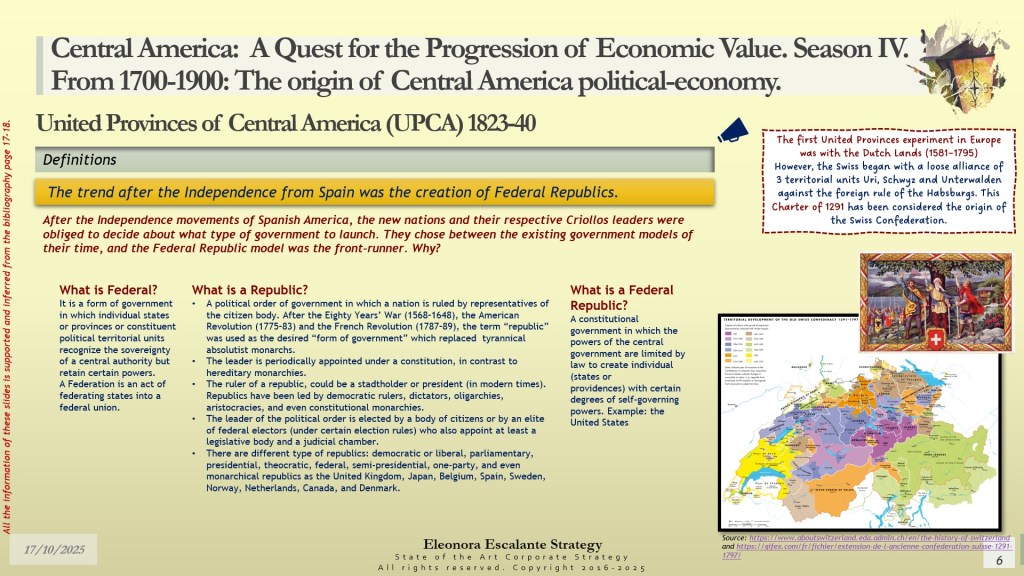
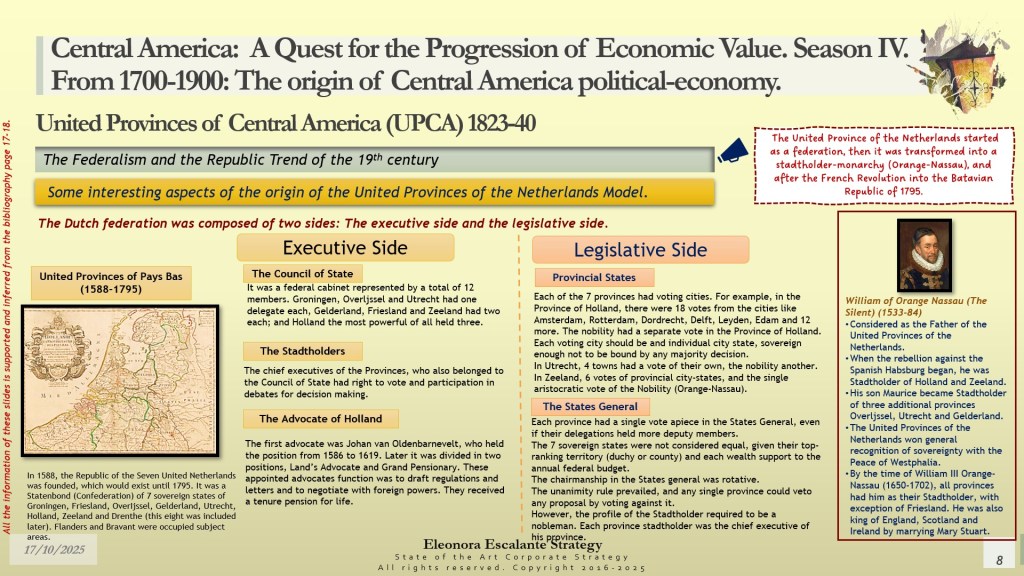
The United Provinces of Central America (UPCA) were baptized as the Federal Republic of Central America with the Constitution of 1824. Its brand name was chosen under the trendy federalism of the epoch. Unconventionally, we start our episode with three basic definitions. Then, we leap into the subject of how and why Federalism was the tendency of the moment, not just in Central America, but in most of the new nations’ development in America. Thirdly, we explain the role models that existed in Europe and North America, and how the Central American leading families, instead of assembling the old Dutch Republic model, opted for the United States Model, which was a unique hybrid conception between British-German and a few of the Dutch Republic principles. Ironically, it is during this time that the Netherlands selected a Constitutional Monarchy model. Our fourth matter is about the United Provinces of Central America’s state of affairs and its strategic impact. We kindly land in the Aycinena family, identified by several historians as the leading economic family of the region, who built a constellation of affiliated families that were tied by kinship. The family networks of the leaders of the Independence and the Federal Republic of Central America were the configuration of the political power. These family grids in the region were built over time by matrimonial alliances, business affairs, geographic closeness, and similarity of cultural, religious, and political values against the liberalism of Europe that devastated most of the monarchies through Bonapartism. Our hypothesis about the Kingdom of Guatemala above the rest of the Viceroyalties is affirmed with the study of the period of the Federal Republic of Central America, and we invite you to visit our slides below.
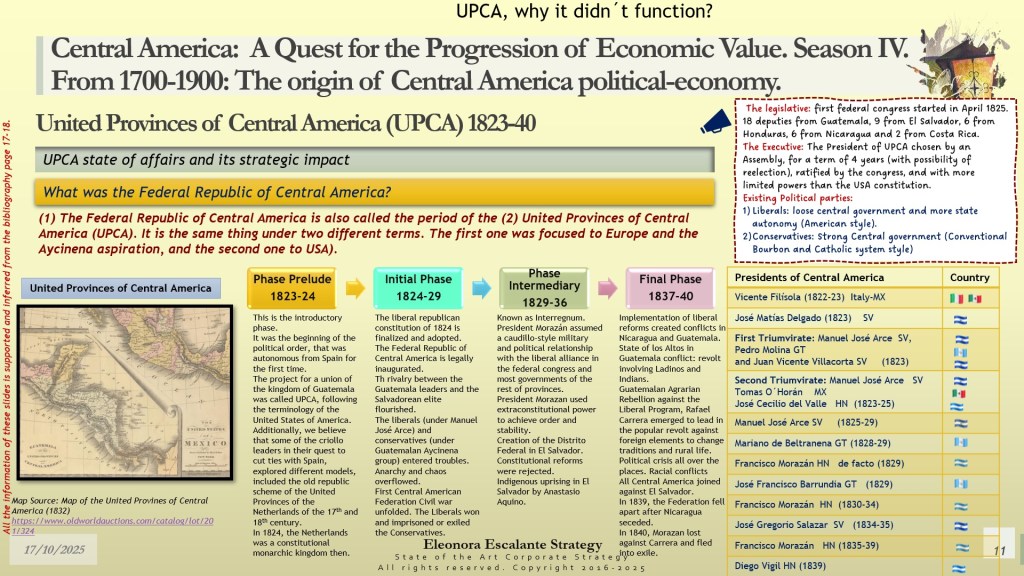
You will discover with deep sadness that the project of the Federal Republic of Central America was designed to fail from the start. It was a temporary rite of passage, arranged to keep the vessel afloat while the leaders of all the resident representatives could find a way to move through the mud of internal and external forces that were stalking them. The separation of the region into 5 countries (Guatemala, El Salvador, Nicaragua, Honduras, and Costa Rica) after this period doesn´t make sense at all from the point of view of the superficial observer. However, if you see the character and the membership of the lineage family leadership of this period, the UPCA was not needed, if they were truly united, regardless of whether they segmented the territories into detached, separate nations.
As usual, feel free to download this material in PDF, print it, feel the pen or your pencil while writing notes, ask yourself questions, and visit the related bibliography affixed to it. Do not forget to share with your family and friends.


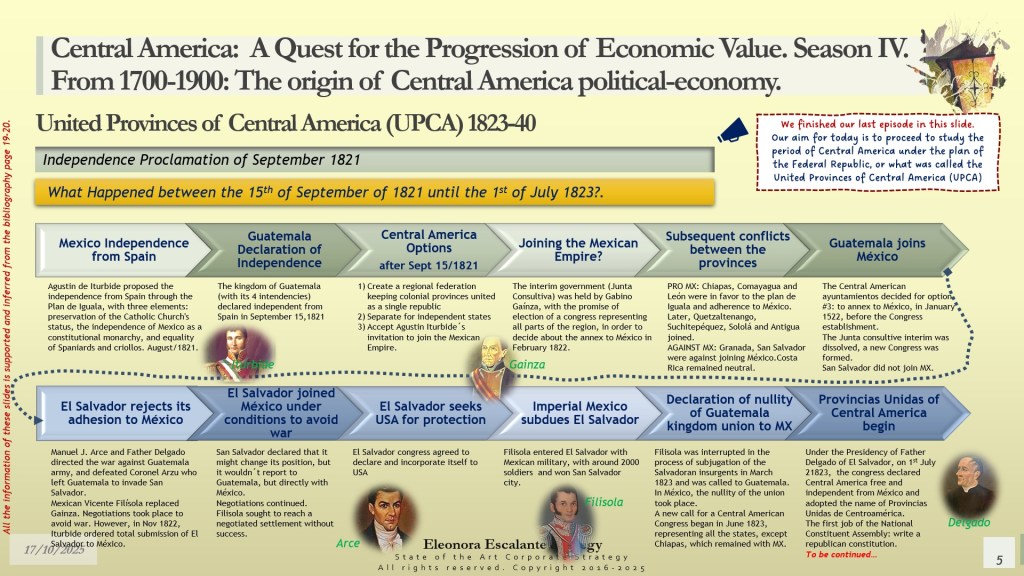






We request that you return next Monday, October 20th, to read our additional strategic reflections on this chapter.
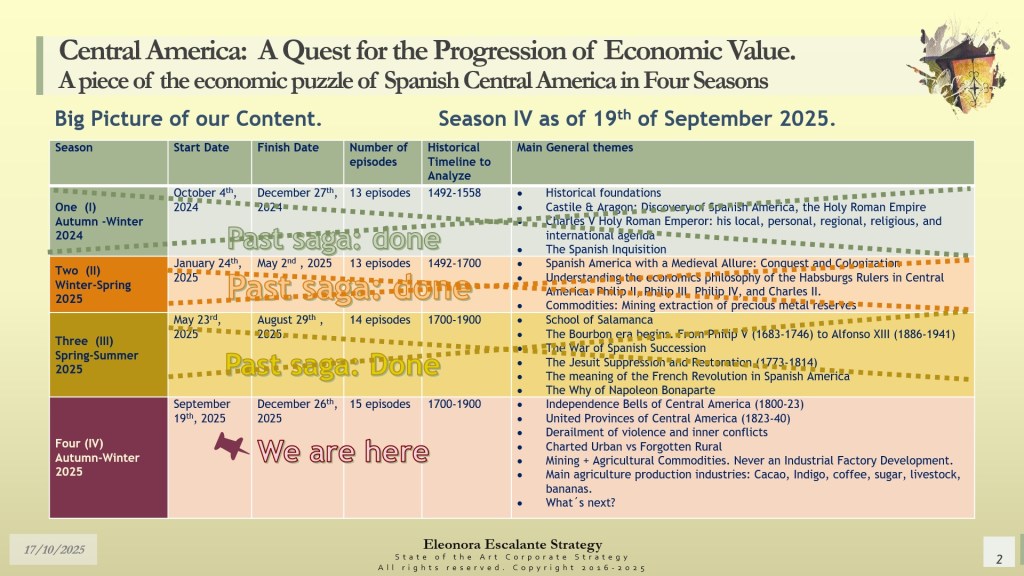
We encourage our readers to familiarize themselves with our Friday master class by reviewing the slides over the weekend. We expect you to create ideas that might be strategic reflections or not. Every Monday, we upload our strategic inferences below. These will appear in the next paragraph. Only then will you be able to compare your own reflections with our introspection.
Additional strategic reflections on this episode. These will appear in the section below on Monday, October 20th, 2025.
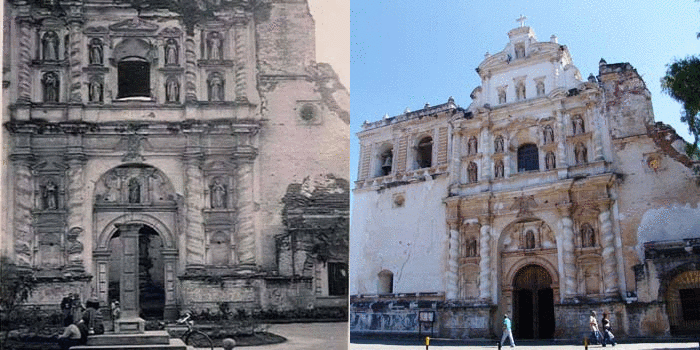
Federalism and the model of the United Provinces of Central America – A dream never true.
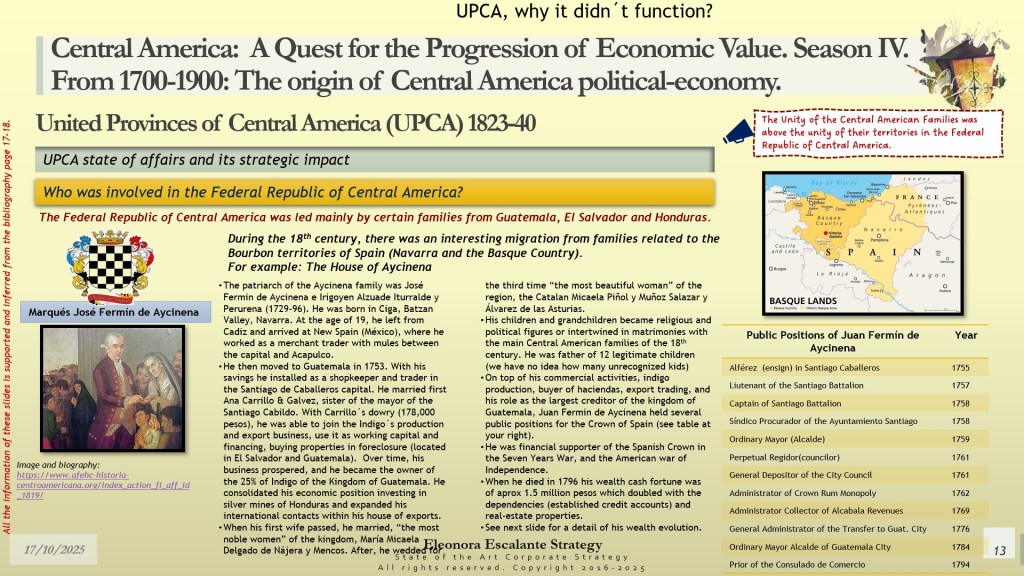
In our quest to find what could have been the inspiration for the próceres and Criollos leaders in Central America, to decide on the model of a “federal republic,” we have explored several angles. The first of these angles is found in the model of the Republic of the Seven Provinces of the Netherlands, which lasted from 1588 to 1795. A second angle has been to explore the by-then recently inaugurated model of the Constitution of the United States of America as a tactic of defense. A third situation is related to the location origin of the Aycinena family, the city of Ziga, at the province of Baztan, in the northern part of Navarra with immediate borders to the French Lower Navarra, Sola and Labourd (this is the place where Bayonne is located-do you remember that former Queen Mariana Wittelsbach-Hessen Darmstadt was exiled to Bayonne by Philip V?); a fourth angle is about the dynastic common denominator of all the monarchical families of Europe between the year 1820 to 1840; and the fifth angle is about the new Britain-German geopolitical position in Central America.
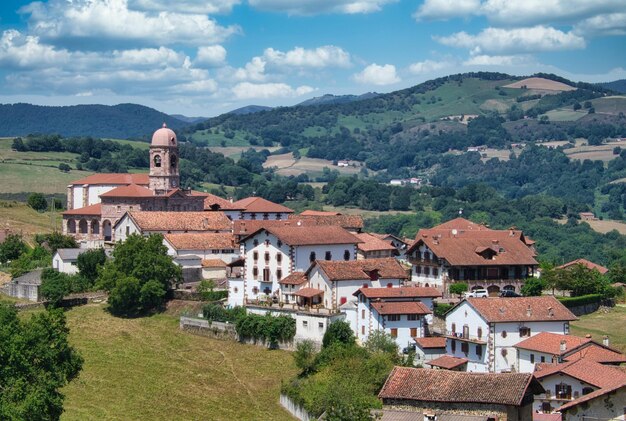
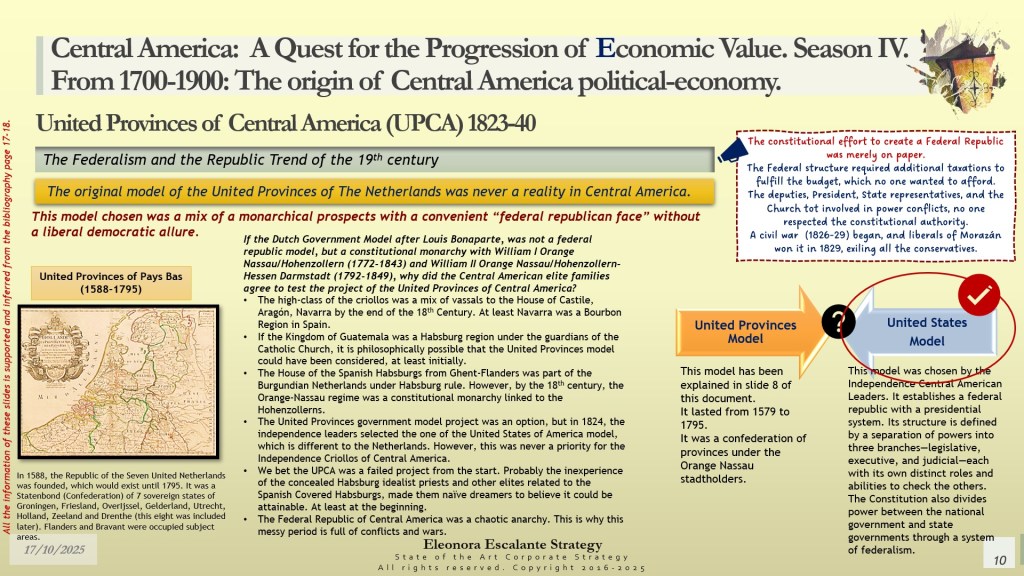
The kingdom of Guatemala after its independence from Bourbon Spain was forced to adjust the sails of their boat, under a new trendy brand called “the federal republic”, not because it was a sincere wish to become a republic similar to what was the United Provinces of the Netherlands, but because the leaders of all the Central American intendencies realized that it was a convenient strategy to look similar to that formula, and defend themselves against the Bonaparte empire model of the post-French revolution. The model of the United States of America looked good and was approved for Protestant Britain and Germany, so it was the “best option available.” Without Spain and with a debilitated Austria, the Kingdom of Guatemala was in 1824, without a constitution, without its own juridical system, without a solid autonomous institutional establishment, without solid commercial revenues, and without a “good brand name that would defend them from external forces coming from Europe.” In that transition, the regional leaders, led by the Navarra-Basque Aycinena family, decided to adopt the “Federal Republic” image as soon as possible, not just to defend themselves from the liberal “enlightenment” ideology that was entering all Spanish America as a reactor chain, but to “look similar” to what was already appropriate and trendy in North America for Britain.
The best way to defend themselves from enemies was to “look like them” on the surface, without the sincere desire to profoundly alter the “modus operandi” of the status quo. And this is why our study and analysis suggest that the attempt to make it a federal union failed from the start. There was no will from anyone to make it work. Not because it was a bad model, that wasn´t the issue. The true concern here was in two dimensions: lack of money to pay for it, and the disruption caused by the liberals (who were trying to copy and paste a new British liberalism, an anti-Catholic mercantilist order) against the Central American conservatives (inheritors of the old colonial criollo order). Sincerely, for Central American families (including the Native Indigenous peoples), a new liberal radical order was overwhelmingly “too much” for them to “accept or even tolerate”. The disruption affected the critical resource of landholding and money lending. It affected the Catholic Church as the backbone of society. In consequence, the wickedest crime of the liberal policies of the Bourbons (and new family associates to them) triggered the Independence. The Bourbons touched the land, territorial, commercial, financial, and social organization of the hub of the Habsburgs in Spanish America, and that had to be blocked as soon as possible.
This region, known as the “Kingdom of Guatemala,” was the hub of decision-making for the rest of the viceroyalties. Suppose there was a concealed Habsburg presence in the Kingdom of Guatemala since Hernán Cortés. In that case, that signifies that there was a royal household in the region that determined the best way to do things in their territory, from Chiapas to Costa Rica. And this royal household was not happy with Bourbon Spain. So, they cut the cords to them. And later, this same cusp of Habsburg leaders guarded it with all their souls and fiercely defended their position to keep the protestant British German model away. The decree for the abolition of slavery was included in the Constitution of 1824 by Salvadoran Procer José Simeón Cañas.
The Federal Republic leaders oscillated from conservatives to liberals and vice versa. After the two triumvirates of 1823 and 1825, you can see how each term of the Presidencies of the Federal Republic was swinging on and on (see slide 11). President Francisco Morazán from Honduras, the military caudillo, could not keep up with the sources of financing for the pace of his movements. All the Central American States refused to support the federal government’s expenses. Only the kingdom of Guatemala was keen to fund it, with Aycinena leading it, while the British Banks were offering it in abundance. To learn more about the lack of funds for the Federal Republic of Central America, we encourage you to visit the link (1) “Financing the Central American Federation, 1821-1838 by R. Smith in the bibliography of this text.
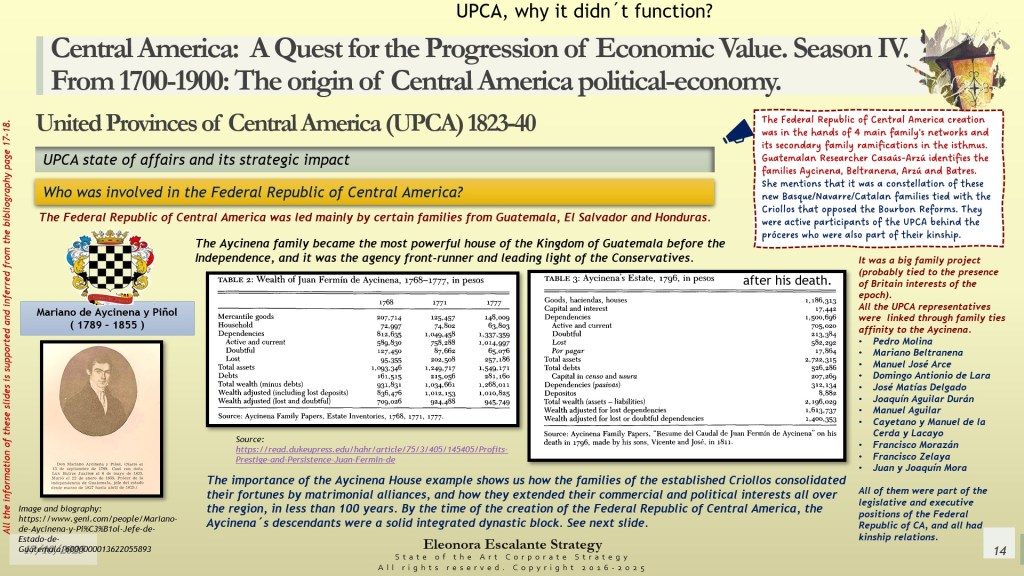
The Aycinena Family analysis. We have been trying to find dynastic ties of the Aycinena house and the royal families of Europe. Our notions are merely contemplative, given their original geographical position in the kingdom of Navarra-Basque Country. The patriarch of the Aycinena family was José Fermin de Aycinena e Irigoyen (1729-96). He was born in Ziga (Ciga), province of Baztán, which is at the borderland with the French Lower Basque Navarra province. Since the advent of King of Navarra, Henry IV Bourbon-Albret, to the French throne as the king of France in 1589, the northern Navarra section of Spain was under a strong Bourbonic influence. Proof of evidence is the first and subsequent Carlist Wars. The Basque Country and Navarre have always been extremely conservative (pro-royalists in favor of the Bourbons), and they supported the Carlist V Bourbon initiative against Queen Isabella after King Ferdinand VII passed away. Aycinena´s origin was from the most conservative region of Navarra-France. However, his coat of arms (checked white and black) resembles the colors of the old Prussian Hohenzollern coat of arms, before the adoption of the black imperial eagle on the white/argent field. Further, the businesses of the Aycinena textiles and indigo were tied to Britain, and that explains his commercial connections with them. The presence of Aycinena during the 18th century in Guatemala was linked commercially, geographically, and economically with British German high-sphere merchant people who were probably connected to royal contacts.
The dynasty of the kings of Britain at the time of Aycinena´s initial presence in Guatemala was hanging from the following last names: Hannover-Hohenzollern-Saxe Gotha-Mecklenburg Strelitz. The dynasty of the Prussian kings was Hohenzollern-Hannover-Hessen Darmstadt-Wittelsbach-Nassau. The dynasty of the new king of the Netherlands (William I, who reigned 1813-40) was also Orange Nassau Dietz- Hessen Kassel-Hannover-Hohenzollern. See the bonus slides below. At least three European royal houses shared first-degree family kinship at the time of the nascent formation of the Federal Republic of Central America.

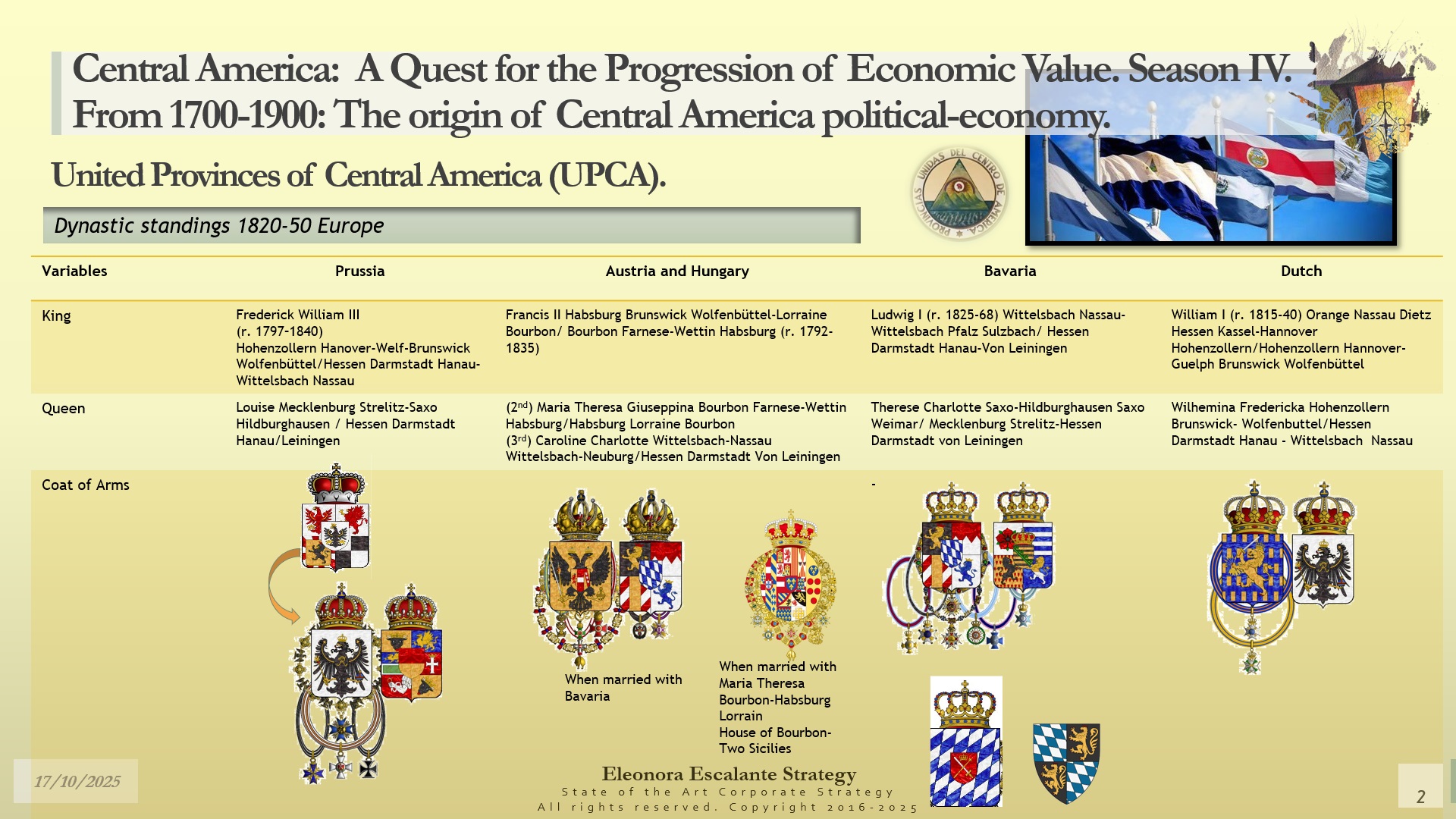


The power intensity of these royal families entering the region was enough reason to be frightened, but they were busy in North America. The British-Germans and Dutch were building their new nation called the United States of America. However, what was their main interest in the Kingdom of Guatemala? We believe it was the Great Ship Channel of Nicaragua. More than 120 conflicts occurred in Central America between 1824 to 1838 to stop it. And we are convinced that without the Clayton–Bulwer Treaty of 1850 between the United Kingdom and the United States, those conflicts could have easily doubled. Looking back, I also think it would have been a terrible environmental mistake to position the Channel crossing the Lake of Nicaragua.
The Aycinenas could have been probably aligned in one way or another with Britain-Prussia, and that is why they were exiled for a few years by order of Morazán. Considering the strong family ties of the Aycinena family all over Central America, what if they were created to be seen as originally aligned with the Bourbons of Navarra, and at the same time playing a double-agency game, aligned commercially with the interests of at least the royal family, who extended the Marquisate Coat of Arms? How to know? Sincerely, I cannot respond to it. The only ones who might answer that question are the descendants of Don Juan Fermin, if they kept memories or records of his ancestors. We are simply suggesting an interpretation of the historical chronicles of the Federal Republic of Central America, and why it didn´t function.
Nonetheless, if the main preoccupation was to save Central America from the intrusion and intervention of Britain-Germany or the Protestant Dutch, then we have explored and unfolded a possibility. How to defend a hereditary Catholic Habsburg hub from a heavy-duty steamroller coming from Britain-Germany? Our suggested humble answer is slide 16.
To be continued…
Announcement.
Episode 5 proposes a different message. Our objective for today is to understand why the family leaders of the Intendencies of the Kingdom of Guatemala decided to design and risk the government model of the Federal Republic of Central America, only to abandon it 16 years later. We examined the trend of this type of power-political organization throughout America and identified a pattern that is clearly visible to all. Don´t lose sight, please. Currently, we are analyzing the political context of the region during the 19th century. In a few weeks, we will proceed with the essence of our saga: the economy. Our next episode is “A voyage after the Republic Separation (1840-70)”. See you again next week. Thank you for reading to us.
Musical Section.
During season IV of “Central America: A Quest for the Progression of Economic Value,” we will continue displaying prominent virtuosos who play the guitar beautifully. However, we will select younger interpreters who promise to become the new cohort of classical guitarists in the future.
For this episode 5, we have selected a Franco-British guitarist, Laura Snowden. She has held a solid education in developing her art. Beyond her interpretations, she is a composer and a creator of music. “Laura’s compositions and arrangements have been recorded for Decca, Rubicon Classics, and BGS Records, broadcast on BBC Radio 3 and Classic FM. We invite you to know her here: https://www.laurasnowden.co.uk/. Enjoy!
Thank you for reading http://www.eleonoraescalantestrategy.com. It is a privilege to learn. Blessings.

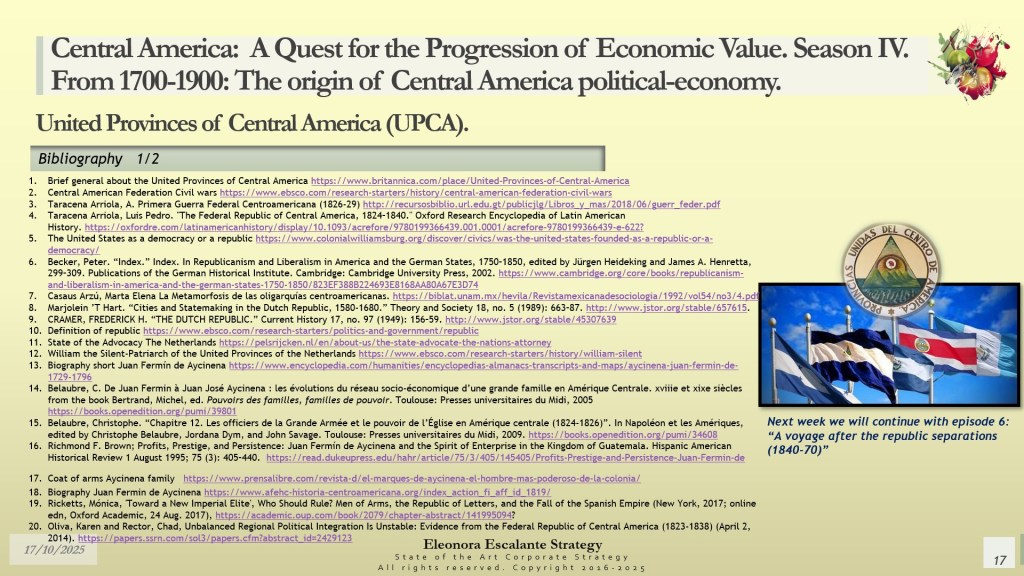
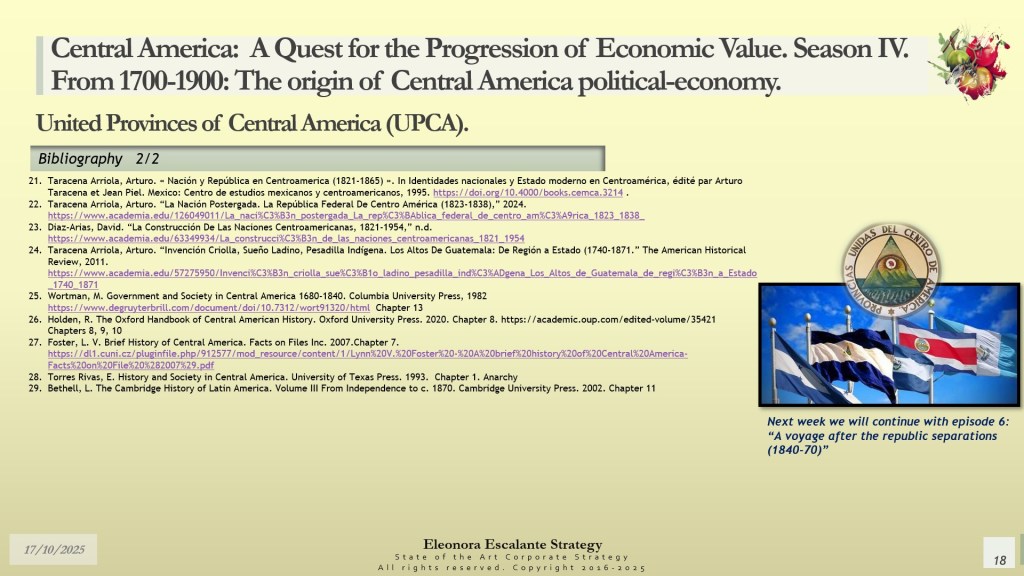
Sources of reference and Bibliography utilized today. All are listed in the slide document. Additional material will be added when we upload the strategic reflections.
(1) Robert S. Smith; Financing the Central American Federation, 1821-1838. Hispanic American Historical Review 1 November 1963; 43 (4): 483–510 https://read.dukeupress.edu/hahr/article/43/4/483/159631/Financing-the-Central-American-Federation-1821
Disclaimer: Eleonora Escalante paints Illustrations in Watercolor. Other types of illustrations or videos (which are not mine) are used for educational purposes ONLY. All are used as Illustrative and non-commercial images. Utilized only informatively for the public good. Nevertheless, most of this blog’s pictures, images, and videos are not mine. Unless otherwise stated, I do not own any lovely photos or images
 Eleonora Escalante Strategy - Strategic Reflections Think Tank