
Central America: A Quest for the Progression of Economic Value. Bonus-Season V. Episode 11. Cattle and Livestock – Haciendas in Central America.
Dear amazing readers:
Today´s class is about the cowboy energies of the Spaniards from Central American stockmen who began with this industry since the Conquest of the region. We have done all our efforts to find historically reliable information about the cattle, understood as livestock (mules, horses, cows, and bulls) and other minor species (hogs, chickens, goats, sheep, etc); and how these European-Asian herds made their entrance into New Spain and the Kingdom of Guatemala. We have left out Costa Rica, not because it didn´t embrace livestock as a subsistence industry, but because this nation is a different outlier case.
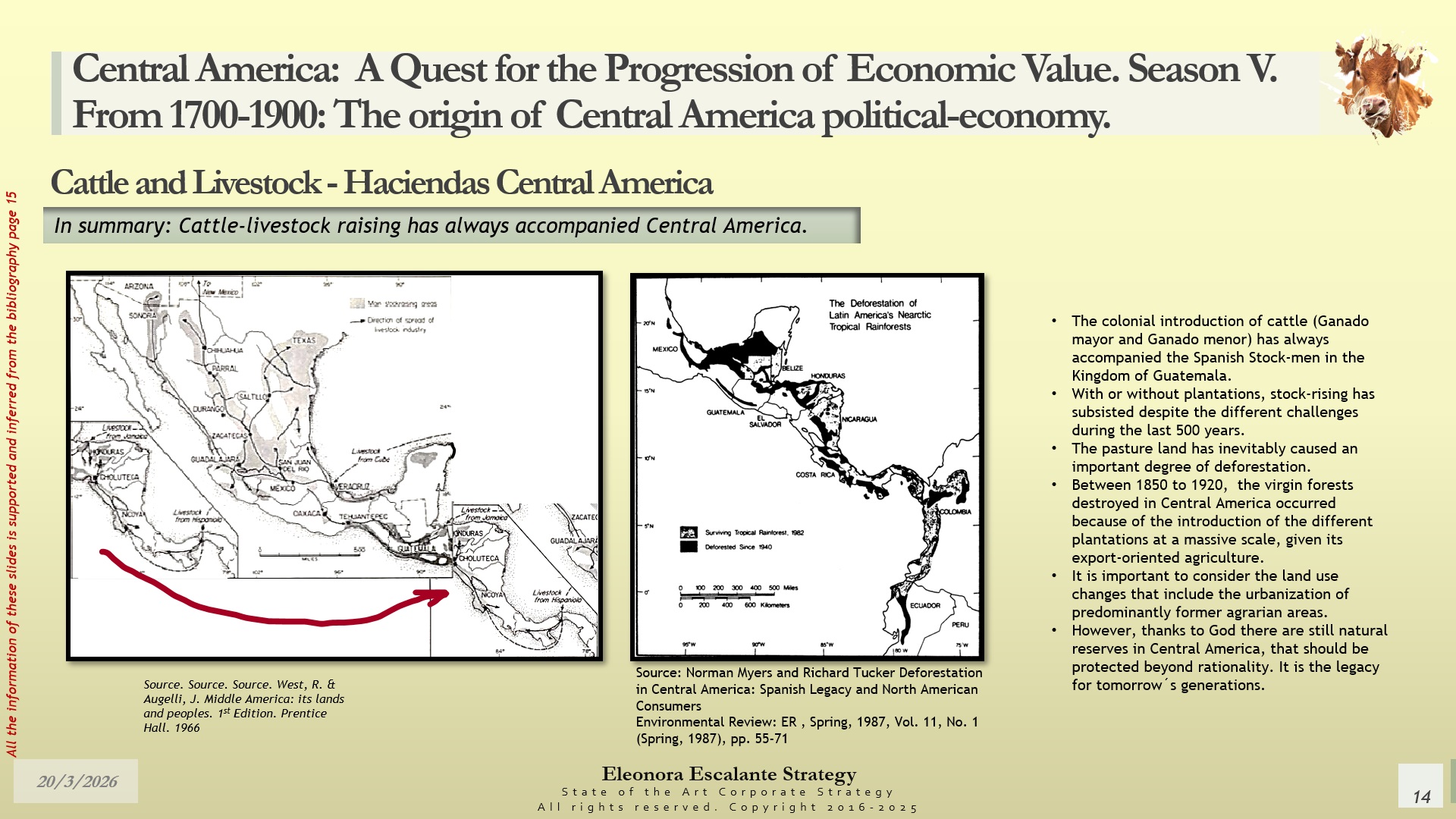
Learning about the origins of the cattle industry in this region opens our minds to the most debatable relationship between cattle rising and deforestation.
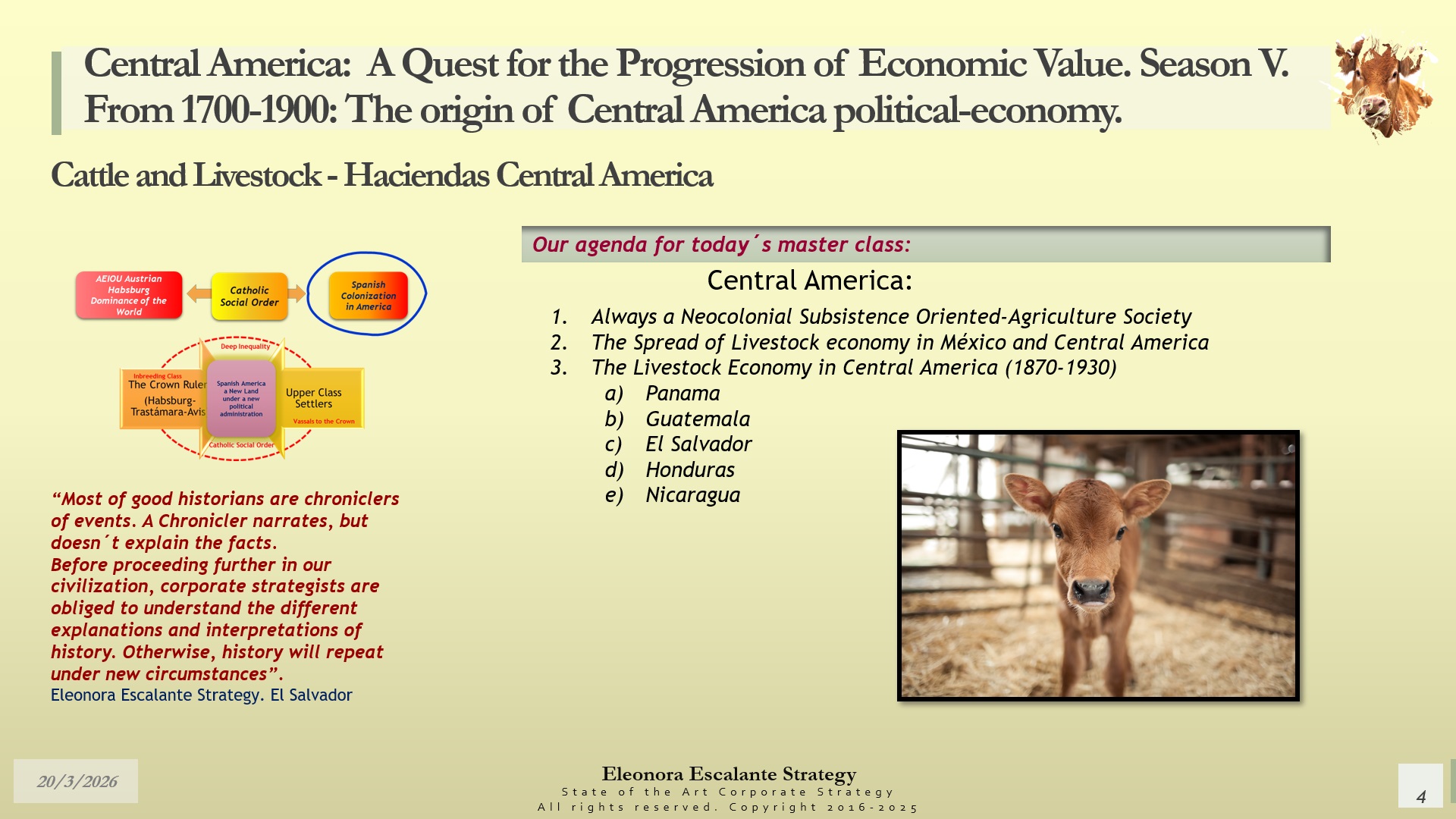
Our agenda for today is simple and short, practically a general overview without numeric analysis. It has been extremely difficult to find accurate information and data about this economic sector in the context of the liberal transition of the banana republics to coffee at the end of the 19th century. Our topics below:
- Central America: Always a Neocolonial Subsistence-Oriented Agriculture Society
- The Spread of Livestock Economy in México and Central America
- The Livestock Economy in Central America (1870-1930)
- Panama
- Guatemala
- El Salvador
- Honduras
- Nicaragua
For now, find our reference material for today´s masterclass. The core of our class is ready for you. Feel free to download it, print it, read it with your friends, family, colleagues, and acquaintances.

We kindly ask that you return next Monday, March 23rd, 2026, to review our extra strategic reflections on this chapter.
We encourage our readers to familiarize themselves with our Friday master class by reviewing the slides over the weekend. We expect you to create ideas that are or are not strategic reflections. Every Monday, we upload our strategic inferences below. These will be discussed in the next paragraph. Only then will you be able to compare your own reflections with our introspection. We always give our students a couple of days to prepare well before our final reflection.
Additional strategic reflections on this episode. These will be in the section below on Monday, March 23rd, 2026.
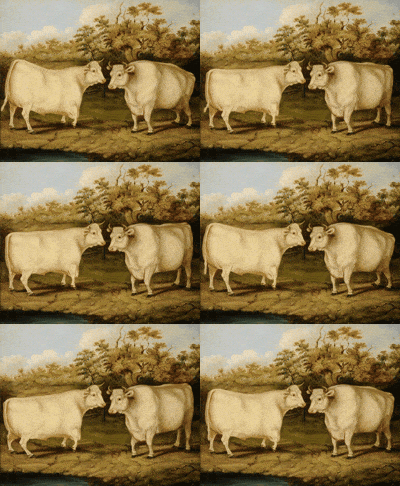
Strategic Reflections on “Central America: A quest for the progression of economic value. Bonus Season V. Episode 11. Cattle and Livestock-Haciendas Central America.
The history of our agrarian economics is the history of the use of the land of Central America.
Until the beginning of the 19th century, Central America, as a region understood between Oaxaca-Soconusco-Chiapas, Yucatán, Guatemala, down to Costa Rica, was the backyard of a royal household that was not interested in producing beyond what was needed for the domestic subsistence and well-being of the people living in the region. The Habsburg constellation of families before the ascension of the Bourbons into power was not inquisitive in developing any industrial paradigm in the region, regardless of the economic promises of prosperity. Their philosophy was not of the extraction of silver and exploitation of the riches for economic success. Their thinking was to protect the region because it was their territorial new house with multiple provinces of some related families and numerous descendants of the military orders who accompanied them in the conquest and colonization of the native Indians. Hernán Cortés (who we truly consider a member of the dynastic gathering Habsburg-Valois-Castile-Aragón) was not a diligent conqueror; he was the audacious and brave royal king or prince who came to colonize his new land on the other side of the Atlantic. In consequence, the history of his decision-making (and that of his descendants) is not Eurocentric-based, but the history of Spanish America. The Kingdom of Guatemala was the kingdom of Charles V, a Habsburg-Valois/Castile-Aragón descendant, and Antigua Guatemala played a pivotal role in the equation. The rest of the territories were viceroyalties, not kingdoms, and there is a core reason for it. Middle America was the conjunction of the viceroyalties of the North and the South. It was their home, and the land, their garden, and backyard. No king of great honor, as it was the monarchical philosophy of the 16th century, would have monitored the conquest of this region via remote control from Spain. It wasn´t like that then.
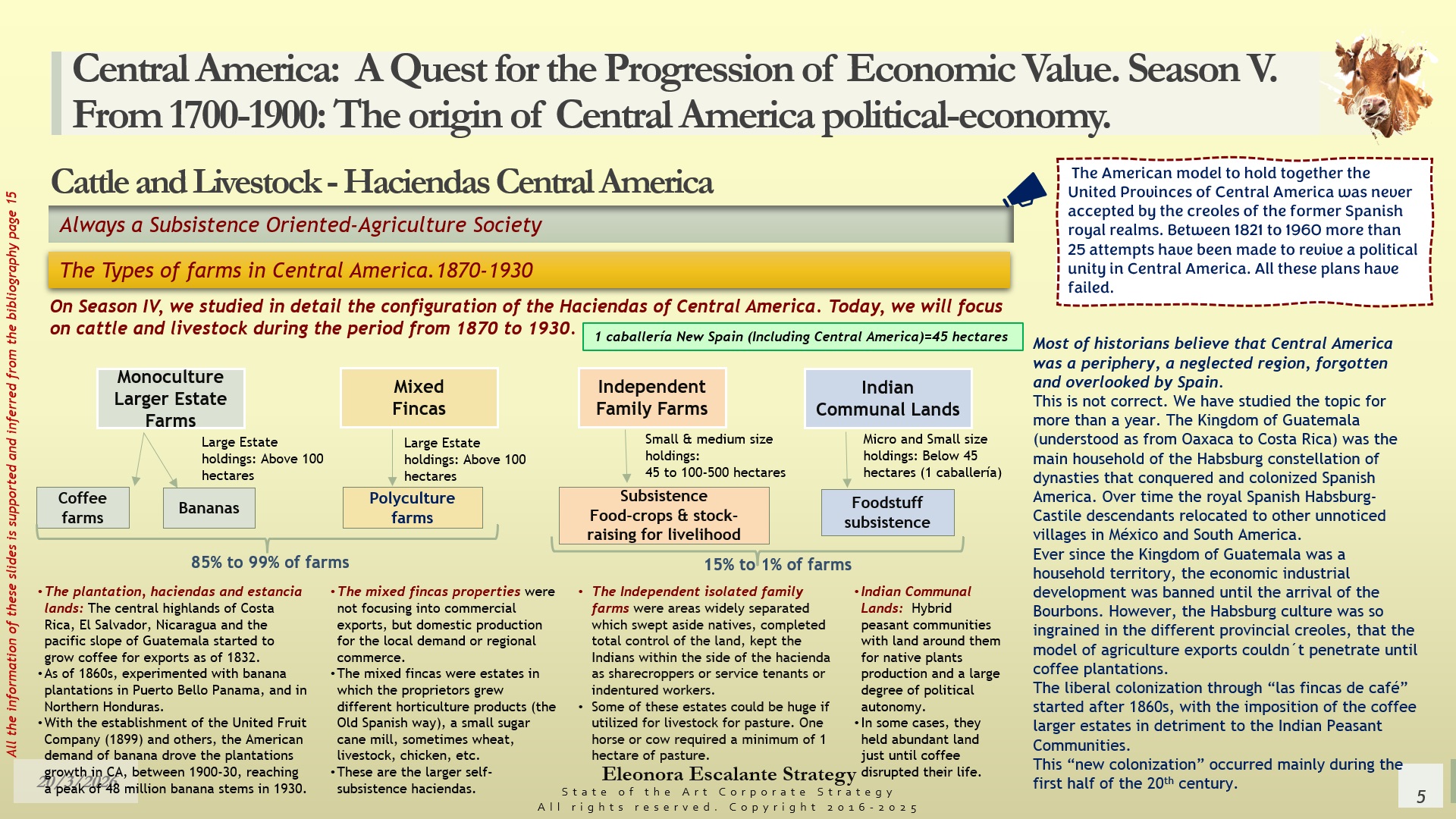
Always a neocolonial subsistence-oriented agriculture society. Slides 5 and 6.
On season IV, we dedicated several episodes to studying the land use of the Kingdom of Guatemala. We advise you to revisit Season IV, and explore Episode 4 (Independence Bells 1800-23) Part 2; Episode 7 (Philosophical Foundations of Agricultural Liberalism 1870-1900), and Episode 9 (The consolidation of the Hacienda Model in Spanish America). According to León García Garagarza (1), the Spanish takeover of Tenochtitlan inaugurated the transformation of the landscape of Mexico after 1521, because the Spaniards introduced cattle and sheep for ranching: The human population crashed in function of the livestock population that soared. The native Aztecs observed how their horticulture cultivated lands were converted into pastures with herds of foreign animals that roamed freely all over. In consequence, the cattle husbandry in the New World was not only associated with a dietary and wealthy sign custom of the Spaniards, but it was also a “dépouillement” tool for land expropriation and land colonization against the indigenous. This model inserted the cattle in the places where the natives once upon a time cultivated maize and other subsistence harvests. This situation also expanded in the Kingdom of Guatemala. The cattle, horses, donkeys, sheep, goats, pigs, and chickens reproduced. The lands managed by the conquistadors’ forces received the vast grants from the Spanish Crown. These lands were given with the specific purpose of producing foodstuffs and raising livestock. The Catholic orders role-modeled the new model of living and helped to evangelize and control the Indigenous communities. Between 1521 to 1550s, the introduction of European animals opened the door first to expel the natives, and then the cattle estancias and haciendas were established. However, there were properties left for the Natives. Despite all, the Catholic orders kept the three sub-economies hanging together, since the friars acted as arbitrers between the Spaniard-Creoles and the Indigenous. The expansion of ranching was predominantly greater in the Viceroyalty of New Spain in comparison to the Kingdom of Guatemala, but the reproduction of the livestock population in free-range grazing land created considerable social tension. It is estimated that more than 1,300,000 cows populated New Spain, and 1/3 of them were found in the tropical lowlands of Central America. Extensive grazing created a new economy based on animal husbandry over pastures, with the roll-out of deforestation, causing large-scale erosion, never before seen in the region. The pattern of the use of the land during the 16th century continued all over the next three centuries throughout the Kingdom of Guatemala. The migration of the natives to the mountains was a consequence of the Spanish appropriation of the land by raising livestock, shifting patterns of crops to cacao, then indigo, cochineal, coffee, and, much later, bananas. And it is in this context that we arrive at the land structure explained in slides 5 and 6.
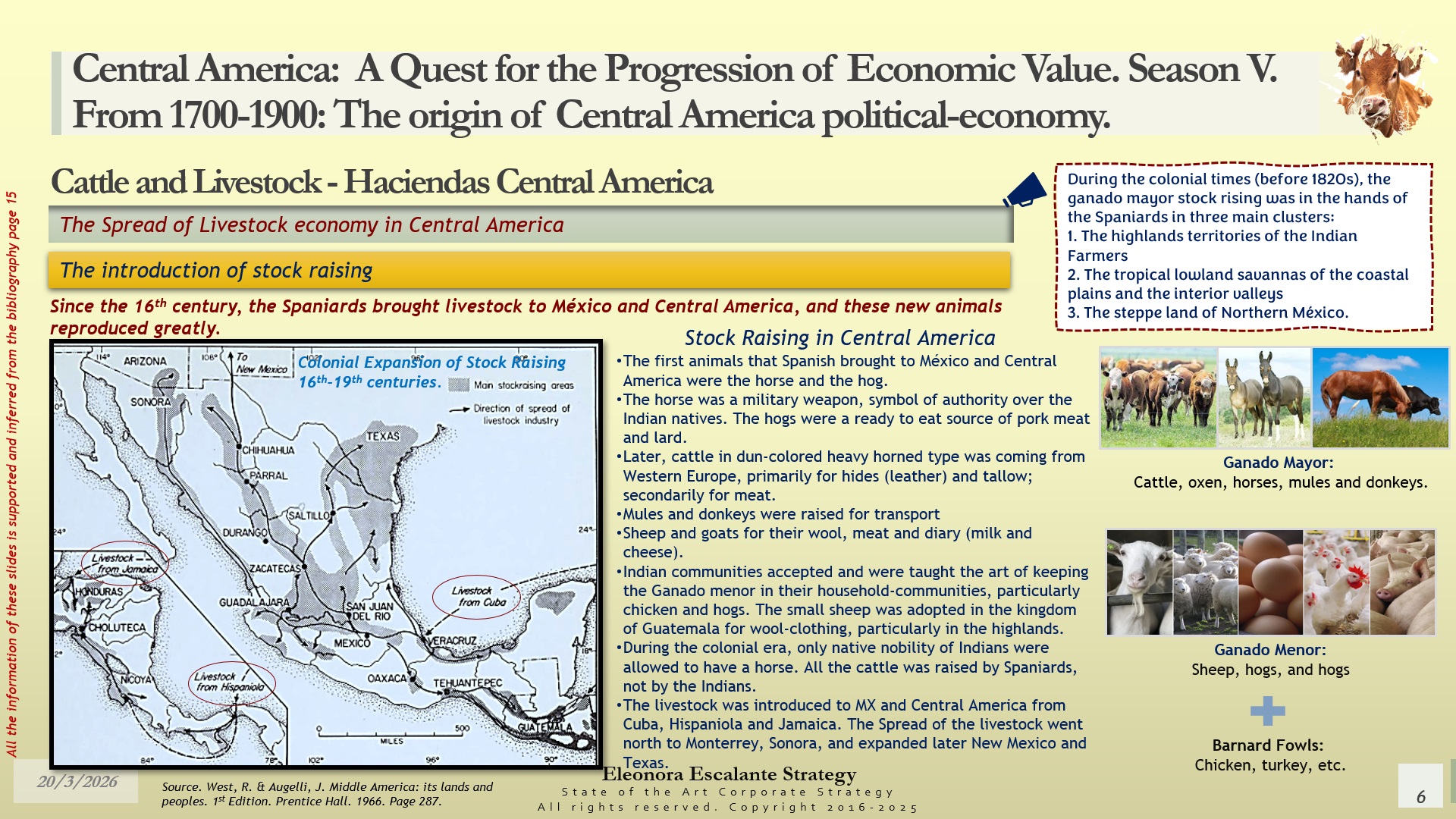
The Spread of the Livestock Economy in Central America. Slides 7 and 8.
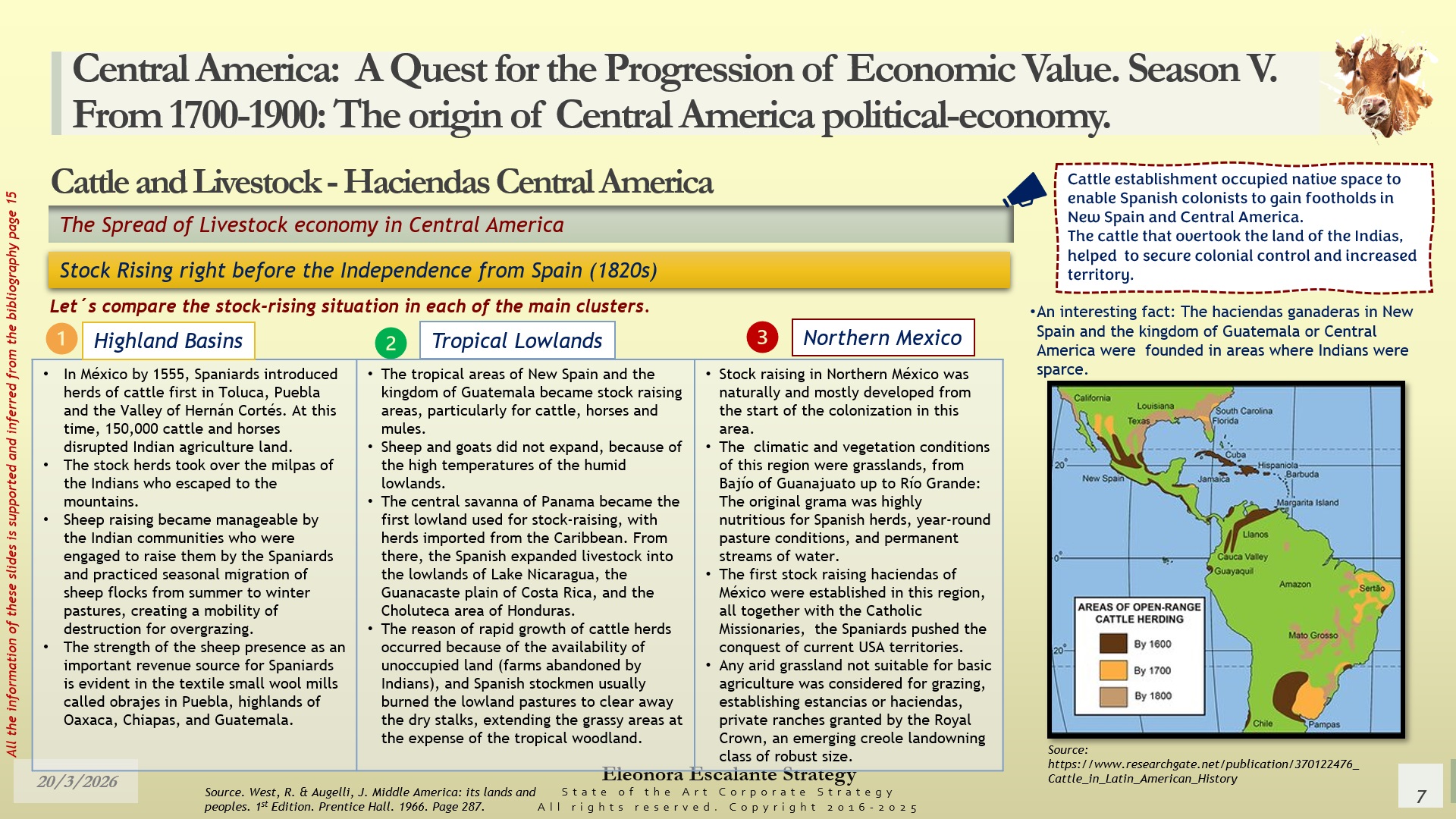
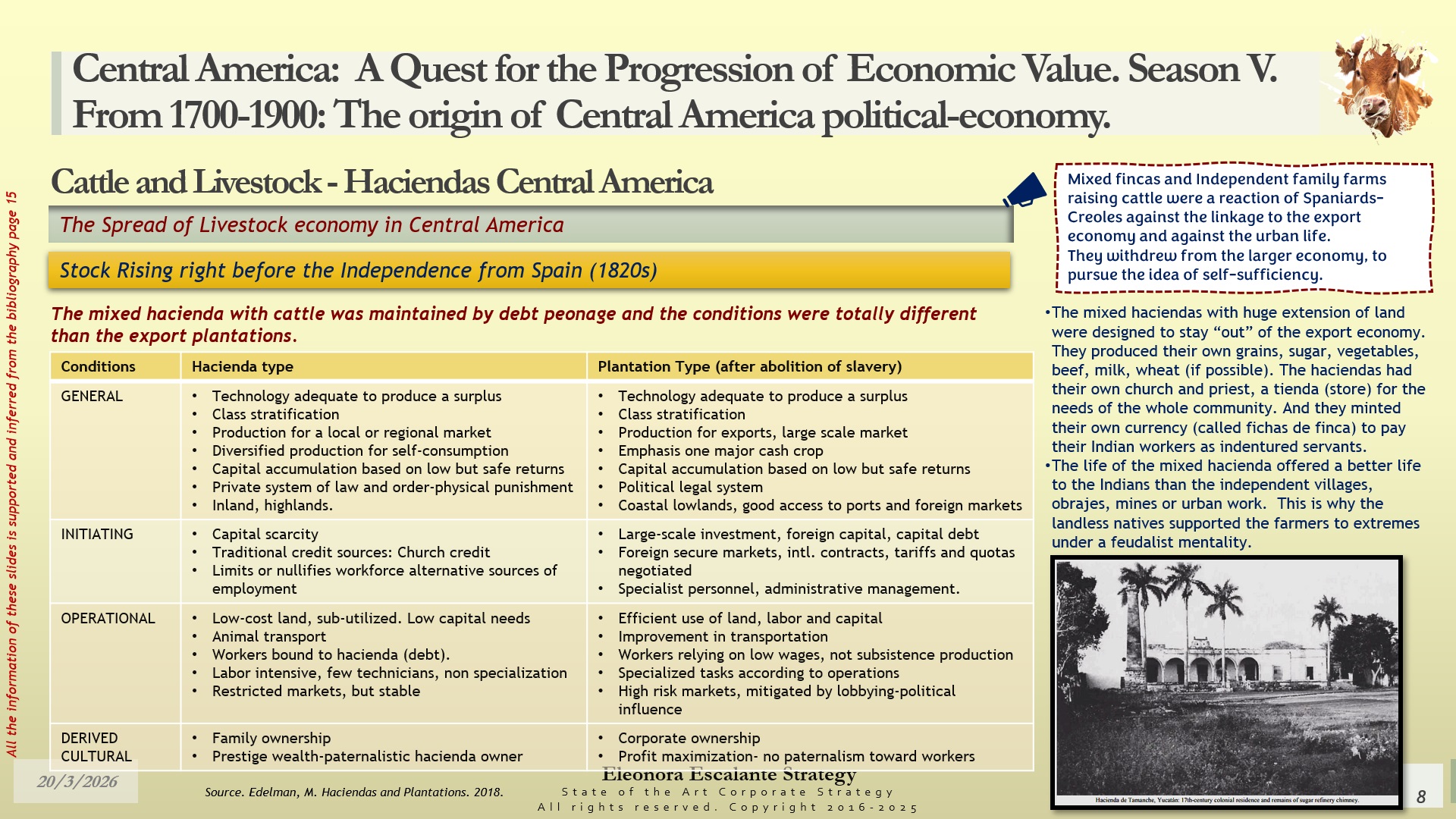
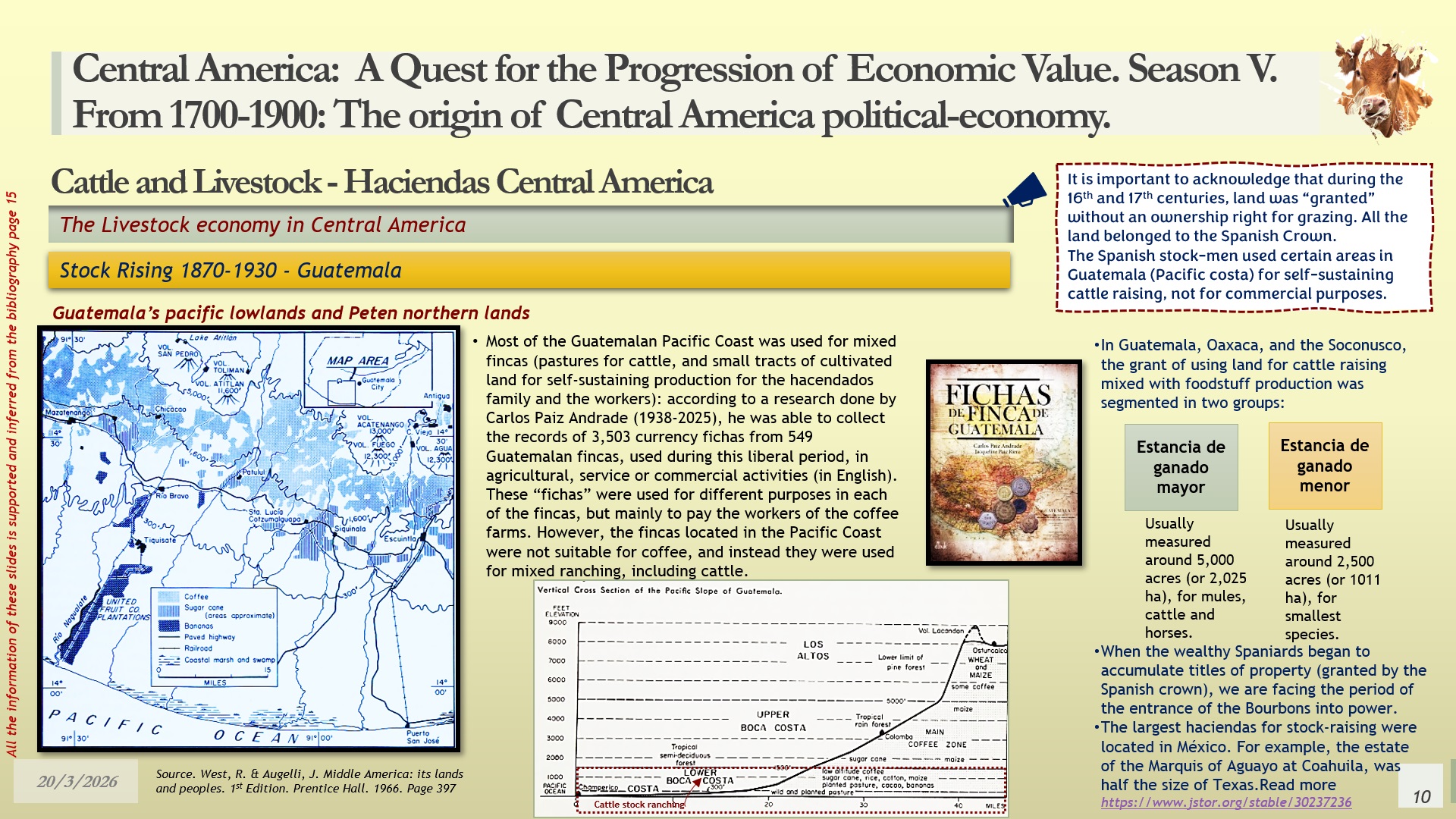
The livestock expansion in the region was already in place when the Independence from Spain (1820s) occurred. With the liberal government agenda in each of the nations of Central America, it is natural to comprehend how the liberal value proposition of “attaining prosperity by producing agrarian-specific exports for the international marketplace” materialized. Despite the political turmoil between conservatives and liberals, the hassle of this global model took place. Suddenly, the garden backyard of the safe land of the Habsburg-Valois/Castile-Aragón descendants was left in the middle of a neocolonial setting, with an imposed libertarian economic agenda, while the Indian caciques and the native communities observed how their lands were again disrupted with the introduction of coffee (sugar was not a relevant monoculture yet in the Kingdom of Guatemala). Most of the Indian populations resented but endured the process during the 19th century; some rebellions occurred in the Altos of Guatemala (during the lifetime of Rafael Carrera as a conservative dictator). We have already explained the political situation of these upheavals when dispatching Season IV. However, the pressure of the new fincas de café expansion was not isolated. Other export crops were popping up during this century. Each nation was facing the burden of dismantling the Sacred Indian Villages. Charles V HRE and his squat team (1520s) didn´t have the emotional gut to ruin that model three centuries before, but after the Independence from Spain (1820s), there was nothing of power from Spain and no one who could stop the liberal agenda. The Jesuits were already gone. The Habsburg-Castile colonial division between the sacred Indian Villages tamed by the Catholic Friars, and the Spaniard urban cities was nullified. And that is how the agrarian wage-earning class materialized. The fincas de café and the banana plantations (of the 20th century) were the new emerging milieu. Still, the livestock raising was growing in parallel, and the pastures continued to take over the savanna territories in the Highland Basins, Tropical Lowlands, and Northern Mexico. See slide 7. Edelman (2) illustrates the differences between a hacienda and a plantation. We have prepared a comparative table in slide 8. Studying this comparison pushes us to question ourselves: If you were a Native American living in this disruptive context, which of these two models would you choose? Both land-tenure structures involved the expropriation of their communal lands and the natives’ own subsistence households. The labor system utilized was not slavery, but indentured labor. Each finca used “fichas as currency,” because metal coins were not in place, there was no unique currency by law, nor a Central Bank in place as a monetary provider. There are a few authors who have taken the toil to compile the “fichas de finca” or “boletos” as part of collecting historical numismatic records about the situation: Carlos Paiz Andrade (3), Alfredo Hermes Iriarte (4), Jose Luis Cabrera Arévalo (5), and Carlos Rodríguez Madriz (6).
The Livestock Economy in Central America: 18th-19th centuries. Slides 9 to 13.
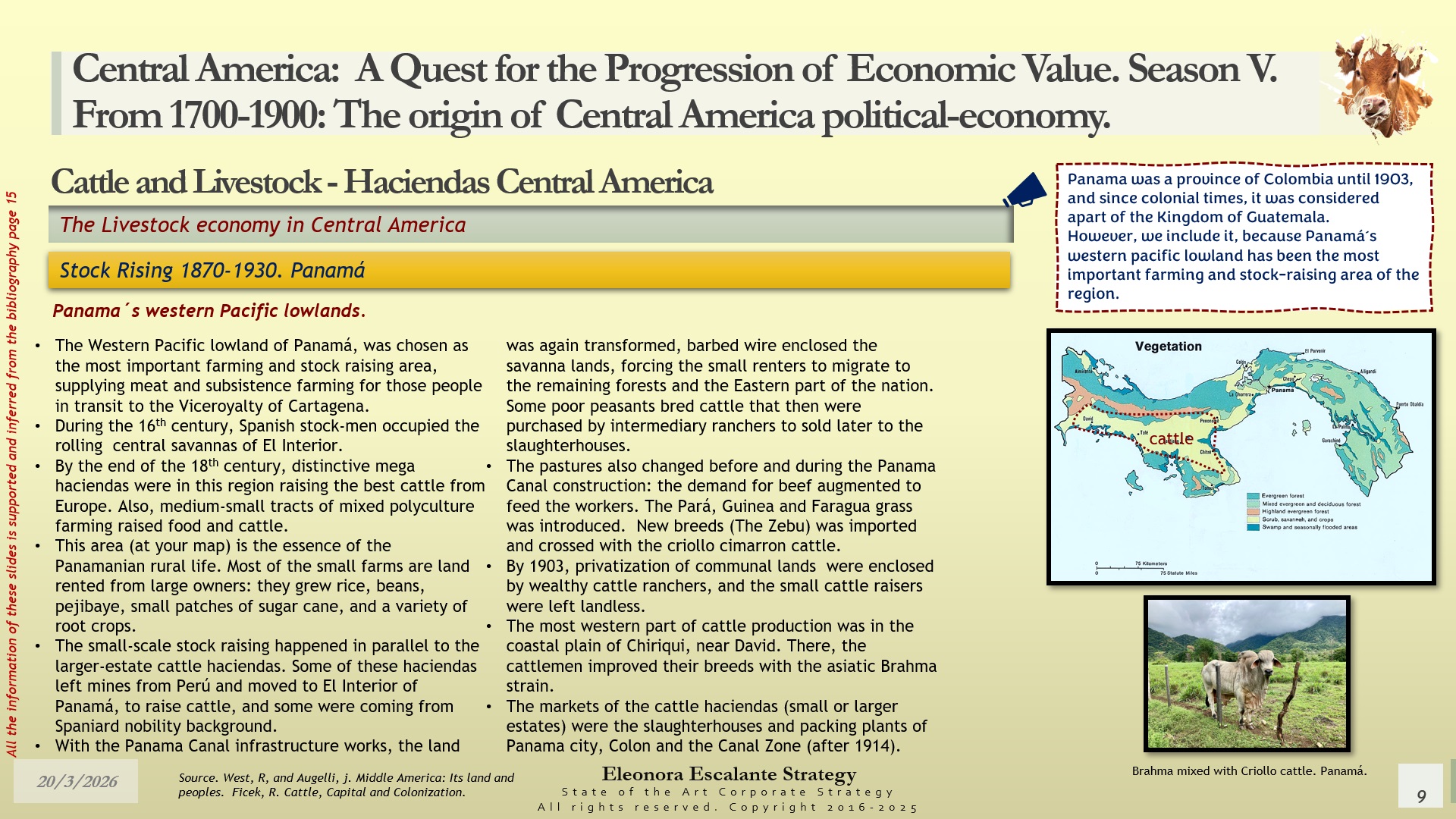
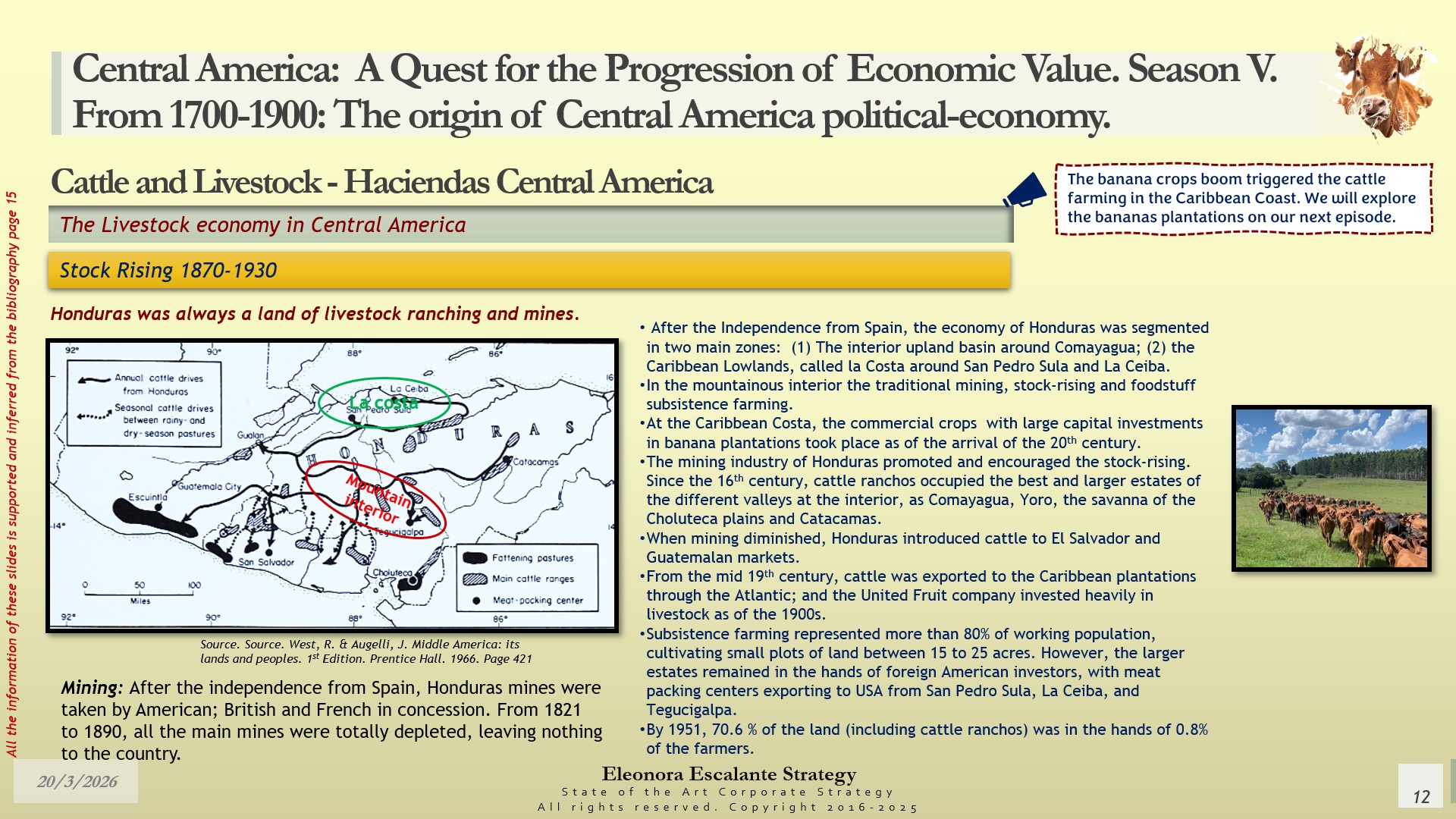
We have focused our attention on the period between 1870 and 1930. After days and hours of looking for data and reliable information that could offer us a baseline for an industry analysis of stock-raising during that period, we found a vast, empty academic chamber. The story is different in México, but in the Kingdom of Guatemala, we were only able to find general facts. It is clear to us that the big haciendas of México, in which the core business was cattle-raising, didn´t occur as such in the Kingdom of Guatemala. Central America, after its independence from Spain, was totally fragmented in 5 republics. The heritage of the land structure then was of the structure of mixed fincas, the type of polyculture farms with some partial holdings dedicated to stock raising. In relation to Guatemala, the mixed fincas of café were on the Pacific coast, where there was an abundance of wild and planted pastures. The exception was the ranchos of Honduras, which were vast and omnipresent in the interior upland basin, and later in the Atlantic coast of Honduras. The mining industry of Honduras introduced cattle and triggered a unique rancher culture with no comparison with the rest of the nations. Authors Robert West and J. Augelli have provided us with enough information that we believe to be authentic, as the base of our current analysis (7).
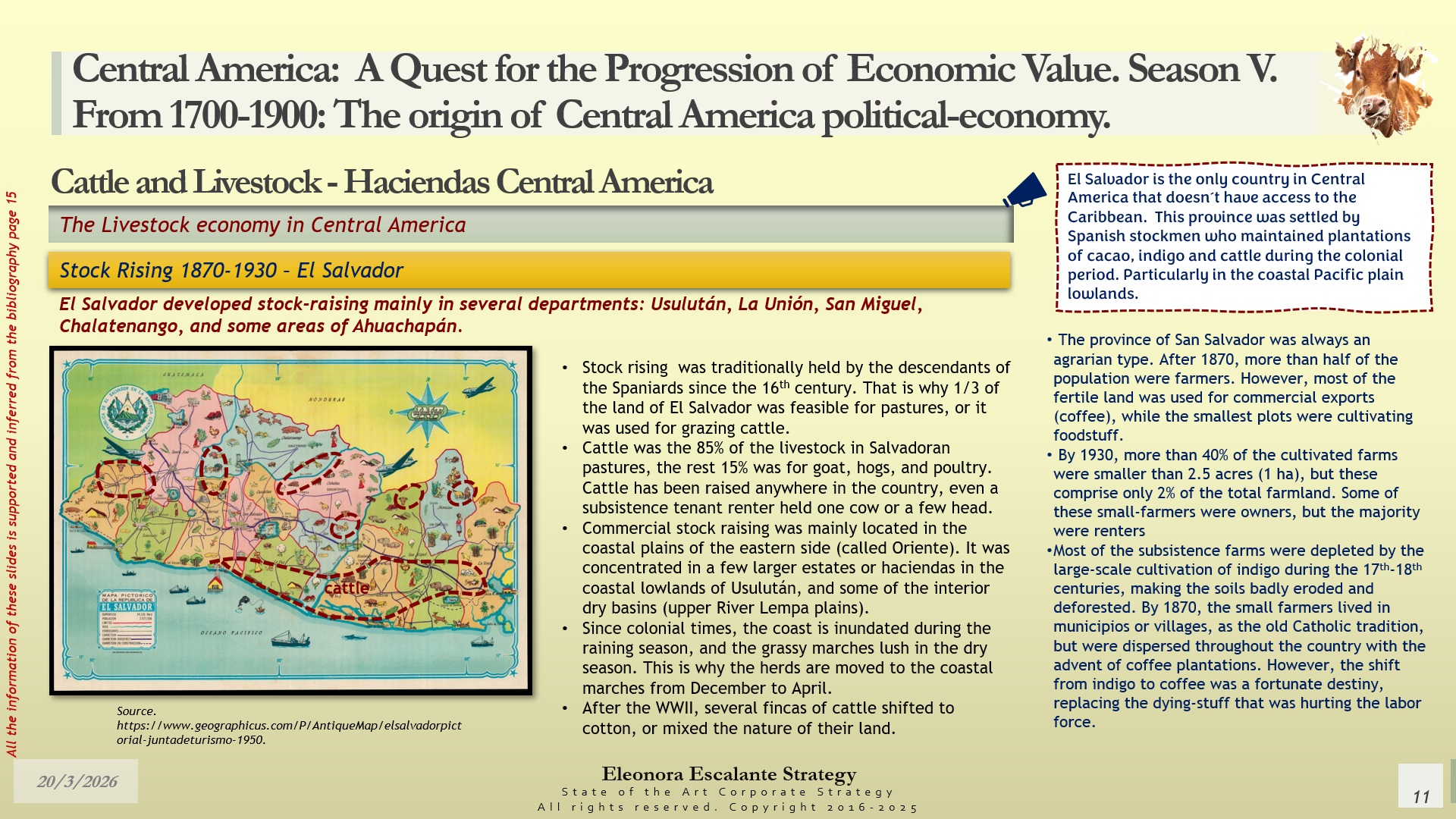
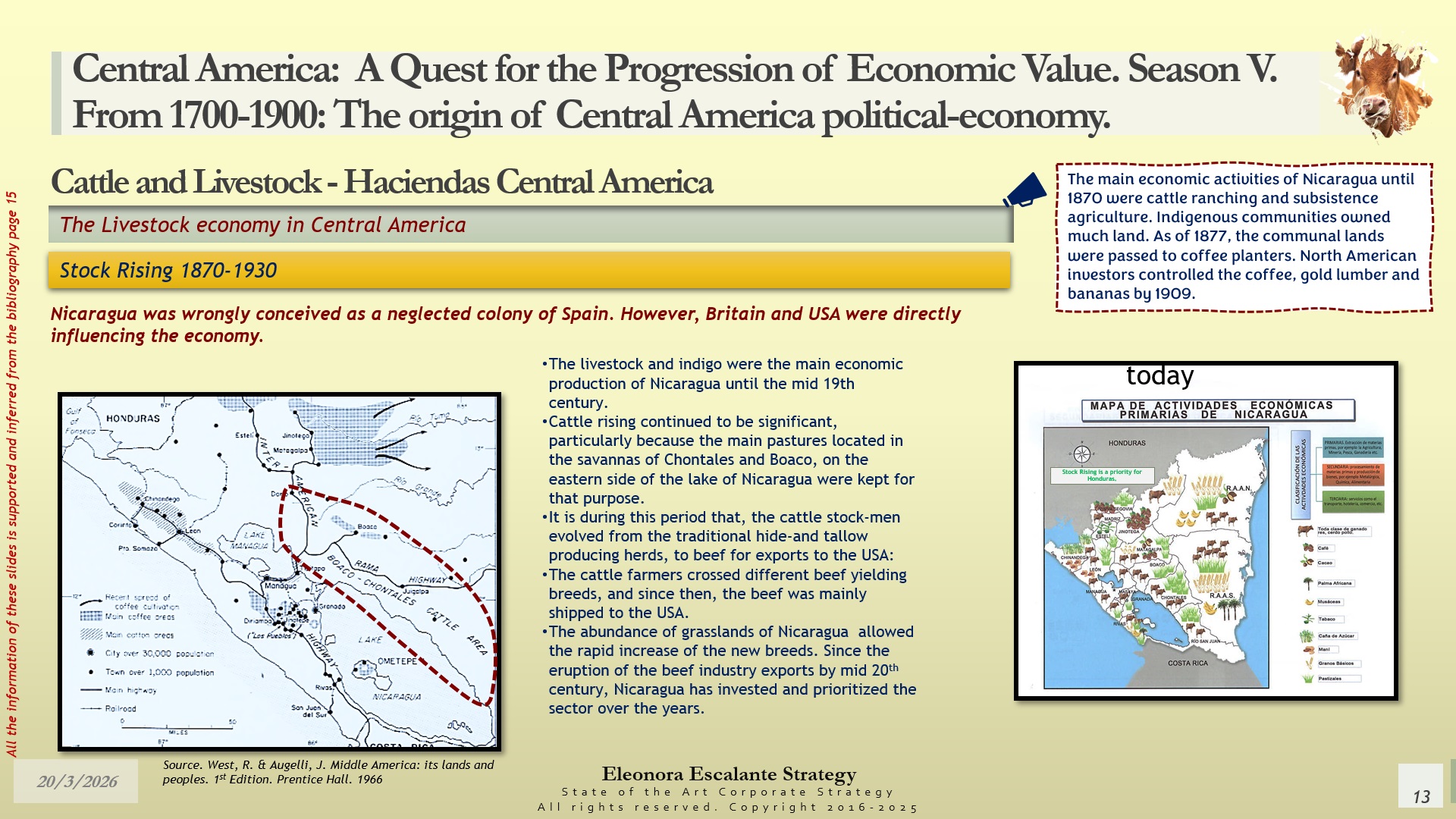
Nowadays, in Honduras, Olancho, the stock-raising is a traditionally male-dominated way of life defined by extensive land use, high-value beef production, and rural self-reliance. We assume it is the heritage of the colonial cowboy culture of mixed fincas that existed during the colony. In the case of Nicaragua, the cattle hacienda is also a nascent industry that slowly developed during the 20th century. For instance, in El Salvador, there are historic records of foreign families that established mixed fincas, with a focus on cattle raising, particularly in the oriental zone: San Miguel, Usulután, Morazán (near Nahuaterique), San Vicente, and La Union. However, it is significant to notice that the dedication of El Salvador to the cultivation of indigo took a toll on the deforestation of the land. Again, take notice, the land of the El Salvadorian hacendados had different soils and levels above the sea, and mixed farming uses. Some part of the land was used for stock raising before the Independence from Spain, but it wasn´t until the 20th century that the land for stock raising grew to relevant proportions. The uprising of the Izalco natives in 1932 is a proof of evidence of the accumulated restlessness of the indigenous populations, who were facing pressure from the expanding commercial agriculture through coffee. The cattle interests over their land were also part of the problem. Since the fincas were mainly developed for coffee exports, that does not mean that part of those fincas were not used for cattle ranching, particularly in the northern part of Ahuachapán. Though the peasant rebellion of Izalco and its surroundings was an announced chronicle. “Numerous violent uprisings were recorded between 1872 and 1898 among the Indian peasant communities in the western part of the country” (8). We suggest that the ideology of the members of the newly formed Communist Party of El Salvador manipulated the discontent of the peasants. At the end, it has been estimated that between 10,000 and 30,000 civil peasants died (9) in a cruel retaliation move from the military forces of President Maximiliano Hernández Martínez. The epicenter of the massacre was the main coffee-producing zones located on the western side of the country, where depression-induced wage cuts struck severely. A worthy fact: the oriental (eastern side) of El Salvador, where the pastures flourished, and the cattle industry was growing in the hands of foreign newcomers who mingled with the criollos, was not a nest for rebellions then. Maybe because of the fear of the population, a cause of the military repression that compelled the mutiny of Anastasio Aquino of the Nonualcos (Department of La Paz) of 1832-33 (10). This event was so shocking to the Eastern peasant community that no relevant insurrection occurred there until the Salvadoran civil war of the 1970s.
In summary, stock raising was a relevant part of colonial life during the time of the royal Habsburgs in Central America. However, the philosophical allure of keeping the sacred rural Indian village in parallel with the Spaniards’ dwelling in the new urban cities was scrambled with the introduction of the liberal agenda and coffee exports in the region. The Habsburg modus vivendi of the Kingdom of Guatemala, as the garden backyard of the dynastic territories, was totally disrupted. The insurrections and native rebellions began to occur in the transition to a liberal export economy. Cattle came with the Spaniards since Hernán Cortés and Pedro de Alvarado, and their growth occurred mainly in the areas where mining was flourishing (Honduras). The fragmentation of the industry is well displayed in our presentation slides. The livestock industry expanded during the 20th century, with the arrival of European foreigners who intertwined with the criollos.
Closing Words. Foreign cattle and Spaniards came together to disrupt the Native American Populations of America. Stock rising was an important axis of the colonial economy of the Kingdom of Guatemala. However, the territorial geography of the mountains all over the region kept the stock rising towards the tropical Pacific lowlands, except for Honduras. After the independence from Spain, the criollos with concealed Habsburg-Castile descent leadership were reluctant to change. The 19th century shows how hard it was for them to surf the waves of the North American agenda. When the imbalance to change the land structure towards coffee plantations touched the sacred Indian villages, rebellions and insurrections ocurred. The military repression against these revolts created an immense fear and a huge polarization that resonated later during the 20th century. The theme of the land in the hands of a few is a recurrent topic that
has not been solved yet in many countries of Latin America. Land Inequality has been the source of problems since Charles V HRE’s arrival in the region. Nowadays, with the digital giga-economy, we are also
facing the same problem in different circumstances.
Announcement.
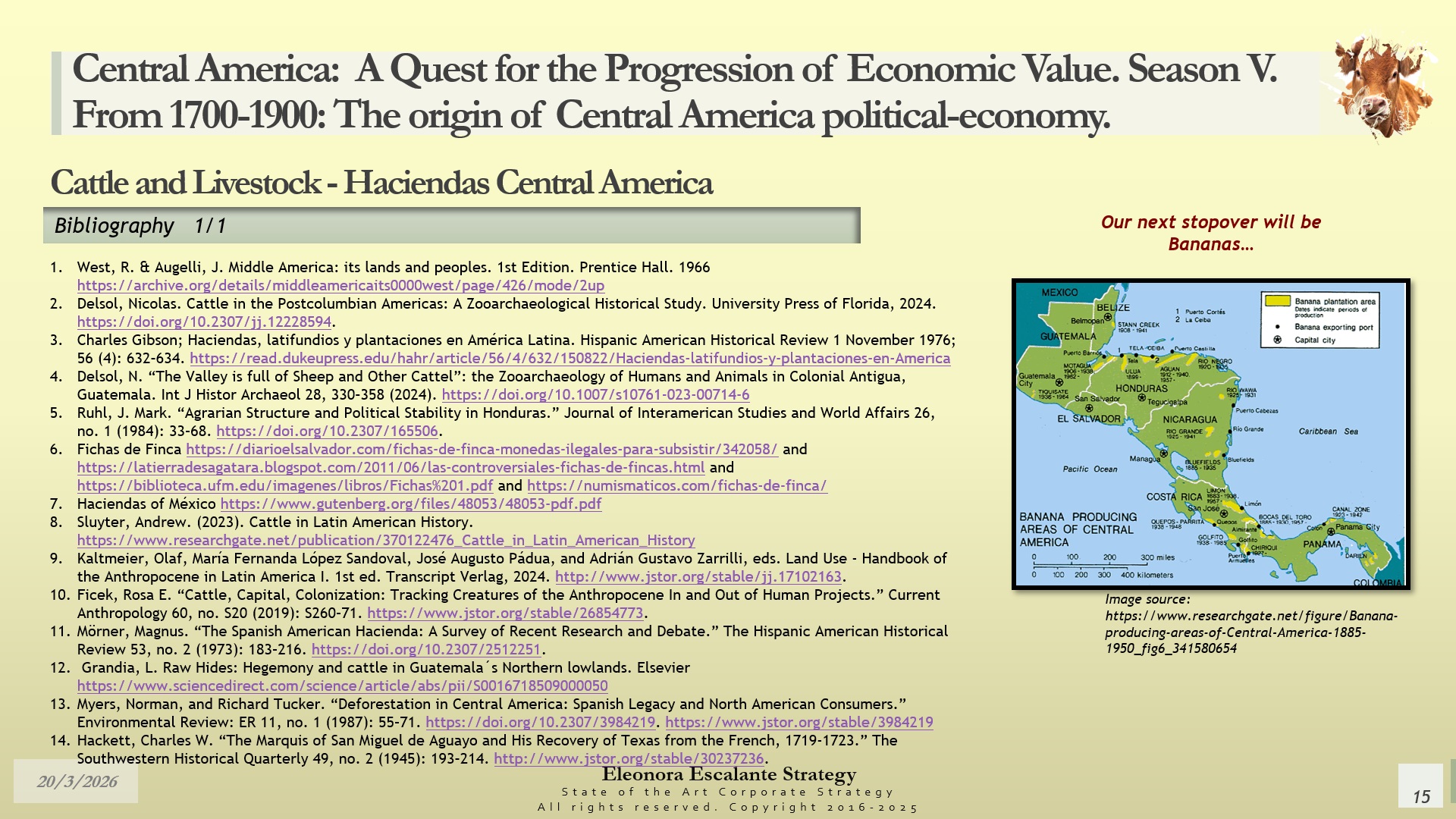
Next week will be about bananas in Central America, the origins of the plantations.
Musical Section.
During our closing bonus season V, we will return to the symphonic, philharmonic, or chamber orchestra compositions. Today, we have chosen conductor and highly recognized American composer John Williams. With his œuvre, The Cowboys Overture. We invite you to visit his biography. Williams has had a career of more than 50 years with 21 honorary degrees in music from the most recognized universities in the world. However, his precious origins were tied to the traditional piano. The piano is like magic for anyone who harmonizes to compose music as Williams has done. https://www.johnwilliams.org/reference/biography
Enjoy!
Thank you for reading http://www.eleonoraescalantestrategy.com. It is a privilege to learn. Blessings.

Sources of reference and Bibliography utilized today. All are listed in the slide document. Additional material will be added when we upload the strategic reflections.
- Few, Martha; Zeb, Tortorici. Centering Animals in Latin American History. Duke University Press. 2010. Chapter 1. The Year the People Turned into Cattle: The End of the World in New Spain, 1558 by León García Garagarza. https://www.dukeupress.edu/centering-animals-in-latin-american-history#Rights
- Edelman, Marc. Haciendas and Plantations: History and limitations of a 60-year-old taxonomy. Sage. Pub. 2018. https://academicworks.cuny.edu/cgi/viewcontent.cgi?article=1589&context=gc_pubs
- Paiz Andrade, Carlos. Fichas de Finca de Guatemala. D´Buk Editores. 2014. https://tienda.sophosenlinea.com/libro/fichas-de-finca-de-guatemala_203748
- Hermes Iriarte, A. Fichas de Finca y Misceláneas de Guatemala. 1988. 4 volumes. https://biblioteca.ufm.edu/opac/record/1069588
- Cabrera Arévalo, J. Las controversiales fichas de fincas salvadoreñas: antecedentes, origen y final. Universidad Tecnológica de El Salvador. 2009. https://isbnelsalvador.binaes.cerlalc.org/catalogo.php?mode=detalle&nt=3456 and https://searchworks.stanford.edu/view/8504509
- Rodríguez Madriz, Catálogo de boletos de café: Costa Rica 1840-2021: reseña histórica de boletos y sus caficultores. Fundación Museos Banco Central de Costa Rica, 2021 https://www.iberlibro.com/Cat%C3%A1logo-boletos-caf%C3%A9-Costa-Rica-1840-2021/31622549230/bd
- West, Robert C., and John P. Augelli. Middle America: Its Lands and Peoples. Englewood Cliffs, N.J. Prentice-Hall. 1966. https://archive.org/details/middleamericaits0000west_s4r4/page/438/mode/2up
- Kincaid, A. Douglas. “Peasants into Rebels: Community and Class in Rural El Salvador.” Comparative Studies in Society and History 29, no. 3 (1987): 466–94. http://www.jstor.org/stable/179034.
- Commemoration of Indigenous People Massacre in 1932. https://www.cipdh.gob.ar/memorias-situadas/en/lugar-de-memoria/conmemoracion-de-la-masacre-indigena-de-1932/
- Ramírez Fuentes, J. A. Anastacio Aquino: icono histórico de los Nonualcos. Central American Online Journals. Revista de Humanidades y Ciencias Sociales. El Salvador. December 2016. https://camjol.info/index.php/rhcs/issue/view/933
Disclaimer: Eleonora Escalante paints Illustrations in Watercolor. Other types of illustrations or videos (which are not mine) are used for educational purposes ONLY. All are used as Illustrative and non-commercial images. Utilized only informatively for the public good. Nevertheless, most of this blog’s pictures, images, and videos are not mine. Unless otherwise stated, I do not own any lovely photos or images.
 Eleonora Escalante Strategy - Strategic Reflections Think Tank