
Central America: A Quest for the Progression of Economic Value. Bonus Season V. Episode 19. Grand finale.
Strategic Reflections on A Quest for the Progression of Economic Value. Bonus-Season V. Episode 19. Grand Finale.
Wrap Up Takeaways
- The darkness of not knowing the truth about the conquest of America. Did the royal kings of Europe come together under the crusade mission of “Conquest America Inc.” as of 1521? This is important because if that is true, at least 6 dynastic nations are responsible for the good and the bad of 500 years of history: Spain (Castile-León-Aragón), England, France, Belgium (Spanish Netherlands), The Low Countries, and Austria. The ambiguity of not knowing the real responsible of the conquest and colonization has positioned Spain as the main blameworthy for the history of our disastrous situation. The Spanish legacy of hiding the truth for 500 years. Why?
- The role of the military orders at the service of the King. This piece of information is another one that has been hidden for 500 years. The knights under the authority of the kings who came to discover and conquer America were not rebellious, mean opportunists. All of them were members of the SWAT security of the king of Spain. In the case of the Kingdom of Guatemala, the Villa Santiago de los Caballeros of Antigua Guatemala was guarded by a knightly military order of top caliber (the equivalent today to the US Navy SEAL or the British Top-Tier Global Special Operations Forces), and no indigenous person would have survived without the direct protection order of the King of Spain. The scenario of a Spanish monarch creating a strategic matrimonial alliance with a Mayan Princess is not out of mind. Particularly if the Kingdom of Guatemala was chosen as a new vacation or temporary royal household. Would it be possible that a monarch of Spain felt madly, deeply, and truly in love with a Mayan descendant Noble? There is no other rational justification for why the Indigenous survived at that time.
- The presence of the king when conquering regions. It is impossible that an operation such as Conquest America Inc. would have occurred without the participation of the Habsburg King of Castile-León and Aragón. In the case of warfare for territorial expansion, which is the equivalent of horizontal growth today, during the 16th century, the kings did not send their militaries to conquer; they fought with them for each inch of land. In consequence, for Eleonora Escalante Strategy, the conquest of America is not separate from the chronicles of the kings of the corresponding European dynasties involved in the pedigree of Charles V, Holy Roman Emperor (Habsburg-Valois/Castile-Aragón) and his grandparents’ ancestors (Emperor Maximilian I Habsburg-Piast/Aviz-Aragón, Duchess Mary Valois-Aviz/Bourbon-Valois of Burgundy, Queen Isabella Castile-Lancaster/Aviz-Braganza, and King Ferdinand II de Aragón Enriquez-Castile/Enriquez de Mendoza-Fernández. All these families were integrated into the main ultimate persona of the conquest of America: Charles V HRE (1500-1558).
- Central America was planned as a secret, hidden royal household (for vacations or for good?). The catholic kings (Castile-Aragón) at the time of the passing of Philip I Habsburg, did not have a main household in Spain; they were moving from town to town, from palace to palace, when the discovery of America occurred. Historians have identified different locations where the kings spent their time throughout the year: they mention the Alhambra Palace as of 1492, the Medina del Campo Castle, the Alcazar of Córdoba, the Alcazar of Segovia, the Palace of Infantado of Guadalajara, the Palace of Madrigal de las Altas Torres, the Alfajeria Palace, the Alcazar of Toledo, the Sada Palace, etc. The same practice was held by Maximilian I Habsburg-Aviz, who was also a nomadic king moving from his different houses at Innsbruck to the Hofburg Palace in Vienna. This consistent pattern is found in the life of the son of Charles V, Philip II, who was also an itinerant king in Spain, and was moving from his main palaces at El Pardo, Toledo, Aranjuez, El Escorial, Valsain to his countryside cottages while he was voyaging. In consequence, if we extrapolate that pattern to Spanish America, it is not difficult to conclude that the Spanish Habsburgs built several royal households all over this Latin-American region, and one of them was in the Kingdom of Guatemala.
- The Habsburgs and all the royals associated with this dynasty were experts in arranging dynastic marriages. These marriages outperformed the lives of the entangled couples, and the impact of those matrimonial alliances created tacit pacts between the families that could last for more than 500 years, when it comes to territorial expansion. These arrangements could only be dissolved by warfare. In the case of the Habsburgs, they were specialists in the philosophy of organizing marriages in such a way that aristocratic ancestry was always privileged (by defense or expansion of the kingdom), while profiting from the resources of the territorial unions and enterprises coming out of those domains. This philosophy is still outstanding in the descendants of the royals, who still exist and are living under a concealed identity. The problem with this philosophy has been the inbreeding, which has caused horrible, extreme situations (Charles II’s mental illnesses and the hemophilia of the descendants of Queen Victoria of Britain).
- Charles V, chameleonic mystery. We dedicated a whole season to finding out who Hernán Cortés was. We elaborated three scenarios, of which we perceive a connection between Charles V Habsburg and Hernán Cortés. However, we still need the confirmation of the Royal house that owns the truth and can validate this secret of more than 500 years. We identified his genetic connections with the Eastern Paleologos family of the Byzantine Empire, his authority over all the kings, princes, and dukes of the German Nations. We researched certain lineages of his ancestors with the Wittelsbach (Bavaria), the Hainault (Holland), and the Plantagenet (Lancaster). Charles V was a man with a genetic complex mix that agglutinated all the main kingdoms of Europe. Even though other royal houses were traditionally prominent, it is not a coincidence that the Habsburg Holy Roman Empire was strengthened in Europe after the fall of Constantinople to the Ottoman Turkish Sultans. This is the reason why the Habsburgs had multiple conflicts with the Turks. We suggest that Vienna was only saved from the siege planned by Suleiman the Magnificent in 1529, after a mutual arrangement in which, probably, Mary of Hungary (the sister of Charles V) could have been exchanged under the fake identity name of Roxelana, the wife of Suleiman. What is true is that the Ottoman rulers kept their promise not to attack the Habsburg capital for the next 154 years.
- Philip II (Charles V´s son) did what his father wrote to him to do. He was the last king of the Spanish Habsburg which added value to the AEIOU strategy planned by Maximilian I Habsburg and his relatives. After the conquest and colonization of New Spain, Central America, and Perú during the 16th century, the Spaniards were dedicated to the silver business, and the Catholic orders to tame and christianize the native populations while discovering and adding more internal land to the Imperial territories. But we do not see anything relevant in Europe with Philip III, Philip IV, and Charles II. We suggest that the inbreeding was hurting the brain capabilities of Philip II’s descendants, or the real kings moved to Spanish America, to exercise their domain leadership from México to Patagonia, leaving inbred representatives with difficult mental issues in the hands of their closest advisors and prime ministers in Madrid.
- From 1521 to 1821, for 300 years, life in Spanish America was purely monarchical Habsburg Style. In the kingdom of Guatemala, we believe there was a tacit arrangement between the Mayan-Native indigenous and the King to let them live in the Highlands and Southern Lowlands, only controlled by the Catholic Church Friars. The result: Three economic systems were operating: the Indigenous one, the Catholic missionary and secular organization, and the Criollos-Peninsulares urban centers. After the Independence movements, there was a shift from the monarchical Habsburg strategy to a feudal corporate strategy. The Bourbons accepted the pre-capitalist design as a medium to create wealth and profits. They were actively participating in the mercantilist global formula, using their closest vassals, and their original plans were to expand the territories of the Spanish and French Bourbons together in America. King Charles III Bourbon-Farnese expelled the Jesuits from all the territories of Spain in 1773. The lands and businesses of the Catholic representatives in the Kingdom of Guatemala were confiscated. After the French Revolution, during the first half of the 19th century and afterward, the Bourbon reforms were blocked completely. Although the Bourbons wanted to follow the top merchant empire of Britain (under Queen Victoria of Hanover), the Bourbons were blockaded at the core of all their local and international plans.
- The Spanish Habsburgs vs. Bourbon Habsburgs: change of monarchical strategy and objectives. We can infer that the change of strategy of one empire, if it is too radical and without the consent of the majority of the educated, massive population, can create more chaos and despair. The Bourbons held a different agenda than the Spanish Habsburgs. The Bourbons were guided by the philosophy of making money as soon as possible, no matter what, even if the base of the population (the commoners) would suffer. Huge mistake. When the Bourbons decided to stop the Jesuits’ works and later push through the liberals in Spanish America, the result was disaster.
- The Bourbons were totally obstructed from 1789 until 1970. In France, it has been impossible for the Bourbons to recover their kingdom since the assassination of King Louis XVI and Queen María Antoinette Habsburg. In Spain, the Bourbon dynasty was in total chaos since the Bonaparte epoch. During the last 50 years, it is possible that the Bourbon family has been trying to find a roadmap to recover its economic solvency, and probably they are busy investing in active and passive ways. The Spanish situation has been in trouble since the financial crash of 2008, and many professionals (all the knowledge economy) have been in trouble since then.
- In contrast, while the Bourbons crashed, the Dutch and the British grew. However, in the case of Britain and the Netherlands, these two monarchies were enthusiastically happy doing business in Asia through the EIC and VOC, respectively. The Brits and the Dutch were participating in shipping endeavors, buying cheap goods in the Asian coastal ports just to sell them with a good chunk of profits in Europe. They were developing plantations, building machinery plants, using every single technological innovation to make money, moving capital from industries back and forth, managing portfolios, using slavery, and applying all financial engineering that allowed them to grow economically. We believe that the British and Dutch royal families have been able to get involved and become experts in the application of horizontal and vertical growth in different types of economic endeavors, and they have learned how to hold ample diversified investment portfolios. These dynasties have organically extended (starting from scratch using the land that was privatized by their vassals) or through mergers and acquisitions. The role of the VOC and EIC as the precursors of Multinational Corporations (MNC´s) was crucial in the shift from monarchical to corporate capitalism.
- We discovered the epicenter of the change for Spanish America right after the ascension of the Bourbons to the English Crown. This is the time between King Charles I Stuart-Oldenburg (1600) and Queen Anne Stuart-Hyde Aylesbury (1714). During the 17th century. The British Stuart-Bourbon got involved in the sugar business using slavery. The Bourbon French connection with the Stewarts from England started 100 years before the arrival of the French King Philip V, Bourbon-Wittelsbach in Spain. Look how long it took the Bourbons to arrive in Madrid. They were planning to take over Spanish America, and this is why the Habsburg princesses got married to them to defend their lands in America. We also explored the entanglement of the Wittelsbach of Bavaria and the Palatine to the Habsburgs and Bourbons, and how the entrance of the Germans into the Spanish and Portuguese Royals accelerated the takeover of North America.
- When the English royal kingdoms accepted capitalism (after observing the patterns of wealth creation in the USA), the business modeling was delegated to their agents: the merchants, Crown financial agents, and their newly acquired expert staff coming out of universities (the beginning of the knowledge economy), and they were rewarded accordingly (at least 10 times more than in Spanish America). In Spanish America, the compensations of the knowledge experts were not leveraged, except for certain exceptions. Nowadays, you can see the relation: Spanish America offers middle-class salaries for managerial positions at least 10 times less in value than in the USA. For example, a recently graduated teacher in El Salvador, if lucky, can earn $700/month, while in the USA, the teacher is able to earn $7,000/month. The exception to this rule is the employees of MNCs working in Central America who are able to earn well ($10,000/month). Most of these positions are held by the descendants of the noble vassals of the monarchs. Eureka!
- The factors that have kept the middle class with minimum growth in Spanish America as of the Independence (1820s) are related to three dimensions:
- The racial-discriminatory understanding about the supremacy of the white-European over the local-Native or mestizo. This is still an attitude that requires attention in Central America. Regardless of the fact that there has been a gradual incremental mestizaje (between descendants of Europeans and mestizos criollos), in comparison to the 18th century, there are still racial-discriminatory social patterns that have not been erased.
- The wrong track was adopted when the transition from agriculture for local subsistence to export commodities was enforced in the Kingdom of Guatemala. The track was mistaken because it was enforced, and it did not create the minimum conditions for the natives to prosper (land, seed capital, credit, education of top caliber, opportunities for economic progress).
- The mentality of feudal serfdom was omnipresent in the rural and urban domains after Independence. Particularly towards anyone who was landless, without education, or deprived of the minimum resources for survival.
- The coffee stimulus of the 19th century. Since the expropriation of the coffee arable land occurred through the liberal agenda of the governments between 1870 and 1930, there was never a model designed for the restoration of a minimum plot of land for housing and subsistence farming to the peasants. Not even as finca colonos or as founders of new villages where the seized subjects could have developed their own small farms or other businesses. You can see the same elements of the reconquest of Spain towards the Muslims: the same elements, under different paradigms. But the same old song.
- Nature of the factors that made the business models immoral or wicked during the colonial and after independence: the slave labor, which later became indentured serfdom, omnipresent inequality of income and land, pursuit of the low-cost strategy to reach the highest volumes for exports, searching for efficiency-productivity premises over the mission of improving quality of life for the poor, warfare conflicts to affect the supply-demand and pricing. Overall, these factors, the big issue here is the lack of a new philosophy in the minds of those doing business in Central America: they started the agriculture exports economy under a capitalist framework, but they did not change the feudal characteristics of the society structure. It is not their fault. I am sure they were not cultivated enough to perceive that their mindset required to change. They were obeying orders to repel the intrusion of future powers taking over their nations.
- The influence of the Germans in Central America. A minimum number of Germans has permeated Central America during the 20th century. Germans moved to the USA in 1853. We explored the causes, consequences, and the original rationale of the migrations of residents from the German nations and the rest of the Protestants living in Continental Europe. Again, the land was so important for those migrants who decided to leave everything in their kingdoms of birth and moved without a doubt to North America. But not to Central America. This is important to notice, because the philosophical way of the German descendants who are driving the USA power is very different from that of the Native-Mayan-Nahuat or mestizo descendants. And the clash of both worlds is at the philosophical level. The protection of the land and the natural resources is the core for the Native American descendants. It is not about the highest productivity for top profits, as the Europeans or Americans want to impose it. The interests are not the same, and this requires immediate attention; otherwise, conflicts will escalate further in the near future.
- Independence from Bourbon Spain. We explored the independence movements of Central America in the Context of being free from Bourbon Spain, not as a freedom cry. We suggest it was a reaction to the Bourbon plans. The former Spanish Habsburg administration of Latin America was defending its original plans.
- The progression of economic value of Central America was restricted to the commodity first phase: In the quest to avoid the manufacturing stages of the progression of economic value, the leaders of the Central American Society forgot to reinforce the basic domestic industrial foundation that is required for the strengthening of the middle class. This is why this framework doesn´t work in our weakened societies, where the 9 elements of business modeling (value propositions, customer segments, customer relationships, channels, key activities, key resources, key partners, cost structure, and revenue streams) do not offer the labor wages to improve the conditions of life of all the stakeholders of the model to help them join the middle-class group. Let´s remember that globally, in the year 2026, middle-class families are those with total household earnings between $30,000 to $175,000 dollars per year after deductions of healthcare, pension, and tax income. This means that right now, a middle-class household with 2 kids, the head of the family must earn at least $2,500/month after deductions (if the wife doesn´t work). Or the husband and wife must earn $1,250/month of income each after deductions. If these levels are not attainable for the employees, that business model is not helping people to leave poverty.

- A case study: The Habsburgs in America. We studied how the economic expansion of empires was made from territorial acquisitions, using warfare to expand economically through exports. We explored the role of silver as a medium of exchange, the monetary supply for the new networks of trade and commerce in Asia and Europe. The Spanish Habsburgs are a case study of their own. It is so important to understand their monarchical strategic decision-making as much as how they functioned as a Dynasty all together with the Austrian branch.
- Empires faced the challenge of capitalism with the approval of the academics. Salamanca School approved lending for profit (1530s). The University of Glasgow approved Adam Smith’s western colonialism and mercantilism/early colonialism (1776). Prussian Cameralism was approved by the universities of Halle and Frankfurt an der Oder. (1727). And the industrialization was the application of science/creation of inventions for energy in different domains, including steam technologies to reduce time and costs in transportation and manufacturing. The Austrian School of Economics is the last validation that the empires required to move forward and bet on capitalism.
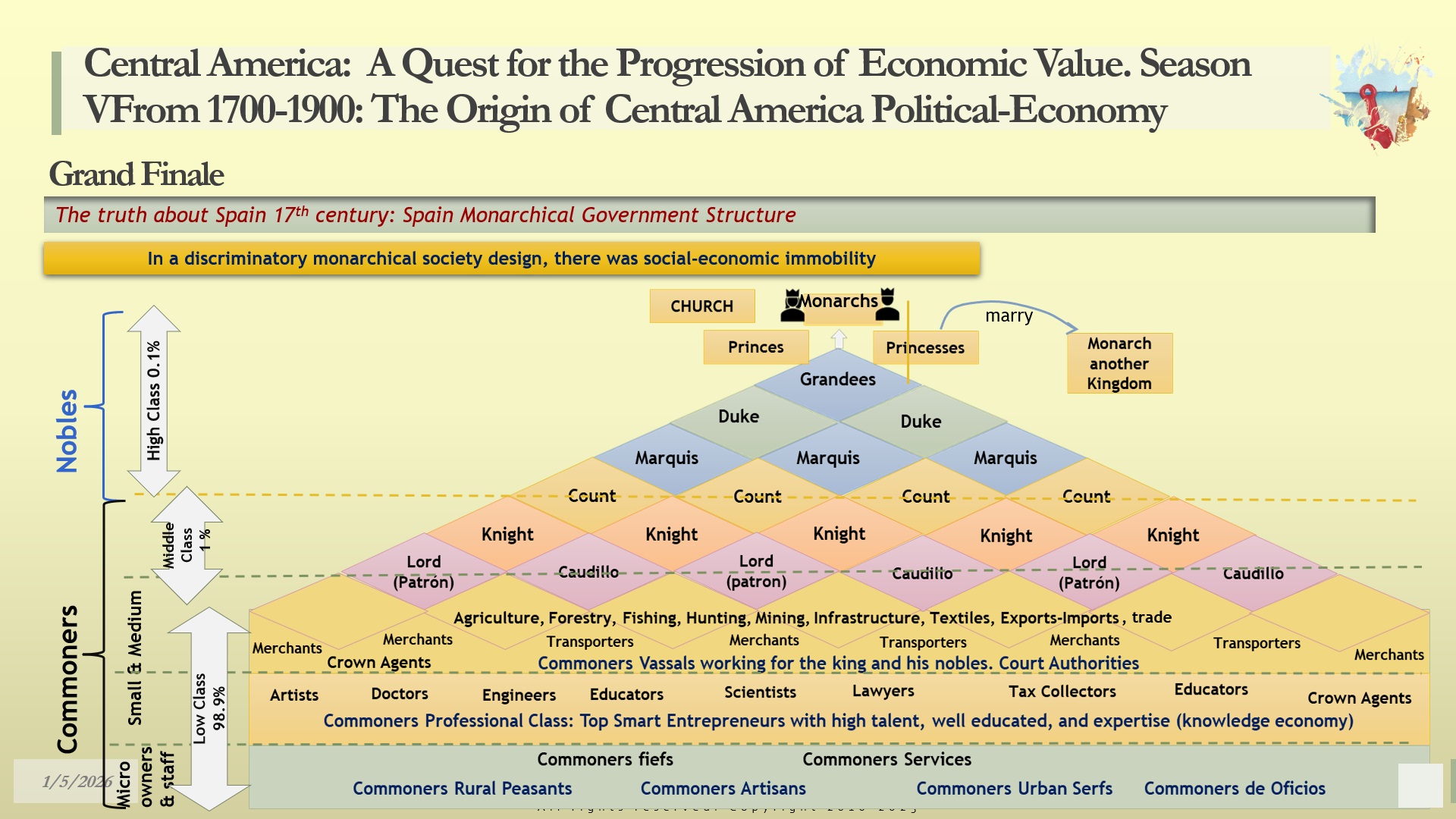
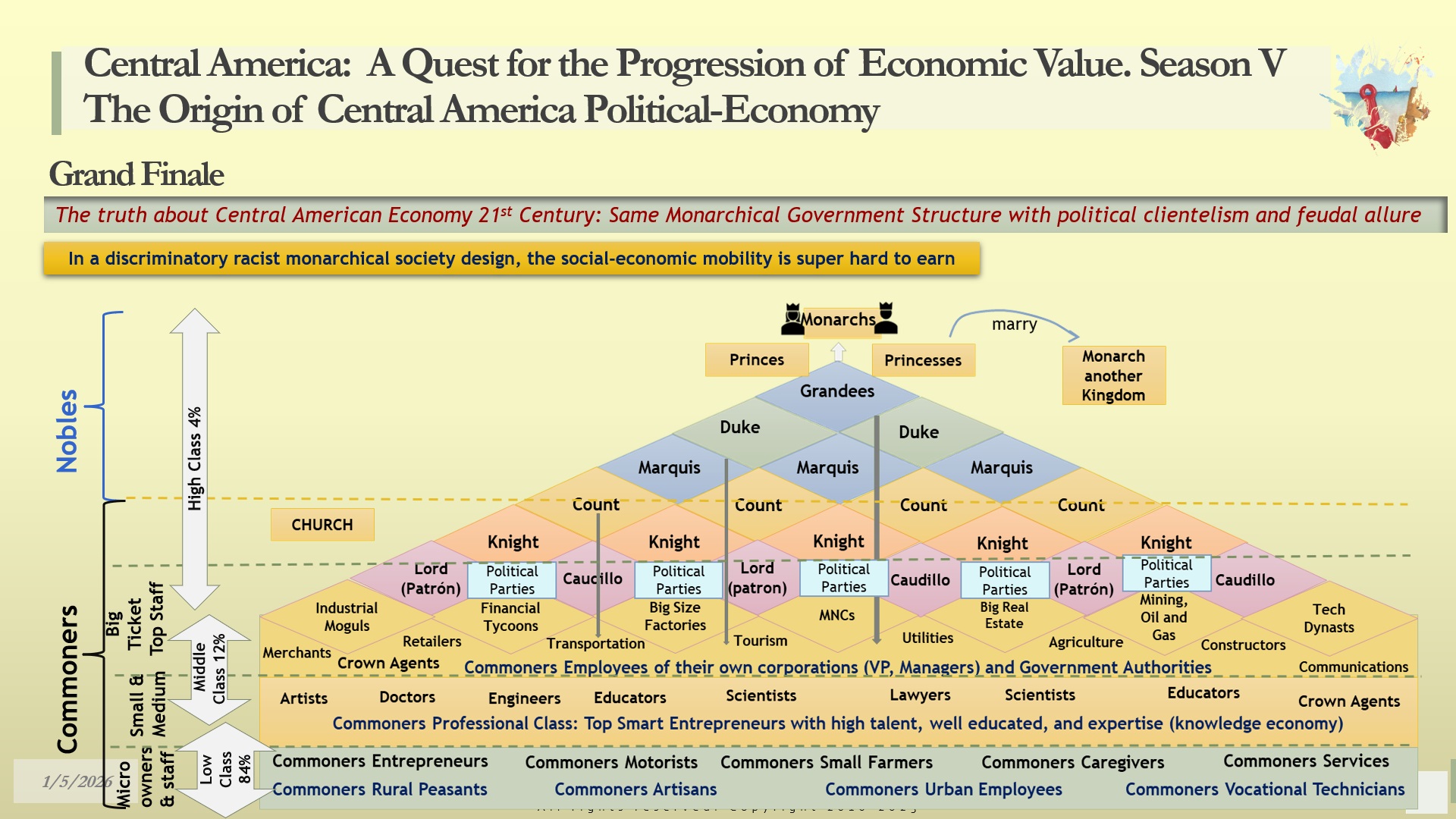
- Testaferros? We discovered that Royal empires or kingdoms used “testaferros” or front-face men to invest and manage royal companies. This is a vassal practice. The old feudal pyramidal organization has been kept above the commoners’ business organization. The democratic expansion of the middle class was initially created for the commoners, but the royal nobility has been kept the same. Over the commoners’ expansion. Look at the two slides below. We have prepared a comparative analysis of how the Spanish society operated at the end of the 17th century, and how it operates in Spanish America now. The difference is that the common middle-class (with zero nobility status) has increased from 1% to 12% (on average for Central America). Look at the proportions of the social stratification, and watch how the nobles have permeated the commoners by taking over the high-paid employee positions of the dynastic corporations. Look how the Church has been degraded in the scale of power relationships, too. Incredible!
- Why do empires sponsor inventions? Empires pursue the latest technological inventions in the marketplace by sponsoring the brightest or most brilliant talents. Once the innovation is ready, the empires buy the invention and set up the inventors to manage the corporations. Empires are looking for profits, and as soon as possible, they want to be among the pioneers and receive the initial robust profits of the industry. Before it is saturated with competitors, they drop it or make it fall, and look for another nascent industry to profit from, regardless of whether the product or service is good or bad for humanity. Sadly, but that is how they have acted for centuries.
- The role of the commerce agents and the political spy agents of the kings. These “mignions” have been crucial in the international operations of the kings, particularly in the colonial trade endeavors of the West Indies and the Atlantic Coast, for the control of the production of all commodities, such as sugar or bananas. Each agent was part of a network of political spies who reported to the kings about the moves of the competition, volumes of production, the slave trade, and any other commercial details. This agentic role is now being transferred to the AI features of your Smartphone. So you will always be tracked.
- Dynasties do not die; not even the Mayas disappeared. European empires mutate according to the circumstances. During my studies of the last 500 years, I have found that the royal families functioned according to the challenges that each generation was facing. There is a pattern that I have observed. A loop, like a spiral hoop of transformation from generation to generation. There are generations where the dynasty head decides to move ahead quickly and reap the first economic yield, without competitors around. Other generations retrench. There are epochs where the dynasty leader is focused on construction (building cities, infrastructure, palaces, urban development). Some female cohorts are totally dedicated to charity and helping the poor through donations and direct benefaction. And there are certain generations in which the royal patriarch or matriarch pushes the youngsters to develop their talents to the utmost. Other age bands decide to adopt the strategy of waiting and see, or are indifferent to most of the population who weep. Other generations dismiss the advice of their eldest experienced relatives, and then the disaster comes. These generations are utilized as failures for learning. However, some current youngsters of the dynasties are totally blind to the NAIQIs (NAIQI is the acronym of Nanotechnology, Artificial Intelligence, Quantum computing, and the Internet). The current enforcement of the Artificial Intelligence movement through social media is insane. Most of the pro-NAIQI are doing it because they have not experienced the pain of warfare or a hard, difficult crisis, and they believe that the Smartphone and the Internet will save the world. This is simply not true in the case of major geopolitical tragedies.
- What awaits us with the digital begging economy? First, we perceive that there is a group of dynasties that have been ripped off by the positive promises of their respective strategy advisors, particularly in relation to AI. Second, if you are keen to observe the situation, this NAIQI era is the same repetitive old song, the same pattern of the past, a new wave of the giga-moguls (backed up by a group of powerful investors) who want to take over, lead, and manage the preferences of the world, but this time it is not through the physical industries, like coffee, or bananas, it is with the virtual-digital industries. The “commoners of this world, or 96 % of the population,” only see a little tip of the iceberg: the flashy internet platforms and applications that have become the repository of our knowledge and creative information, and everyone is happy-stupid enough to share without charging one cent. Third, once our content is deposited there for free, and all the commoners are celebrating the news, videos, and social media for free, all the content producers are begging for donations or a cup of coffee. We are all feeding the Artificial Intelligence (AI) systems, which are soaking, sucking, and withdrawing our knowledge (gratis). The AI systems are evolving so rapidly into a “non-human intelligence” that, according to Eric Schmidt (former CEO of Google), this giant scaffolding will, within the next few years, reach a level of superintelligence exceeding human capabilities across all domains. Why does it matter? Because once the “artificial superintelligence” acknowledges and pulls our “middle-class super capabilities”, we are and will not get a good income job for accomplishing it. We are and are going to be replaced or kicked out, while the owners of the apps’ artificial superintelligence are and will profit from it. Fourth, the Artificial Intelligence scaffolding systems come to hurt the professional class of the knowledge economy, that middle class that was built after the French Revolution (1789). That 12% of the population represented the middle class expansion. The AI establishment is designed to destroy the human side of all the brain-power activities of the incipient global middle class that has outperformed salaries or has brought excellent entrepreneurial income during the last century. Finally, we are living in a digital feudalism. None of us is the owner of the internet platforms and systems that are utilized by the “commoners”. We pay a fee for using them. But the asset is not ours. And this network of systems has systematically pulled all our financial, social, educational, and entertainment activities. We live in a digital or technological feudalism, and it has happened in less than 20 years.
- Central America has never pursued a robust industrial development beyond agriculture. Point. Nothing, nothing means nothing. In the 20th century, certain Industry experiments were implemented. But, the land ownership at the end of the 19th century, in the kingdom of Guatemala, was still an outstanding problem with medieval feudalist practices in a world that was heading to capitalism. Recently, there have been some diversified efforts in other industries. To push our nations into the digital begging economy is a historical error, it is an economic mistake, it is a business model misstep, it is a social blunder, and it is the cause of more mistakes. There are natural industries for self-sustainability that Central America needs to develop in its territories. “Self-sustainability or self-sustaining is the degree to which the system can sustain itself without external support”, and there are basic industries that have not started in here; we are not self-sufficient enough. The digital begging is not going to feed or shelter us. That is a fact. In Central America, the risks associated with AI and digitalization also present inherent risks that may amplify the negative consequences for the region. For example, the United Nations Industrial Development Organization has listed these risks where there is no minimum protective regulation for consumers and users: “the irresponsible use of AI can exacerbate issues such as fraud, discrimination, bias, and disinformation, while displacing and disempowering workers, stifling competition, and posing security threats. The complexity and rapid evolution of digital systems challenge traditional regulatory models, making it difficult to ensure that AI serves society’s interests rather than undermining them.”
- This is it for the saga “Central America: A Quest for the Progression of Economic Value”. Five seasons, from October 2024 to May 2026. Thank you, God. Thank you for arriving at this last episode. We conclude our work with appreciative thanks to all: my beloved readers, my superb authors, and professors who wrote the 30,000 pages of books, academic papers, reports, and articles that I have printed and read since I broke my left 5th metatarsal bone in August 2024. Thanks to my academic peer reviewers. Thanks to my parents, who have supported me all these years. Thanks to my beloved dog Luna, who loyally accompanied me from sunrise till very late at night during all these months. She gave me the strength to go on when I was so tired after reading or writing. Luna died five months before this grand finale, and I miss her immensely every day. In loving memory of her presence throughout all these years, this saga is dedicated to her. Luna, we did it!

Research agenda for the future:
- For Royal experts: Please say the truth. It is time to disclose the truth. I mean, you could have saved me months of reading if the truth had gone out little by little. My appreciation of the truth still needs to be validated. And without the truth, we won´t learn from the mistakes of our ancestors, and will continue repeating them. Look at the mess that awaits us with the AI digital begging era. It can´t happen again.
- For Historians: Thank you for leaving clues about the secrets that we have discovered. You have risked your life by letting all those hints that are overlooked by those who don’t read. I understand that historians from old times were compelled to hide the truth in the context of the huge power of the Inquisitorial Imperial Spain. It is understandable, but research needs to move ahead and touch on topics that need to be disclosed for the benefit of all society members. For Spanish American historians, it is time to dig into these topics that will help us to understand our economic foundations. I was propelled to generalize several topics, including sugar business modeling, because we do not have access to that type of confidential information. There is a huge amount of work to do in terms of Spanish American history research. And there are financial limitations to performing it. It is important to fund good research (and do not use AI, please).
- For Economists and corporate strategists: Stop enforcing recipes of economic development that do not fit in Spanish America. We are at least 300 years behind Europe in terms of corporate governance, societal cultivation, and weak institutional structures. There has been some tiny progress during the last 50 years. But the mentality of the vassals to the Spanish crown still exists. And it has been feudal. And it has been perpetuated, with a makeup of capitalism. And now, you are considering imposing a techie value proposition without considering all the consequences. It is crazy to impose an NAIQI digital begging system in our societies. Particularly in education and the knowledge economy. We do not have a robust middle class that can soften future economic crises. One mistake, and we will fall without mercy.
- For Philosophers: It is time to begin to create the Latin American new philosophy viewpoints. Spanish America has its own way of thinking, and we need to analyze the causes, effects/consequences of our reasoning. Nowadays, the new generations do not know how to think properly, given the bombardment of information coming out of smartphones. There is too much confusion. Latin American Philosophers need to stop seeing the dialectic as the game-changer. It has caused innumerable sacrifices that do not allow us to grow.
- For social science researchers: Do your research. There is so much to investigate in the context of the current NAIQI technologies and how our Spanish American societies are affected by them. Look at the teenagers who are suffering from social media and AI in schools. It is important.
We close this last episode with an oeuvre of the Vienna Philharmonic Orchestra. This orchestra is considered by far the best in the world.
https://www.wienerphilharmoniker.at/en/ Enjoy!
Thank you for reading http://www.eleonoraescalantestrategy.com. It is a privilege to learn. Blessings.

Sources of reference and Bibliography utilized for today´s inferences. The bibliography is listed in each episode and season. Click the respective URL to trace them.
Disclaimer: Eleonora Escalante paints Illustrations in Watercolor. Other types of illustrations or videos (which are not mine) are used for educational purposes ONLY. All are used as Illustrative and non-commercial images. Utilized only informatively for the public good. Nevertheless, most of this blog’s pictures, images, and videos are not mine. Unless otherwise stated, I do not own any lovely photos or images.
 Eleonora Escalante Strategy Strategic Reflections Think Tank