

From the Enlightenment to Business Models. Season III. Episode 6. Enlightenment and Freedom of Thought & Speech
I hope you can enjoy the beautiful moon and the fantastic month of September that makes us joyous for the new Autumn season that is around the corner. Let´s begin.
The Enlightenment was our first historical phase in which freedom of thought and expression reached a tipping point.
The Enlightenment (at least in the radical and moderate/mainstream canons) was a unique definite stage in human history, in which there was an alignment of three things:
- There was a need to express things in favor of or against the status quo. When there is no intellectual class in societies, or when the intellectual class is like Princess Sleeping Beauty, nothing comes out “as a result of” critical thinking. Judgment requires discernment, and discernment necessitates a certain amount of knowledge, perceptiveness, and acumen to realize, or to find out something else that requires our analysis and evaluation. Regardless that judgment has always been omnipresent in humans, critical thinking wasn´t the case. To argue if a reality is unequivocally correct or not, involves a comparison of cause and effects, in multiple scenarios through observation and calculations. It requires “critical thinking”. When Science began to flourish in the Renaissance, the obscurity of superstition was broken with the light of assessment and the exercise of thought. In consequence, when humans began to grasp something new, they also had an inner yearning to share it, not just to reveal it but to review it with others and resolve the truth of it. That “need” occurred first at the scientific level, and then at the philosophical and theological level. All over Europe, Universities created erudite men of science, not just one, but many men of thought.
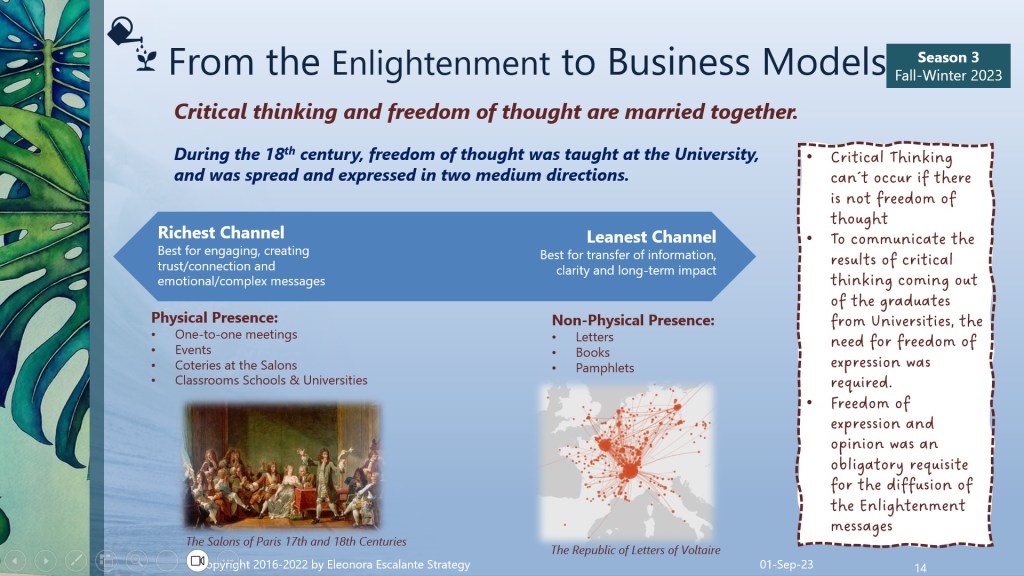
- There was a want or a wish to express things in favor of or against the status quo. The channels to communicate scientific or philosophical discoveries (no matter if the content was wrong or not, for the context of the epoch) weren´t the problem. The channels existed in a verbal manner, either in person at the salons, meeting places, classrooms, clandestine events, or coteries of Paris and other European cities. The written channels were also efficient for printing under secrecy, despite the persecution and the Inquisition. The European Universities were creating spaces of discussion and debate. The despot Enlightenment rulers were committed to at least relaxing some kind of censorship of these channels of communication. If suppression of books and persecution of writers was the norm, the clandestine flow of ideas continued. The monarchies’ ancient regime was built under premises that were refused by the new philosophical, theological, and scientific discoveries. By the 11th and 12th centuries, when universities were erected, those who attended them to be educated were also trained to think progressively to express themselves. It took around 500 years for erudition to reach a critical mass of people in European nobles and court-educated officers to realize that there could be a new possibility for progress and improvement of society. That inner light desire, longing, or aspiration for expressing the knowledge received and constructed in and from universities, began fervently to be exposed not by one, but by a critical mass of intellectuals at different levels of members of the nobility, the court officials, and the academic community. And the domino effect of contagion began. The Counter-enlightenment canon only created more radical or moderate enlightenment responses: illicit printed literature flowing back and forth in clandestine ways; the furtive network of the republic of letters; the creation of the secret societies; and the strategy to keep the information stream (books) on the reading intellectual community. The consistent rapid diffusion (particularly during the last 30 years before the French Revolution) took place in an accelerated way because the “esprit philosophique” was censured by the same authorities.
- The tipping point took place in the 17th and 18th centuries. This was the boiling time of reaching enough critical mass of intellectuals who could defeat the wrong premises that were the foundations of feudalism and the monarchies. As I mentioned above, from the installment of the first universities between the 11th and 12th centuries (Salerno, Bologna, Reggio, Paris, Montpellier, and Oxford) to the Enlightenment epoch, more than 500 years were required to harvest the possibility of finding a genius mastermind as Descartes. Regardless if Descartes was or was not totally correct in his theories, Descartes contribution was only exceeded by Locke and Newton, who basically completed a decisive loop of understanding. Several other scientists were reaching parallel explanations of the reality, such as Wolff and Leibniz in Germany. The evolution of academia and its most remarkable scientists in Europe were playing a concert of interactions that were in crescendo, and all together, thinking and writing each of them in different canons, only reached enough level of importance when a new different order society was able to get to know a different explanation of our existence. All these men of science and philosophy completed an “eureka” moment, and all of them agreed that something was wrong with the traditional understanding of the monarchical regimes in feudalism: superstitions, ignorance, intolerance, persecution, slavery, poverty, and lack of freedom. Precisely in the 17th century. The universities in Europe (after 500 years) accomplished their objective: to create a critical mass of true thinkers. Without universities, no critical mass would have ever reached that point. It was the climax of time in which the premises of the Enlightenment were prevalent enough to grow and sustain a potential change.
We have prepared the following set of slides as a frame of reference for this publication. Feel free to download them or print them if you wish.


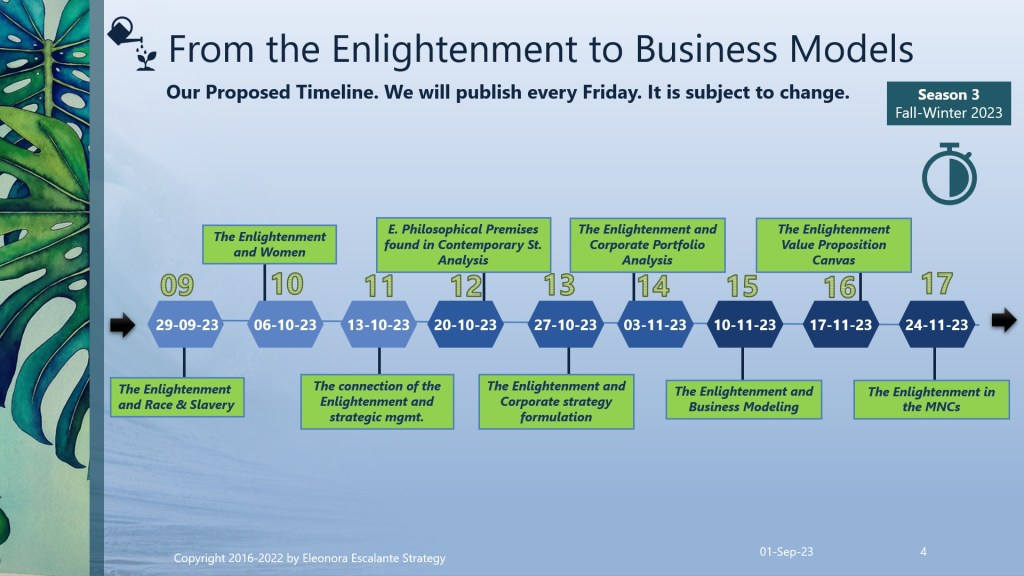
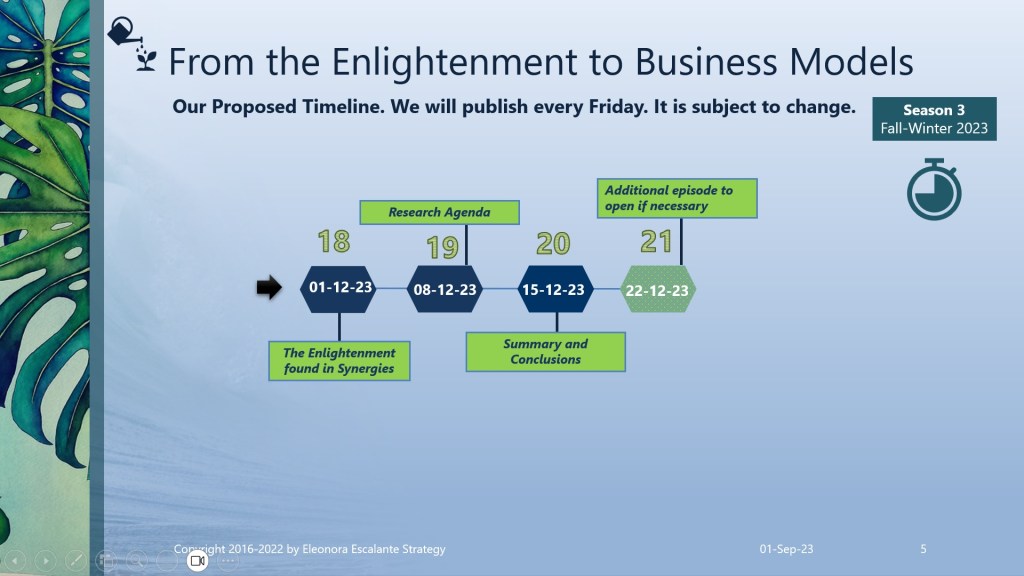
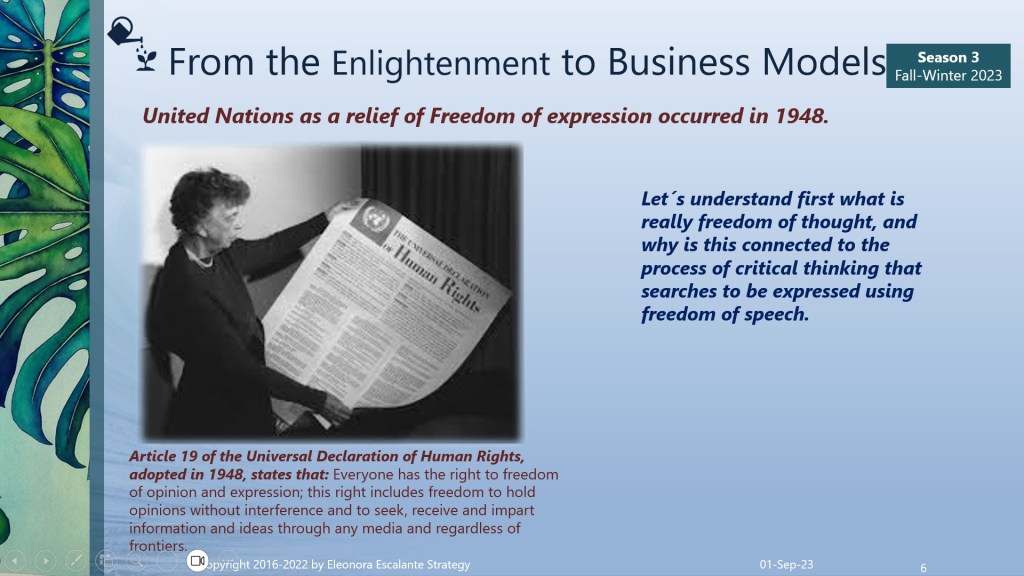




The universities expanded critical thinking. Universities, even the most conservative catholic ones, were teaching rhetoric in between other subjects. Literary humanism took the stage as a slow process since rhetoric was required by future eloquent speakers and/or writers for the art of communicating using language effectively and persuasively for future positions in the Government and the Church. Rhetoric was crucially important in the beginning of the Universities in Europe. Rhetoric was “formerly a discipline aimed at the technique of beautiful and correct presentation of ideas, especially when preaching was concerned” (1). The contribution of rhetoric, grammar, and Latin; constructed a mix of abilities that helped to create high-skill literacy people who then started to write literature from the Universities. Additionally, the character of retaking the classical texts of humanism found in the literature of ancient Greece and Rome provoked critical historical research in the study of law, history, medicine, and theology (including biblical history). The study of classical history triggered an explosion of information that needed to be shared. On purpose. The culture of expressing, showing, communicating, and debating was omnipresent in the Big Universities. “Salerno, Bologna, Montpellier, Chartres, and Paris were all built in towns” (2). The eruption of knowledge and the success of the Universities were determined by the general development of urban societies in the 12th century. For example: In the University of Paris, there were 4 theological schools. Each with its own staff of faculty teachers, and this meant that more theologians gathered in Paris in a livelier way than any other city on earth. The centuries passed by, and that is why Paris emerged as the Enlightenment’s most prominent city where science and philosophy built a critical mass of enough thinkers (and respective followers) who took the lead to express those needs and wants of expression of new breakthroughs. Don´t take me wrong, since the beginning of the Universities and maybe beforehand (when education was established in the monasteries following the Carolingian model), there were always studious “outliers” residing in the monasteries in all the monarchical countries of Europe. But they were hidden behind the cloisters´ walls. I doubt there were not people of studious discipline and capacities, the majority under the “Catholic Church organization”, or after the Reform, within the new “protestant entities” from Northern Germany. Paris delivered teachers that were streaming from there to all other centers of education in Europe. But it coincides that only when universities began to flourish in the number of students and the quality of their thoughtful works all over Europe, that was exactly the tipping point that nurtured a positive correlation to the growth of the “boombox” of the intellectuals that stretched the zenith with the Enlightenment thinkers of the 17th and 18th centuries.
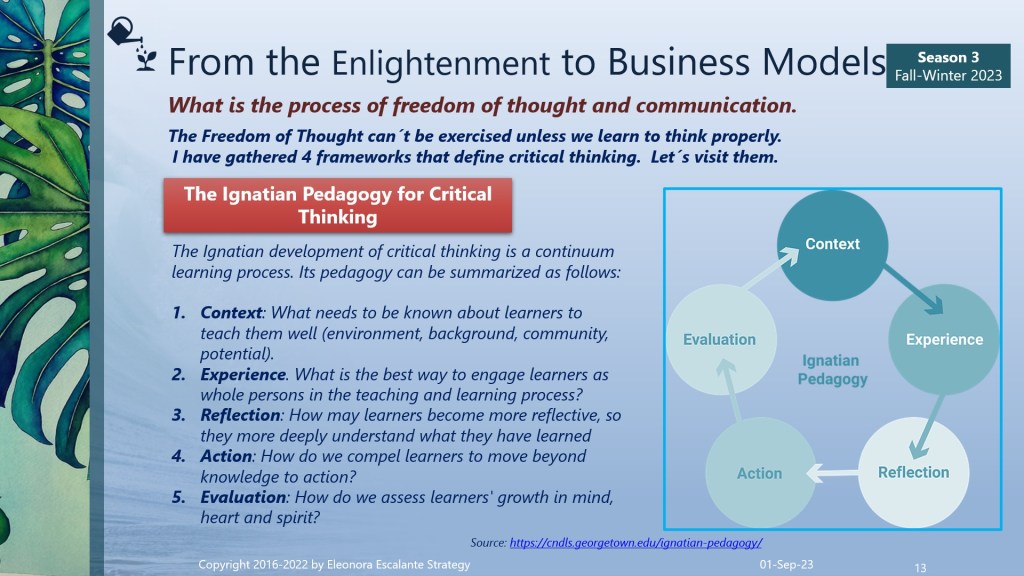
There is no freedom of expression (speech or press) if there is no freedom of thought. It took several centuries to arrive at the Enlightenment after the initiation of Universities in Europe. See slide number 16. Freedom of expression starts with freedom of thinking. To think freely, people are required to learn how to think. To think properly, humans are compelled to observe carefully, to study, to read, to discover. To think with discernment is a process of life. It takes years of preparation to think with ample 360-degree vision. Observation by practice is always tied to a theoretical framework. Particularly, the Jesuit Universities were excelling in the Ignatian pedagogy of critical thinking, and it is important to remark that the Jesuit schools influenced most other secondary and university curricula with the Ignatian Reflection framework, which is the basis of critical thinking (see slide number 13).
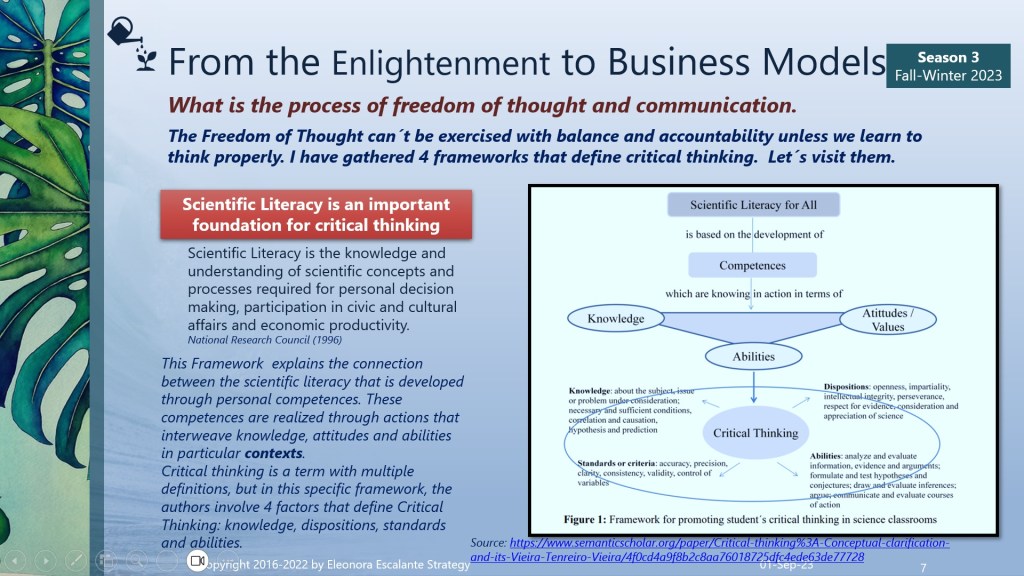
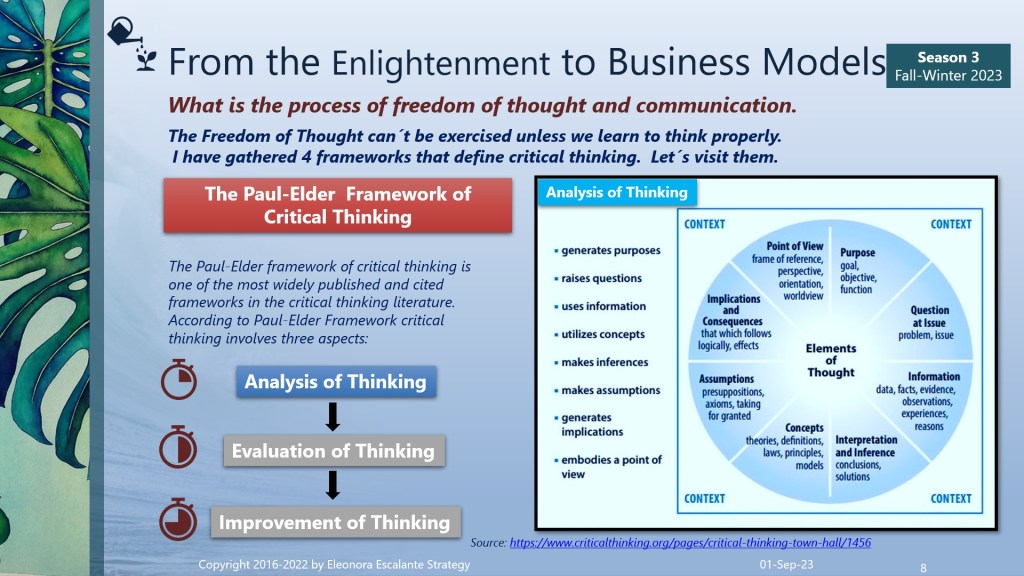
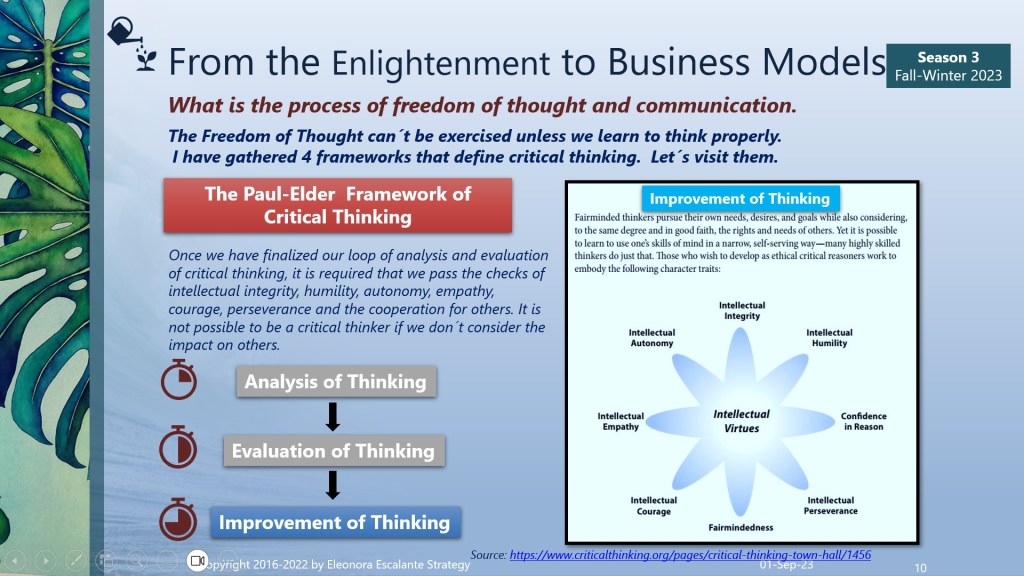
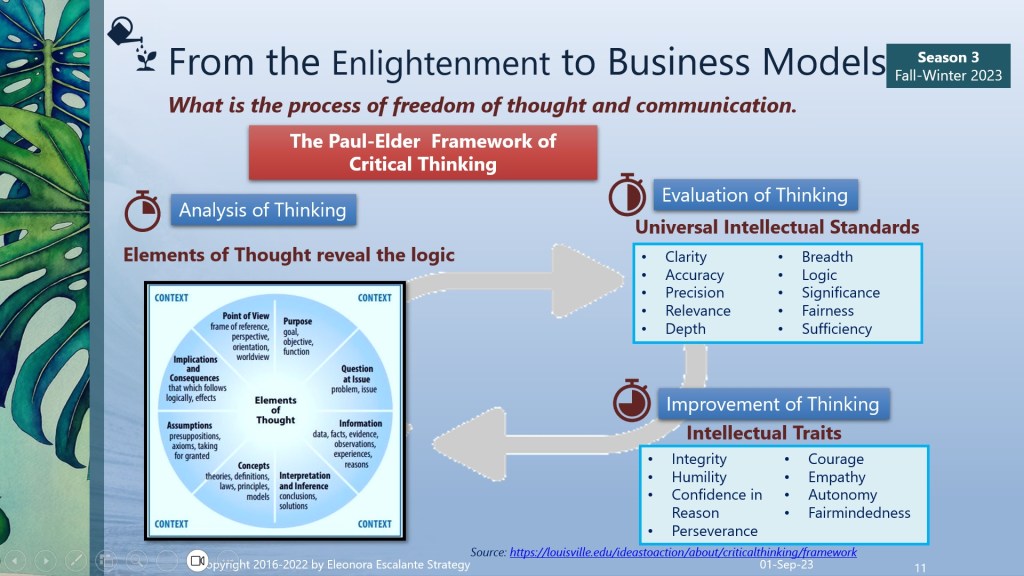
With the application of critical thinking, freedom of thought was required. Critical thinking and freedom of thought are married together. With freedom of thought also comes one of the greatest forms of responsibility linked to the obligation of investigating the truth. And truth can only be discovered if people access discernment. The process of critical thinking is explained today through several frameworks of reference. We have shared 4 of these frameworks:
- Critical Thinking as a result of Scientific Literacy (see slide 7)
- The Paul-Elder Framework of Critical Thinking (See slides 8,9,10 and 11)
- The Dwyer-Hogan-Stewart Integrative Framework (See slide 12)
- The Ignatian Pedagogy for Critical Thinking (See slide 13). This is the foundation of the first three.
There are more critical thinking frameworks prepared by several professors, researchers, and national academic councils, but all of them, include at least the following elements: knowledge, reflective judgment, discernment, analysis, evaluation, inference, a contextual situation, and experience.
During the 17th and 18th centuries, freedom of thought was taught at the universities, the critical thinking was part of all the Jesuit colleges and universities in the faculties of philosophy and theology. With this type of education, even if it was traditional and classical, the real result was that the Universities were producing writers, scientists, doctors, and many professionals that were requiring freedom of expression. Freedom of expression was an inevitable and obligatory requisite for the diffusion of the creations of the graduates from universities, that were producing a whole range of Enlightenment messages in different canons.
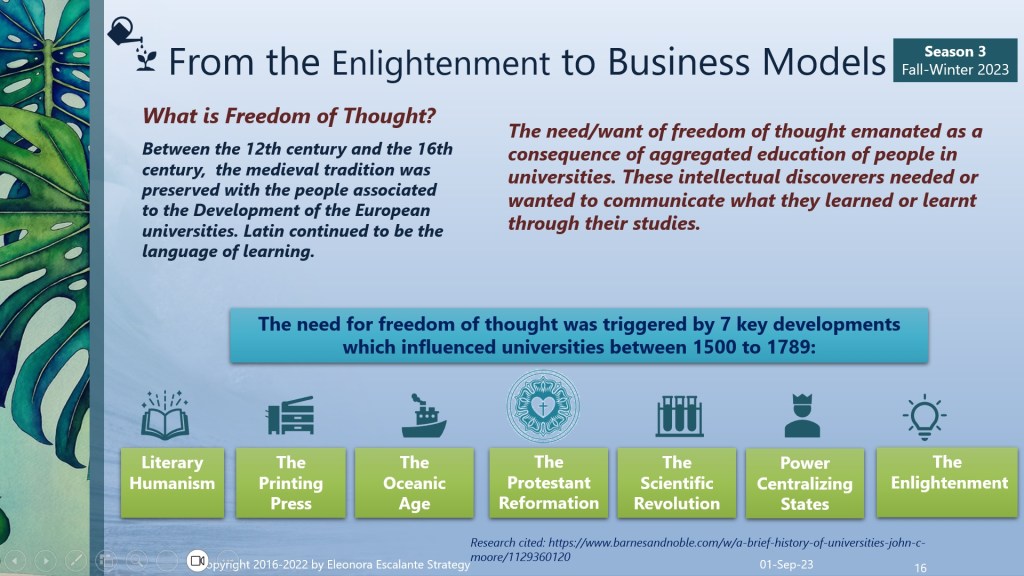
Finally, it is important to bring to our mind the context in which freedom of thought was developed. The need and want for freedom of thought was triggered by the slow evolution of 7 key developments that influenced the Universities between 1500 to 1789 (3): (a) Literary Humanism; (b) The printing Press; (c) The Oceanic Age; (d) The Protestant reformation; (e) The Scientific Revolution; (f) The Growing Power of Centralizing States and (g) The Enlightenment. See slide number 16.
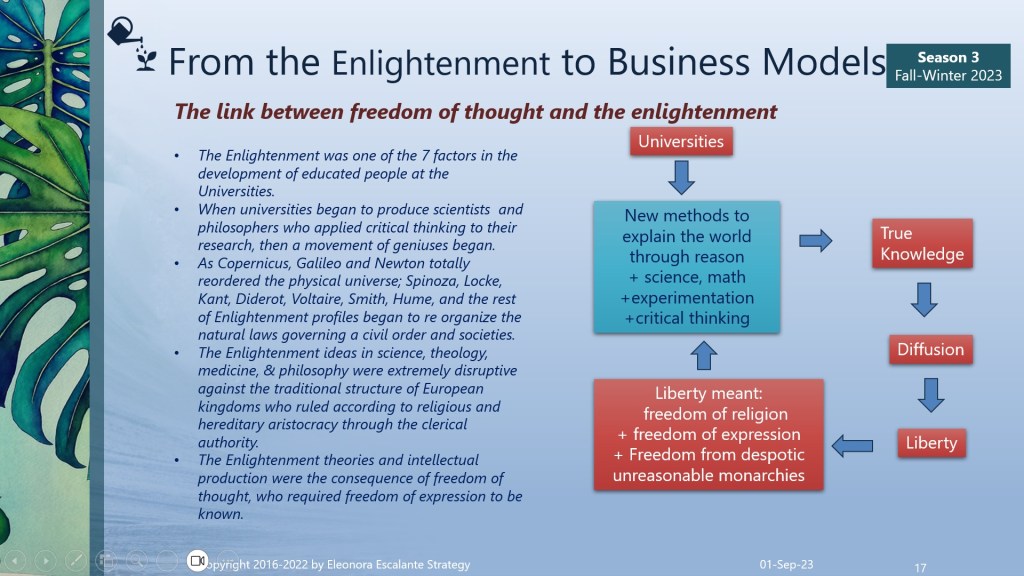
The link between freedom of thought and the Enlightenment. Please visit slide number 17 which explains in detail the loop that connects freedom of thought and the context of the Enlightenment.
The boundaries of freedom of thought and expression.
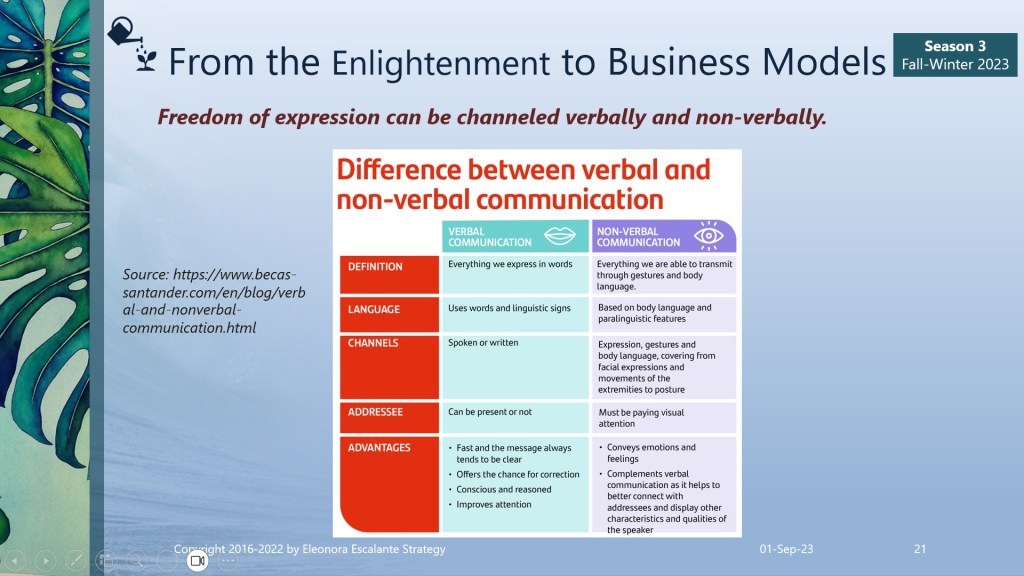
We can´t close this publication without considering the boundaries of freedom of thought and expression. Since the inquisition and censorship of speech during the Enlightenment, humans have tried to learn how to express themselves without hurting others. It is not easy. It doesn´t matter what type of expression channel we use, if verbal or non-verbal, or if digital-virtual or in-person-to-person presence.
There are vices of freedom of expression that we can perceive with certain contents in the context of offensive harm or ignition of violence toward others. Two examples that are harming societies are pornography and hate speech. I also would add some explicit “inclusive” content that can´t be understood by children and teenagers below the age of consent of sexuality. Look at slide number 18. The bottom line: each society places some limits on the exercise of free speech. It is beneficial if the ethical values of the community are a priority to keep harmony among its inhabitants. Too much freedom of speech may harm people. Particularly for children and teens who are in the process of maturing, and are required to grow in the best possible environment. This issue is an outstanding and remarkable cause of debate and reviews all the time. Specially in the present moment, within the context of Artificial intelligence products such as Generative AI, etc.
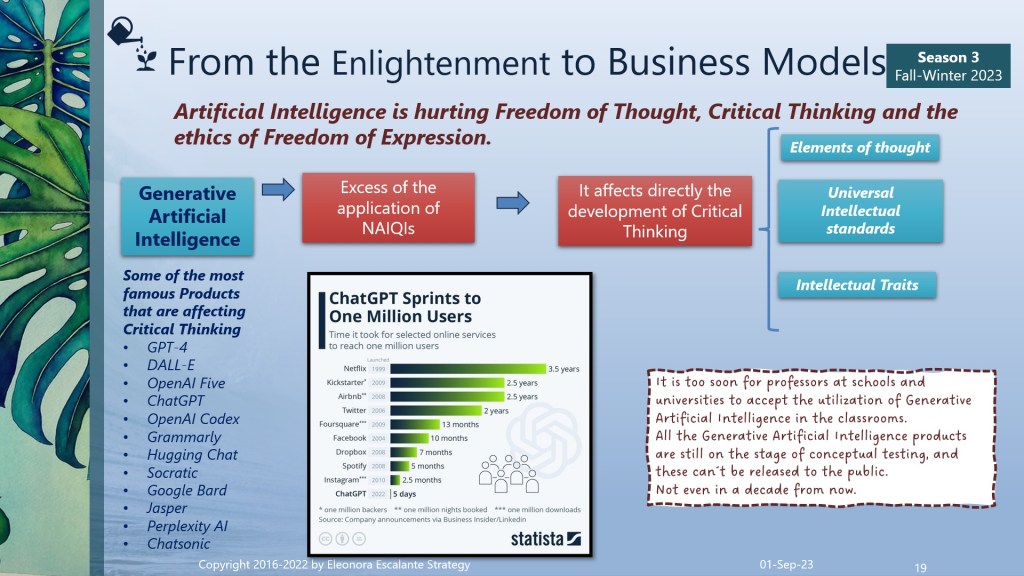
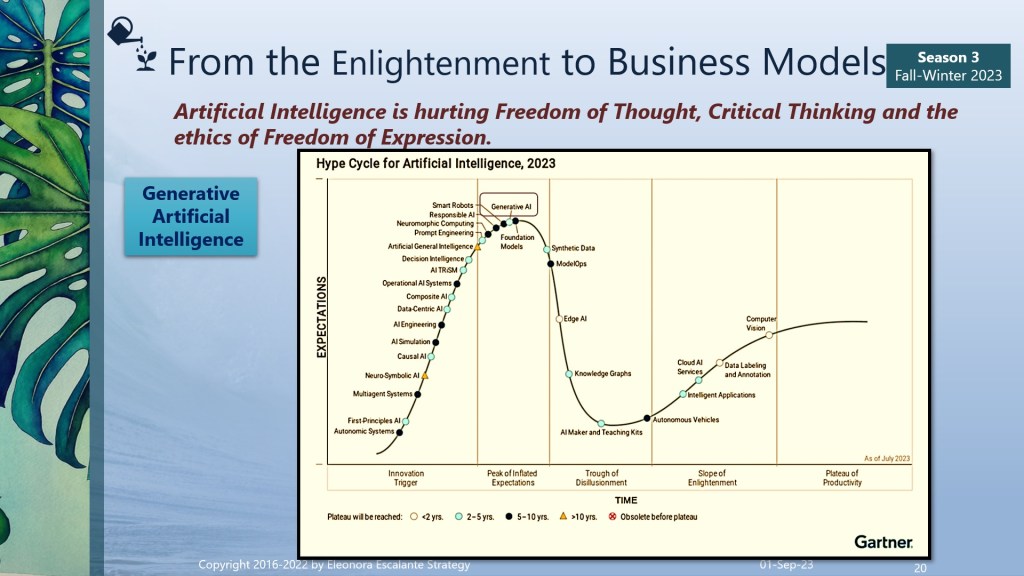
Artificial Intelligence is hurting freedom of thought, critical thinking, and the ethics of freedom of expression.
Our communication digital devices are not free. Each of us is paying to the communication spiral empires for its usage. It is a chain of payments: acquisitions of tools, subscriptions, mobiles, etc. In the meantime, what is driving the essence of digital transformation is not the well-being of people, but the profits of those who are letting us use their applications, platforms, and digital services. Many would argue: that there is nothing wrong with this framework of doing things. However, there is something improper and doomed in this flow of business using Generative AI: the quest for maximizing profits (quickly) is privileged above the competencies of human beings when exercising freedom of thought and critical thinking. All our economic, strategy, and business frameworks that allow the business plans of AI corporations in their calculation of earnings are not searching for the critical thinking development of the brains of the people. What matters the most is the invention of Generative AI tools for the profits of the pioneers in the new technologies. The AI companies are taking us back to feudalism, to the times in which we were not able to think or write (because we had no education in universities then), with the difference that at that time someone at the cloisters or monasteries had the knowledge and kept trustful information hidden. Today, with Generative AI applications (see slides 19 and 20), we are basically accepting (ubiquitously) that humans are not able to produce literature or other formats of speech with excellence. We are handling and giving our responsibility creation to these Open AI applications. With it, our competencies of critical thinking are being hurt at the core. And the public massive amount of non-trustful information makes us extremely unfortunate. Now, I can´t judge what is worse: Having too many erroneous or partial or wrong sources of information available on social media and the Internet that then are used for generative artificial intelligence applications; or not having anything. Sometimes I think that before the Internet, at least we had precious unique books (written with excellence) that we were able to find in excellent libraries, and we were more secure against the excesses of freedom of expression in our formative years. See slide number 19.
Announcement.
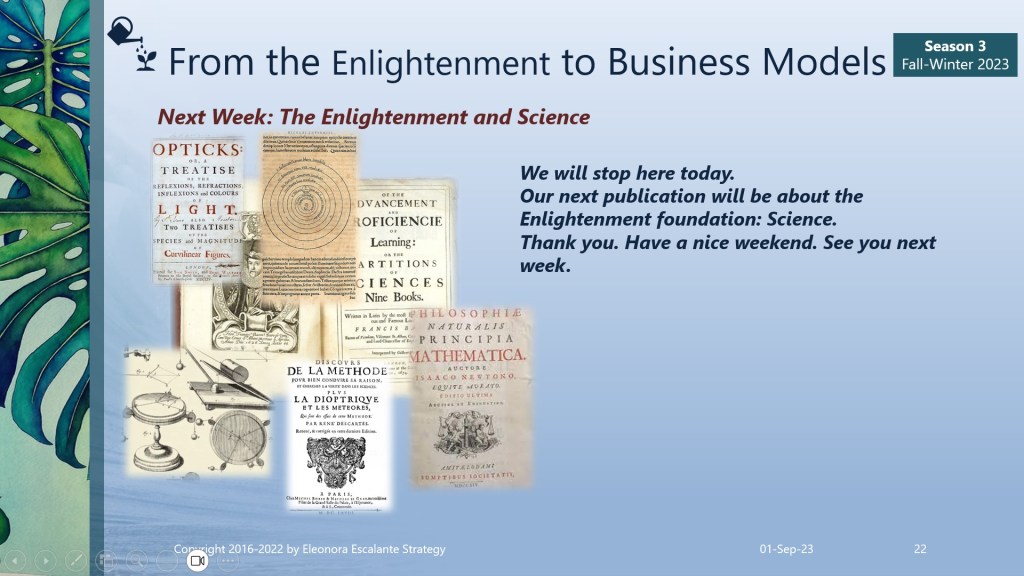
Our next publication will be next Friday 8th of September. We will continue our journey with the topic: “The Enlightenment and Science”. Blessings and thank you for reading our episodes.
Musical Section
To accompany your readings, we have decided to continue sharing classical flute magical music that was composed, released, or performed between the 17th and 18th centuries. Today our musical video is from Classical Tunes, Vivaldi Flute & Chamber Concertos. Played by prominent flutists of today: Maria Giovanna Fiorentino with I-Fiori Musicali, Marcelo Gatti, Federico María Sardelli, and Modo Antiquo an Italian instrumental ensemble dedicated to the performance of Baroque, Renaissance, and Medieval music.
Thank you for reading http://www.eleonoraescalantestrategy.com. Have a great weekend.

Sources of reference utilized today
All are in the slides. This text shows the following:
(1) Pedersen, Olaf. The First Universities: Studium Generale and the Origins of University https://www.cambridge.org/core/books/first-universities/1253A846131CFE1626B2BE18CEEFE816
(2) Ruegg, Walter. “A history of the University in Europe”. Volume II https://www.amazon.com/History-University-Europe-Universities-1500-1800/dp/0521361060
(3) Moore, John C. “A brief history of universities”. https://link.springer.com/book/10.1007/978-3-030-01319-6
.
Disclaimer: Eleonora Escalante paints Illustrations in Watercolor. Other types of illustrations or videos (which are not mine) are used for educational purposes ONLY. All are used as Illustrative and non-commercial images. Utilized only informatively for the public good. Nevertheless, most of this blog’s pictures, images, or videos are not mine. I do not own any of the lovely photos or images posted unless otherwise stated.
 Eleonora Escalante Strategy - Strategic Reflections Think Tank