
Central America: A Quest for the Progression of Economic Value. Bonus Season V. Episode 14. Summary and Conclusions Season I.
Dear beloved readers:
We are in the final stretch of our race to finish the saga, “Central America: A Quest for the Progression of Economic Value”. This has been an eighteen-month academic marathon that we started in October of 2024. It has been behemothically enormous to study more than 400 years of European and American history in parallel, within the context of a unique, entangled narrative that has never been written as such. The odyssey for us was to re-create a resourceful, trustworthy history line of what ocurred after the discovery of America in 1492. To re-create history is not my expertise. But I was obliged to do it to write this saga. I am a corporate strategy theorist who is trying to contribute to the design of our new corporate strategy theories for the future. And it happens that I love to paint watercolors.
To understand the premises of business and economics of the past is just the starting point to review why we design businesses as we do in the present. To go to the past is imperative. But if the past is not well described or misunderstood, we are lost in our present, too. As a result, with this saga, our strategy house was on duty to understand the mindset of the historians who have written magnificent books about our past. However, we encountered numerous surprises in the process. We were compelled to comprehend our history beyond what was written. We were obliged to knit history differently, finding elements that could fit and make economic sense of the different versions of historians and the existing separate studies that have a certain degree of truth, or a partial element of reality. As a consequence, initially, we thought this saga was going to last a year. But over time, we found ourselves playing an historical puzzle of fragmented and dispersed information, trying to fill the spots with the incorrect historical puzzle pieces, so it was a scattered paradigm for us. The pieces were not there, or weren´t found. What we did was to modify the gaps so the puzzle paradigms could fit properly with a new rationale. Our goal has been exquisitely demanding. We have fulfilled it beyond our first purpose, the one that we drafted in October 2024. Evolving, during each season, we were modifying our content accordingly, and here we are, dispatching our first episode of summary and conclusions about Season I.
During the next 15 days, we wish to honor our work by segmenting a “summary and conclusions chapter” for each Season. Today is the turn of Season I. Please take notice that Season I corresponds to the period between approximately 1492 and 1558. It covers the life of Charles V Habsburg-Valois/Castile-Aragón, Holy Roman Emperor, and the background of his dynastic ancestors.
Summary of Season I.
The summary of each episode is shown below. Please download the following document. Print the slides, please. We encourage our students to read each of the episodes we have shared the URL for again. It will take some effort, but it will help you to remember various elements that you may have forgotten.
For the academic international community that is doing a peer review of my saga, the summary document below is supported by a robust bibliography that is listed in each of the respective episodes.
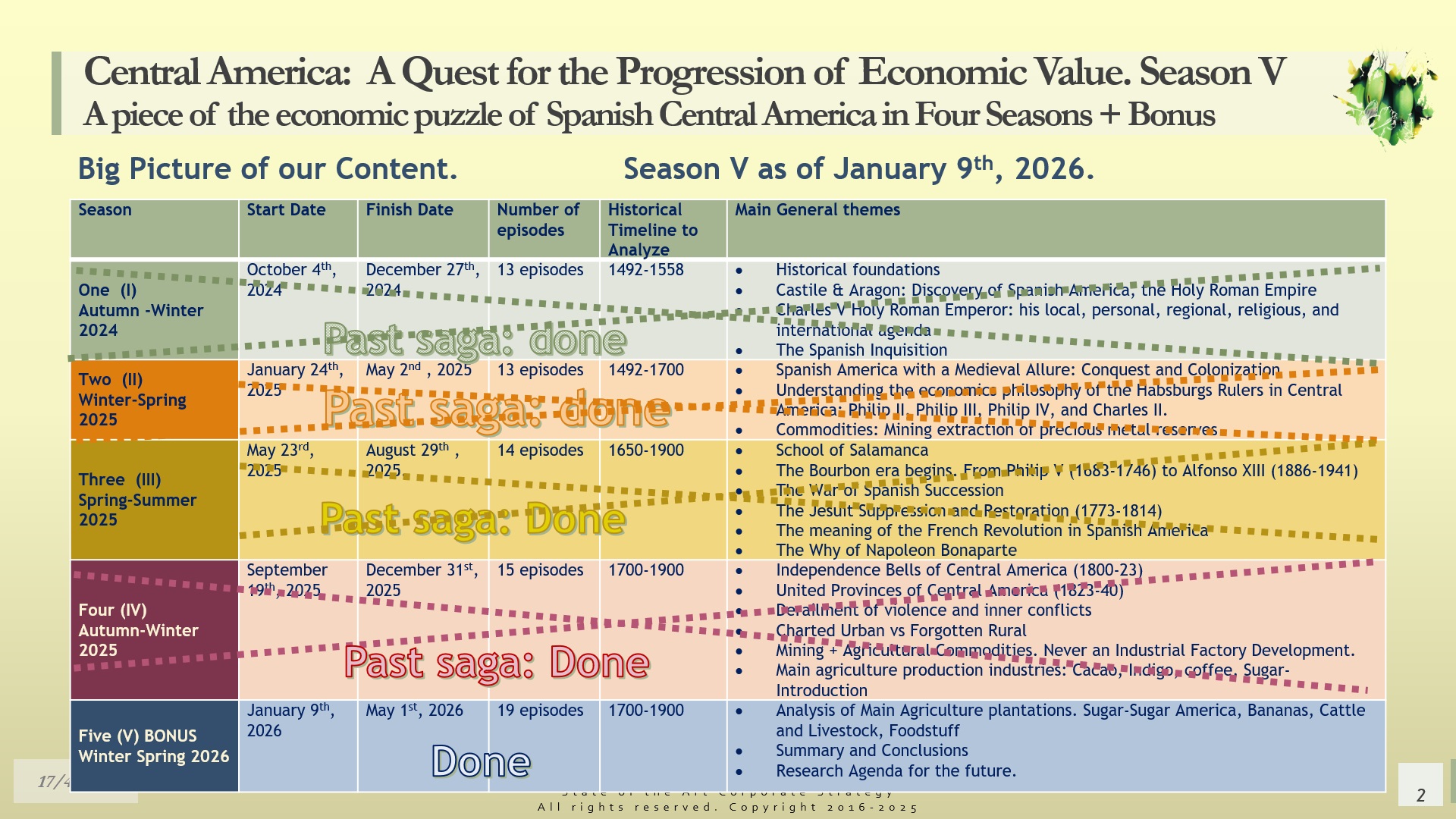
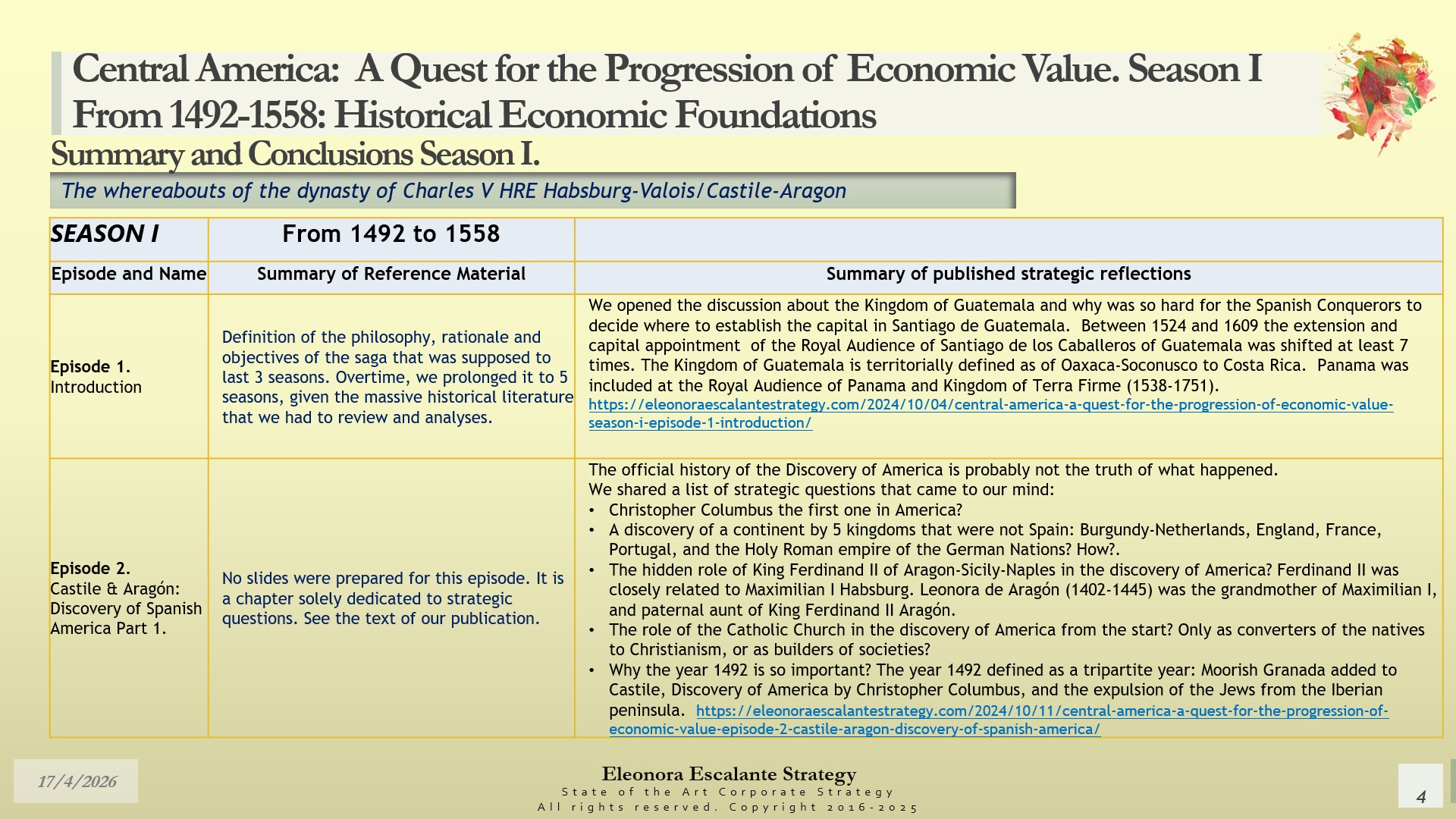
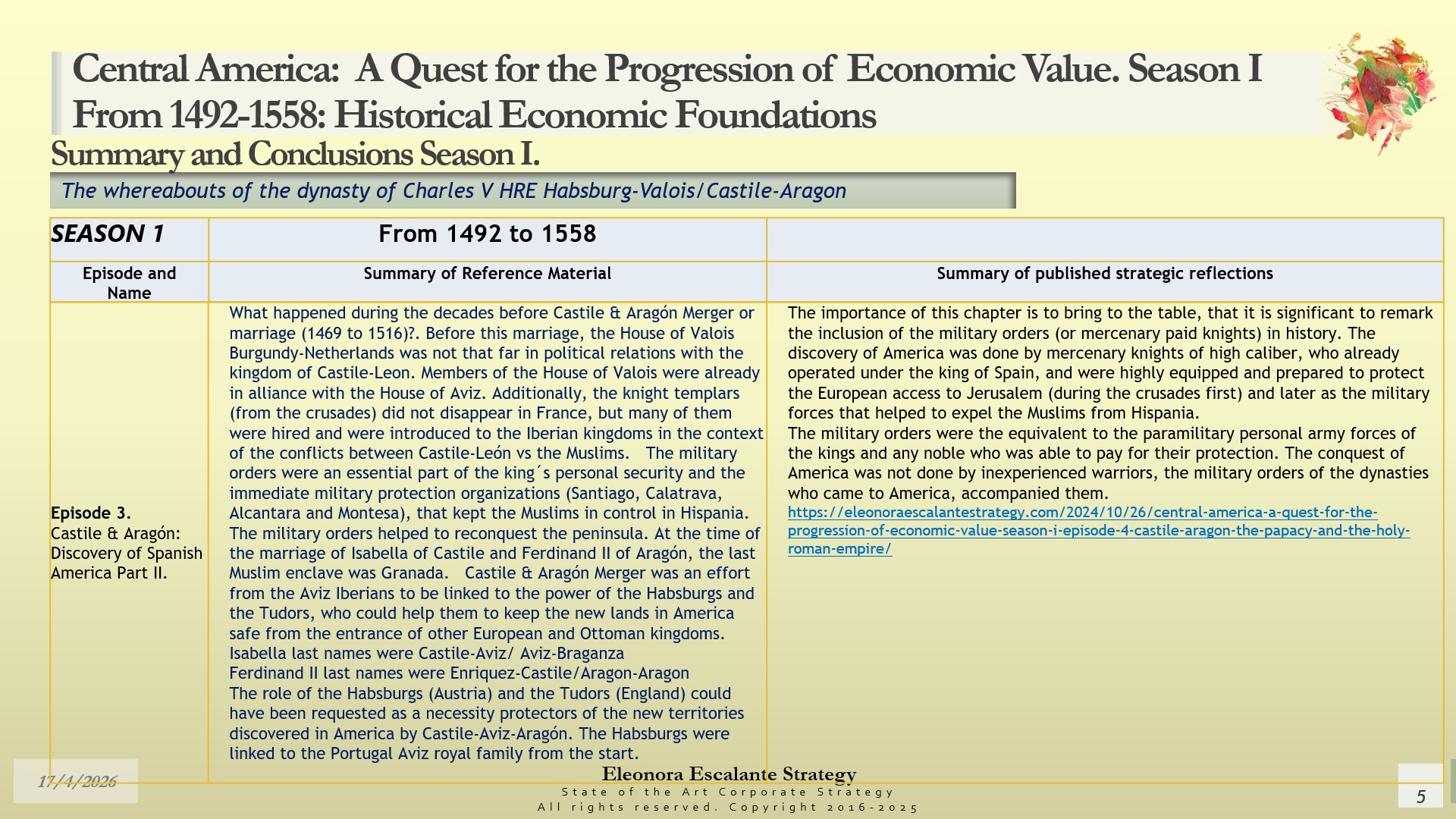
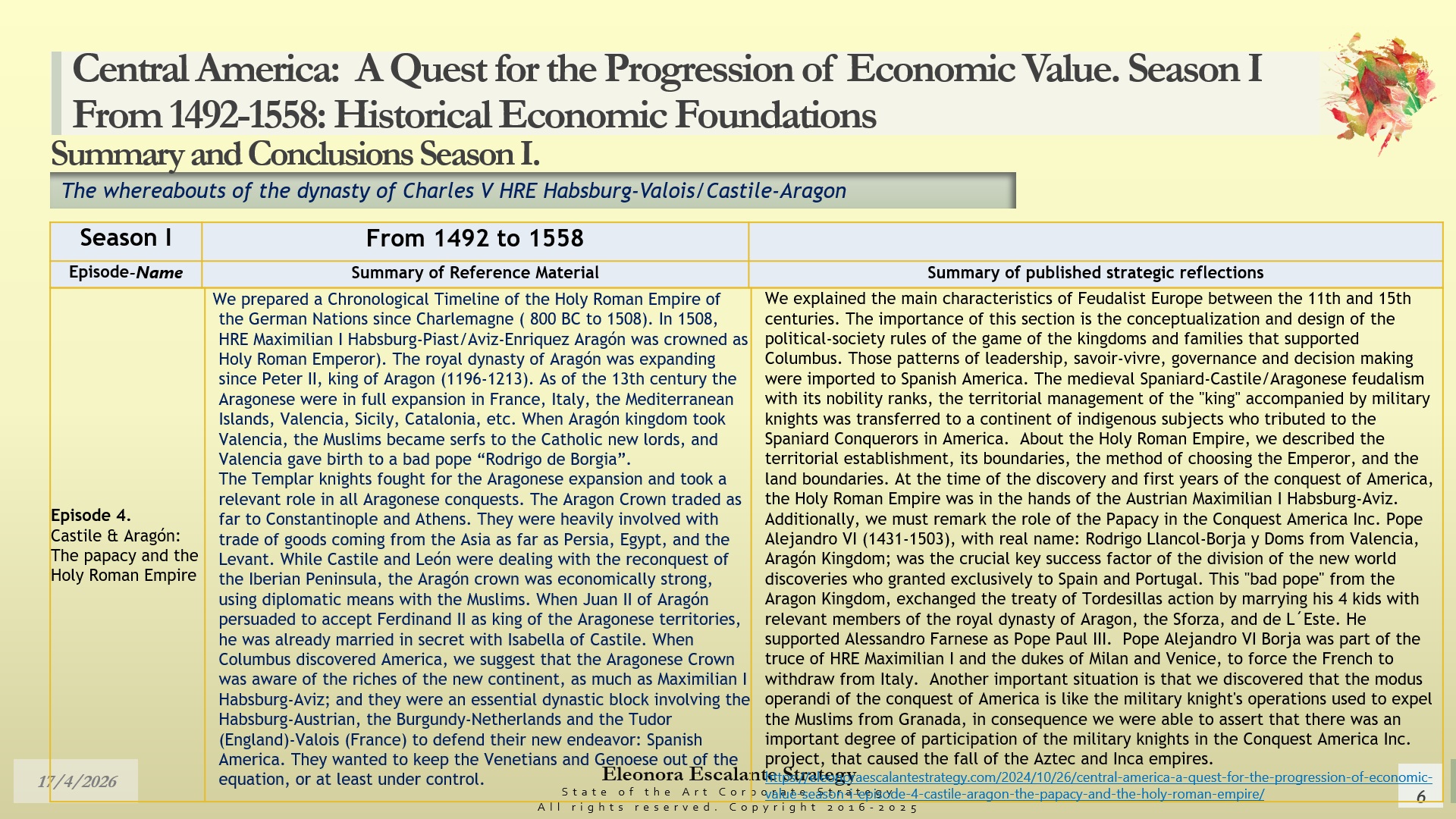
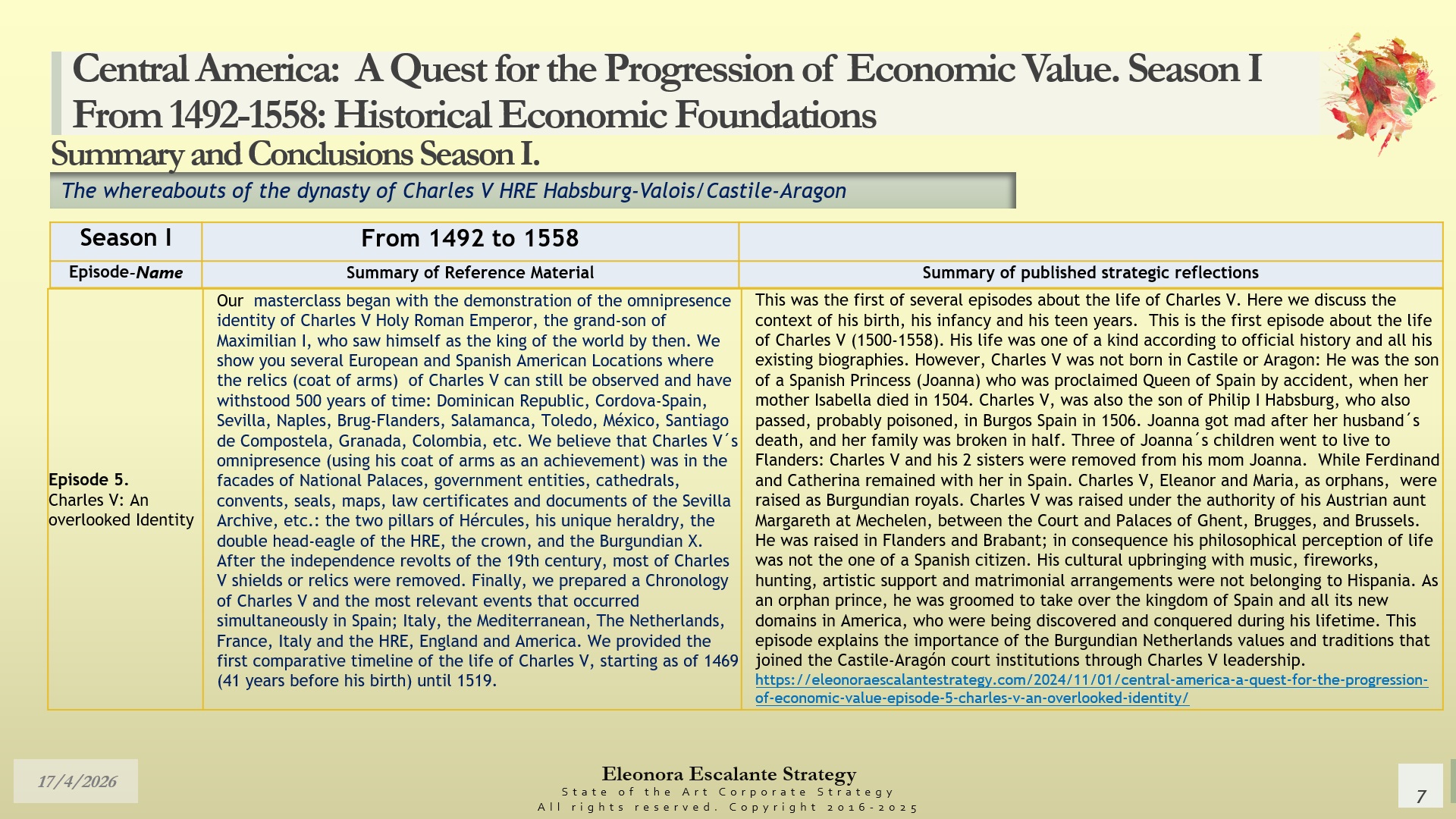
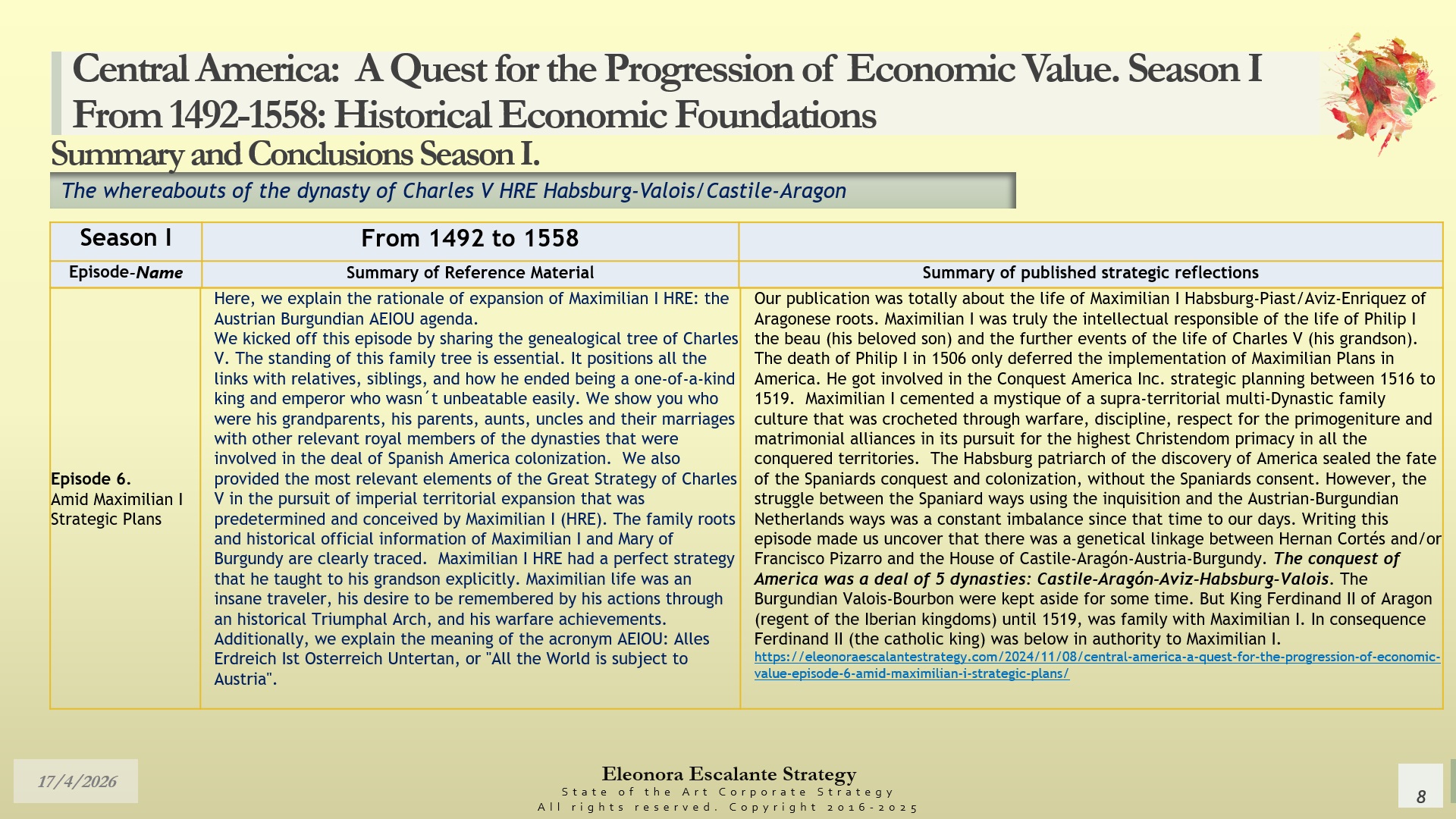
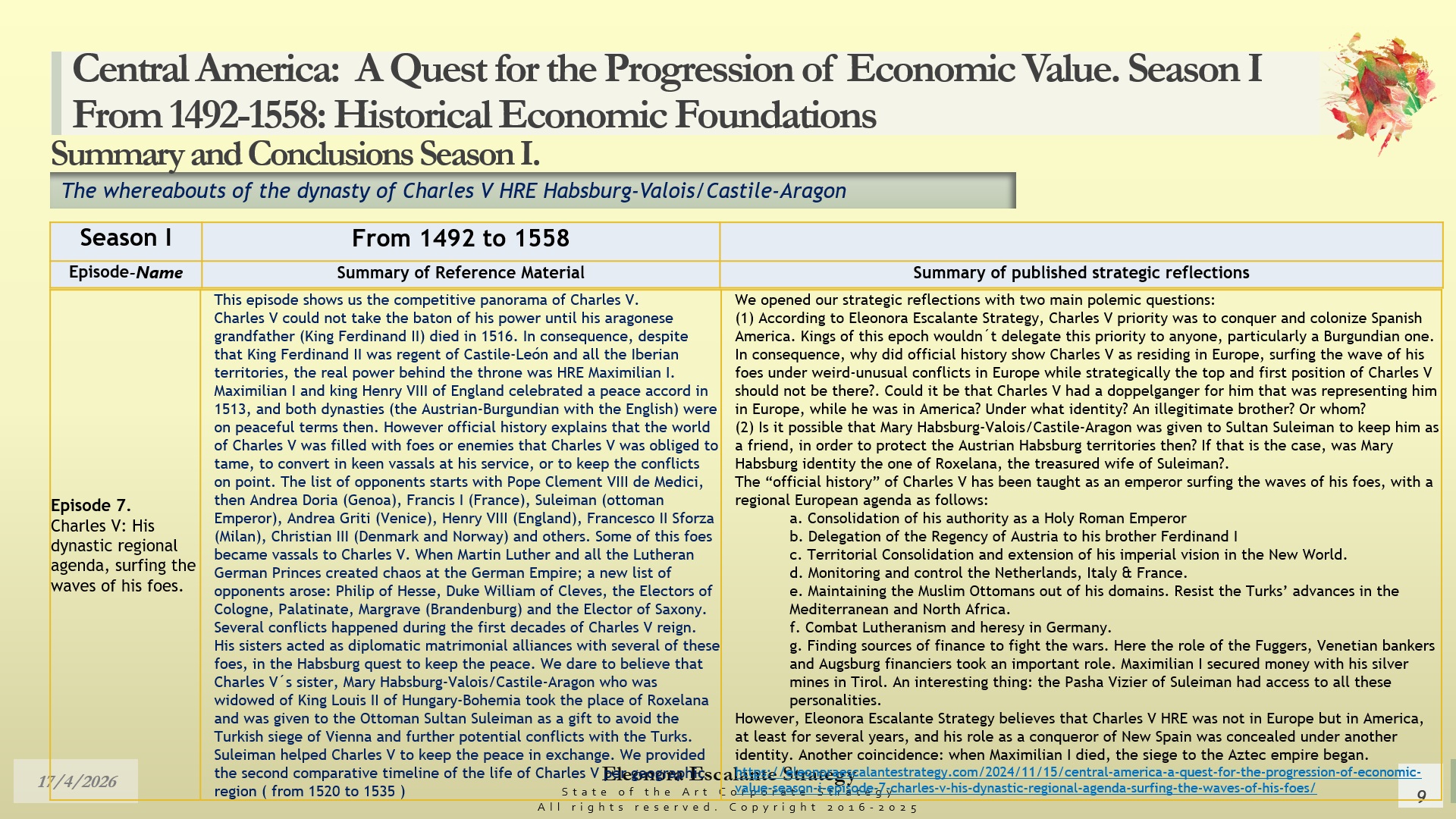
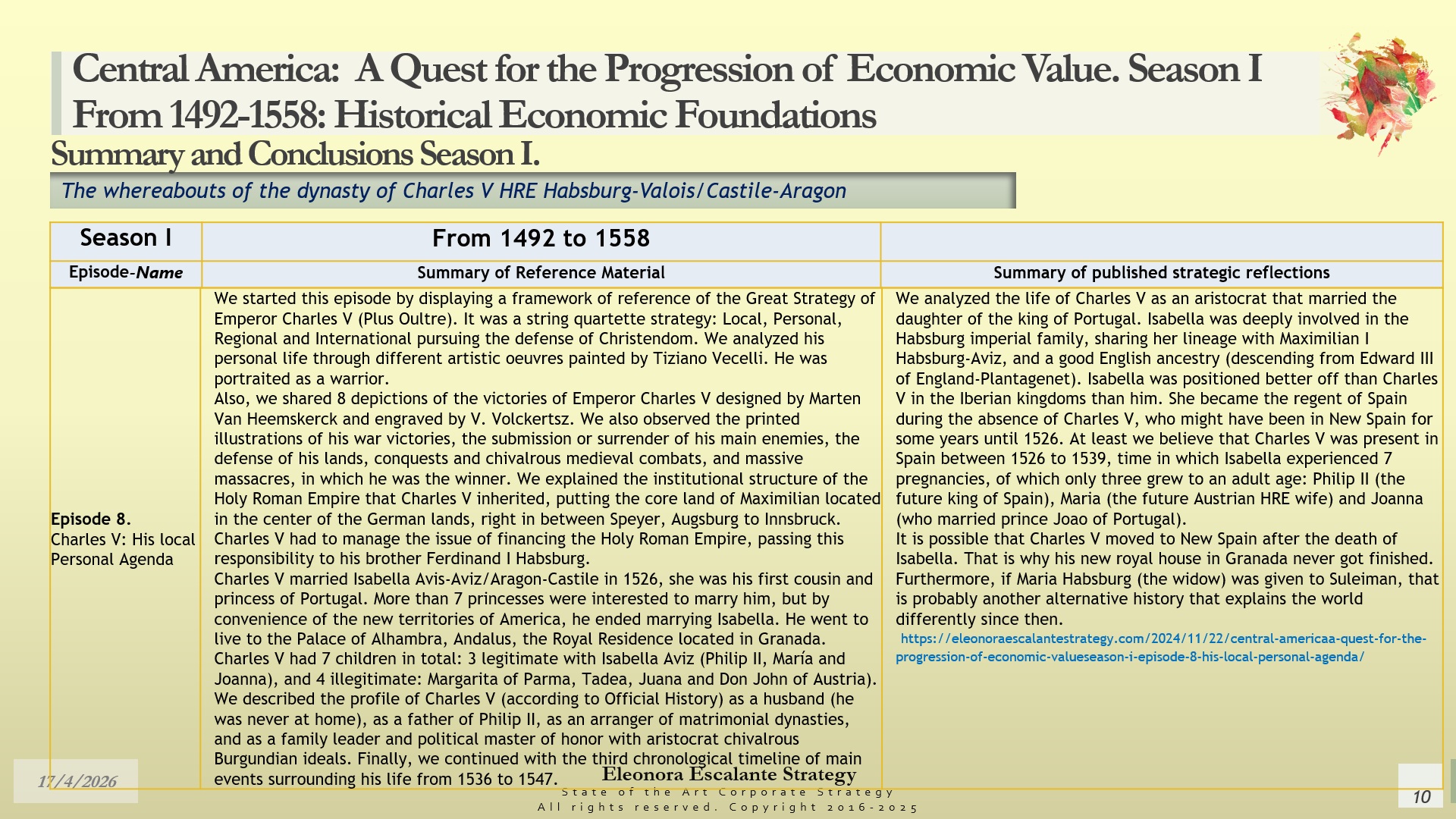
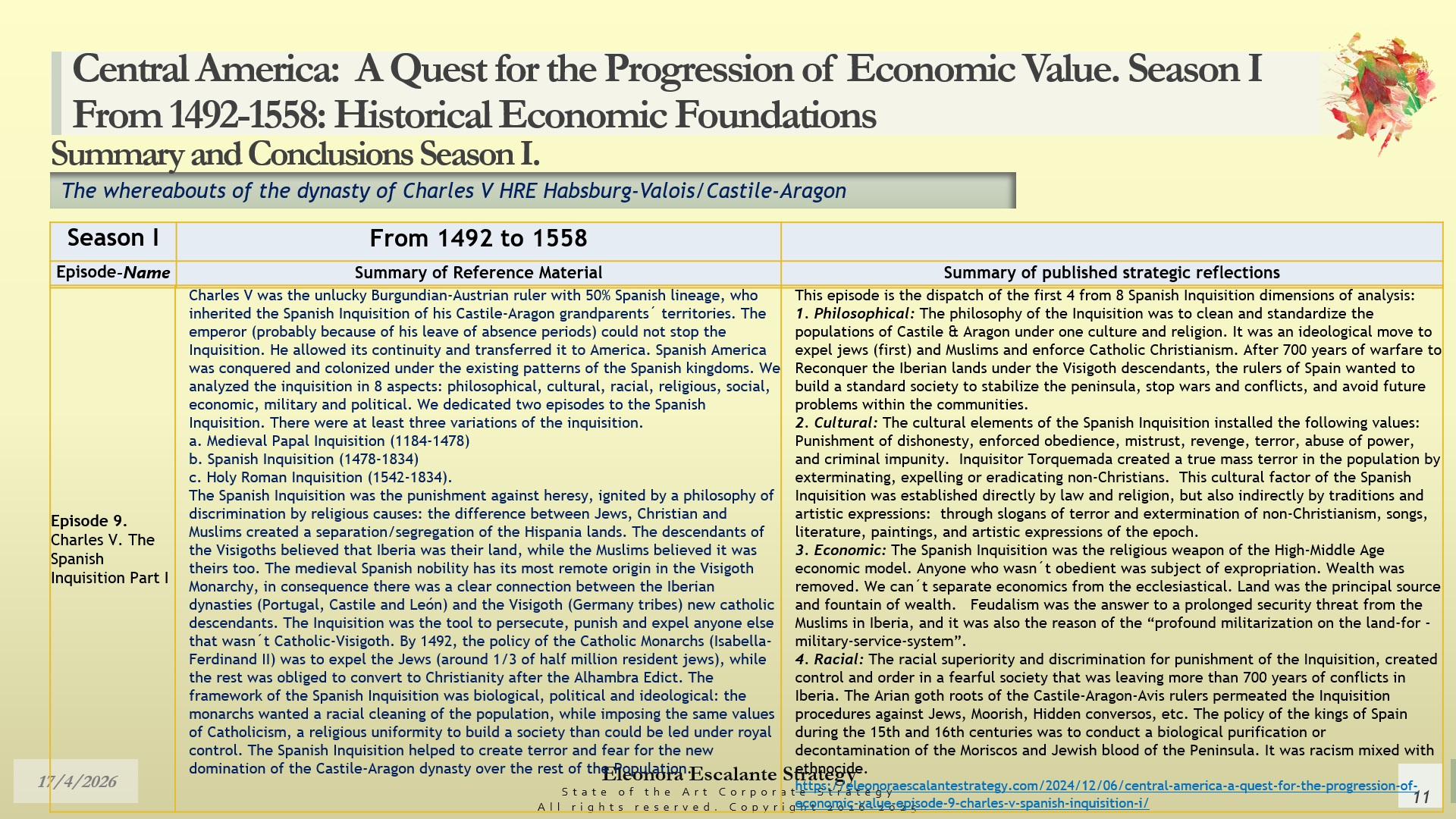
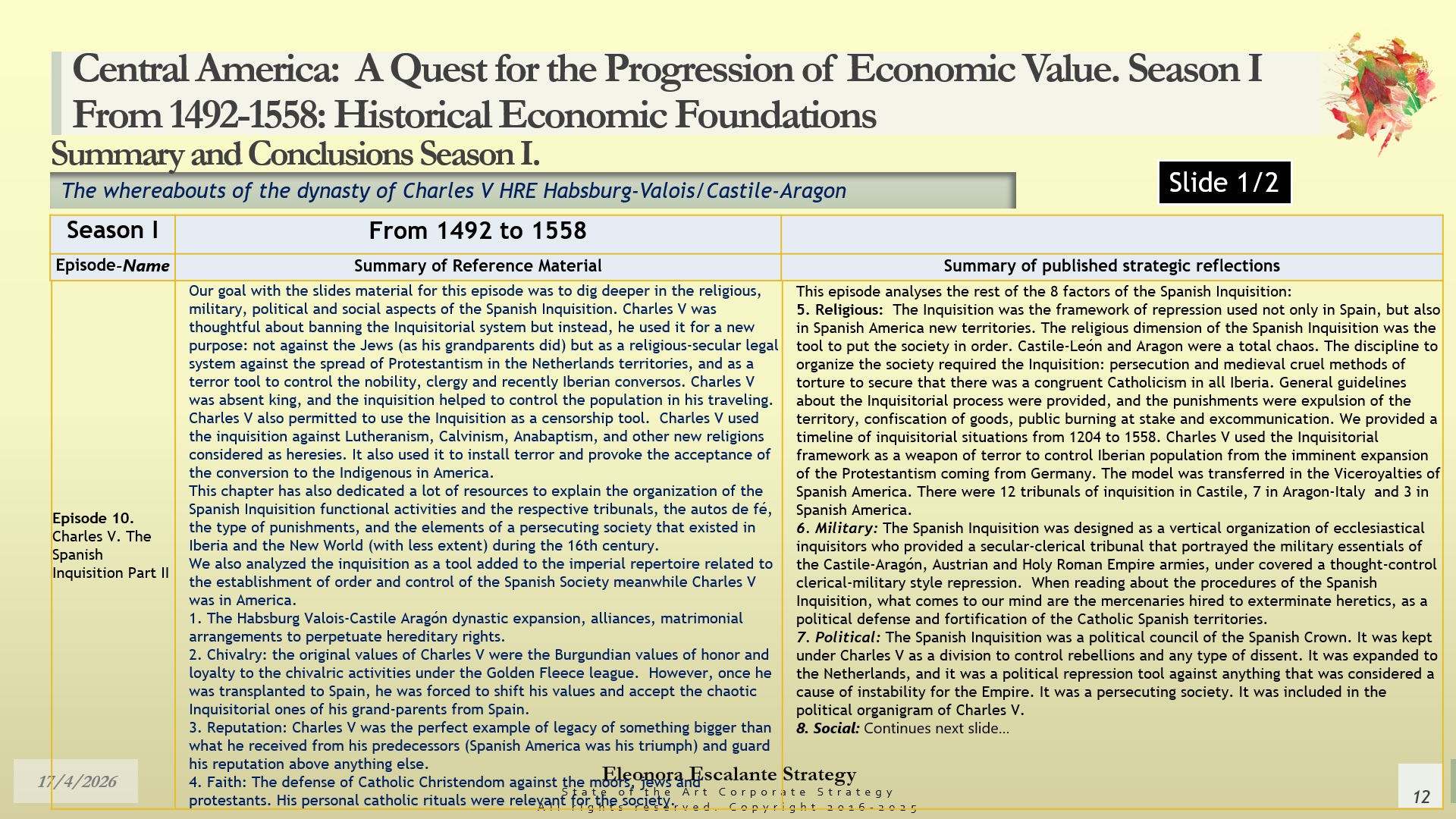
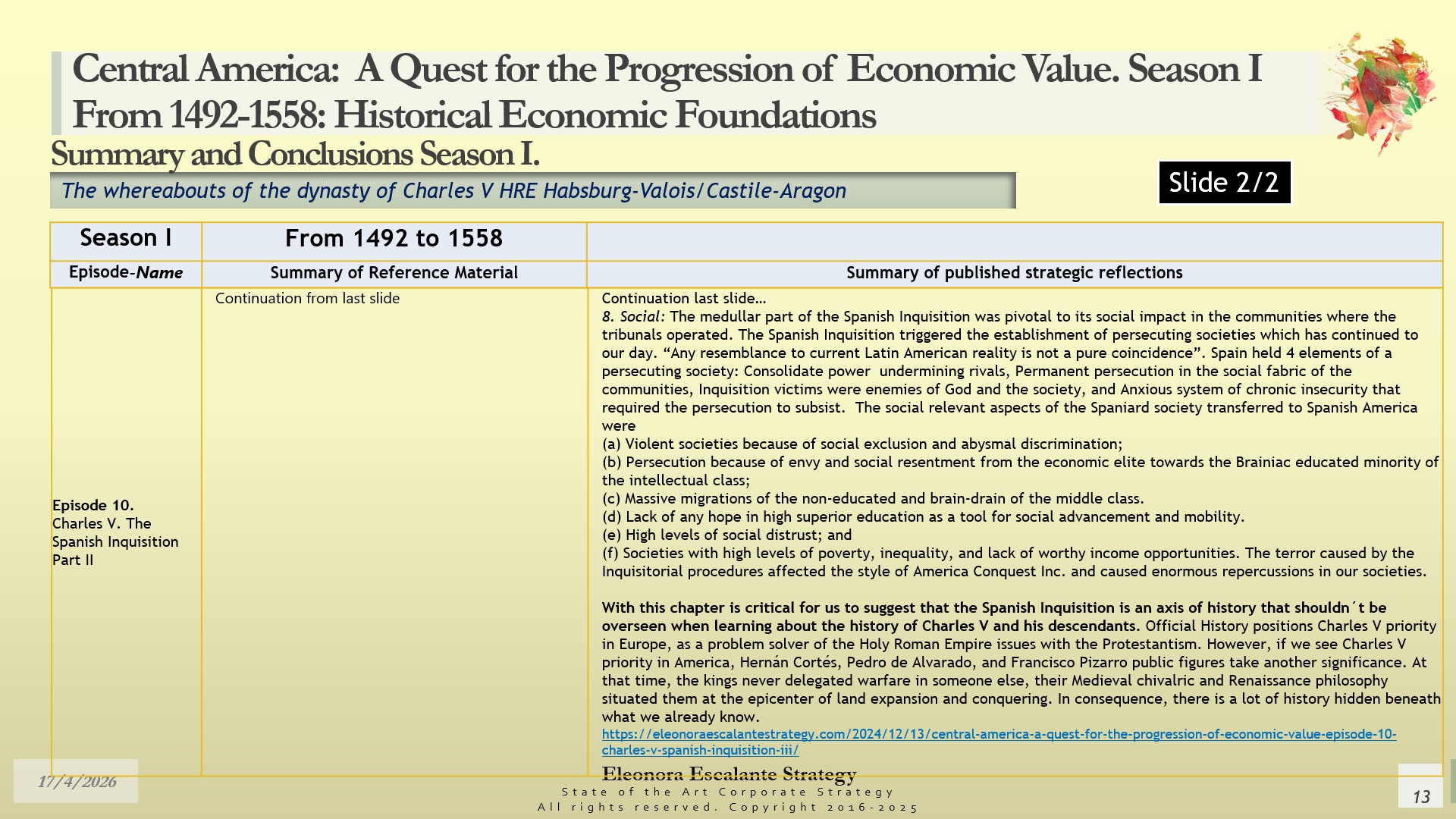
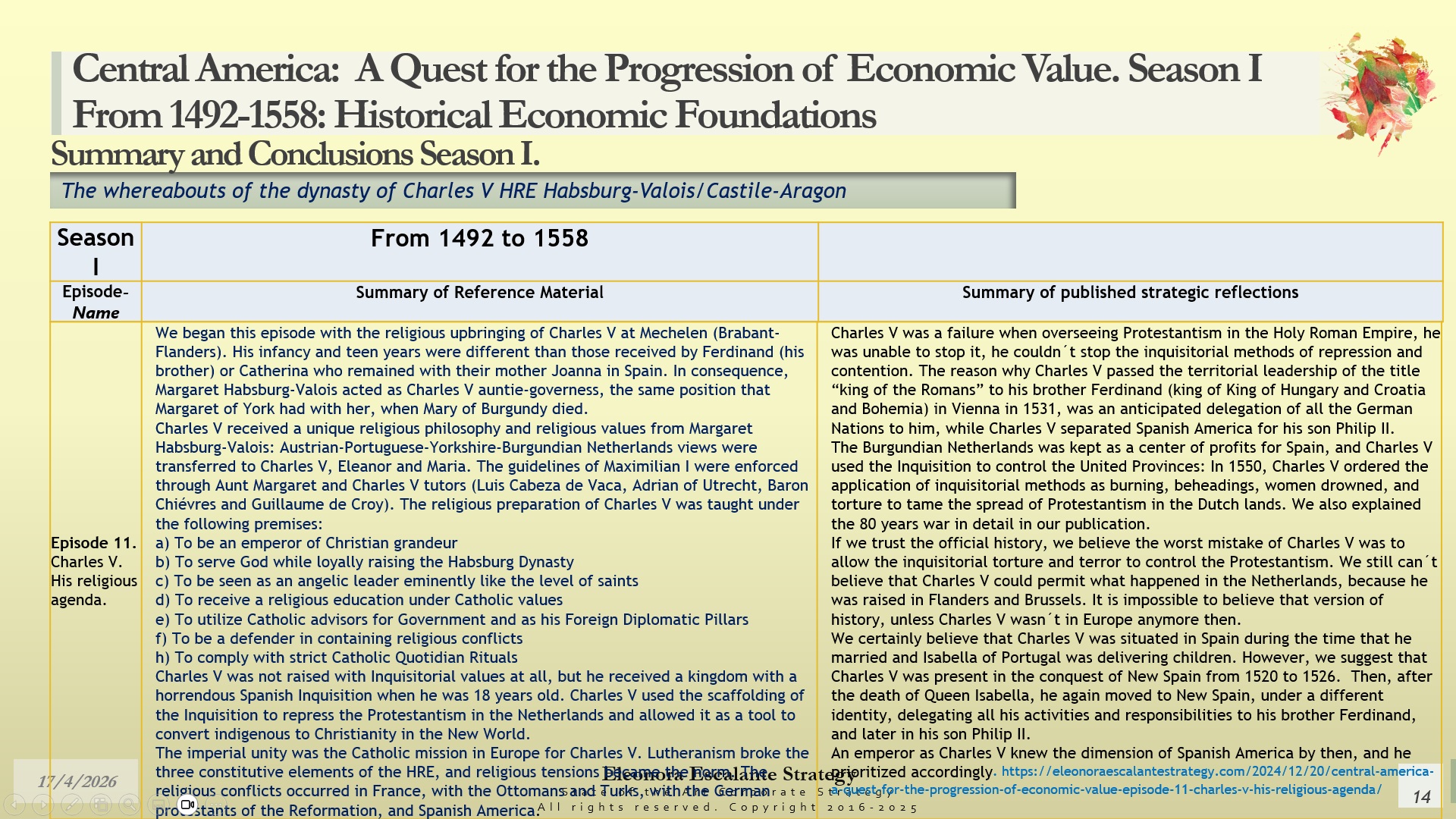
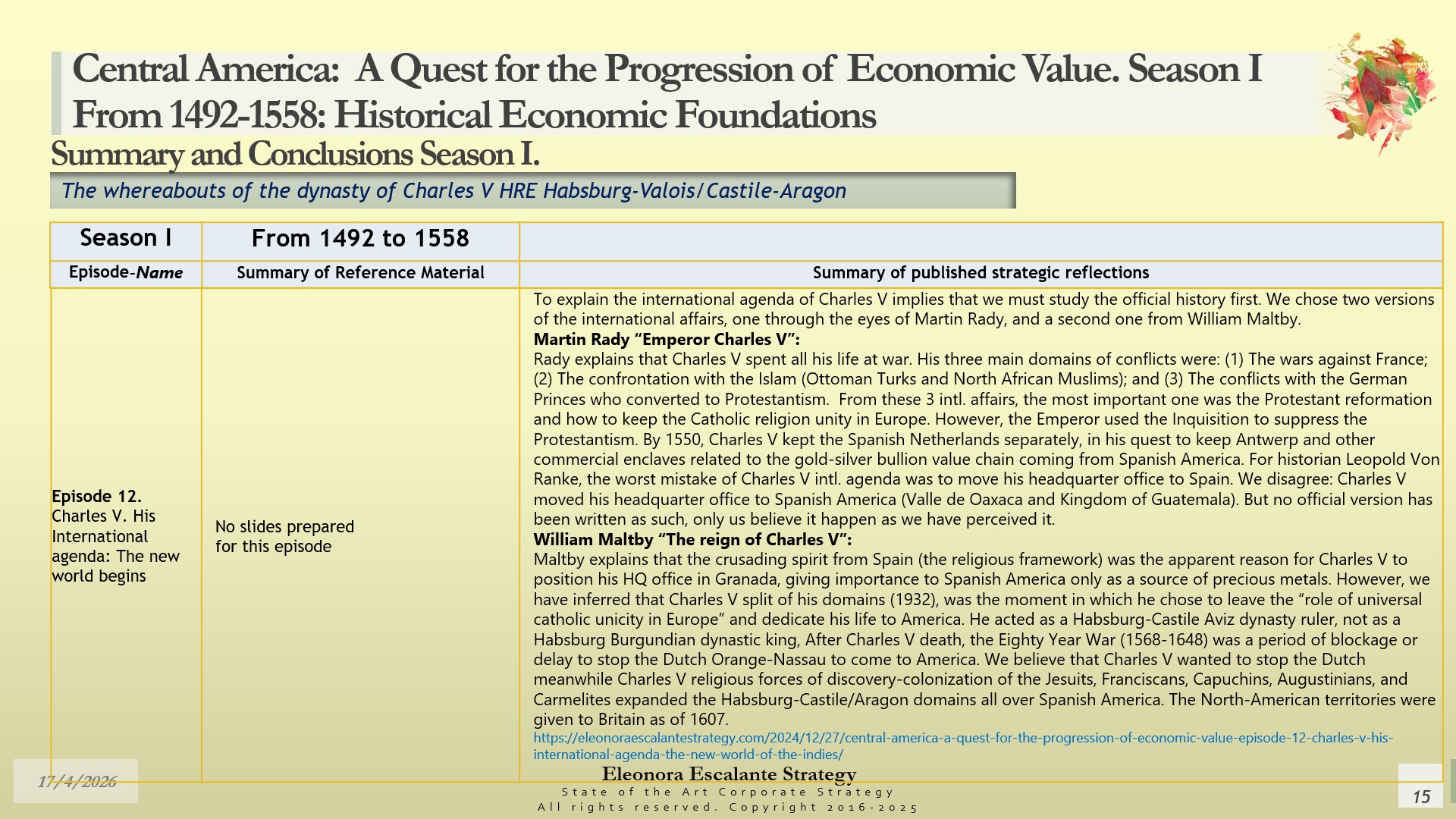

Conclusions of Season I. Central America: A Quest for the Progression of Economic Value. Period of study: From 1492 to 1558: Historic economic foundations. The Life of Charles V, Holy Roman Emperor.
After reading the summary of the slides above, we proceed to conclude this season with the key elements that must be memorized in your mind. Our contribution to the economic history and the corporate strategy domains is the discovery of the following features that require our attention.
- The discovery of America wasn´t a casual accident. It was planned by a dynastic arrangement of royal families that were leading Europe in the late 15th century. The role of the Aviz family of Portugal is fundamental in our analysis. Before the presence of the Austrian Maximilian I, HRE, who was the son of Leonora Aviz-Aragón (Portuguese-Castile-Aragón origin), the discovery of America couldn´t have been possible. We believe that the Portuguese discovered America before, but they also knew they couldn´t tame the existing tribes alone. The Catholic Iberian kingdoms were in a chaotic, violent geopolitical situation for 700 years, and they needed help from the Pope, from the Holy Roman Empire, and from the richest of all the kingdoms of Europe: Burgundy-Netherlands.
- Emperor Maximilian I of Austria was the patriarch who designed and was probably involved in the operation of the discovery of America. According to official history, his son Philip I Habsburg-Valois died in 1506. From 1506 to 1519, his grandson Charles V was not ready to lead such an enormous responsibility. His other grandson, Ferdinand I, was raised as Spanish under the authority of his grandfather Ferdinand II of Aragón; in consequence, Maximilian knew that he had to take over the operation. However, Maximilian I died in 1519, and it was the turn for Charles V, a young, inexperienced king.
- The role of the military orders of Spain and other mercenary knights. According to official history, the Templar knights were sacrificed in France during the 14th century. Pope Clement V disbanded the order in 1312; however, many of them were hired by the kings of Iberia as mercenaries to expel the Muslims from Hispania. We perceive that the 4 main military orders of Spain were assembled under the leadership of the rulers of Spain. So these knights accompanied Columbus in his voyages, and much later accompanied the Spanish conquerors in the siege of Tenochtitlan.
- The conquest of America was not in the hands of errant vagabonds or adventurers. During the 15th and 16th centuries, the expansion of territories was never delegated by the kings. The kings were fighting with the knights and soldiers for every inch of land. We suggest that the project Conquest America Inc. was directly led by the King of Spain and probably other princes or kings related by blood to the dynasty Habsburg-Aviz-Valois/Castile-Aragon.
- The role of the Catholic Church in the Discovery and Early Colonization of America: The bad Pope Alexander V (Rodrigo Borgia), born in 1431 in Valencia, was crucial for the Portuguese and Spanish in their quest to defend the newly discovered territories in America. The different religious orders were also essential to Christianize the indigenous and pacify the new territories: Augustinians, Franciscans, Jesuits, Dominicans, Carmelites, and Capuchins. We dare to suggest that many princes or nobles came in undercover identity, posing as priests or friars.
- Charles V HRE reached Spanish America?. We suggest that Charles V, Holy Roman Emperor, came twice to live in Spanish America. He came under another identity to these lands, and we also suggest that he decided to live in the Valley of Oaxaca, in the Kingdom of Guatemala. This affirmation is explored in detail in season II. If the priority for Charles V HRE was America, then his issues were not Eurocentric. That explains numerous inconsistencies and incongruities in the official version of his history.
- The life of Maria Habsburg Valois-Castile Aragón, a possibility that she married Suleiman? We suggest that this might have been a possibility because Suleiman almost took Vienna, and Maria´s husband was killed. The widow could have been a hostage, or could have been exchanged in return for peace between the Turks and the Central European kingdoms. The situation was unnamed then; it was a dishonor and shameful event of discrediting proportions. It could have been hidden by the historians on purpose.
- The role of the members of the Order of the Golden Fleece: Although the chivalric medieval order was designed by the ancestors of Mary of Burgundy, we believe that it was an element of importance during the Conquest of America.
Announcement.
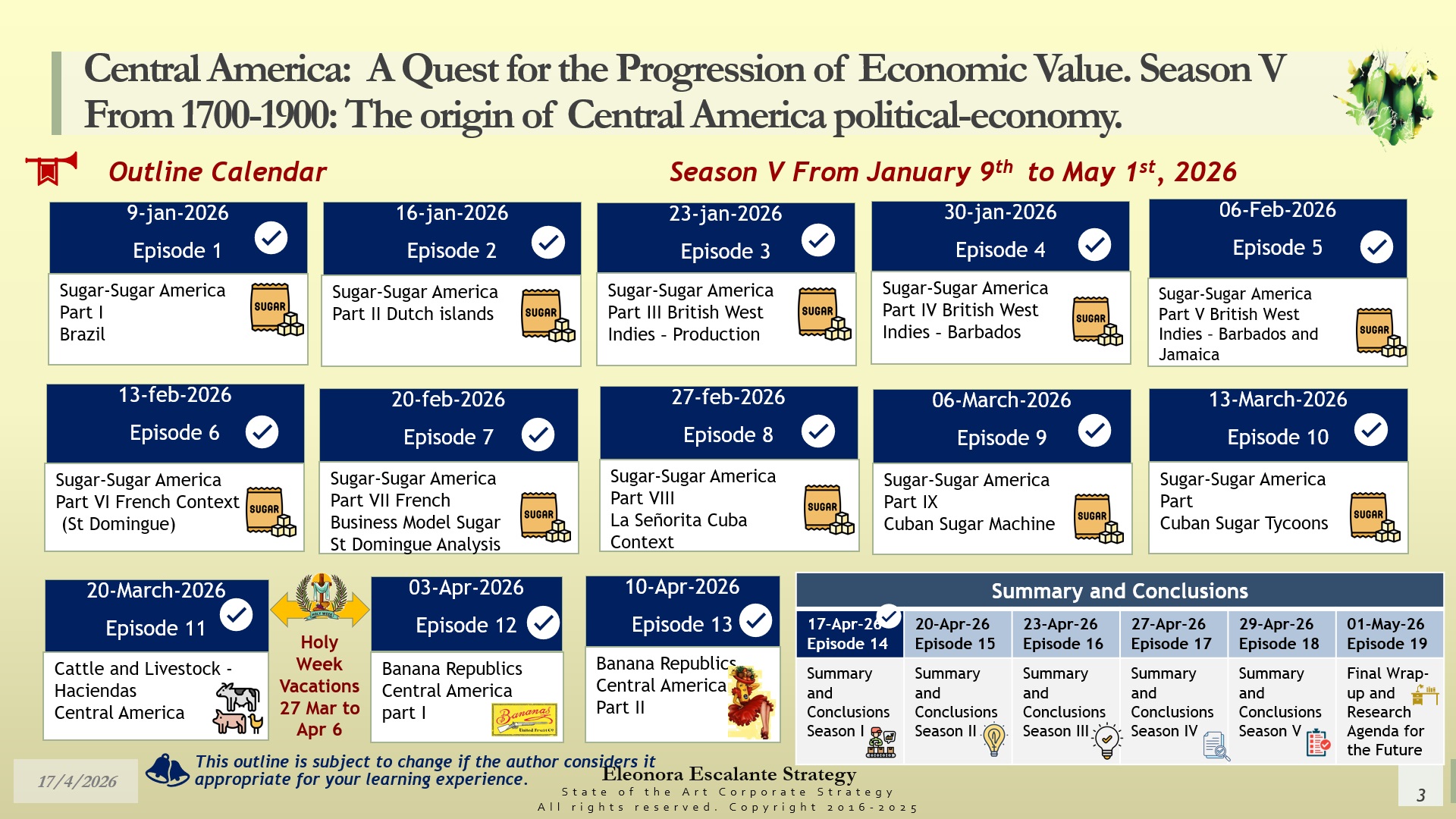
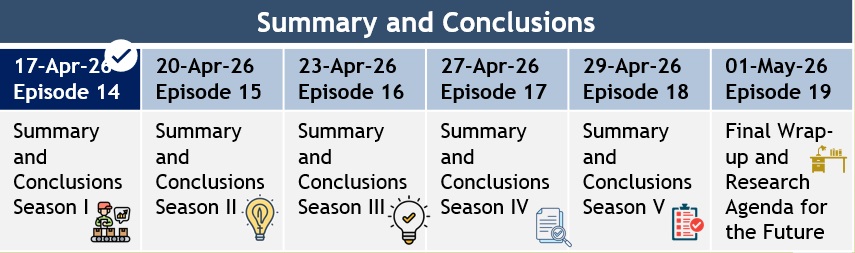
Please take notice of the calendar of the next episodes. We are working nonstop during the following days. Our next episode is about the summary and conclusions of Season II. We will conclude all our work by May 1st, 2026.
The next saga: Coffee-Cacao Strategy 101 for Family Farm small-holders will begin on May 22nd.
Musical Section.
As of today and during the next 5 episodes, we wish to share one piece of work of the top orchestras of the world. Today we start with a North-American one: The Chicago Symphony Orchestra. https://cso.org/
Riccardo Muti leads the Chicago Symphony Orchestra in the first movement of Mendelssohn’s Symphony No. 4 (Italian). This little piece of the oeuvre was played in 2023.
Thank you for reading http://www.eleonoraescalantestrategy.com. It is a privilege to learn. Blessings.

Sources of reference and Bibliography utilized for today´s inferences. All were listed in each respective season and publication days before.
Disclaimer: Eleonora Escalante paints Illustrations in Watercolor. Other types of illustrations or videos (which are not mine) are used for educational purposes ONLY. All are used as Illustrative and non-commercial images. Utilized only informatively for the public good. Nevertheless, most of this blog’s pictures, images, and videos are not mine. Unless otherwise stated, I do not own any lovely photos or images.
 Eleonora Escalante Strategy Strategic Reflections Think Tank