
Cacao and Coffee 101. Success Strategies for Small Farm Holders. Episode 4. Sustainability: beyond caring for the land. Part 2.
Dear incredible readers:
The second section of Sustainability that we have prepared goes straight to the point. We would like to thank the “terroir” of each of the regions and microregions used for coffee and cacao production in the tropics. It is with the terroir blessings that we got inspired to prepare our material for today. There is hope for all the small farmers because of the “terroir” of the coffee and cacao trees.
Find the preparation material for the class below. Feel free to share it with your beloved friends who are exploring coffee and cacao as their strategic plan for life. Those who are already in love with their farms will comprehend this rehearsal immediately. Print the slides, and follow our bibliography for your reference.
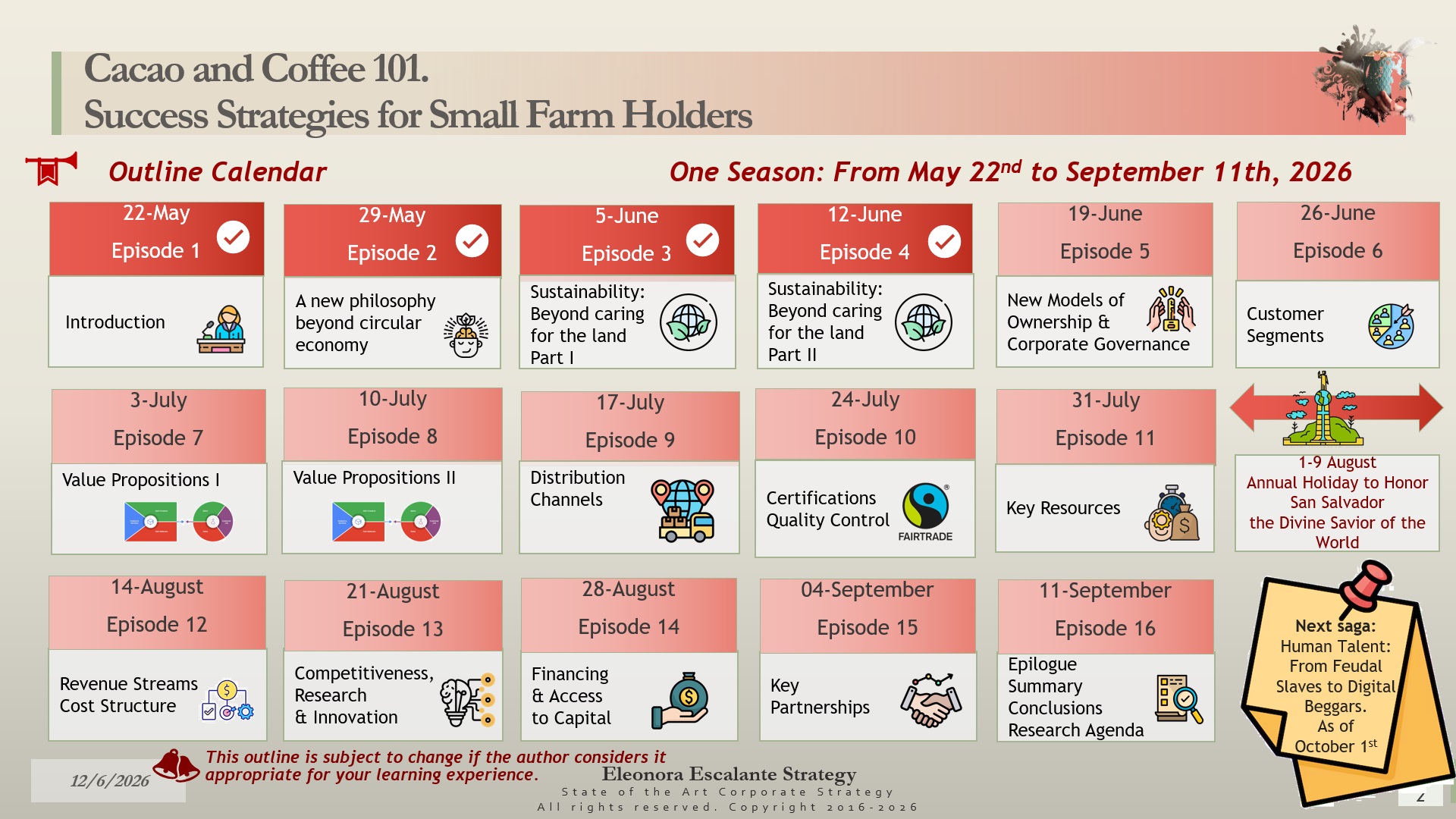
We kindly ask that you return next Monday, the 15th of June 2026, to review our strategic reflections on this chapter.
We encourage our readers to familiarize themselves with our Friday master class by reviewing the slides over the weekend. We expect you to create ideas that are or are not strategic reflections. Every Monday, we upload our strategic inferences below. These will be discussed in the next paragraph. Only then will you be able to compare your own reflections with our introspection. We always give our students a couple of days to prepare well before our final reflection.
Strategic reflections on this episode.
These will be in the section below on Monday, the 15th of June 2026.

Cacao and Coffee 101. Success Strategies for Small Farm Holders. Episode 4. Sustainability. Beyond Caring for the Land. Part 2.
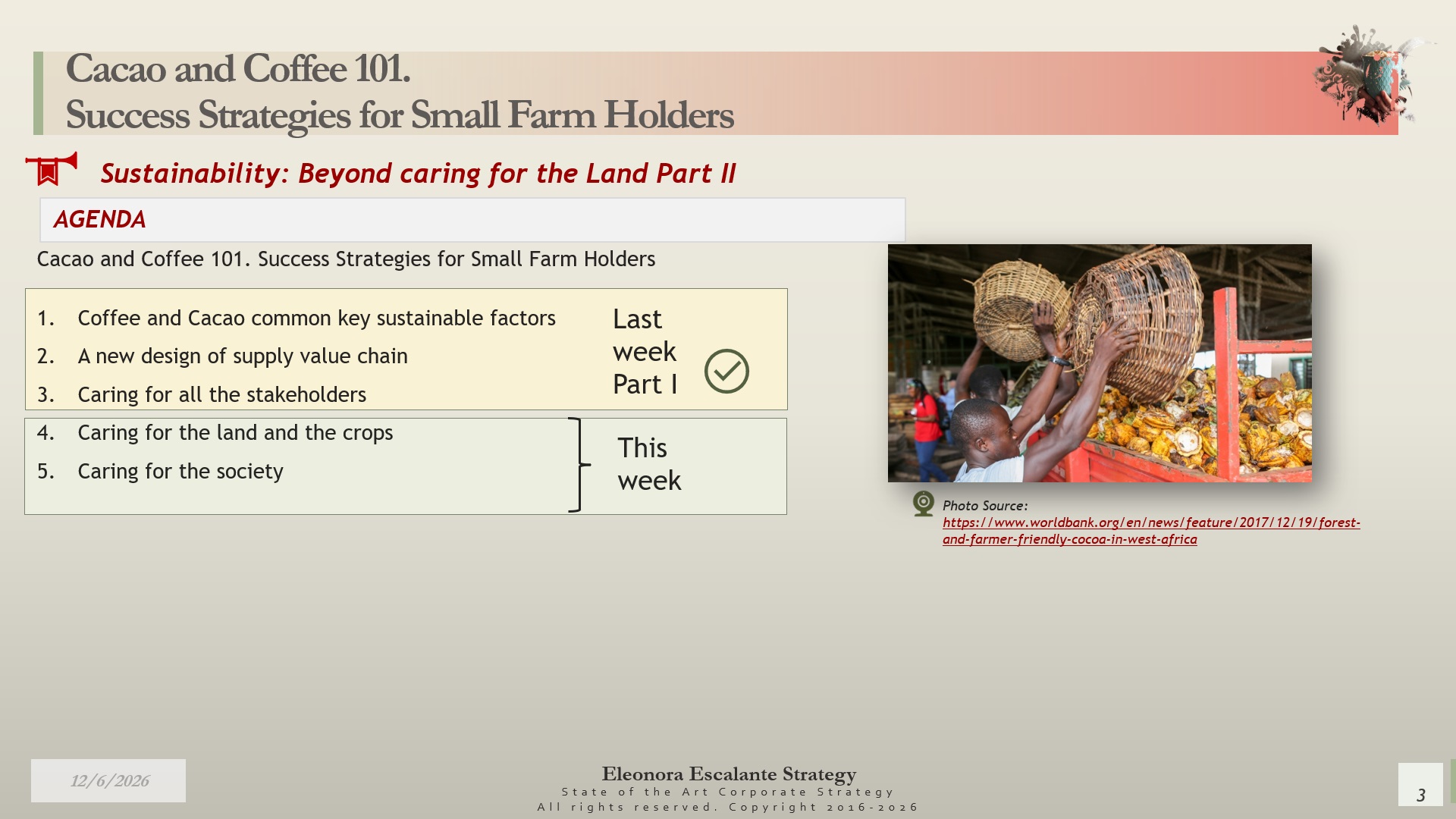
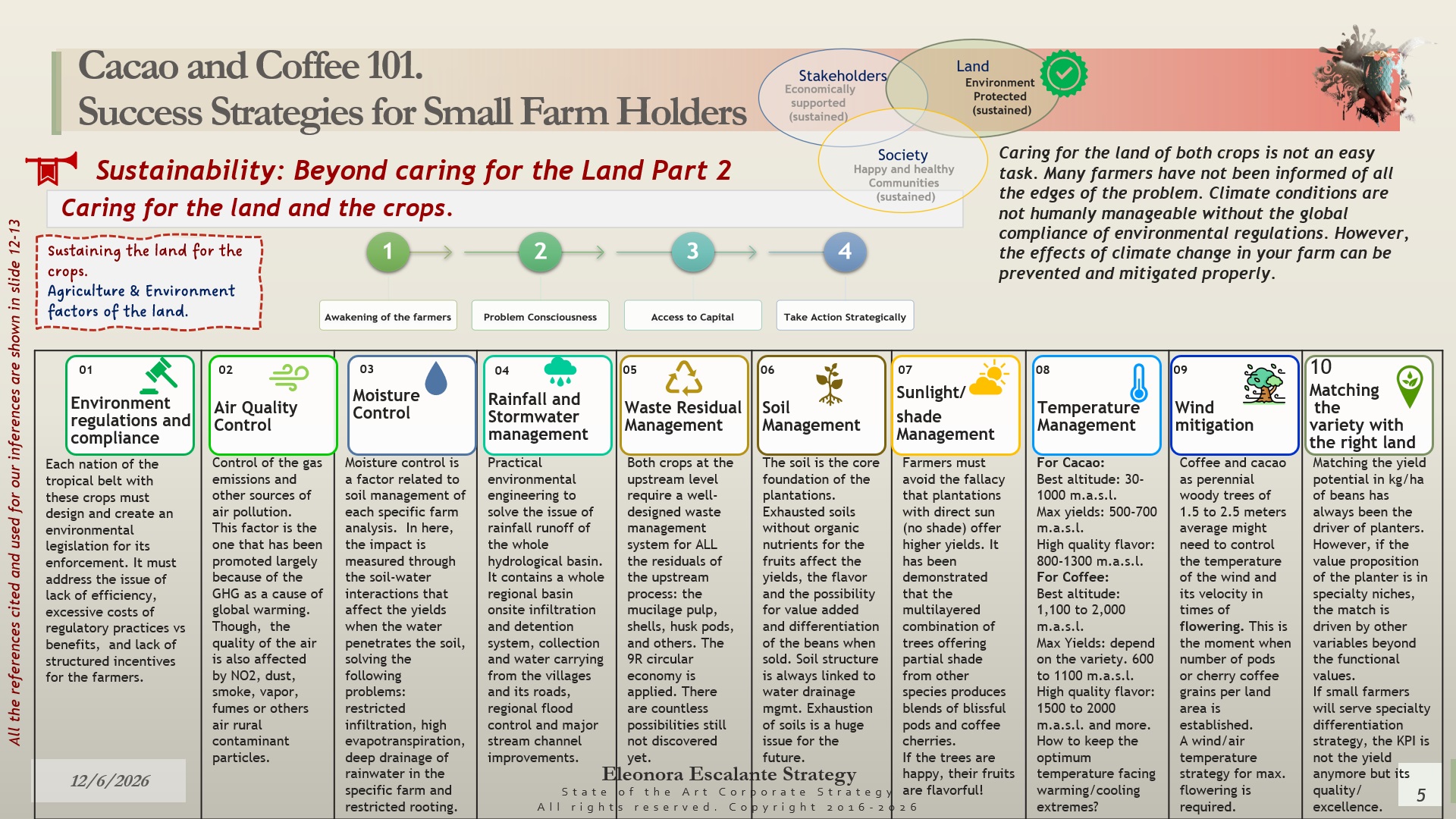
Caring for the land and the crops. Slide 5.
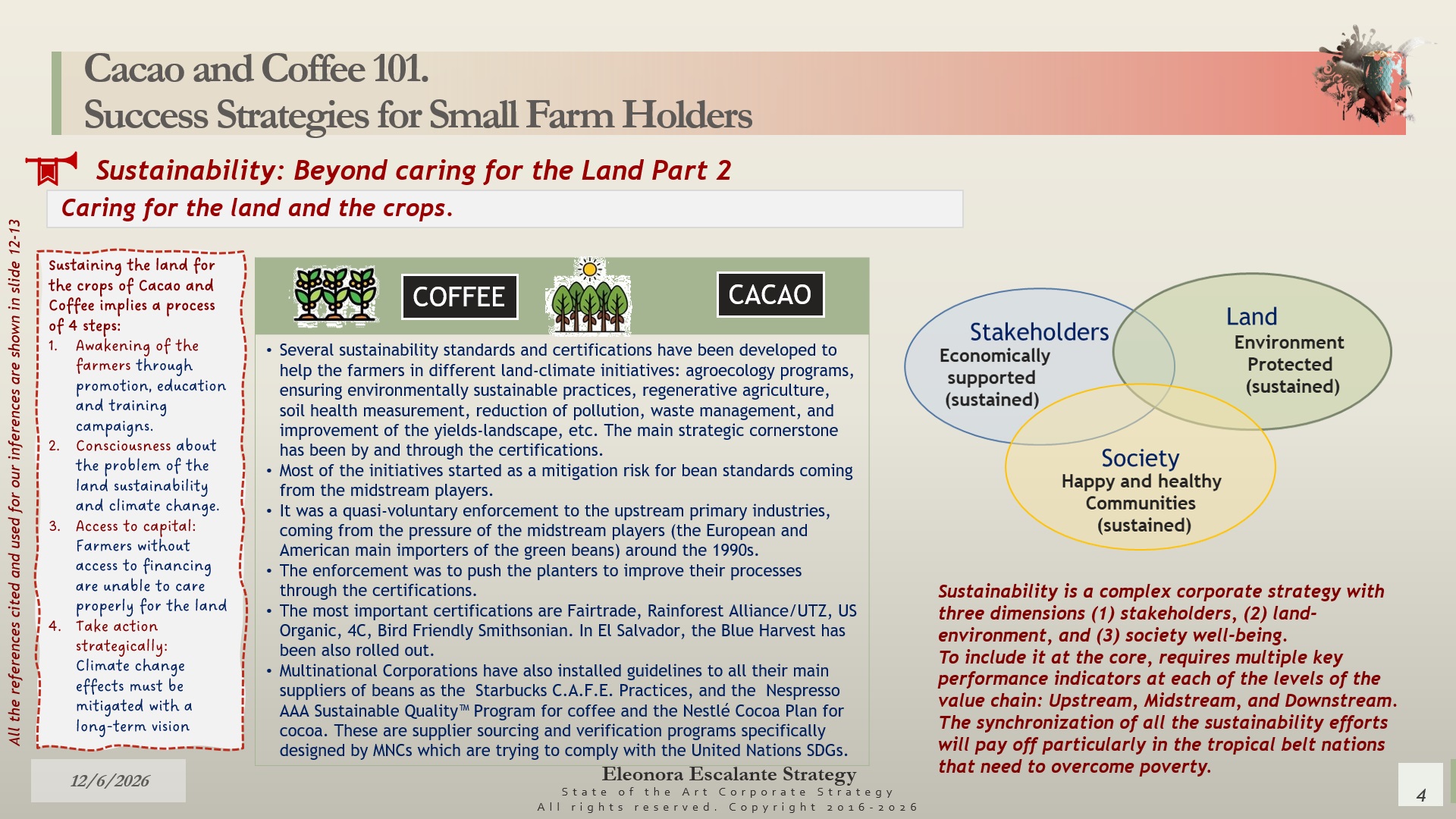
This slide is revealing. Most of the cooperation agents who support the coffee and cacao sectors are mainly involved in helping small farmers to access certifications (such as Fairtrade), to train them about the risks of climate change and the reduction of the yields, and to provide knowledge and best practices about deforestation, promoting the multilayered shade trees to protect the natural humidity and keep the soils well. So it is not new that there was some international aid for the coffee and cacao sectors. But let´s learn what they have been doing.
We have defined a process for sustaining the land in 4 phases (in here we will add a fifth one):
(1) Awakening of the small farmers
(2) Problem consciousness
(3) Access to capital
(4) Take strategic actions
(5) Measure the impact of the strategy in specific results using KPIs (Key Performance Indicators).
There is dedicated support in terms of technical assistance for small farmers in the tropics. During the last 20 years, the assistance has existed, on and off, but it has occurred. Several consultants have provided analysis to cooperation agents, and most of the analysis has been done with direct support of the United Nations and European Commission. Additionally, there has been a flow of strong support from the coffee and cacao midstream players, such as Illy, JDE-Peets, Lavazza, LDC, Nestlé, Neumann Kaffee Gruppe, Volcafé, Caffé Borbone, Kraft-Heinz, Starbucks, Tata, Ecom, Olam International, Sucafina, Louis Dreyfus, J.M. Smuckers, Strauss, etc. On the side of cacao, the situation is strange. Main midstream players are Barry Callibaut, Mondelez, Cargill, Ecom, Touton, Sucden, EcuKao-Goddard, General Cocoa Company, Hershey, freight companies, etc. Since the cacao has a complex value chain, the big players expect to import excellent-quality cacao beans, but that is not the reality. Many times, they have little control over the quality of cacao beans because they deal with intermediaries, when they are not vertically integrated, operating in the tropics. There are untraceable importers of beans with shady integrated holdings, often lost in between the shareholding of other phantom conglomerates. There are also midstream players who buy a semifinished product from these untraceable traders, in the form of cacao paste after the first grinding, a process made in a manufacturing plant X located near the plantation (this is done to avoid the quality control of the cacao beans and reduce costs of production). According to some researchers, the untraceable tag corresponds to upstream intermediaries that are fully vertically integrated with midstream players who are probably using their respective domestic figureheads’ agents as a make-up governance. These farms are enormous in hectares (some of them, the size of 1/4 of Wisconsin state), and they employ an African or Asian cheap labor force. The range of salaries for these workers is between $0.73 to $1.50 pppd (1). Can you believe it? And the worst part: these farms are allowing children to work. This piece of information is denounced repeatedly on the internet, and it requires urgent attention, because all children must be banned from the workforce at any type of farm on earth.
On the positive side, when I was a World Bank officer, I was an impartial witness to learn about the programs and international funding available for the agricultural sector of the tropical belt nations. I am still a direct observer of several initiatives, particularly those that have been focused on phases one and two described above. Nevertheless, the scope of these activities has not been abundant enough to cover all the small farmers. In consequence, the “awakening and problem consciousness of the farmers” phase has been the backbone of “support” to the tropical belt nations. At the moment of writing this episode, there are multiple technical assistance programs running and dedicating training for the small farmers all over the world. However, the “big issue” is the third phase: access to capital. This is the bottleneck. Despite the fact that most of the nations have been inventoried and identified in their key resources by the main players of the midstream industries, access to financing for small farmers facing climate change has not yet begun. This is not happening yet.
Now, let´s visit some math numbers: For each small farmer who manages 10 ha of coffee Robusta, with an annual yield of 1000 kg of green beans/ha. The income of the intermediary who sells the farmer’s harvest at a future price exchanged ICP April 2026 (2) (international pricing) is 1000 kg/ha x 10 ha x US$2.664/pound x (2.2046 pound/1kg) = US$58,730.54 of revenues per year for the small farmer (these are gross revenues, not operational profit, nor EBITDA). If the price of the contract at a future price is negotiated at US$5.00/pound, then the revenues for that small-farmer family increase to US$110,230.00 dollars. If the yield falls to 600 kg/ha, the gross revenues for the first scenario (US$2.664/pound) are $35,238.33 dollars per year. And for the second scenario (international price of US$5/pound), the yearly income is US$ 66,138 dollars. High income for a farmer, isn´t it? Stop. This is the income to the intermediary, the trader of the beans, not the farmer. At the end of this panorama, the farmer receives between 60% to 80% of the revenues, because the trader keeps a commission of 40% to 20% of the gross sales.
With this example, we can illustrate what variables are important in the calculation of the income of the farmers:
- International Price (usually on a future contract price). If the price is high, the income is higher. If the price is low (as it is now), the income is low.
- Yield of green beans/hectare: farmers with higher yields receive greater revenues, while those who yield less per hectare obtain less income.
- The role of the intermediary trader, who has contacts with other intermediaries who participate in positioning the beans at an international contract future price.
Moreover, every small farming family has working capital issues. This is natural to the coffee-cacao farms. It is historical. All small farmers (with certain exceptions) do not have access to low-priced capital, and many of them are indebted for each working capital load required for the annual harvest. Let´s illustrate this again: Each farmer´s gross sales (received from the intermediary) should subtract the costs of goods sold (COGS) and the Sales-Administration expenses (SGA) to arrive at the level of Operational Income. And then the subtraction continues: To the Operating profits, we should deduct the financing costs (interest payments), the taxes, the depreciation of any equipment or asset, and amortization expenses: And just then, we arrive at our beloved EBITDA number: EBITDA means Earnings Before Interests, Taxes, Depreciation and Amortization. If EBITDA is negative, we are in deep trouble, and this is the reality of all the small farmers on earth. Many farmers only care about the revenues, or the gross margin, or about the variables of how well they are making coffee and cocoa beans. It is unpretentious. They are farmers, and they adore producing colorful cacao pods or beautiful cherry coffee units. The most advanced farmers (with certain knowledge about accounting and economic management) are interested in their Operational margins, or how profitable they are at selling coffee or cacao beans after negotiating with the intermediary, covering their own salaries and the farmer´s overheads. But in agriculture, caring for the land, considering additional expenses of the slide 5, is almost unbearable for the farmers. Why? They have no cash in hand, their EBITDA numbers are negative, and they owe money to everyone, because without positive EBITDAs, it is impossible to generate cash flow to pay all the lending agents (short-term and long-term). Now imagine that you have accumulated negative annual EBITDAs over decades. Mon Dieu!
Small farmers understand the huge risks of climate change to their farms. They observe what is happening day by day. They are not stupid. They know something wrong is going on. But do not demand that they re-invest profits in adaptation, mitigation, regeneration, or recuperation of their land, like planting new trees for partial shade to avoid deforestation, if they live with negative EBITDAs, particularly if they sell the beans to intermediaries (traders), who then resell them again to other intermediaries before they are shipped to Europe or the USA.
Yields can be improved through agricultural practices and climate change mitigation, which is true, and there is no doubt about it. The farmers know it by heart. But international good pricing doesn´t happen every year; consequently, the coffee-cacao planters are betting on the price to rise, and if it happens, the cash available is merely to cover past obligations, but the EBITDAs continue being negative the next year. Commodity pricing fluctuates, and sometimes the reason is not under the supply-demand curve. Adam Smith was suspicious about the invisible hand.
Climate Change requires investments. To sustain the land, there is a need for enough money to solve the issues of each planter´s farms, which are caused by endogenous and/or exogenous reasons. These are small farms of no more than 10 ha. These farmers have been carrying negative EBITDAs for years. If the small farmer family re-invests something in the improvement of the land, this is because their yields are not enough, but not because of climate change mitigation. If the EBITDA is positive, because the international price has gone up, this only happens once every 10 years, then there is no creation of wealth in this farm, but an accumulation of many debts that need to be paid once every 10 years, and the cycle of poverty continues. The climate change mitigation investments that each farmer must consider are beyond their budget, even in their most profitable year. Let´s follow me with the irrationality of requesting investments in climate change for small farmers. The farmers struggle with the land, and they know more than I that climate change mitigation requires 10 simultaneous expense segments to bear: air quality, moisture control, rainfall-stormwater management, waste residual management, soil management, sunlight-shade management, temperature management, wind mitigation, and the reconversion of their trees to new specialty varieties that fit perfectly with their type of soil. Compliance with all these factors requires paying for a government police agency to supervise them. Without regulatory enforcement, even the most diligent farmer runs away. Now, let´s go to Africa, where the salaries are below $1.50 pppd? People are living in extreme poverty there. Do you think they can care for the land? Even if they wish, the small farmers do not have positive EBITDA, and they cannot afford it. Particularly if these small farmers (and their employees) live in horrendous, precarious conditions?
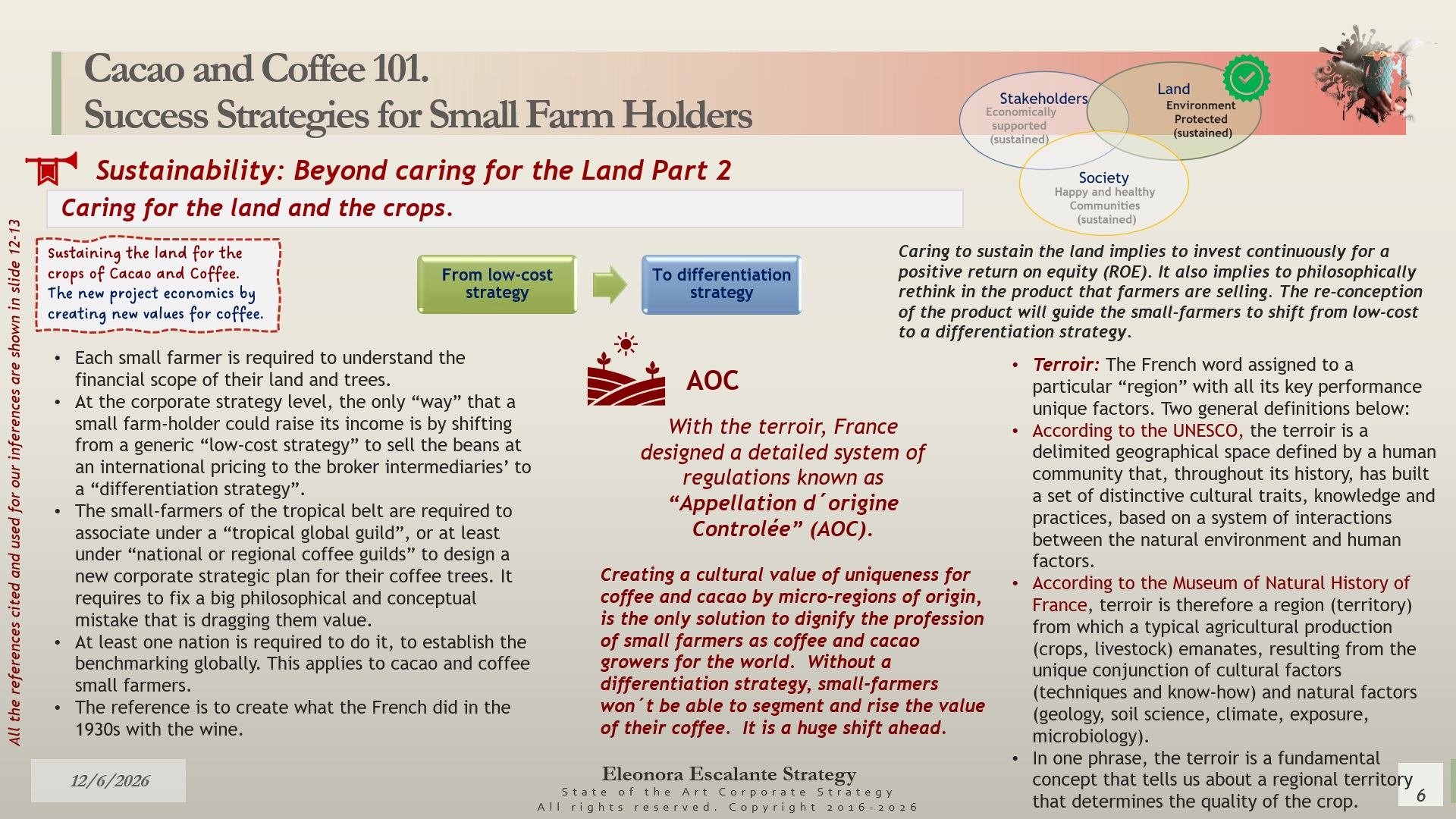
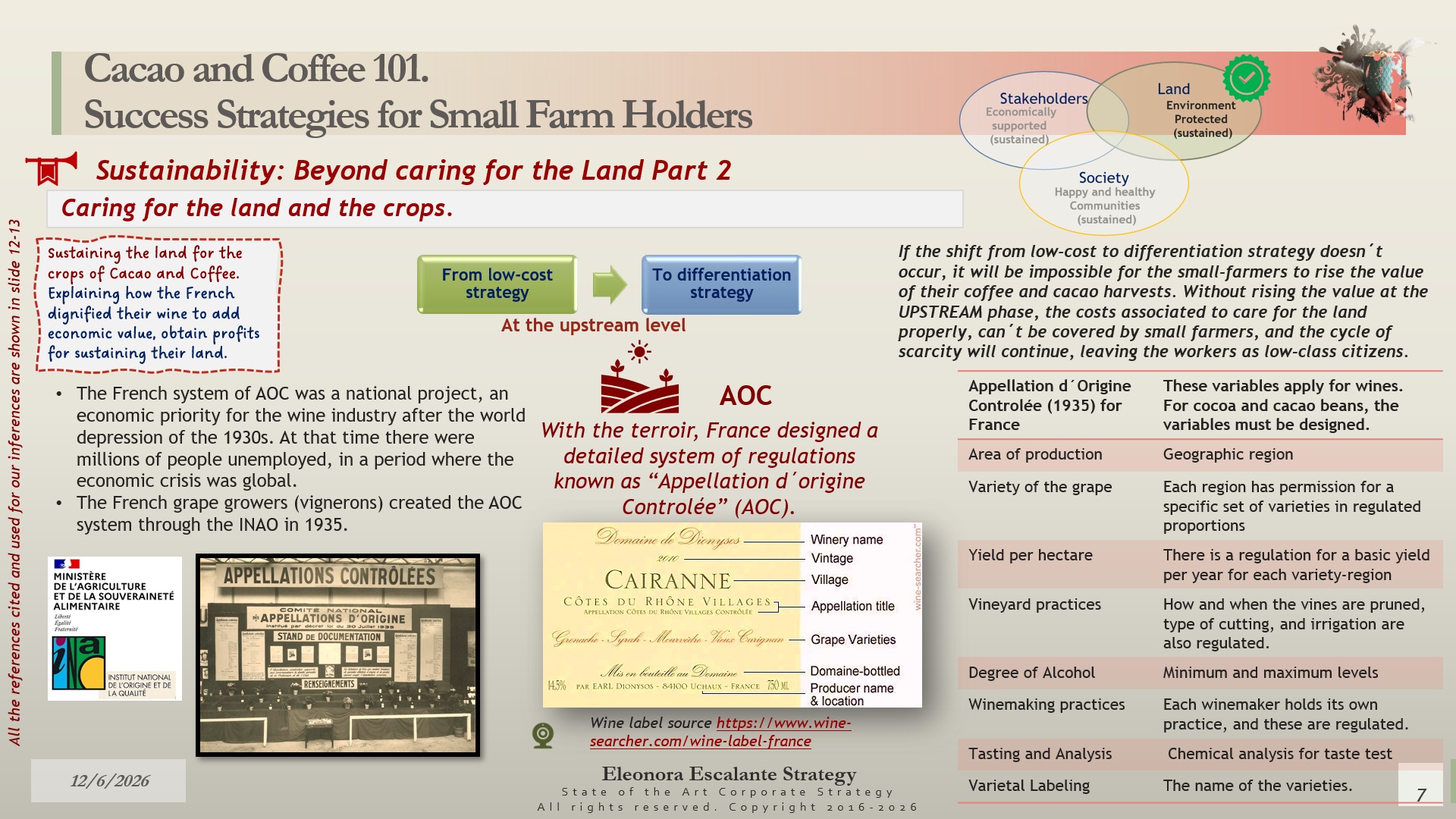
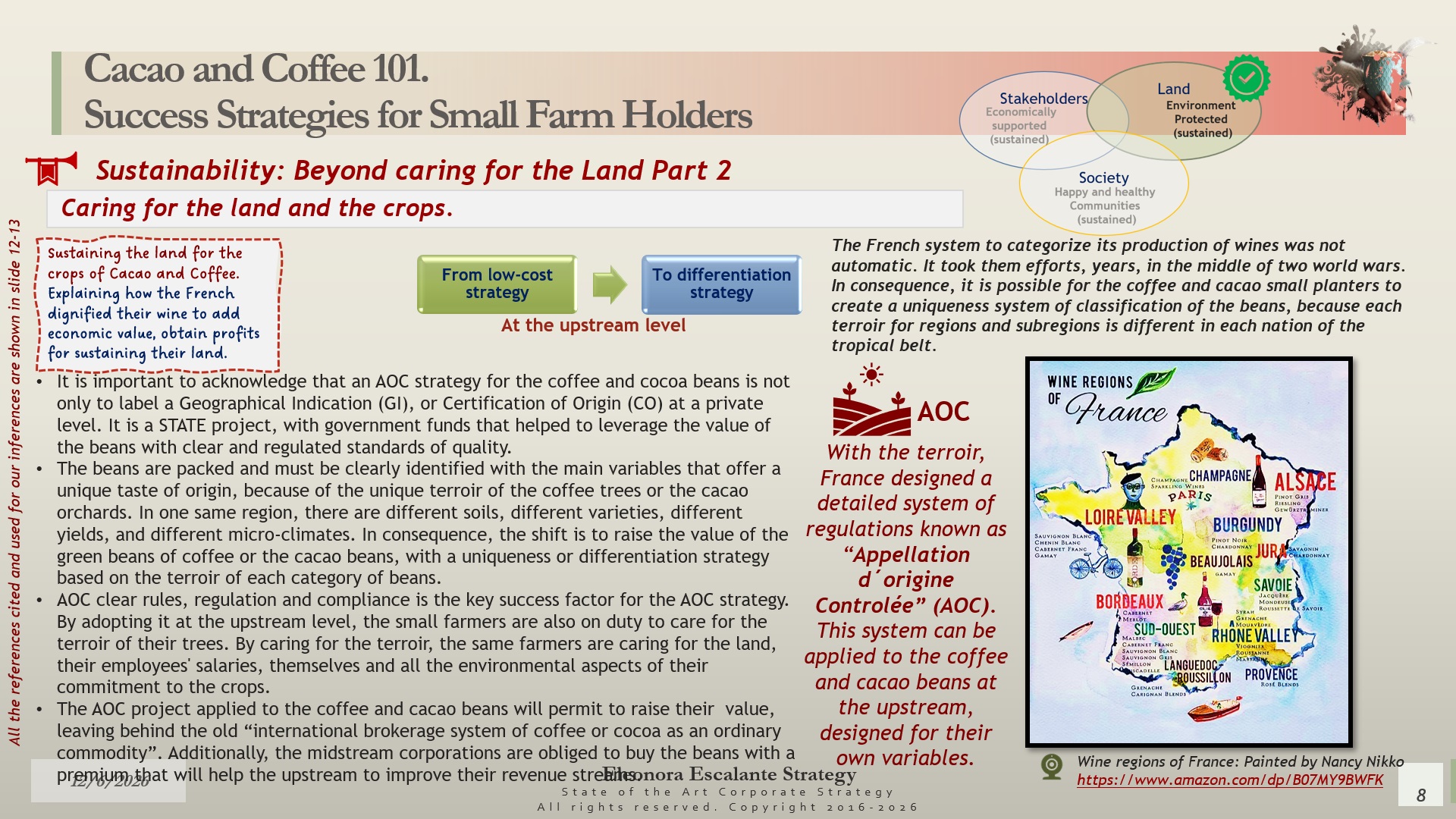
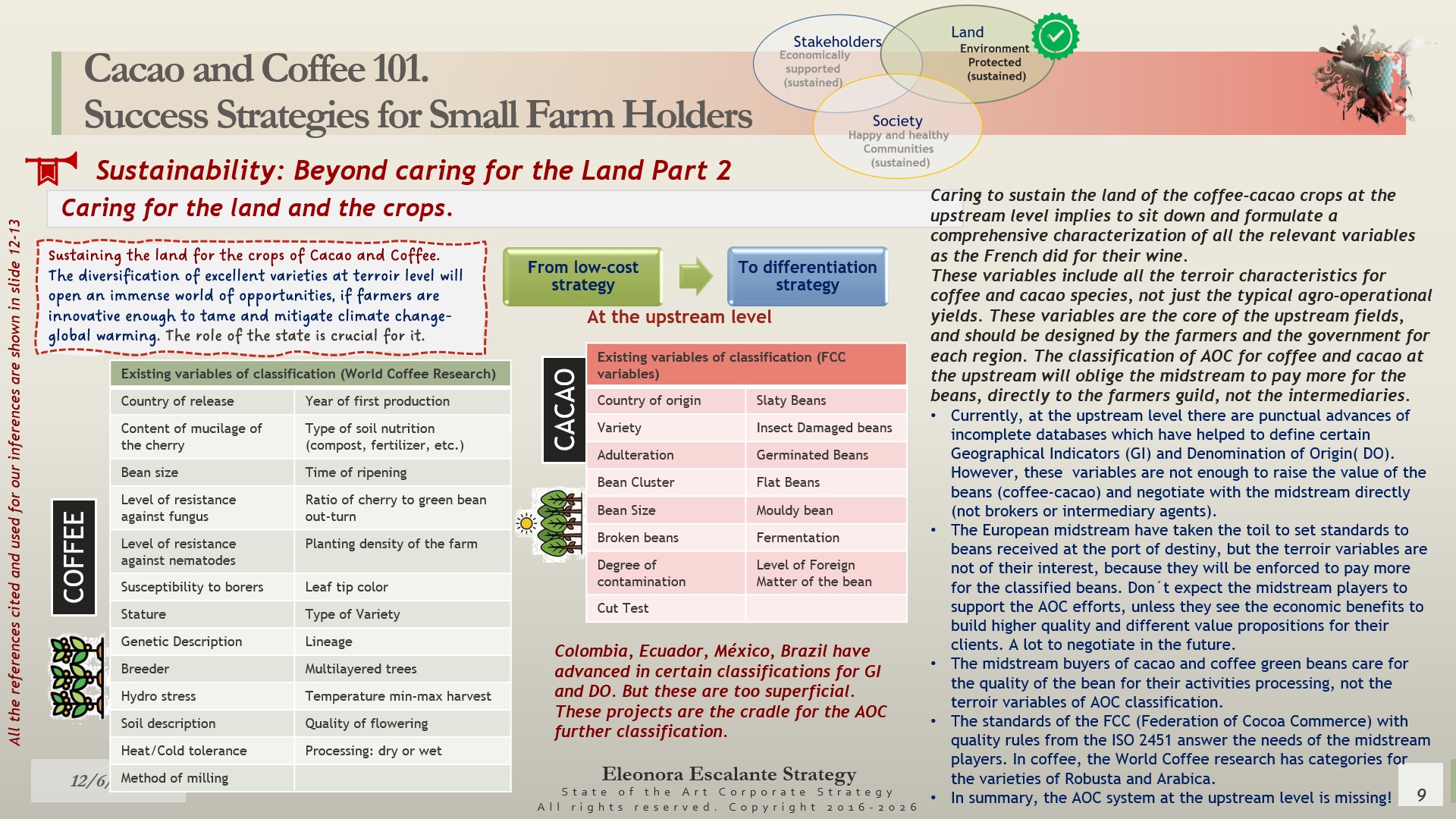
Appellation d´Origine Controlée (AOC) applied to coffee and cacao. Slides 6 to 9.
The French wine Industry is an example of how a nation decided to elevate the characteristics of the terroir (all the local characteristics that allow a differentiation strategy for an agricultural production, to raise the value of the quality of the crop). Wine is a beverage. Basically, coffee and Cacao are also beverages, while cacao has multiple end-formats for different clients. The wine, coffee, and cacao as beverages share something in common: these three products are positioned close to the hearts of consumers. The importance of these drinks is so intense that no matter whether we are rich or poor, we all need a cup of coffee every morning and every afternoon. Chocolate always accompanies our entertainment and social reunions, and wine is omnipresent in the French Culture. But there is a difference with wine: the French raised the value of the wine industry at every level of the value chain, from the farm to the glass. The value chain of wine in France was totally redesigned in the 1930s under the same parameters at all stages. It was conceived totally under the variables of uniqueness or differentiation. Now, let´s go to coffee and cacao, as we taught you last week, the value chain of coffee and cacao has a colossal flaw. The upstream industries are philosophically built under a low-cost strategy, while the midstream and downstream industries are conceived under a differentiation strategy. There is a huge mishap at the philosophical level of corporate and business strategy. This mishap was a core premise during mercantilism when slavery was the norm for protected industries exporting goods and raw materials between Asia-America to Europe. But we are in the 21st century, and it is inconceivable, or unthinkable, to maintain farms where the laborers pickers are earning below US $1.50 pppd. This is inhuman and unbelievable in the tropical belt nations. Just do a microscopic comparison, look at the labor earnings per farmer in France, the average farm laborer’s gross salary per hour is €12 euros. Since workers toil 35 hours per week, each of them earns US $84 pppd.
From slides 6 to 9, we have explained the origin of the AOC system and why it was crucial for the French wine industry. The French did an excellent job by dignifying their own regions (terroirs) of origin with the flavor or taste characteristics of the final product. The French added value to the grapes, and since most of the vignerons are fully integrated, they organized the value chains with variables that have made the wine a regulated industry with standards. If families are low-class, the culture of wine is so important (as our coffee) that they buy the cheap wine. If they can afford it, the families buy better wines with excellent flavor. Please read the slides; all of them are understandable and self-explanatory about the terroir as a mechanism of a differentiation strategy. The terroir for an AOC system is the only hope for the upstream industries. The terroir measured and used by the small farmers in the tropical belt nations will fix the huge mistake of the cacao and chocolate value chain. At least that is the only solution that we find under transparent global commerce rules. It will raise the upstream value beyond the commodity international pricing of today, and it will create a culture of transparency, which will offer different segments of quality (based on varieties, terroir characteristics, and other flavor-taste factors). The idea is to leave the old pricing system that has reduced the value of the upstream players, but this can only occur if the quality of the upstream products is greater, and according to the AOC requirements of each region. Additionally, if the upstream industry designs an AOC system, and the compliance is flawless, the midstream players will finally be appreciative to negotiate directly with the farmers (as a block or as a guild), dismissing the intermediary trader and the rest of the commission agents that are taking the current value that belongs to the farmers. If the coffee and cacao value chains are not fixed structurally at the core of its philosophical corporate strategy design, it doesn´t matter what the United Nations or cooperation agencies are doing with their climate change programs, because the farmers can´t sustain themselves under the low international pricing scenarios.
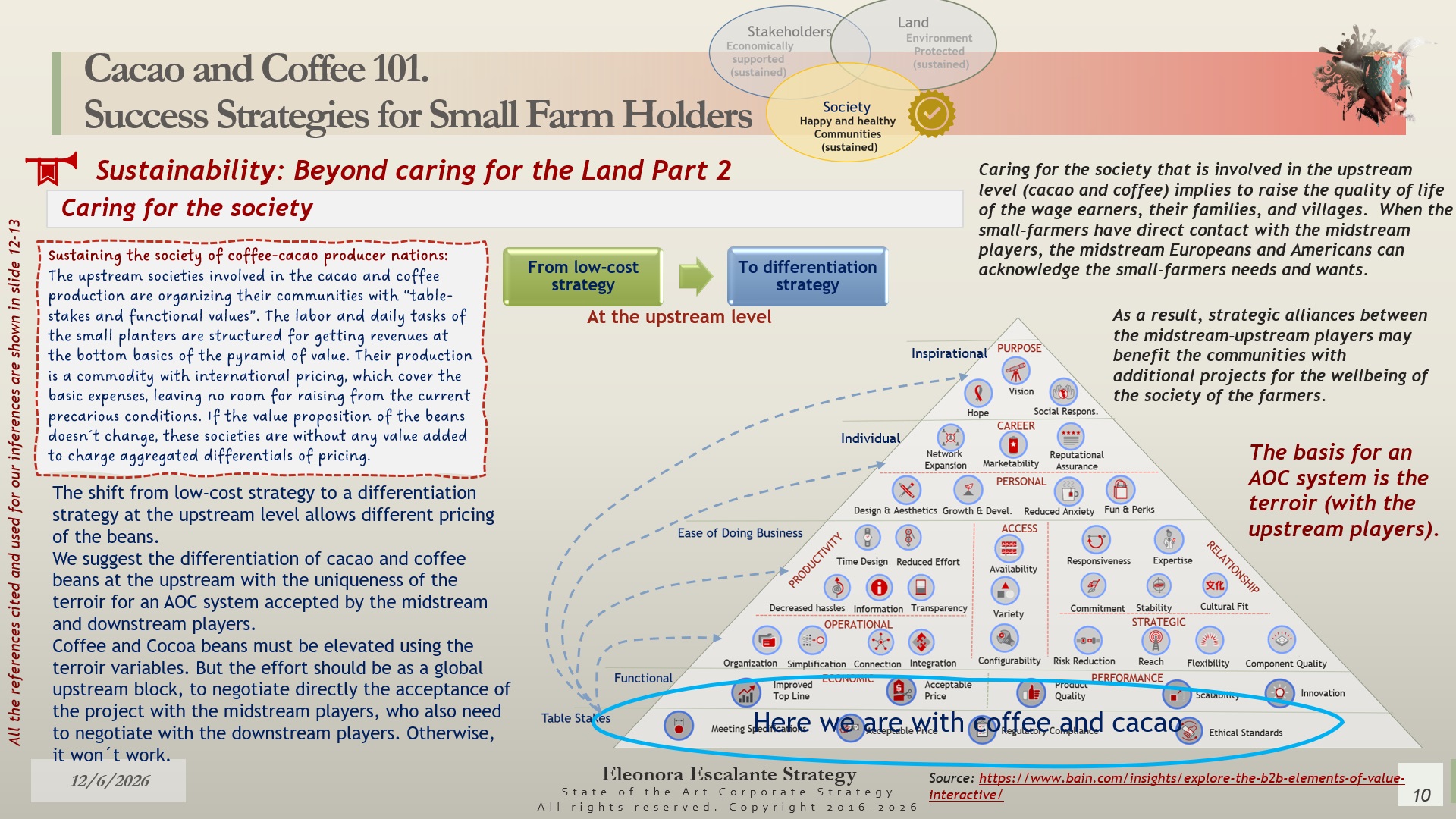
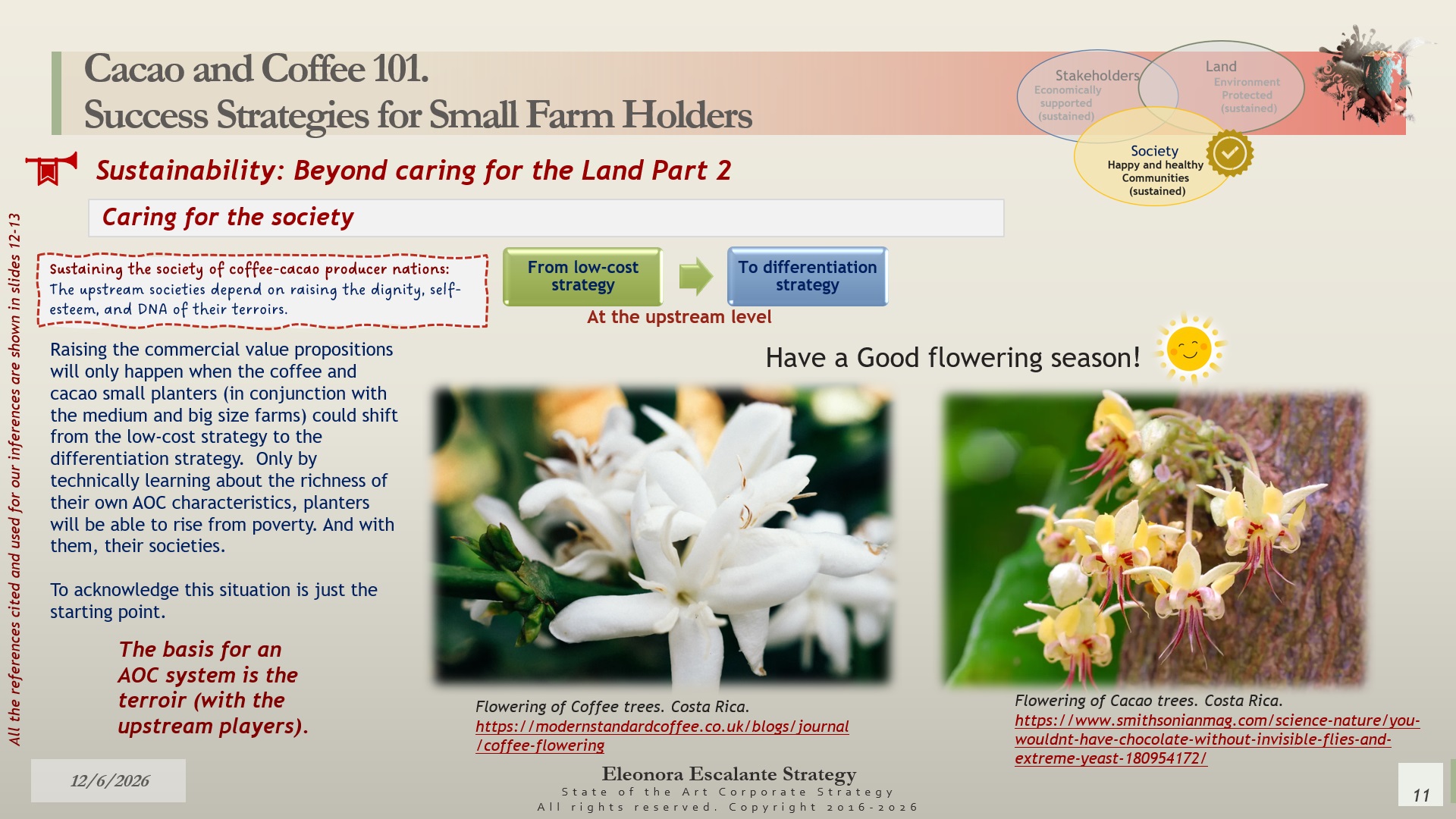
Caring for society. Slides 10 and 11
A society is sustained by its consumer members, entrepreneurs, and companies. If societies do not have robust and vigorous companies, capable of selling their products with some value added, instead of commodities, the economic value of these companies is reduced to minimum levels for those who don´t have economies of scale. Companies that sell commodities can´t generate progression of economic value for themselves, nor for their employees. It is a tacit mercantilism that has not changed since the 17th century. Just observe the value chain, and the eureka light will open your eyes to this matter.
When there is aggregation of value at the upstream levels, there is a diversification of the green beans supply per AOC variables. Naturally, the local markets start to comprehend the beauty of their own coffee and cacao, because they are being educated to breathe that culture in their blood from childhood. Once this happens, the societies outset to see coffee and cacao as part of their own DNA, and their innovation is edified to build additional alternatives to create local midstream-downstream new companies for domestic consumption.
For the time being, until now, our material has been conceived to open the eyes of our students about the general issues of the global value chains of coffee and cocoa. We have discovered the philosophical main mistake that is dragging the upstream industries. It is crucial to elevate, to raise the value of the beans at the upstream levels, in such a way that intermediaries do not take what belongs to the farmers. It is not in the fluctuations of commodity price where you can fix the mistake of the cacao and coffee value chains, but in adding new categories of value at the upstream level that can shift the current table-stakes/functional characteristics of these two agro-products and convert them into a diverse range of regional-inspired values for the new culture of coffee and cacao lovers of the future.
Closing words.
To design and establish an AOC (Appellation d´Origine Controlée) for coffee and cacao beans is not an easy task. It will have numerous detractors, particularly those who lose with a new neatness of an AOC system of beans: the intermediaries, and the untraceable, powerful players. The coffee and cacao industries’ value chain has been operating under a monopsony configuration; some economists have alleged it is a “cartel.” The good rules of commerce and trade only happen when there aren´t monopolies, when there is transparency of everyone involved, and when there is true ethical competition. Without regulations and good enforcement, humans do not behave well, not even at the FIFA World Cup games. A profound moral commitment from all the players of the cacao and coffee value chain is required to fix the upstream level issues, of which the low salary is only a small but essential piece of the puzzle, when we face climate change.
Announcement. Our next episode is a brainstorming session about new models of ownership and corporate governance that our strategy house has been ruminating on. It will be tailor-made for small farmers.
Musical Section.
This saga is committed to raising the traditional musical instruments and their respective musicians over the digitally produced sounds. This saga is dedicated to the chamber orchestras.
Today, we have chosen the Orpheus Chamber Orchestra from New York. The interpretation is a Tchaikovsky composition, Serenade for Strings, Op. 48. For more information: https://orpheusnyc.org/about/about-us
Do you know that coffee and cacao trees adore classical music! All those trees are affected by our sounds
more than you can imagine!
Enjoy!
Thank you for reading http://www.eleonoraescalantestrategy.com. It is a privilege to learn. Blessings.

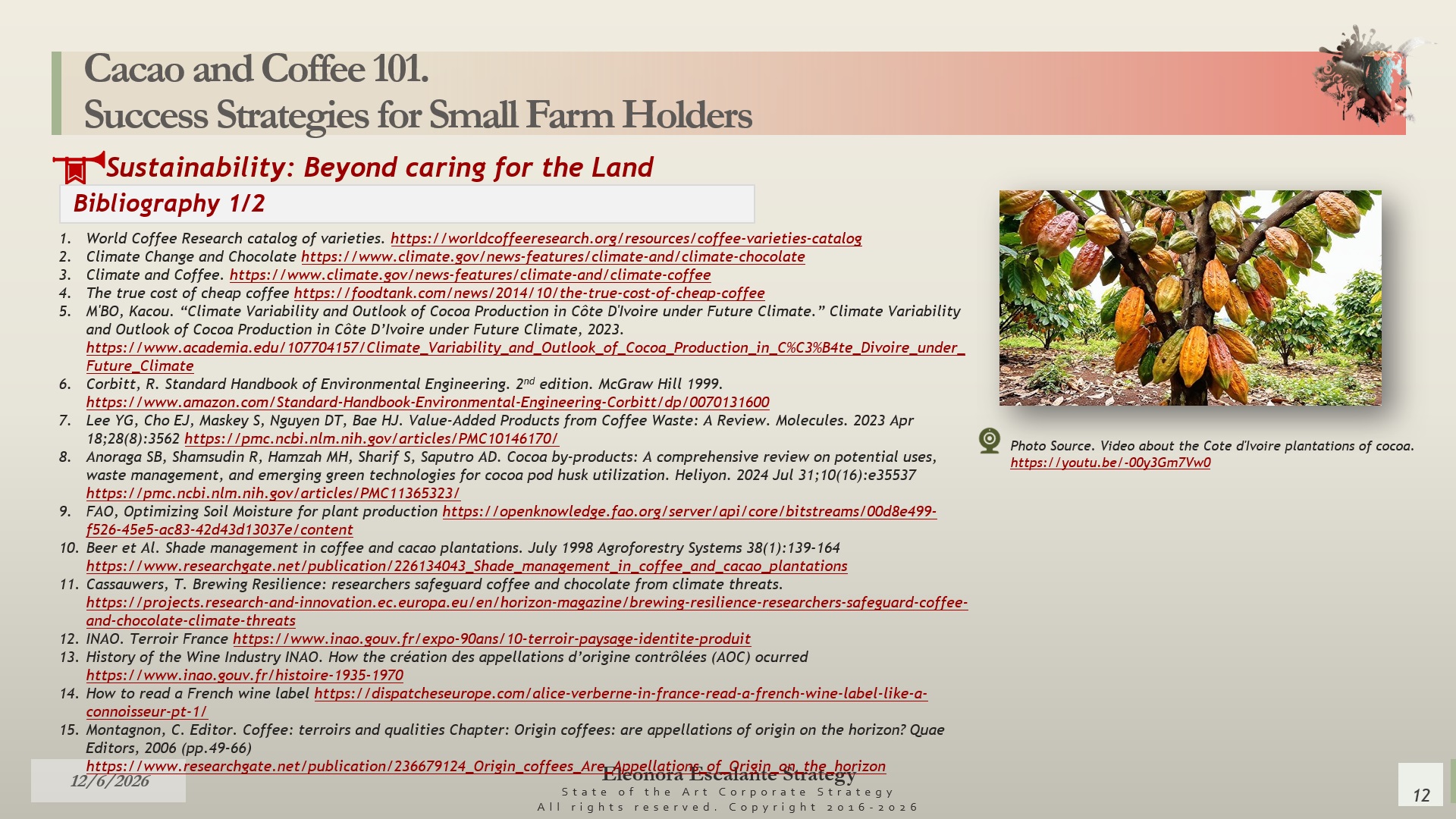
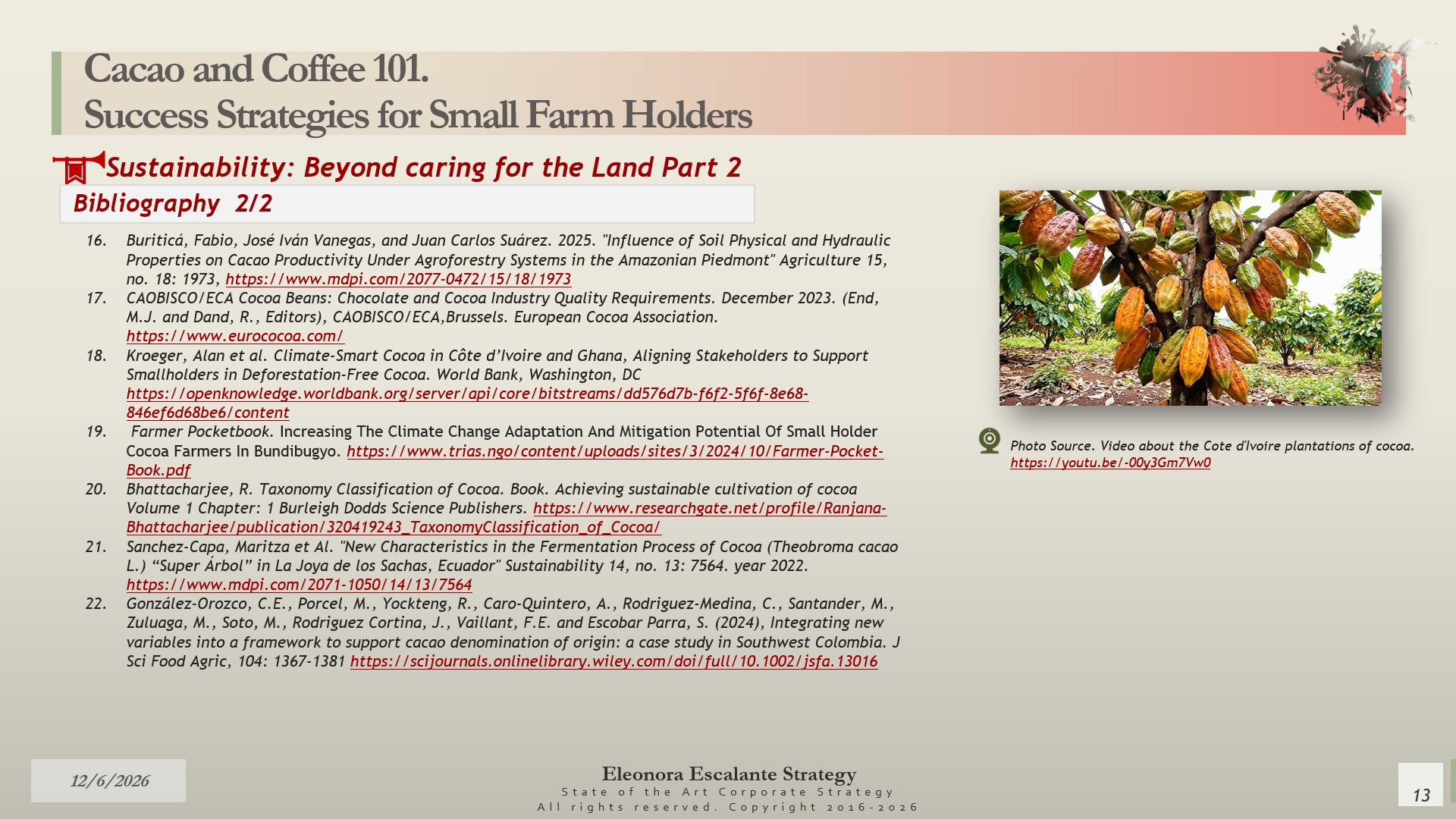
Sources of reference and bibliography utilized for today´s inferences. The bibliography is listed on the last slide of the reference reading material. Click the respective URL to trace them.
Bibliography in this post:
(1) https://wage.is/ghana/vs/ivory-coast/
(2) https://www.ico.org/documents/cy2025-26/cmr-0426-e.pdf
Disclaimer: Eleonora Escalante paints Illustrations in Watercolor. Other types of illustrations or videos (which are not mine) are used for educational purposes ONLY. All are used as Illustrative and non-commercial images. Utilized only informatively for the public good. Unless otherwise stated, I do not own any lovely photos or images.
 Eleonora Escalante Strategy Strategic Reflections Think Tank