
Cacao and Coffee 101. Success Strategies for Small Farm Holders. Episode 8. Value Propositions 2.
My dearest adorable readers:
Welcome to our Masterclass of today. We are thriving and lovingly thanking the Universe for this chapter. The two packages of slides below are the result of 10 consecutive days of non-stop work, with a few journées in which I was compelled to get out of bed at 5 am to keep on going with the research and material preparation for today. Notice that we do not use Artificial Intelligence for our ideas or analysis, and we are against its utilization in problem-solving for many reasons, but mainly, we do not wish to lose our brain power, and that is why we do not use AI.
Three value propositions are the result of this demanding lesson. We encourage our readers to try to do their VPs at home, using post-its over a whiteboard, because the importance of these two episodes is normative and foundational for the coffee and cacao small farmers of the world.
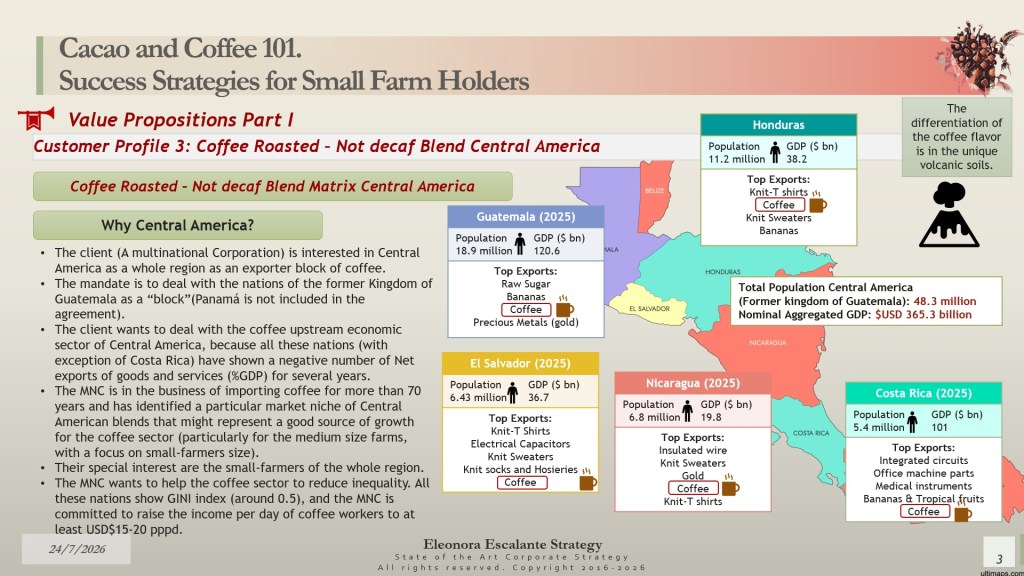
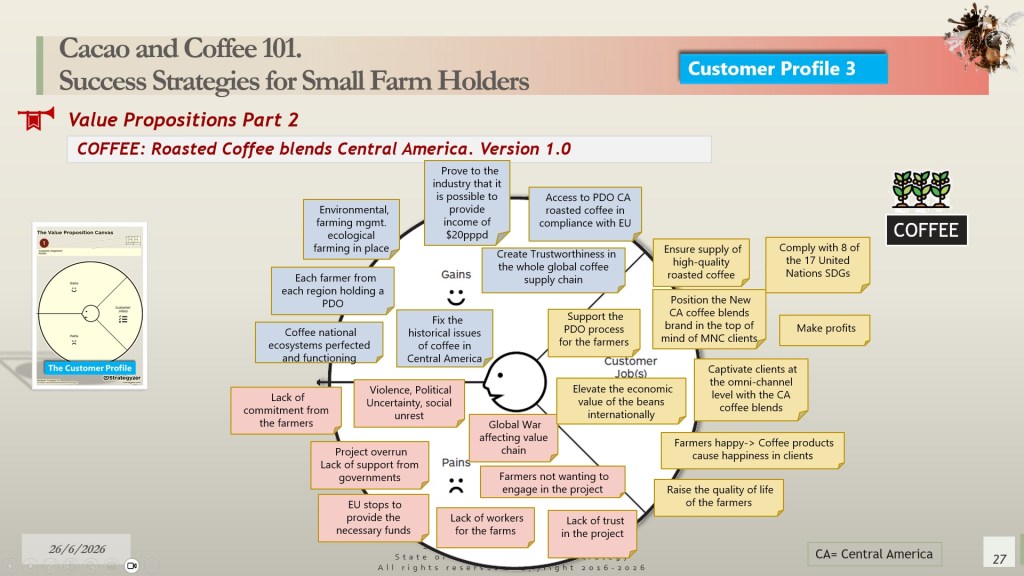
First, I would share the solution to the customer profile version 1.0 for case three that was left as homework for you. This is customer profile 3: Roasted coffee in Central America. Find the material below.
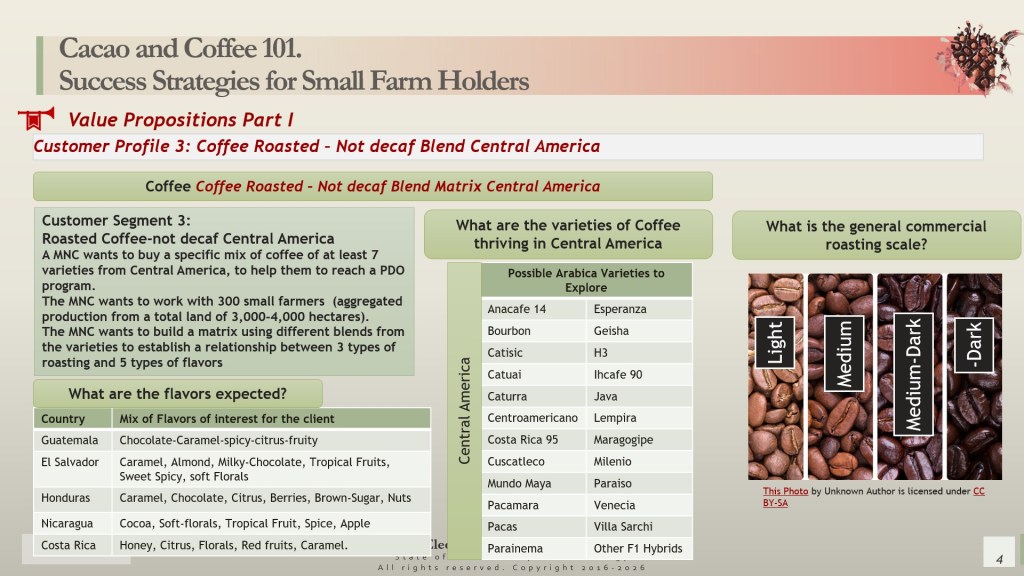
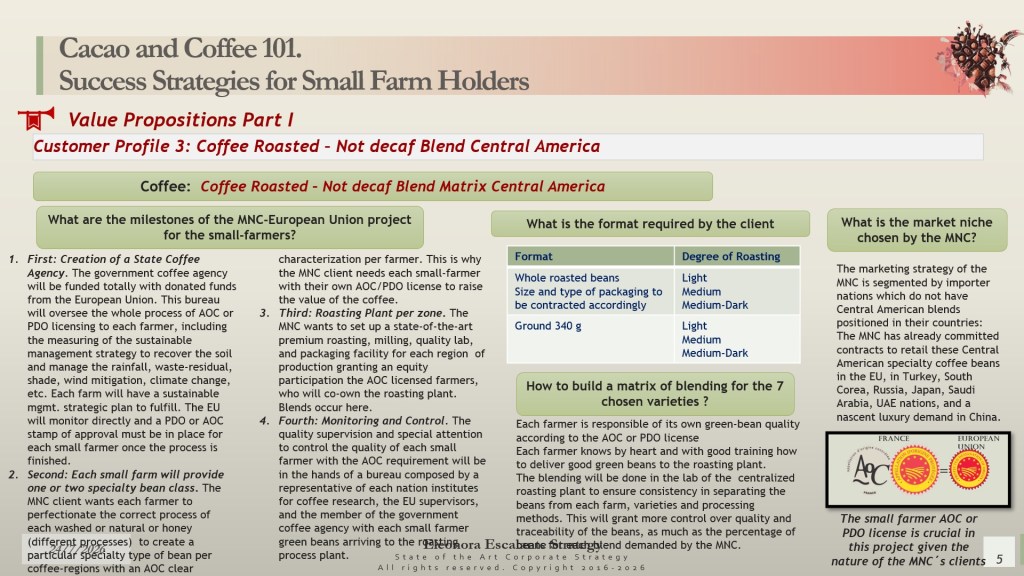
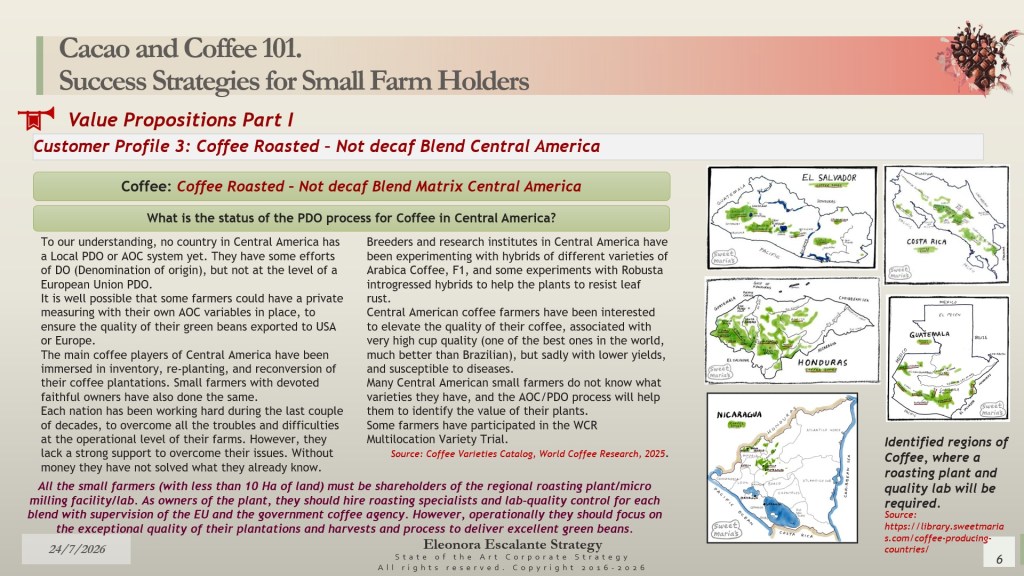
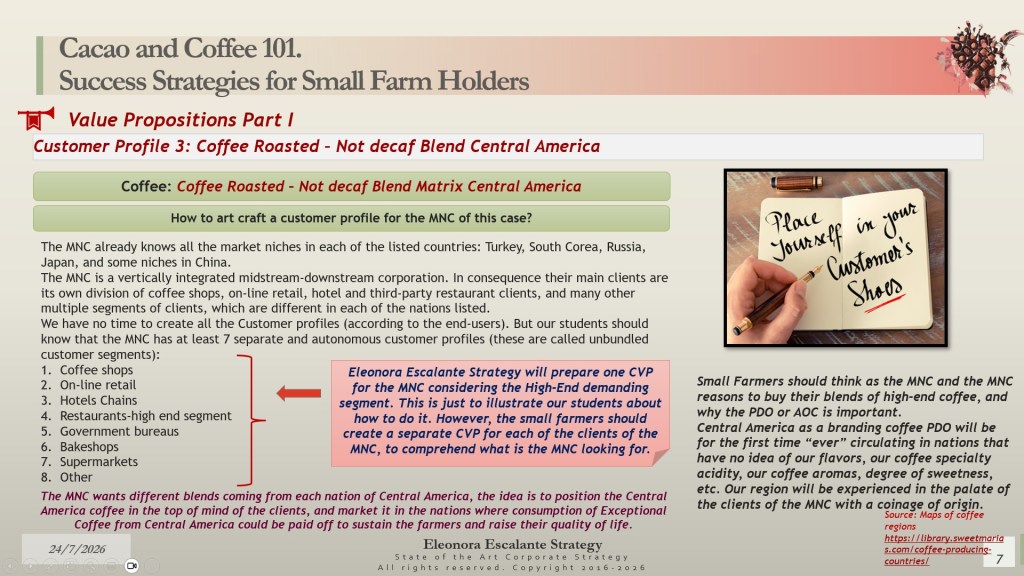
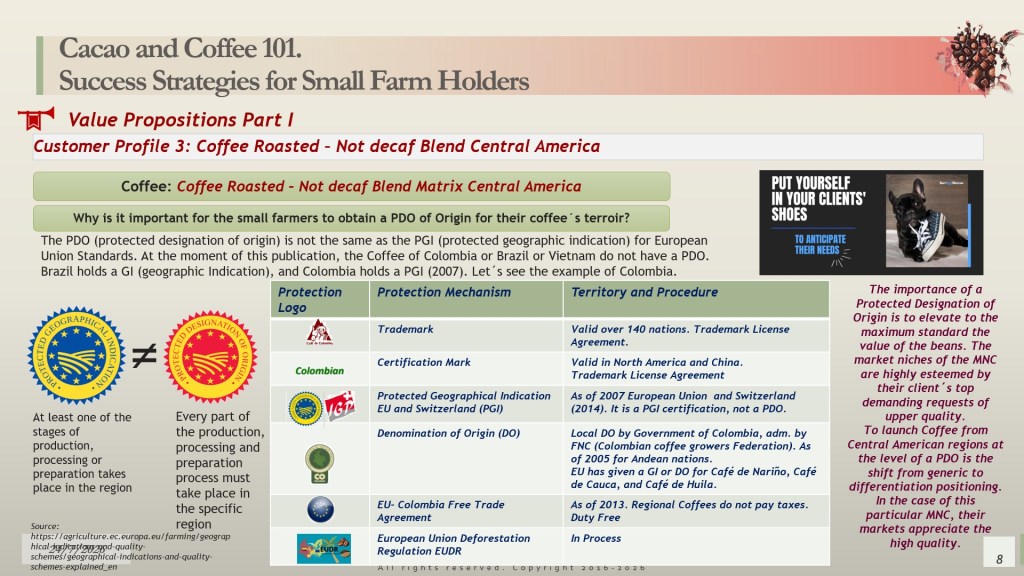
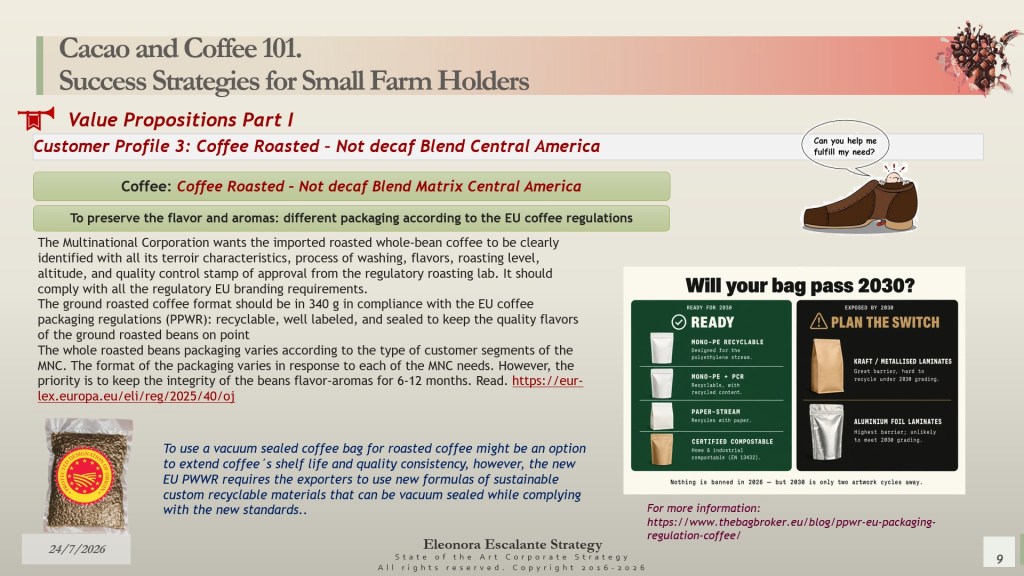
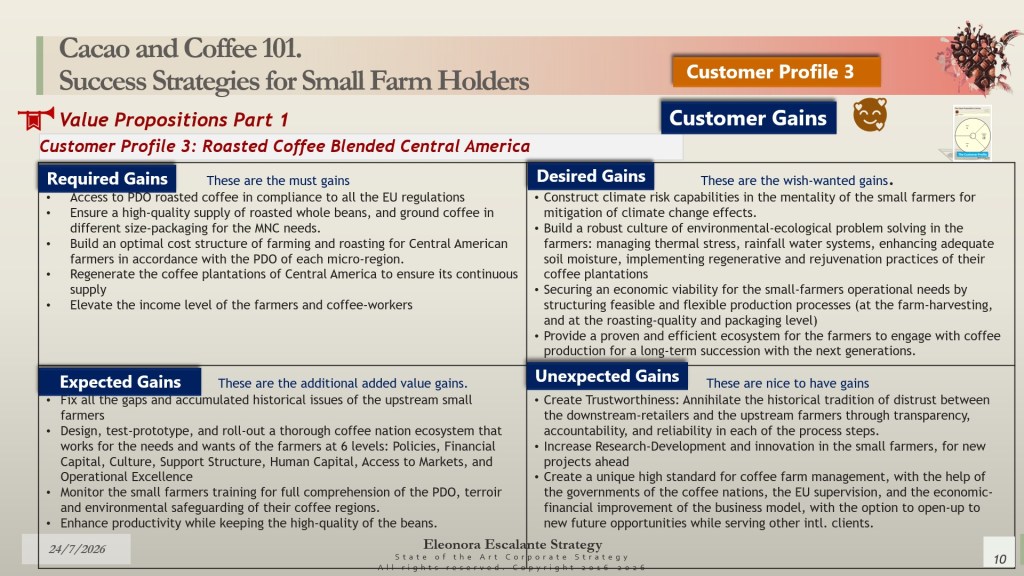
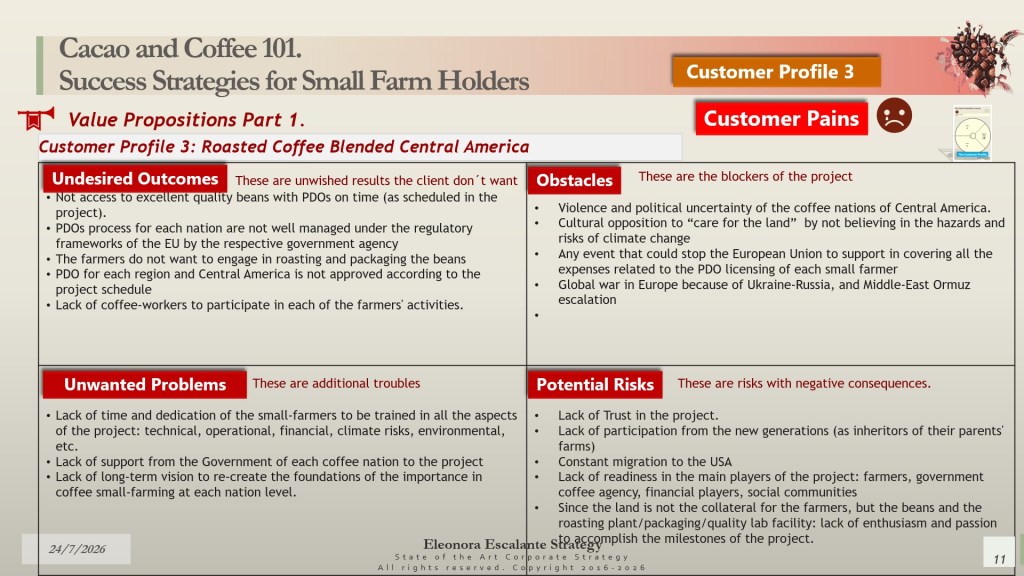
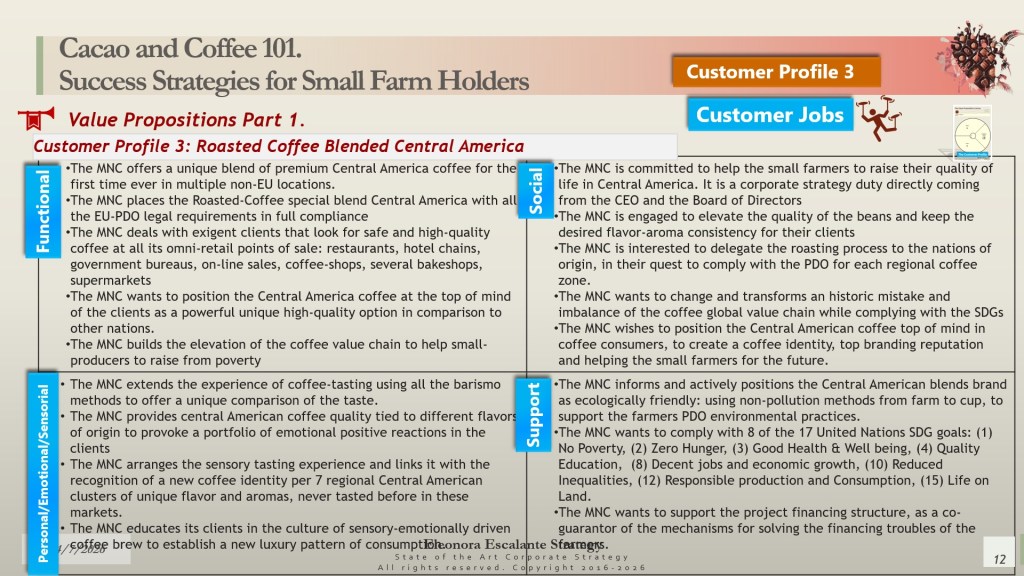
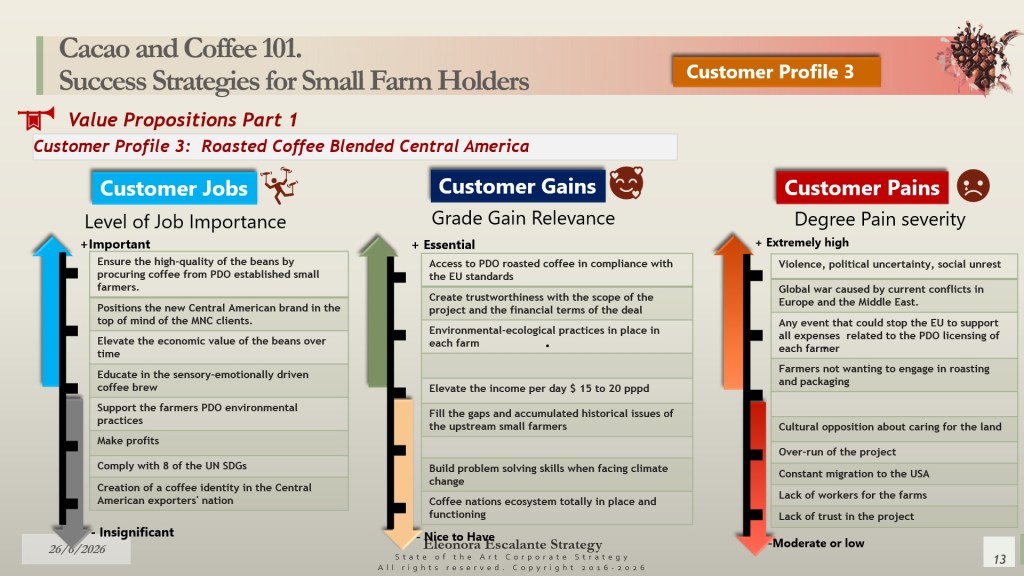
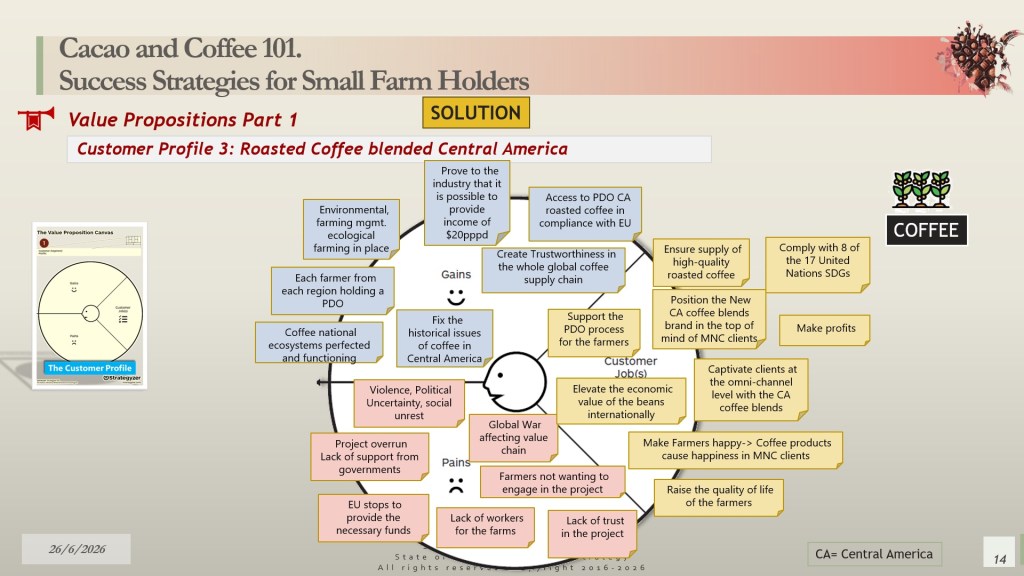
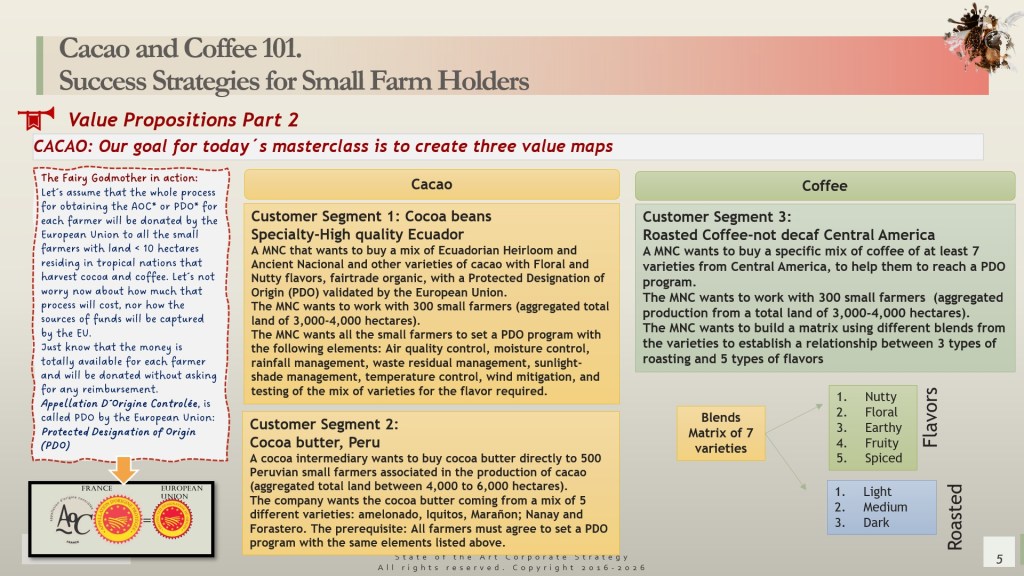
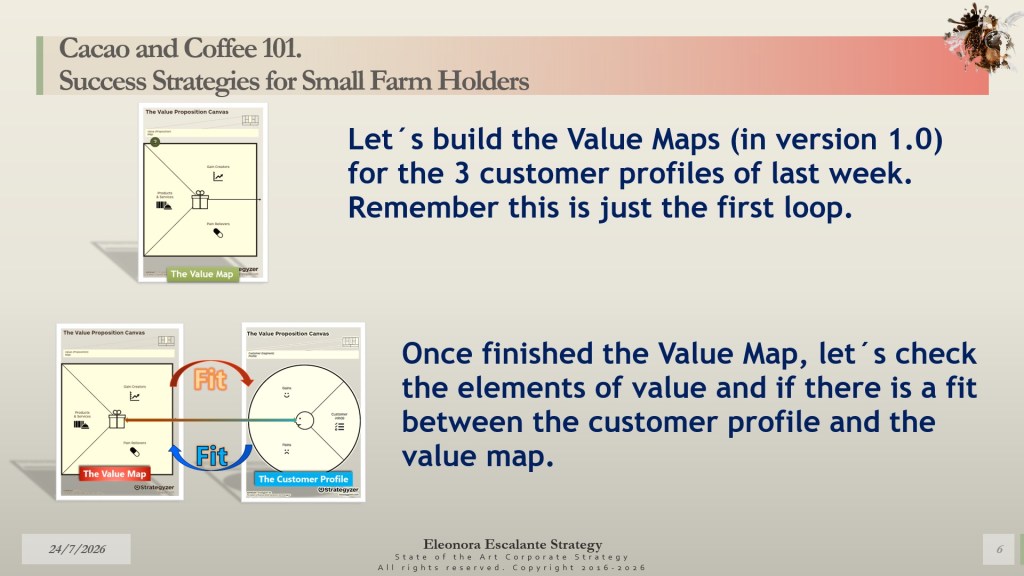
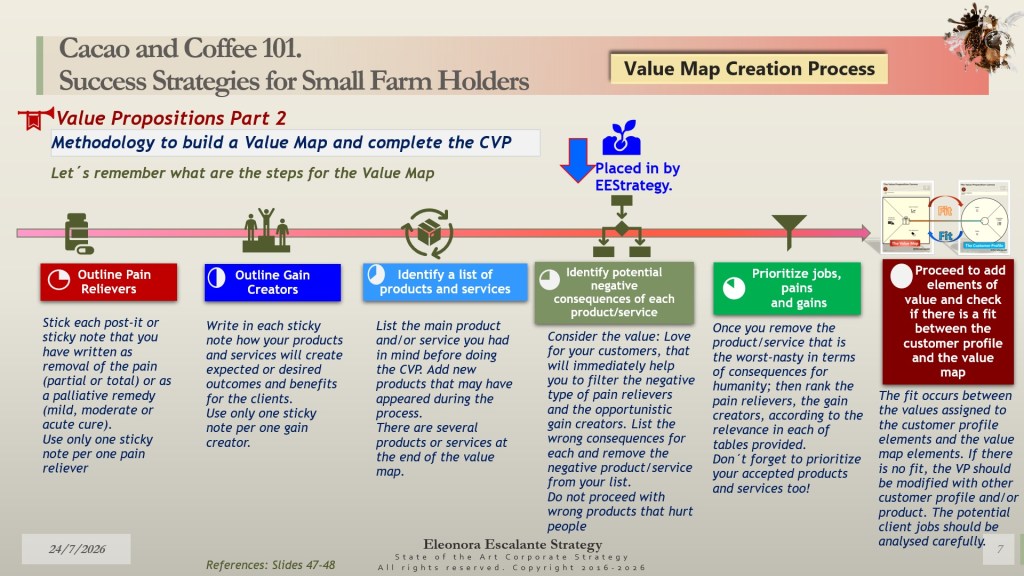
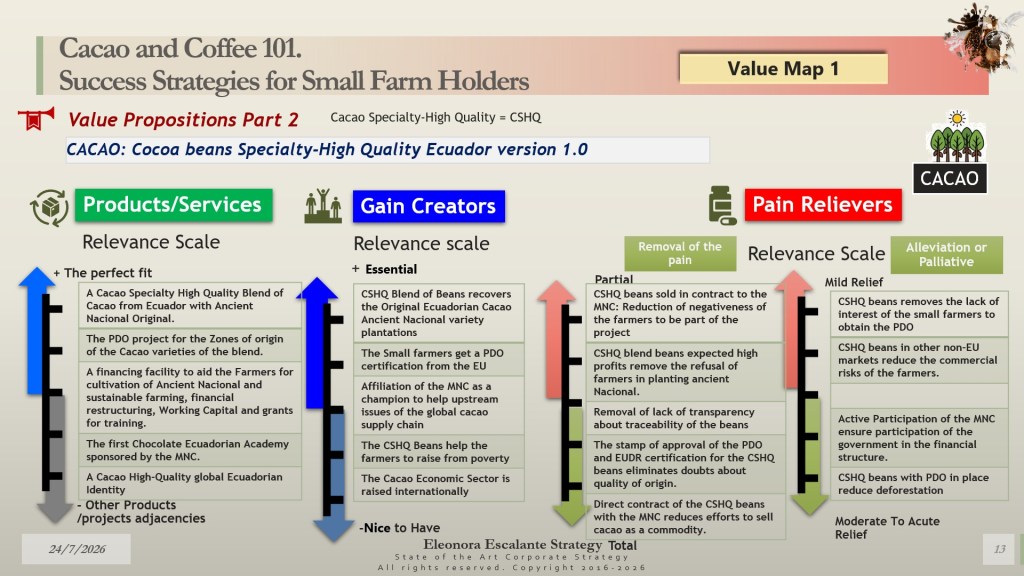
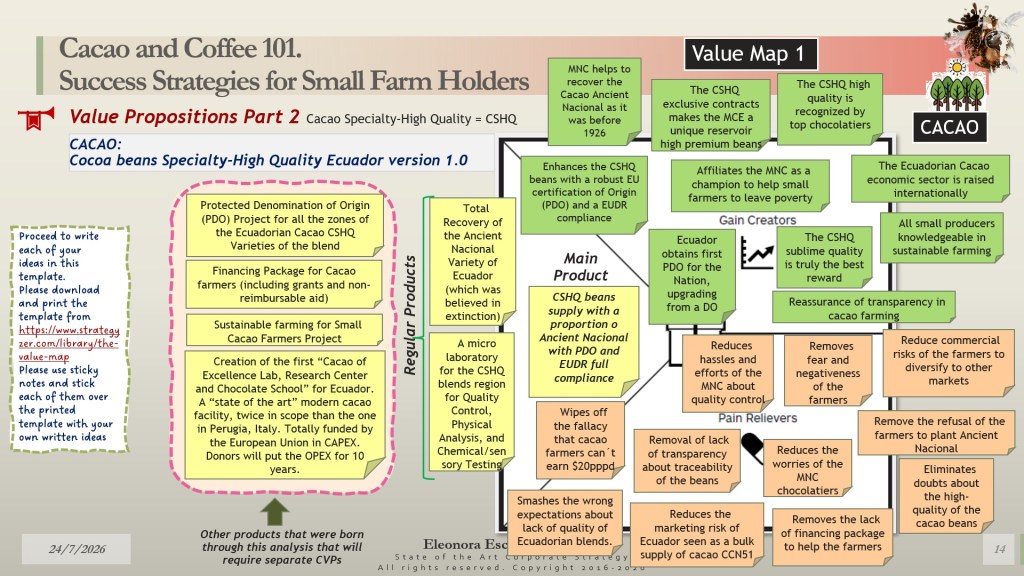
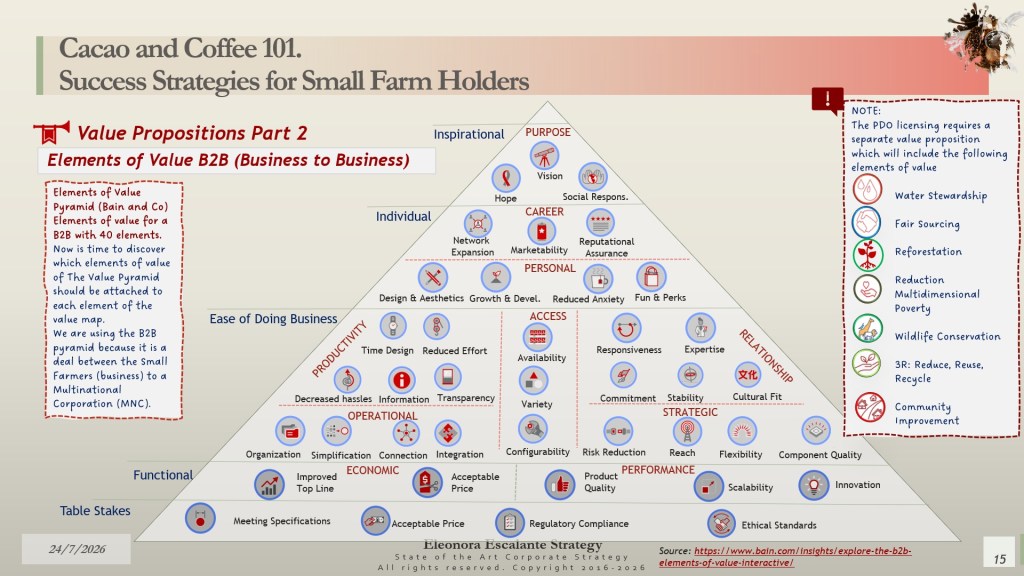
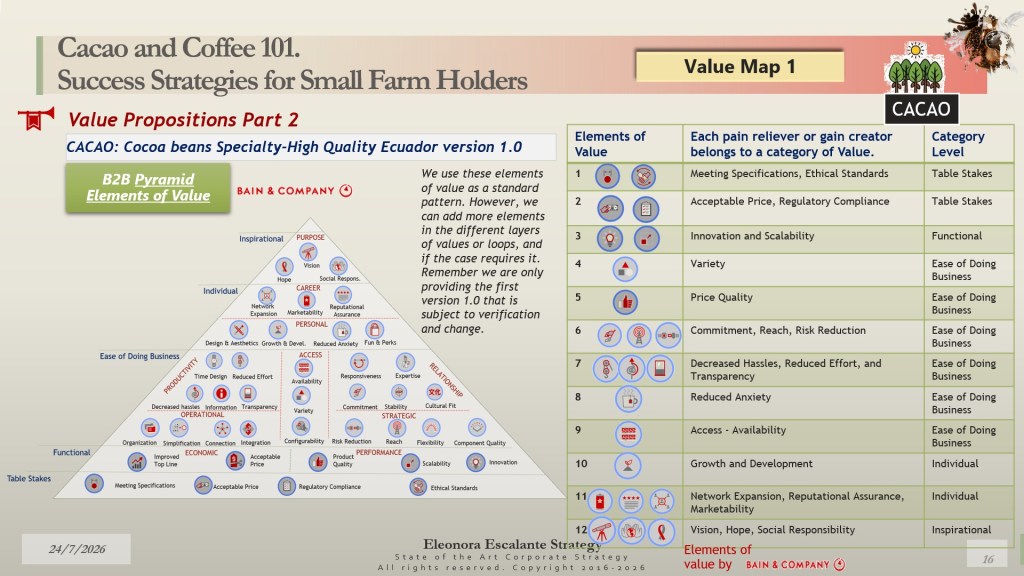
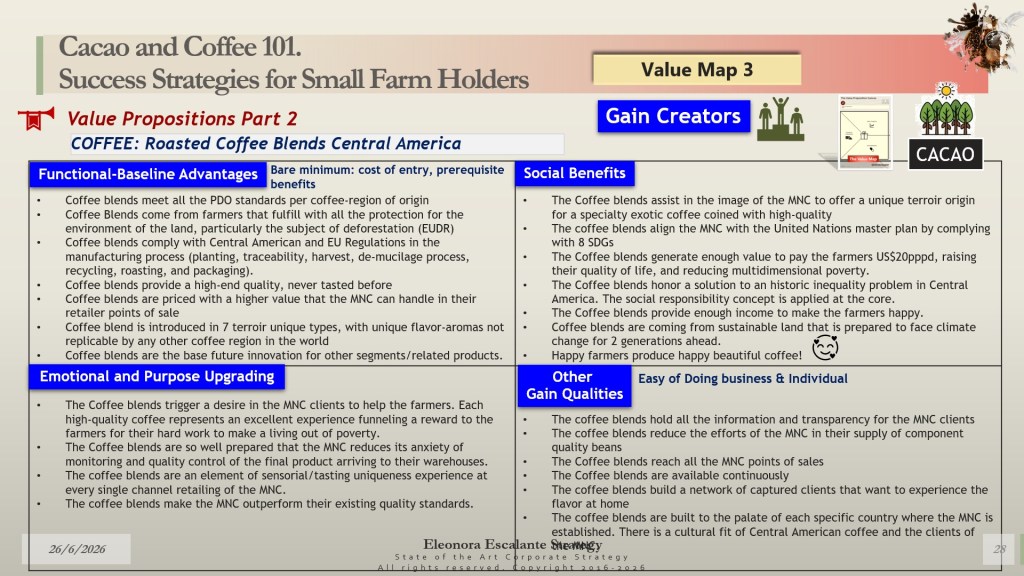
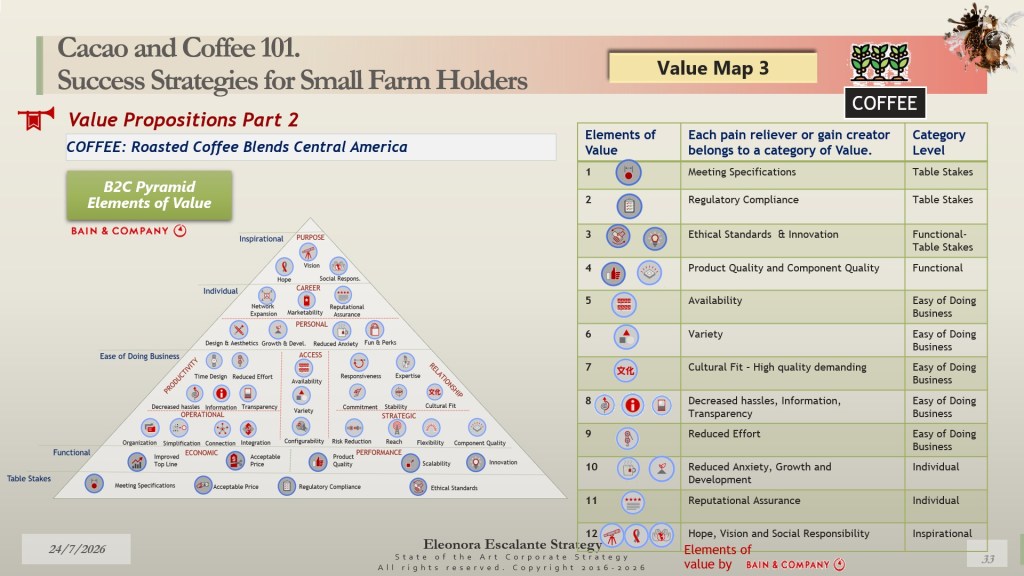
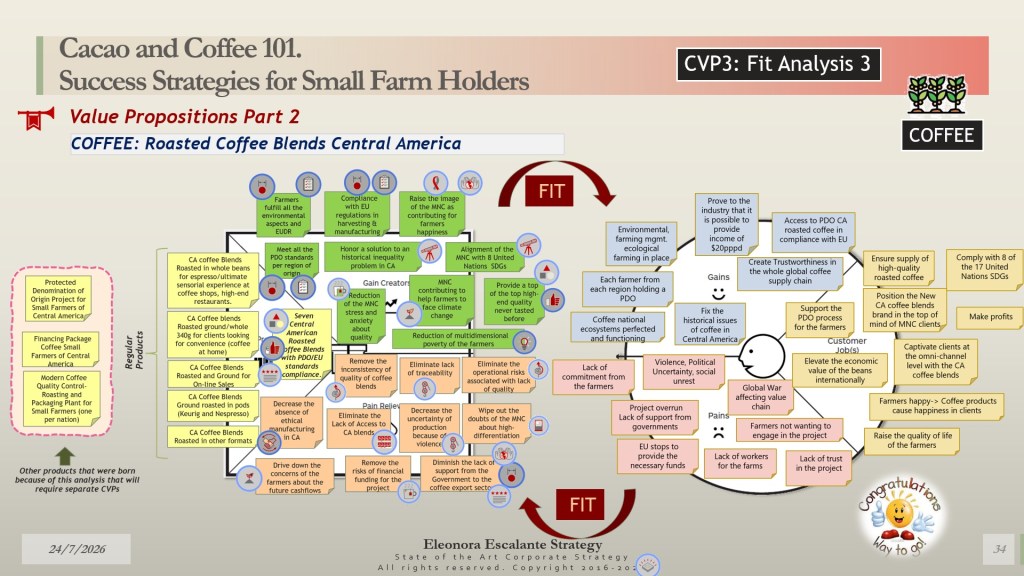
Next, we provide the value maps for the three cases and the assembling of the three value propositions. Please notice that we are simplifying the exercise to show you only version 1.0. All our assumptions must be confirmed through focus groups and additional marketing research activities, the European Union authorities, the financial partners, the MNCs involved in supporting small farmers, the governments, and the will of several donors in the cacao and coffee industries worldwide. These types of projects are complex, but if the value proposition is correct after several review loops, then the value elements of alignment will keep the structure and prioritization in perfect orchestration while all the parties in place negotiate the legal documents for its further implementation. The hypothesis of non-EU nations buying the cacao or coffee products is merely a non-familiar portrait; however, since the MNCs hold downstream businesses in these particular countries, these markets have been chosen because of the growth potential, the luxury clients who can pay for aggregated value in high-premium chocolate and coffee, and because of the diversification of commercial risks. Our aim is to help small farmers to diversify their supply with secure contracts with other non-EU markets, and the multinational corporations are showing us other streams of cash-in-hand opportunities.
Don´t forget to print the material. Save it in your files. And proceed to study it thoroughly. Discuss it with your loved ones. There is always something to learn from others.
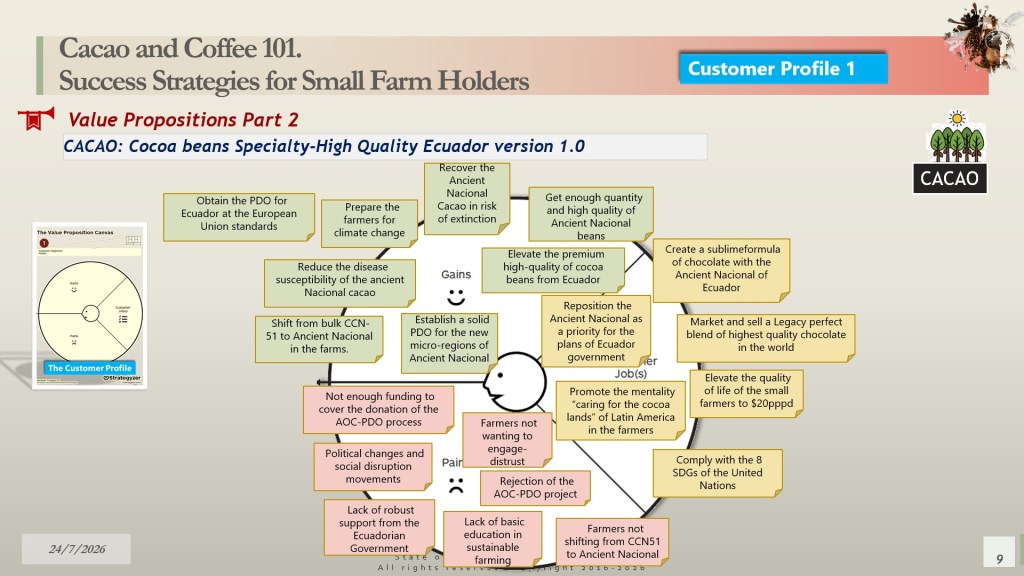
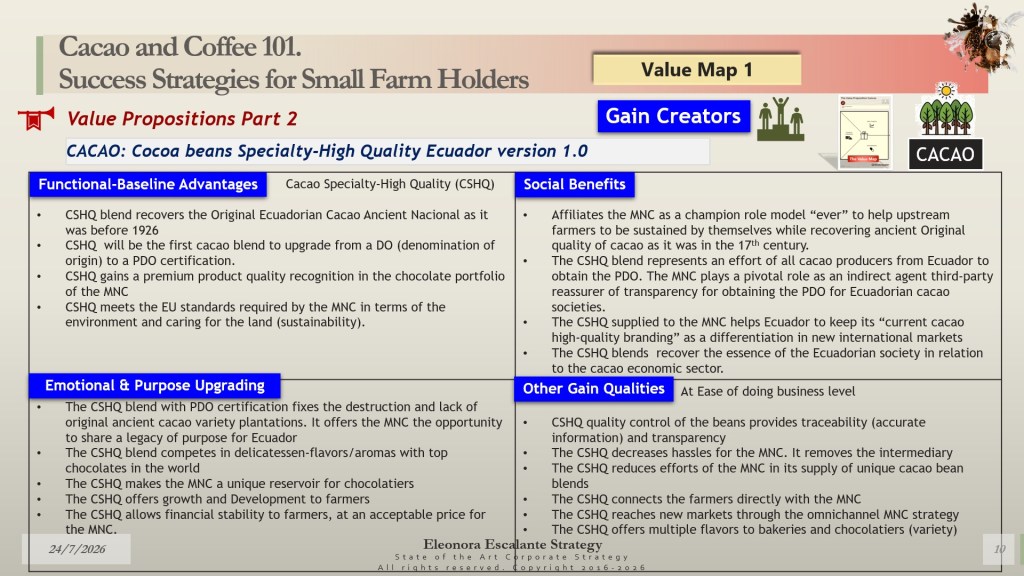
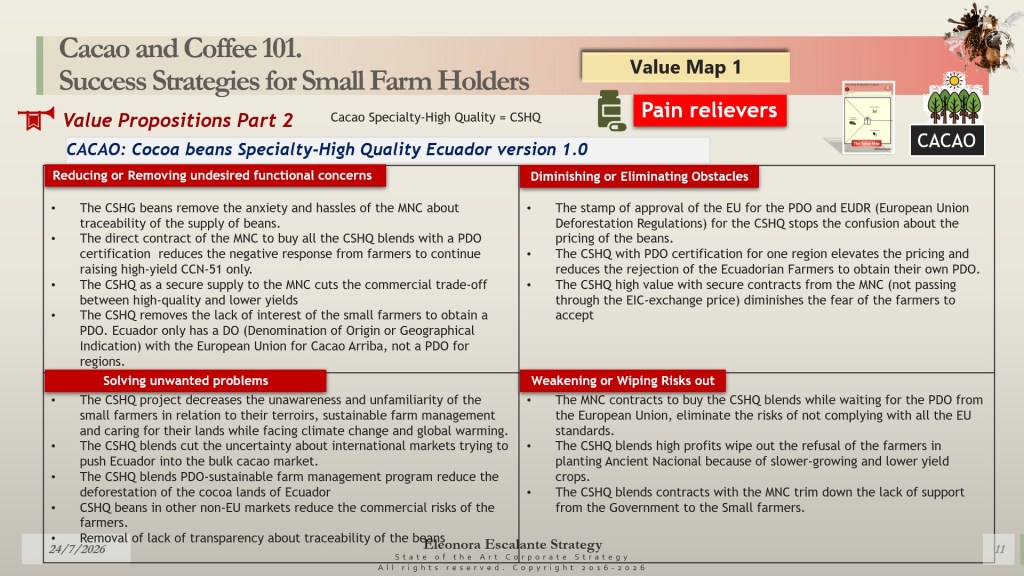
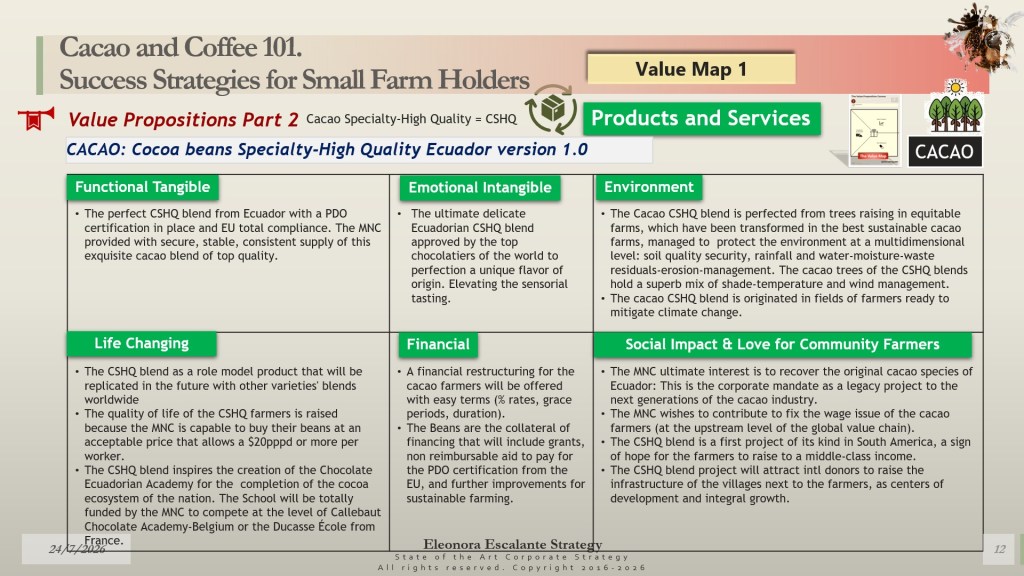
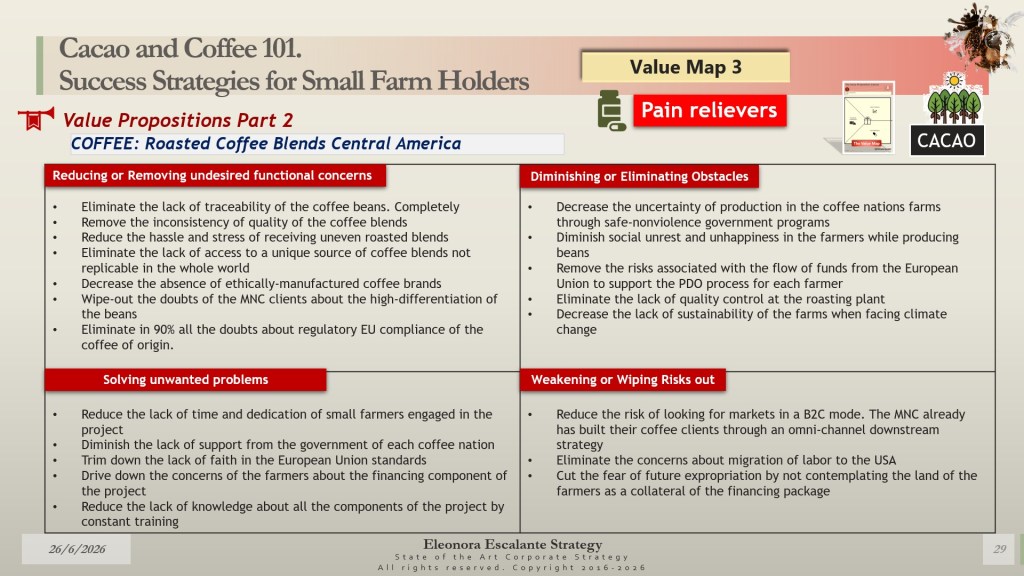
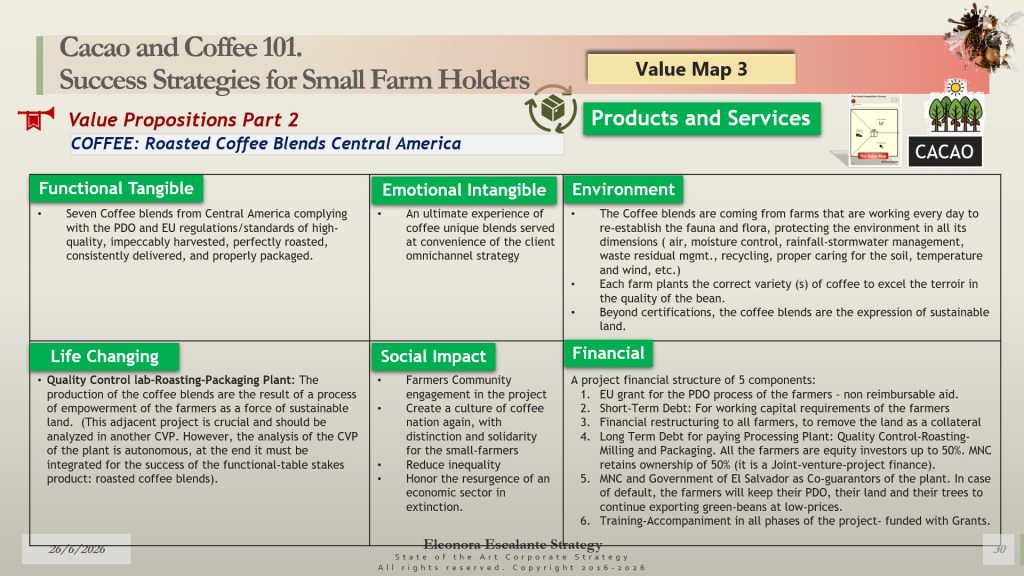
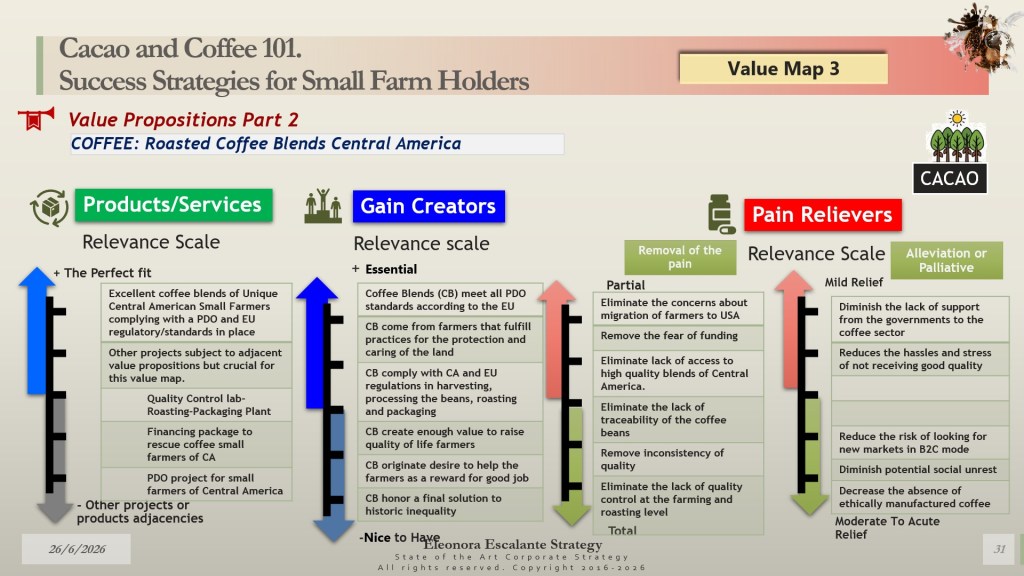
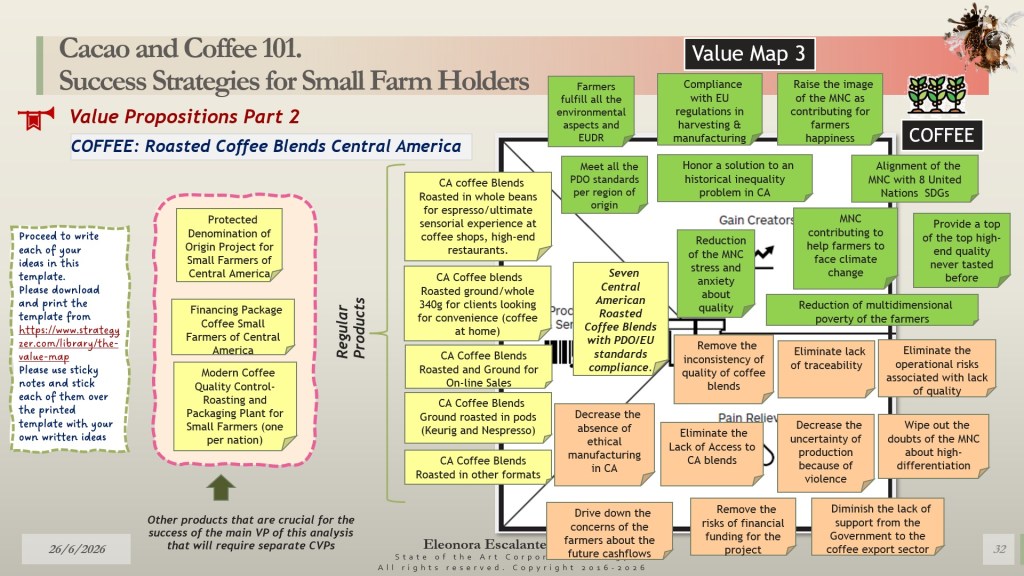
We kindly ask that you return next Monday, the 27th of July 2026, to review our strategic reflections on this chapter.
We encourage our readers to familiarize themselves with our Friday master class by reviewing the slides over the weekend. We expect you to create ideas that are or are not strategic reflections. Every Monday, we upload our strategic inferences below. These will be discussed in the next paragraph. Only then will you be able to compare your own reflections with our introspection. We always give our students a couple of days to prepare well before our final reflection.
Strategic reflections on this episode.
These will be in the section below on Monday, the 27th of July of 2026.

Cacao and Coffee 101. Success Strategies for Small Farm Holders. Episode 8. Value Propositions I and II.
The art of doing Value Propositions is not static.
We have prepared three customer profiles, three value maps, and three analyses of the elements of value to show you three value propositions (VPs). Two about cacao, and one about coffee. But the three final VPs require validation, scrutiny, and more loops. What we have provided for all of you is just Version 1.0. Usually,
the value proposition gets right by around the 3rd or 4th loop. We have no time to continue refining
the work, but at least we are pretty sure that our work has been effectively prepared. It can help small coffee farmers and cacao landholders as a starting foundation. The VPs have been created in the context of the year 2026, in the middle of a tremendous El Niño climate event in the Pacific Ocean nations, and in the context of wildfires and strenuous high temperatures in Europe. Our climate is not getting back to normal any time soon. Climate change exists; global warming is not an invention, and the current climate imbalance affects not only coffee and cacao, but other tropical plantations.
About the methodology to create Value Propositions: The reason our strategy house insists on using “post-its” of different colors for each category group over a whiteboard or a paperboard is simple. We should move those pains, or gain creators, or pain relievers several times. Using a tablet or computer doesn´t help to see the big picture of the exercise. We always recommend using “post-its” and markers.
About a general observation on this episode: The three VPs have common denominator: the Protected Denomination of Origin (PDO) licensing for each farmer is the bare minimum, the basic requirements, or the bottom foundational part that is convened as a pre-requisite, or “the cost of entry”, for the acceptance of the cacao beans (Ecuador), the cacao paste (Perú) or the roasted coffee in multiple formats (Central America). Without the PDO (as a stamp of approval from the European Union), it is impossible to raise the value of the beans. And without raising the value, it is impossible to resource better wages or salaries. The importance of this saga is to acknowledge that, in the transition from a generic commodity product to a differentiated or unique good, there must be an element of distinction that should be transparently measured to boost its value. Without that mechanism, it is “impossible to sustain a higher value” that will help the farmers to rise from poverty. The PDO (Protected Denomination of Origin) is the foundation for the pursuit of higher value. This is something that Colombia understood many decades ago, but they still have not gotten a PDO for its farmers when we disembark to study zonas cafeteras (coffee lands). The PGI (Protected Geographic Indication) has helped Colombia to trade its best green beans with multinationals, but if they want to shift from selling green beans to roasted beans with specialized packaging, the PDO is a “must” required.
For the tropical producer nations of cacao and coffee, the PDO (Protected Denomination of Origin) is the difference between obscurity and the bright light of hope. As essential as that.
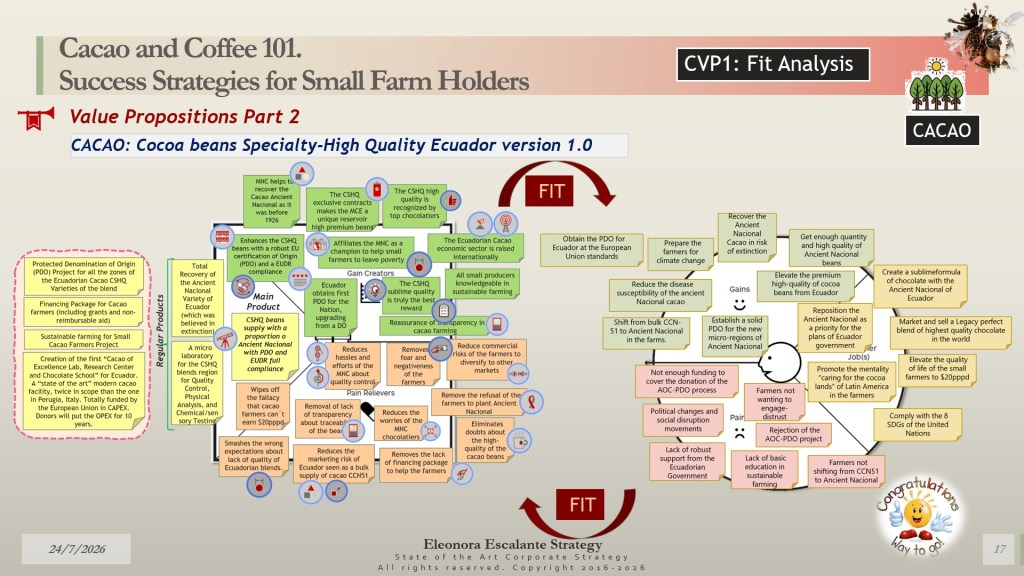
Value Proposition 1: Cacao Specialty High Quality Blend (CSHQ), Ecuador.
Here we believe that our work has been straightforward. We won´t comment on anything new about this VP. We have prepared all the basic elements for your proper comprehension. The priority for the MNC (The client) is to recover the Ancient Nacional (original) variety of Cacao, and the whole VP is focusing its efforts on that main goal.
A relevant element that we have added is the setup of the Cacao of Excellence School for South America, with headquarters in Ecuador, to serve the cacao ecosystem of this nation and beyond. This institution will change the farmers of Ecuador forever.
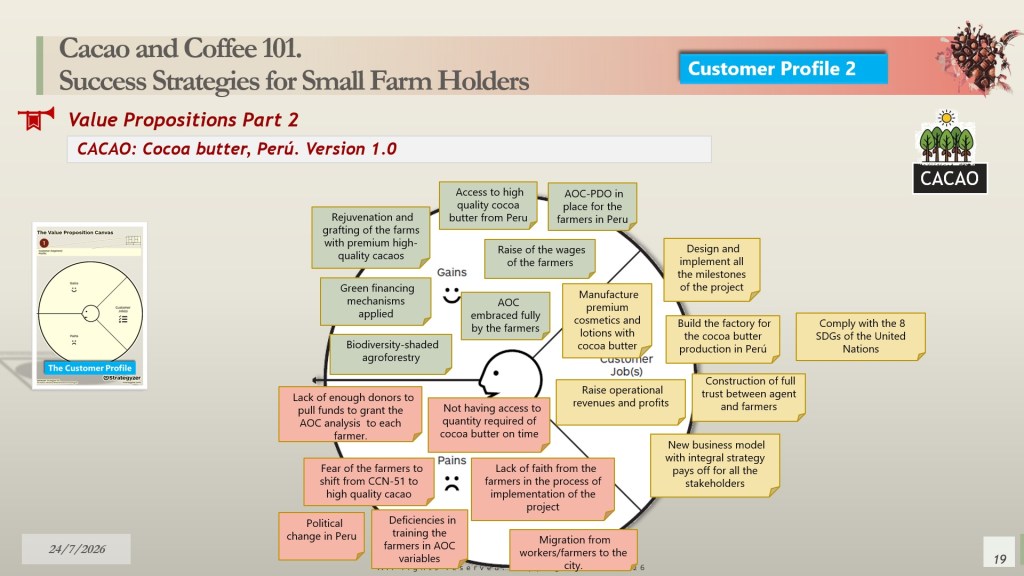
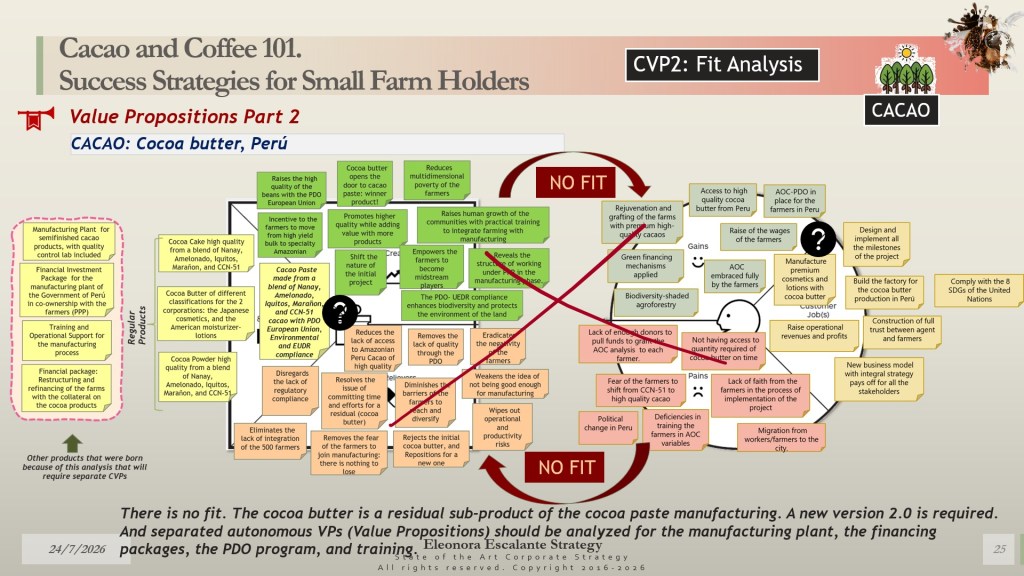
Value Proposition 2: Cacao Butter, Amazonian Perú.
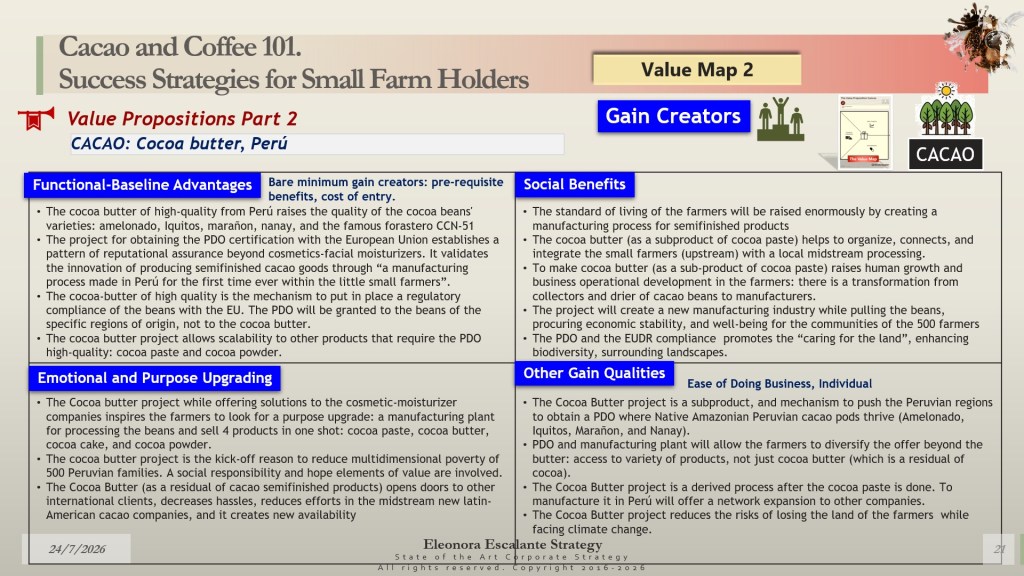
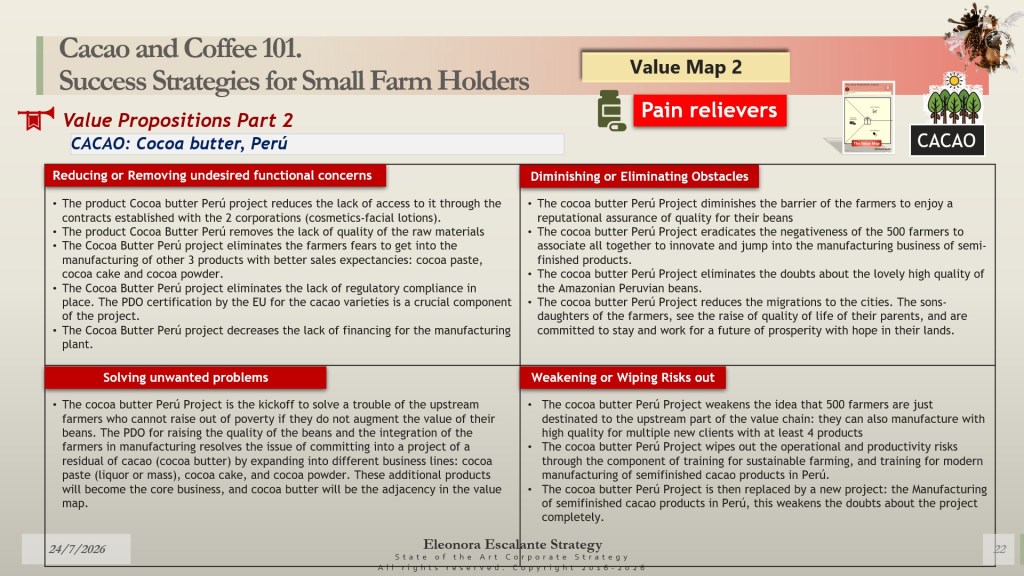
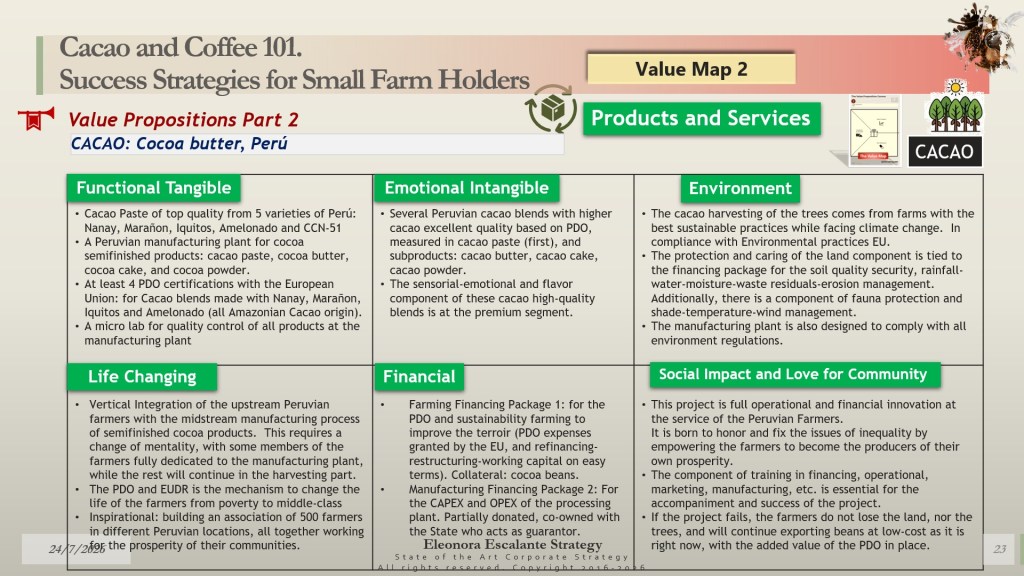
This second VP is exceptionally illustrative for our students. We defined it in the context of cocoa butter, because the two corporations (one from Japan and the other from the US) wanted this specific raw material for their cosmetics-lotion moisturizers. These two international corporations have discovered the unique properties of the amelonado, Iquitos, Marañon, and Nanay varieties of cacao. All coming from the Amazonian part of Perú. However, producing cocoa butter implies a manufacturing plant in place, with rigorous compliance of the respective cacao nibs at the farm, before entering the processing phase. There are several international standards applied to cacao:
- ISO 2292: Cacao beans – Sampling
- ISO 2451: Cocoa beans – Specification and quality requirements
- ISO 34101 series (7): Sustainable and Traceable Cocoa
- ISO 23275-2: Animal and vegetable fats and oils – Cocoa butter equivalents in cocoa butter and plain chocolate.
The top Cocoa associations and organizations in the world are mainly composed by an entity called “Chocolate, Biscuits, and Confectionary of Europe” (CAOBISCO), European Cocoa Association (ECA), European Federation of Food, Agriculture and Tourism Trade Unions (EFFAT), Federation of Cocoa Commerce (FCC), International Cocoa Farmers Organization (ICCFO), International Cocoa Initiative (ICI), ISEAL Alliance, Solidaridad Network Foundation and World Cocoa Foundation (WCF). These organizations have been working together with the main midstream and downstream multinational corporations, such as ADM, Armajaro, Barry Callebaut, Cargill, Casa Luker, Cemoi, Dutch Cocoa, Ferrero, Guittard, Mars, Mondelez, Nederland, Nestlé, Olam, Lindt & Sprüngli, Storck, Touton, Valrhona, and others. When facing EU regulation, the result of the endeavors of all these players is a compilation of a guide (updated in 2023) “Cocoa Beans: Chocolate and Cocoa Industry Requirements” that shows all the elements of quality for exporters.
In addition to compliance with the latter document, the European Union has introduced strict regulations to tackle sustainable production and reduce deforestation (EUDR). Furthermore, the European Union has positioned itself as the top regulator of cacao and coffee for non-EU nations. It is also requesting precise compliance with business ethics, social responsibility, and food safety when processing the beans (Hazard Analysis and Critical Control Points), reduction of food contaminants in cocoa products (heavy metals such as cadmium, pesticides, mycotoxins, Polycyclic aromatic hydrocarbons, microbes and foreign matter, and extraction solvents). Additionally, the EU has rules about packaging and labelling cocoa and coffee products that should be obeyed.
If the coffee or cacao develops a unique flavor-taste-sensorial innovation, the EU requires intellectual property rights to secure patents, trademarks, or processing trade secrets, to keep the competitive advantage and the high value of the product. This is where the PDO plays a crucial green card for the farmers.
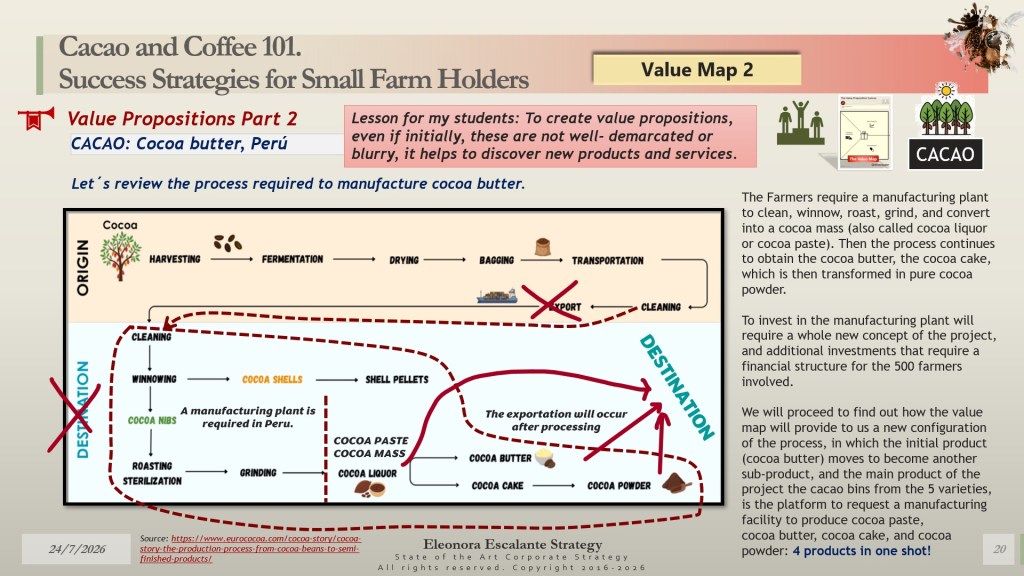
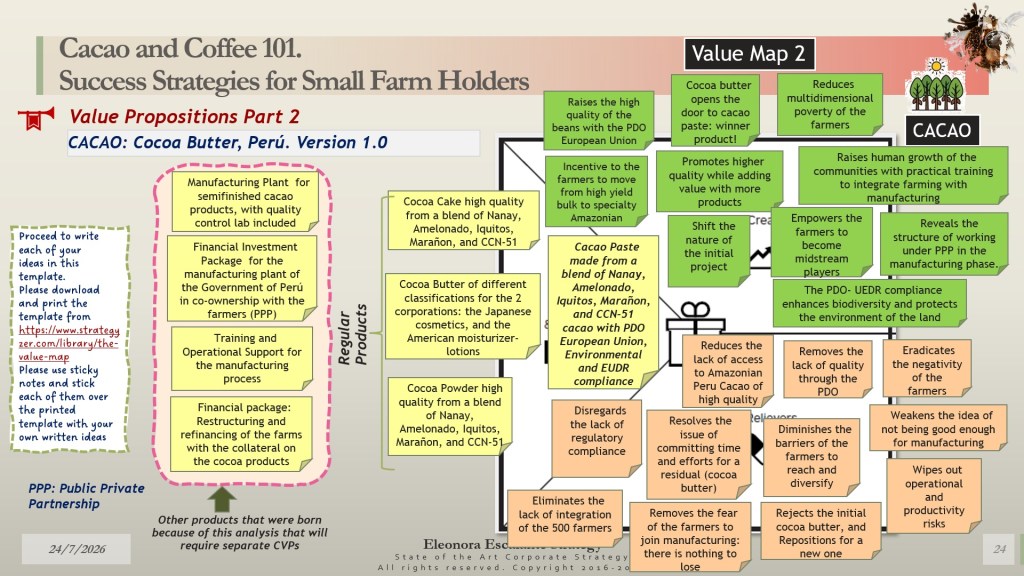
Landing into the Peruvian Cacao value proposition: the intermediary agent of the two corporations (the Japanese cosmetics organization and the American moisturizer company) came to the farmers to propose the manufacturing of cocoa butter. However, since cocoa butter is a residual of the cocoa paste production, it is illogical to build a manufacturing plant only for the butter, especially if the varieties are of high-flavor quality. See slide 20. In consequence, the inconsistent premise of cocoa butter as the final product became a secondary one, and the CVP first loop became null as an exclusive deal for the agent of the two corporations. The Peruvian Farmers understood, in the first loop, that they should look for other multinational or South American clients that would like to partner with them to offer the cacao paste and the cacao cake (cacao powder).
As a result, the Value Proposition (Cacao butter-Perú) shifted to another visionary perspective: the visionary farmers decided to do not deal with the Japanese cosmetics and American Moisturizer company for the time being (they put the negotiations on temporary pause), without closing the doors. And they openly explained why. The farmers decided to drift apart from the intermediary agent for a few months, putting the cocoa butter project “on hold”. In the meantime, the farmers’ representatives are knocking on the door of other international chocolate players that would be interested in building a partnership to build their precious factory or manufacturing plant of cocoa paste, in Perú, with all the regulations in place. However, as a result of VP version 1.0, the first thing for the farmers would be to obtain the PDO for each of the zones of production of their precious Amazonian varieties.
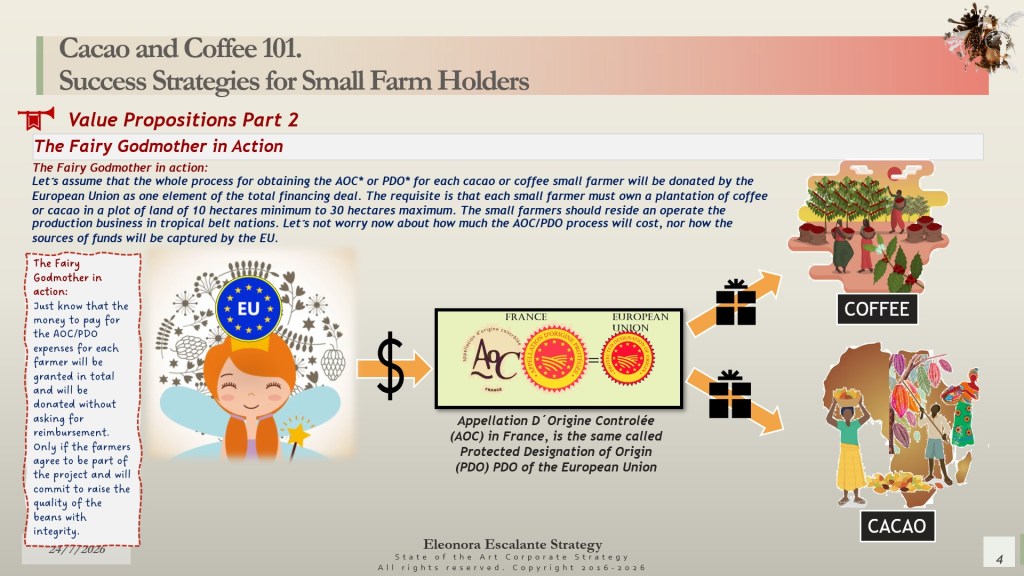
Finally, the Peruvian farmers, after elaborating each of the VPs (in several loops) below, have organized a timeline program to rebuild their operations in several phases, of which the first stage is to obtain the Protected Denomination of Origin (PDO), using the financial funds available for that purpose through the European Union. Let´s look at the main components of the program:
- EU Green Financial package for restructuring and refinancing of the farms to comply with all the environmental and Sustainable farming (see slide 23-episode 7). This component of the project is important because it ties the collateral of the loan to the beans, setting apart the land.
- Obtainment of the Protected Denomination of Origin (PDO) for each of the regions of the Amazonian Cacao varieties. The funds will be a gift from the Fairy godmother of the European Union.
- Reorganization and New Production of the farms: planting-rejuvenating the farms with fine-cacao varieties, grafting old existing trees, replacing the CCN-51 bulk trees in proportion to the future needs of the blends.
- Construction of the Manufacturing Plant Semi-finished Cacao Amazonian-Peru, with a Quality control lab included: this is a co-investment with the government of Perú, the MNC that will buy the blend cocoa products, and the farmers (a Public Private Partnership). The factory will be able to establish contracts with other clients (not only the MNC).
- Training and Operational support in all the phases of the project (10 years in total).
- Production of cacao semi-finished goods (cacao paste, cacao cake, cacao powder, and cacao butter) made from the blend of Nanay, Amelonado, Iquitos, Marañon and CCN-51.
Value Proposition 3: Roasted Coffee Specialty Blend Central America
This value proposition is not something bizarre for the coffee producers of this region. Inadvertently, several medium-to-large coffee farmers have been trying to set up the business of selling micro-lots in roasted whole-beans format, in the segment of high specialty coffee without a PDO. Other coffee producers have established an excellent supply with multinationals using intermediaries such as ECOM. Can you believe how hard it has been for them to establish a faithful relationship with the American or European importers without a European Union PDO certification or license? I cannot imagine how difficult their journey has been, almost an odyssey, and if it is functioning, that has occurred based on a long time of bonding for accountability, and because they have gone through a certification process with entities such as Rainforest Alliance, Fairtrade, EU organic, etc. However, for a small farmer, without a critical mass of beans, to open and maintain a business without a PDO in the segment of high-quality premium excellence is truly an epic crusade. Small farmers benefit the most from a European PDO because their size (alone) is irrelevant for international markets, and only together as Central America blends (agglutinated under a venture of legal convenience) can they clearly cross the bridge to put their products at a higher value. The differentiation strategy of the farmers is based on the unique terroirs of the coffee plantations, which are mostly on volcanic soils. All of Central America is part of a special Cordillera Volcánica, and it has a tropical climate that makes the coffee flavors totally unique! Never comparable to any other area in the world.
This project (roasted coffee specialty blends from Central America) is the best alternative option that our strategy house has found. Of course, it can be implemented with certain changes if these benefit the small farmers. Believe me, I have tried to find other possible ways in which Central American Coffee can gain value and raise the wages of the poor people who work for the farmers, and I don´t find any other recourse. The design of the global value chain of coffee and chocolate has been made to keep labor underpaid at the upstream level. It is an historic design that is not the fault of the current middle-large farmers of coffee or cacao. It is an historic mistake, and without a shift as the one I am proposing, I do not see any other chance that could be sustained over time for the next generations to come. The supply/demand can be manipulated through forced inventories for a year or so to raise the price of the beans at the ICE Intercontinental Exchange Inc. (ICE) in NY, London, or Singapore. But these collusive market measures (similar to what OPEC does with petroleum) are not the solution to the upstream farmer problems. There is no other way to increase the value of the coffee green beans but by transforming them into a higher-value, outstanding blended experience that could be tasted phenomenally and re-assured as a “unique” progression of economic value by the most competent coffee connoisseurs in Europe, and other non-EU markets. Additionally, a cascade of profit advantages comes with the efforts of diversification, endeavors directly correlated to the luxury segment operations of the MNC in other non-EU nations. There is a market segment for each type of coffee. It is a waste of money to have precious beans in Central America and not get the value of them to elevate the quality of life of those related to this upstream industry.
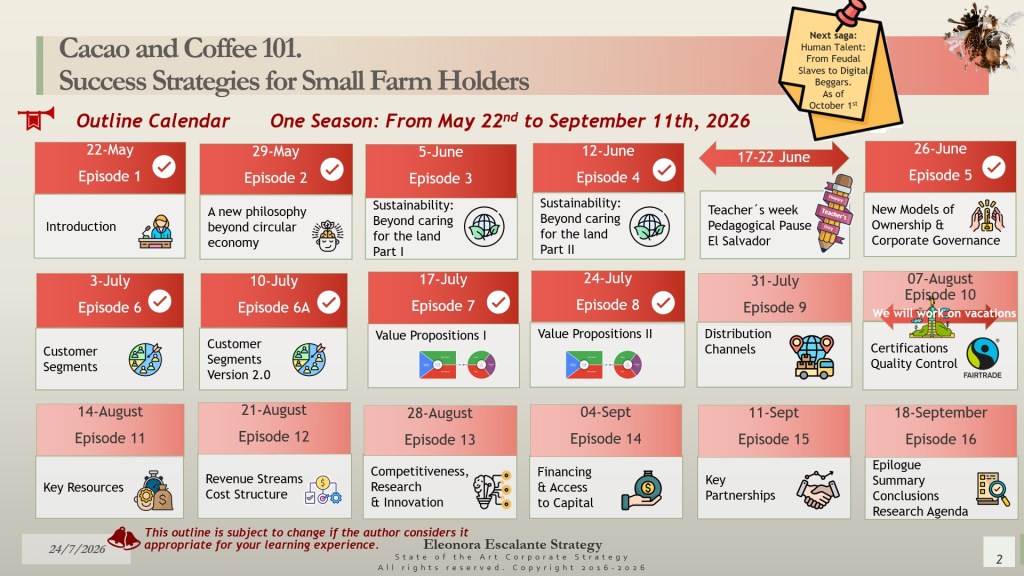
Announcement. This week, we have elaborated on value maps for each customer profile. We have checked if there is a fit between the customer profile and the value map in the first loop. Two of the value propositions (VPs) show us that it is the way to go. However, the second VP about the Peruvian Cacao butter is subject to change completely, because there was no fit. New projects and products were born as a result of the first loop. Next week we will continue with our outline: Distribution Channels for the Small farmers’ products and services.
Musical Section.
This saga is committed to elevating traditional musical instruments and their respective musicians over digitally produced sounds. This saga is dedicated to chamber orchestras.
Today, we have chosen the English Chamber Orchestra (ECO). https://englishchamberorchestra.com/. The artwork played by ECO for this occasion is the soundtrack of the movie “Pride and Prejudice” (2005), based on the novel by Jane Austen. This romantic movie is captivating not just because of Joe Wright’s (the director) incredible work, but also because of the music, played by the ECO. The production of the soundtrack was in the hands of Dario Marianelli, with Jean Yves Thibaudet as the main pianist. The first solo piano video shown below is merely an introduction to the playlist. The rest of the songs are all interpreted by the English Chamber Orchestra. Enjoy the whole playlist!
Thank you for reading http://www.eleonoraescalantestrategy.com. It is a privilege to learn. Blessings.

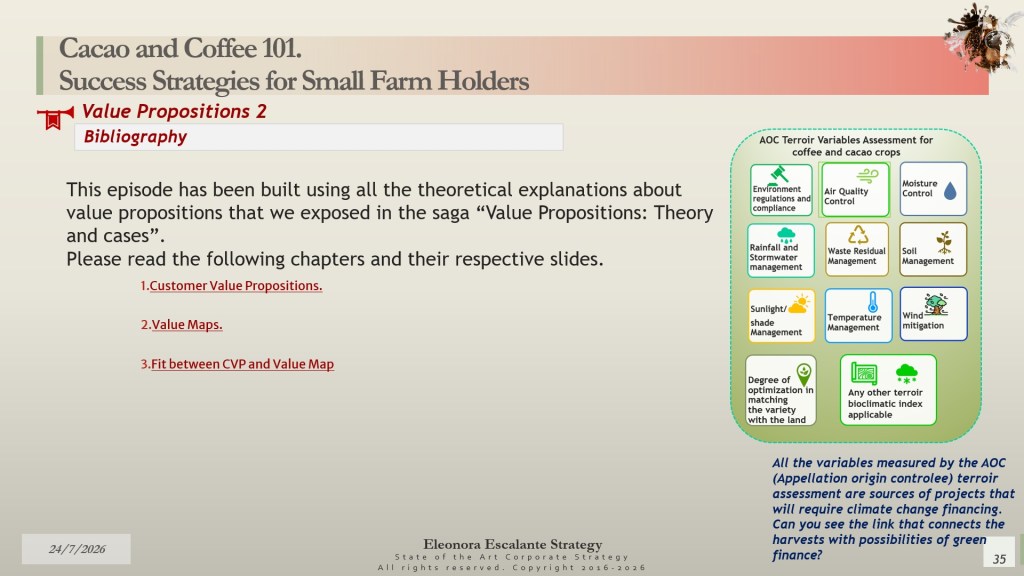
Sources of reference and bibliography utilized for today´s inferences. The bibliography is listed on the last slide of the reference reading material. Click the respective URL to trace them.
Bibliography in this post: This will be added accordingly with the strategic reflections.
Disclaimer: Eleonora Escalante paints Illustrations in Watercolor. Other types of illustrations or videos (which are not mine) are used for educational purposes ONLY. All are used as Illustrative and non-commercial images. Utilized only informatively for the public good. Unless otherwise stated, I do not own any lovely photos or images.
 Eleonora Escalante Strategy Strategic Reflections Think Tank