
Cacao and Coffee 101. Success Strategies for Small Farm Holders. Episode 9. Distribution Channels
Dear magnificent students and readers:
It is the end of July. A pleasant season is around the corner. Hopefully, for the Western world, the high temperatures will be gone in a few days, and the autumn breeze will surround us with the fragrance of cinnamon pumpkin café lattés as the orange, reddish-burgundy leaves begin to fall.

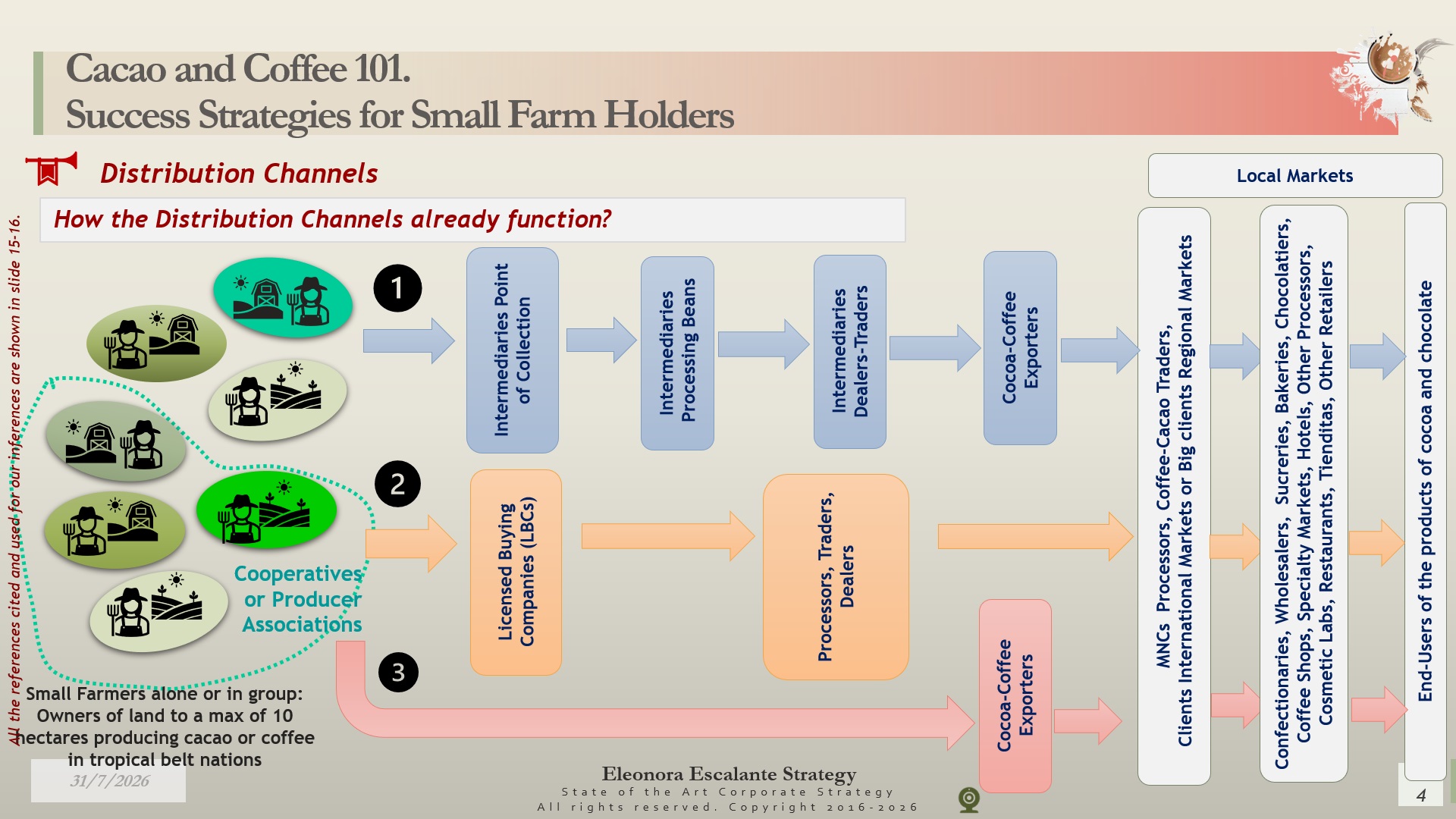
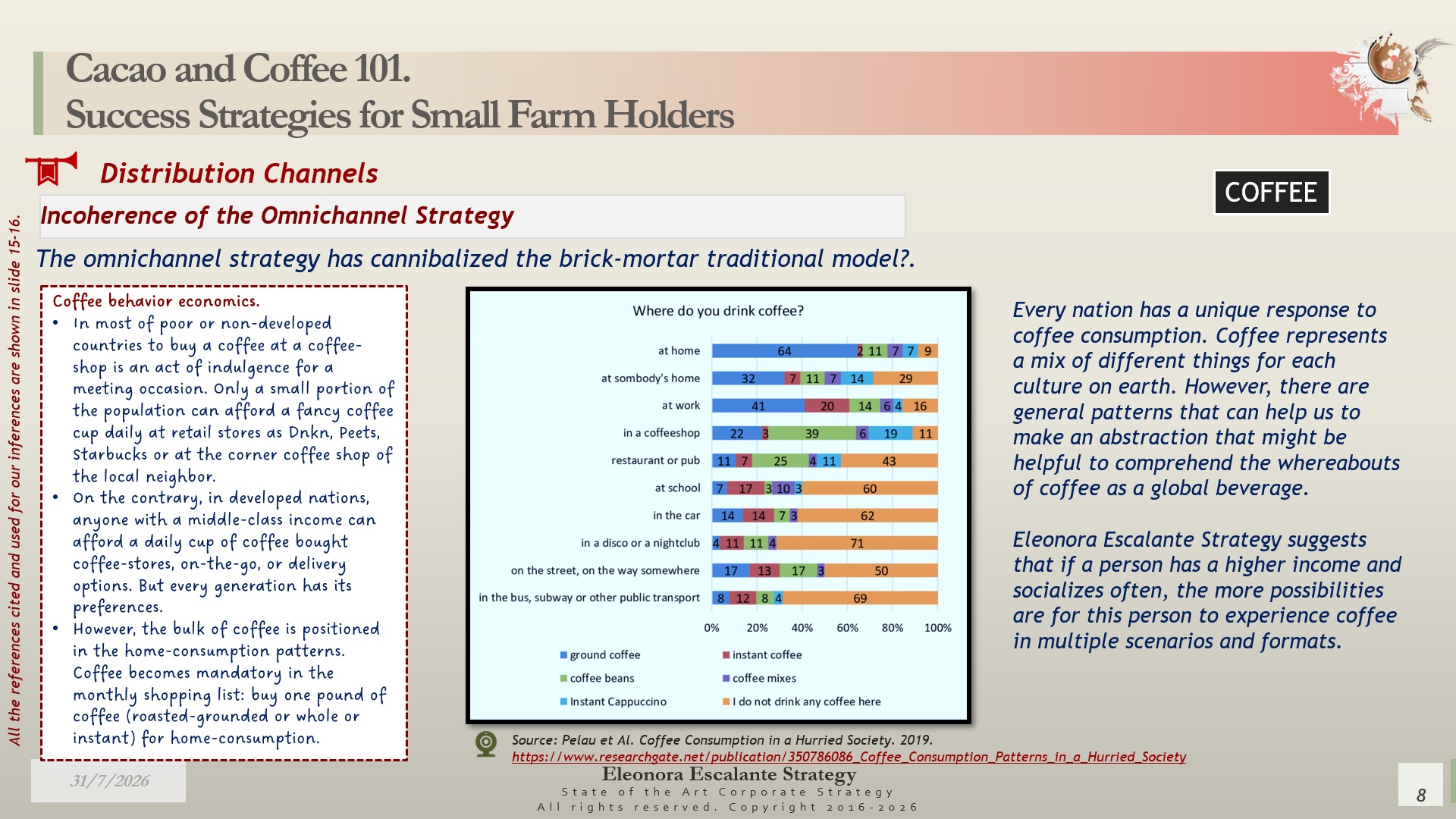
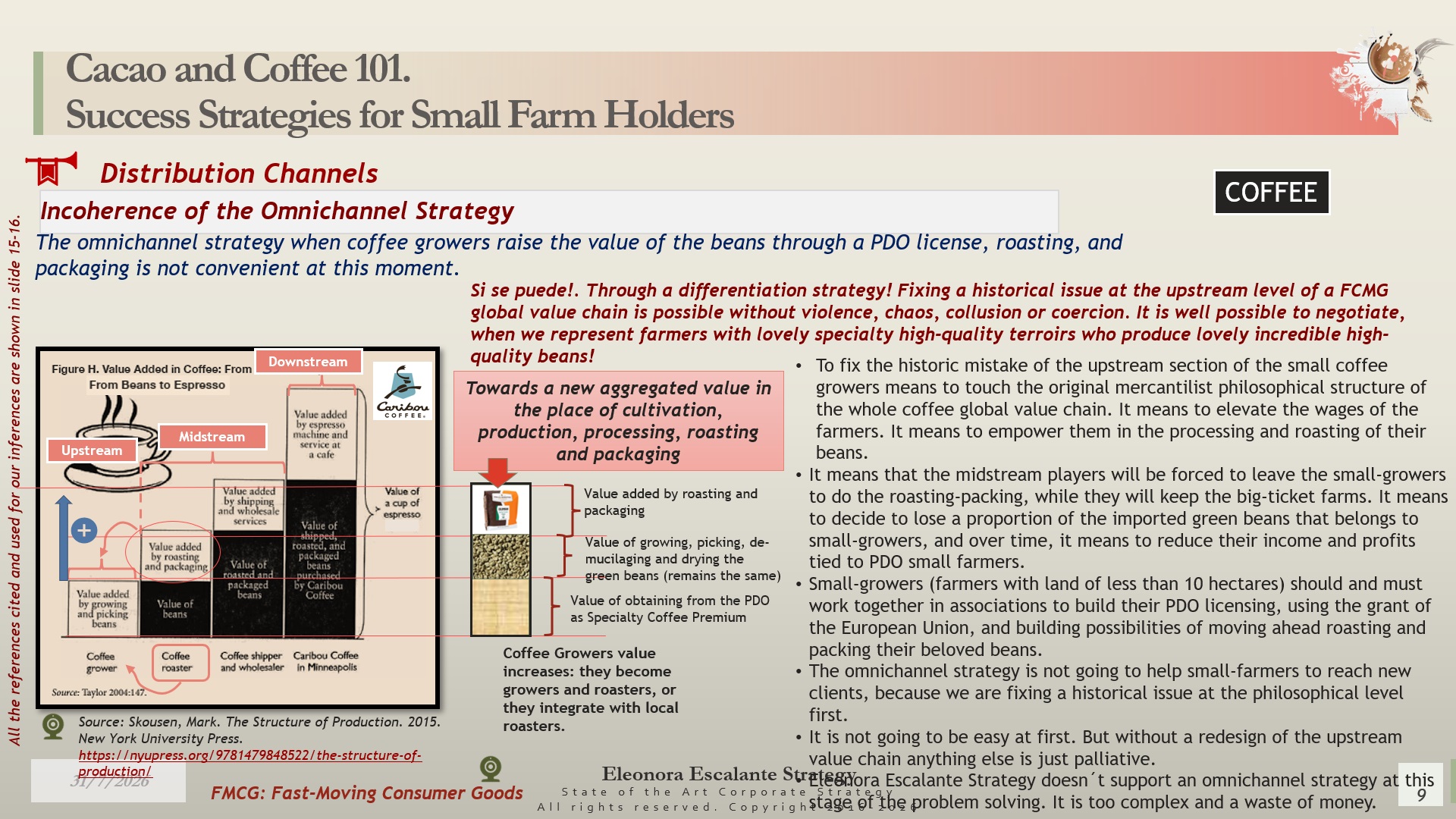
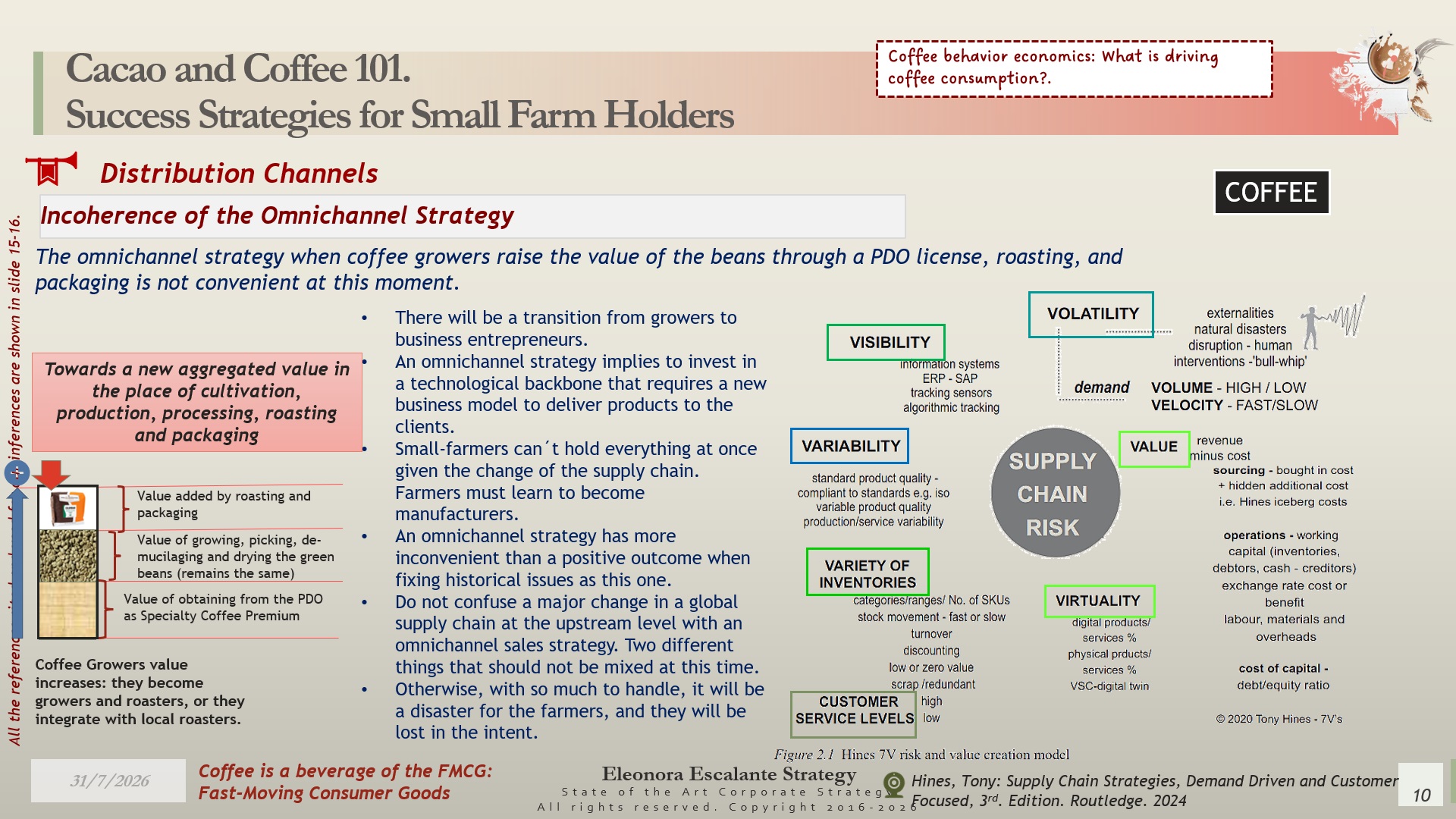
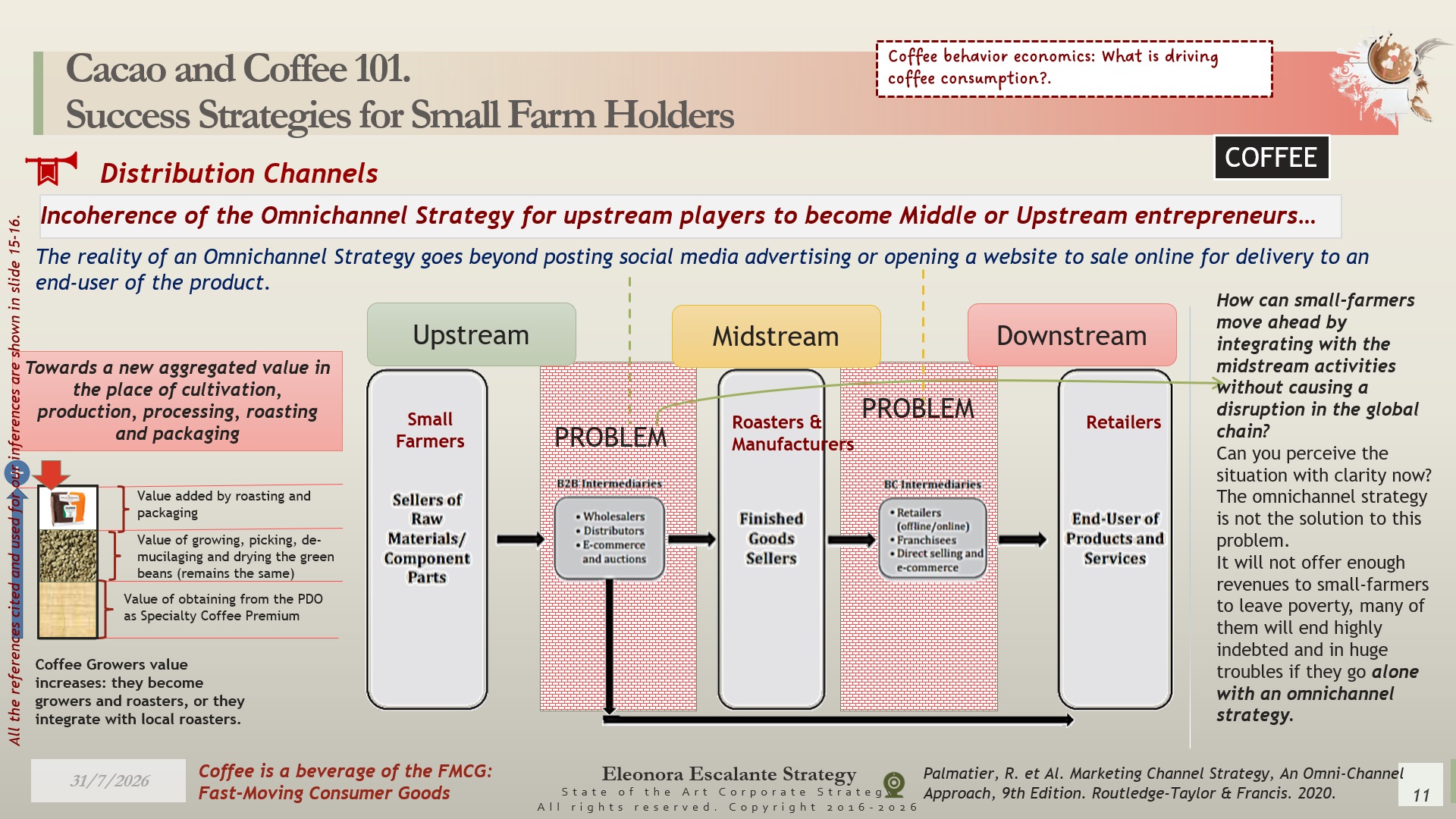
Our master class of today is grounded in a philosophical economic debate that has been on the table since the Austrian Carl Menger joined the scene. Our intention is not to teach you about the different channels available to small farmers. Our goal is to show you where the trouble is with the omnichannel strategies that are currently being utilized by small farmers in their quest to sell coffee or cocoa products to end-users, intermediaries, manufacturers of other products, and retailers.
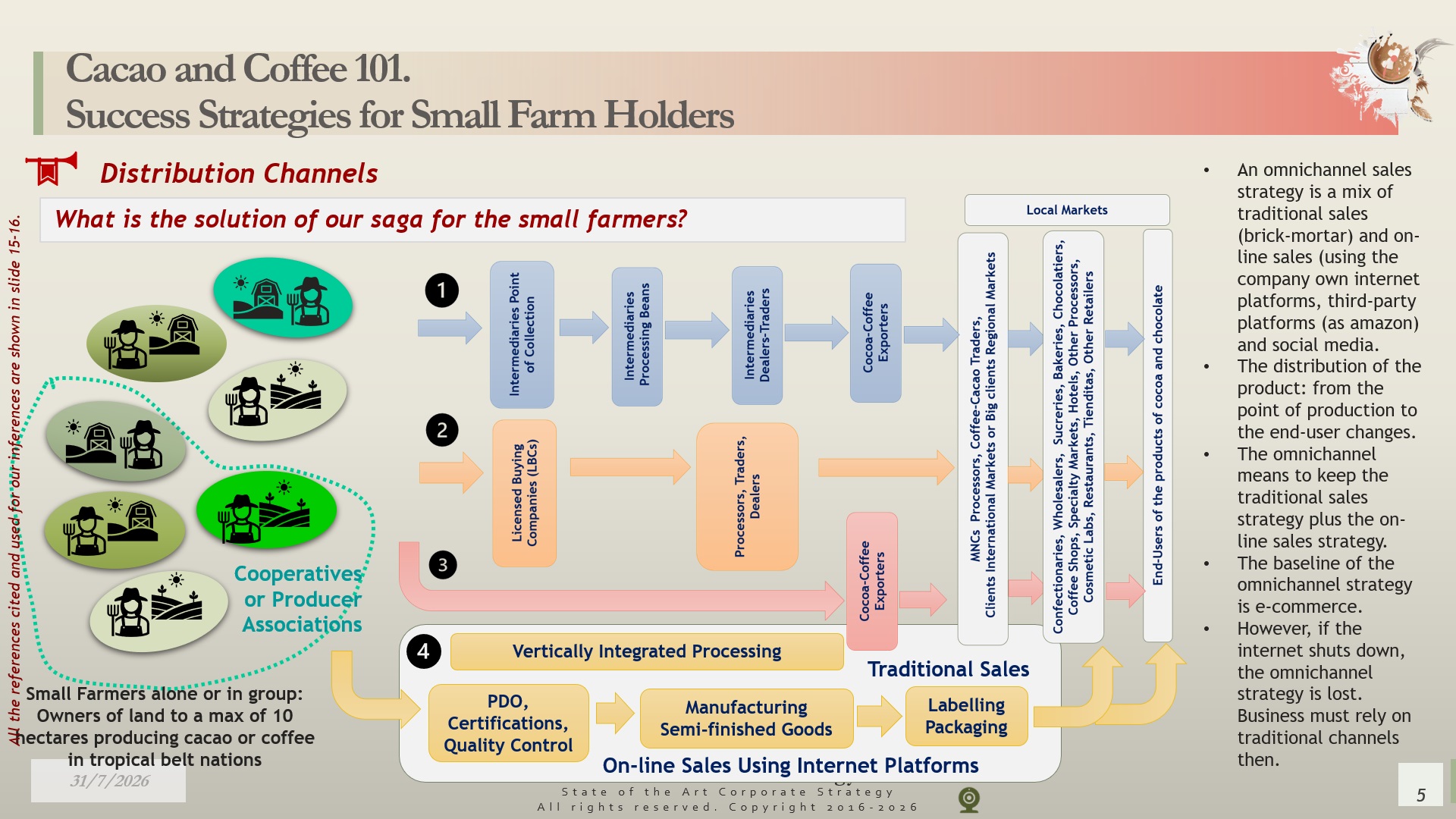
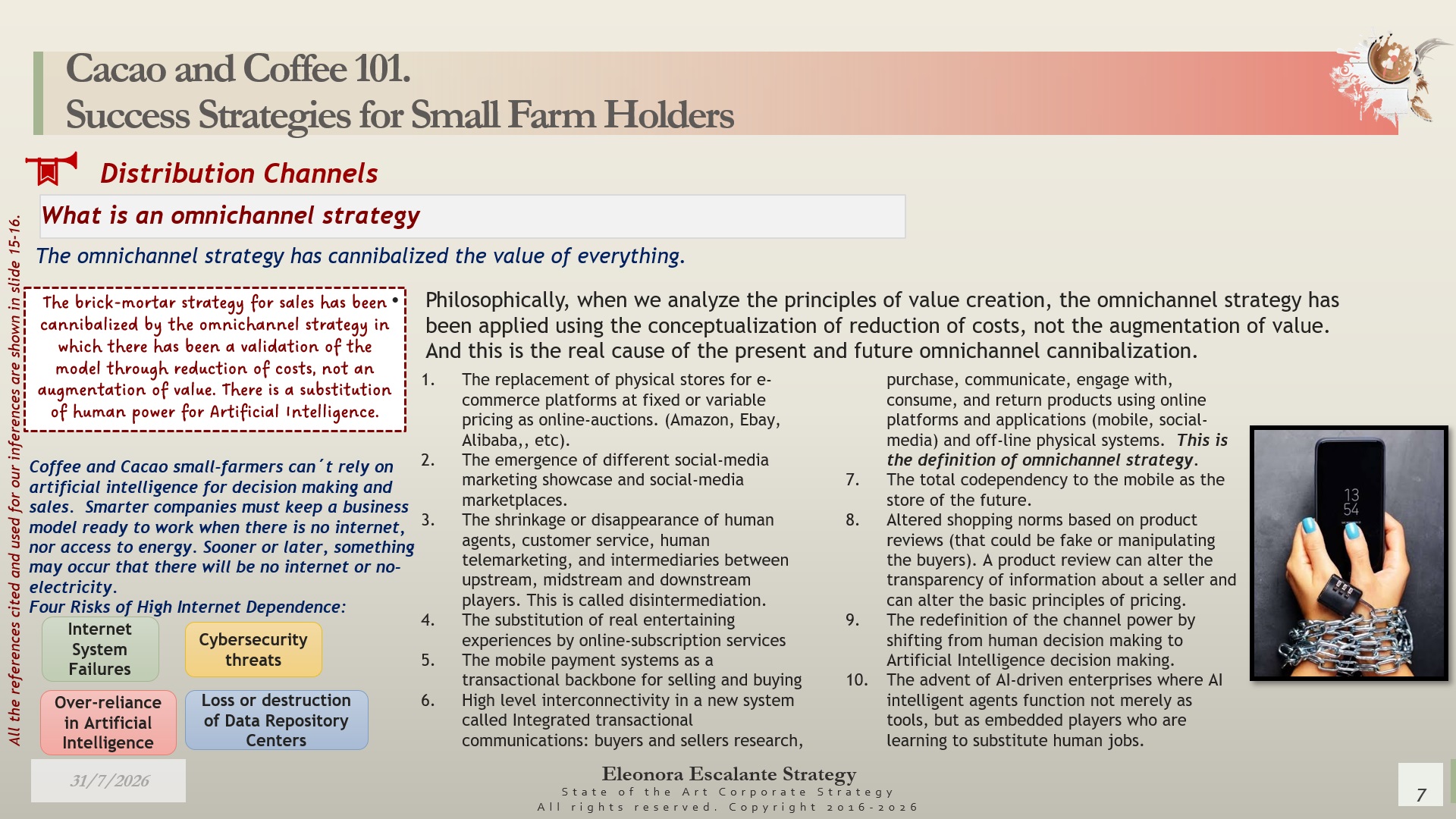
There is a conceptual, institutional, and systemic issue with the omnichannel strategy in the context of the ubiquity of multiple internet channels or e-commerce. During the last 10 years, most of the corporations have switched from physical retail direct-to-consumer stores to an omnichannel system that promised to integrate marketing, sales, communication, payment systems, and delivery using multiple platforms: e-marketplaces, organic applications, and third-party online portals. This shift was believed to help customers to find products through mobile, social media, and offline physical channels. The purpose: to capture consumer engagement across various channels of communication during a potential purchase transaction. The multiple channels varied from social media DM, email lists, web links, mobile platforms, e-marketplaces (such as Amazon or eBay), physical store visits, and promotional efforts in other retailer-based formats not owned by the manufacturer.
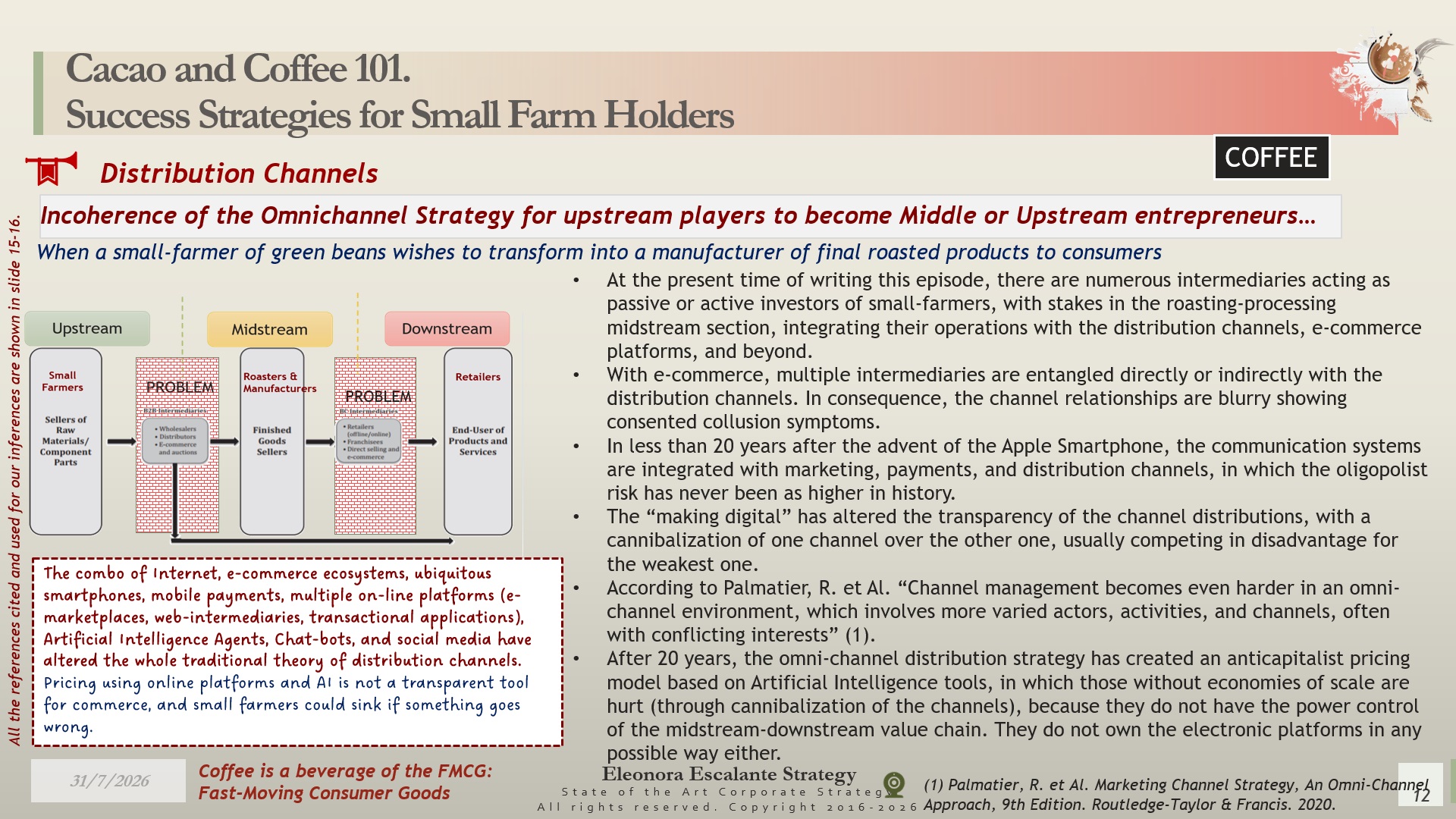
If you do not own the e-commerce platform where you showcase your products and services, you are absolutely codependent on that marketplace and its respective associates. If you do not own the social-media platform, you are absolutely codependent on that channel. If those e-channels use artificial intelligence, the situation is worse, because your business can be manipulated with wrong data that you will not be able to confirm, jamais!. If coffee-cacao small farmers start to sell their lovely roasted grains or cacao paste or chocolate through third-party online vendors which also depend on at least 4 to 6 entities to operate, can you imagine what type of e-commerce oligopoly has been formed, particularly if all coffee-cacao competitors are using the same online-distribution channel… Once you understand that numerous agents, brokers, vendors, traders, and financial entities are part of a few e-marketplaces which can manipulate pricing at their convenience, you will perceive how far an anomalous non-capitalism has taken place. Since the farmers do not own the e-commerce channel, can you understand to whom they are or will become absolutely codependent?
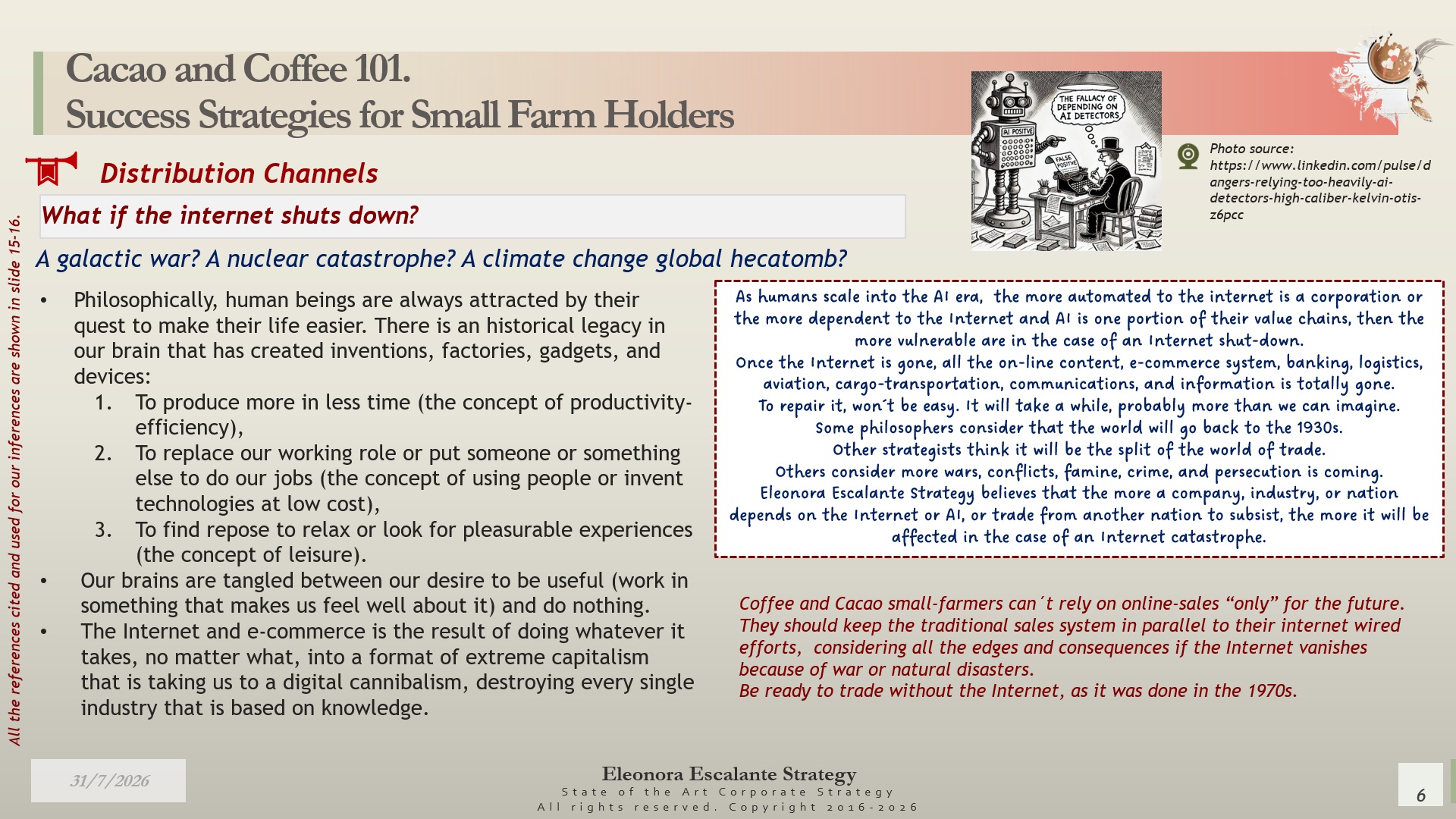
Find your master class preparation material below. You can download it and print it for your files. No one knows when the Internet may plunge. It is a stupid disgrace to build an economy based on the Internet and Artificial Intelligence if there is not a physical system to re-establish commerce. Humans should be prepared for everything, not just to defeat climate change.
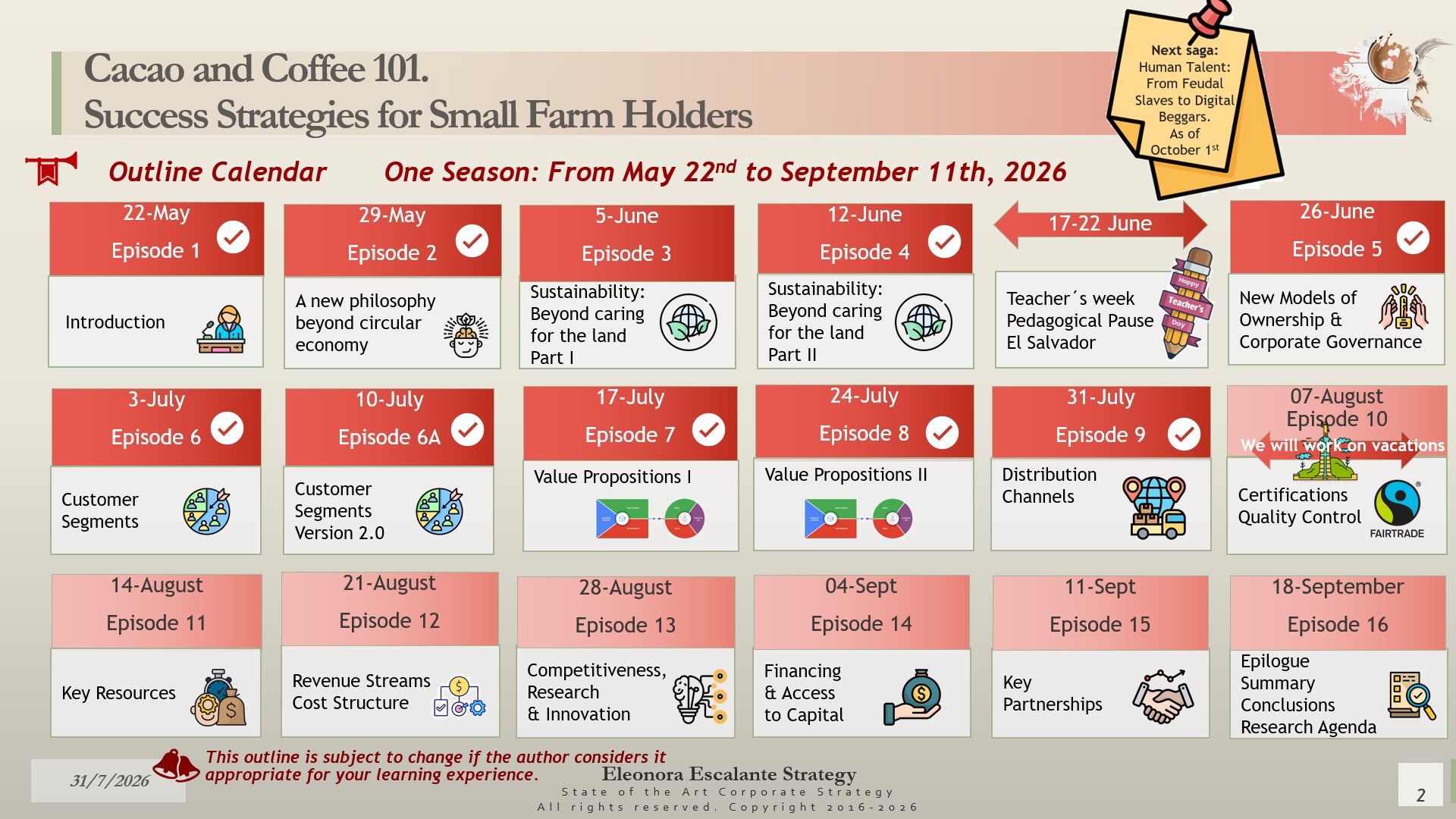
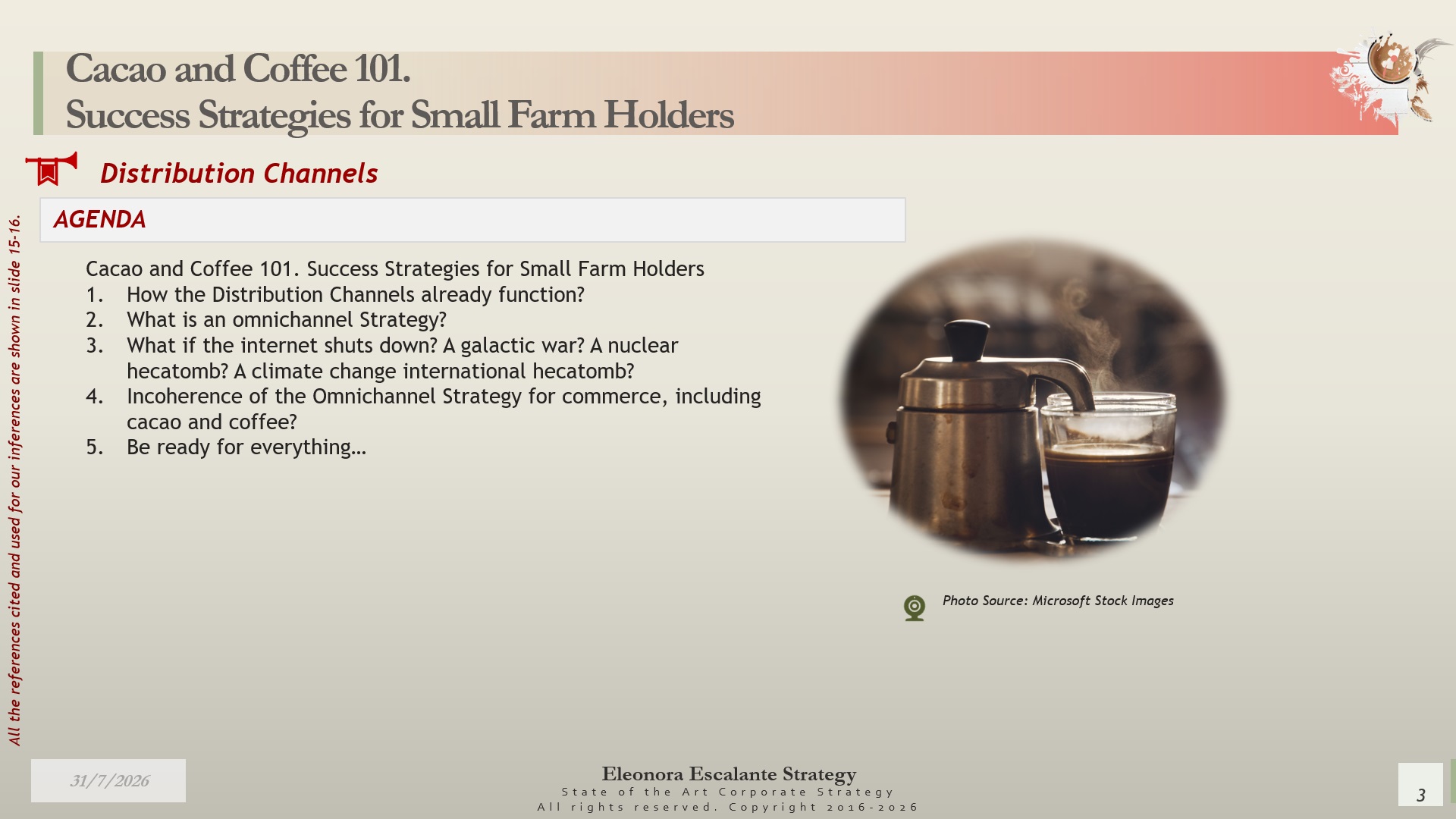
We kindly ask that you return next Monday, the 3rd of August, to review our strategic reflections on this chapter.
We encourage our readers to familiarize themselves with our Friday master class by reviewing the slides over the weekend. We expect you to create ideas that are or are not strategic reflections. Every Monday, we upload our strategic inferences below. These will be discussed in the next paragraph. Only then will you be able to compare your own reflections with our introspection. We always give our students a couple of days to prepare well before our final reflection.
Strategic reflections on this episode.
These will be in the section below on Monday, the 3rd of August of 2026.
Strategic Reflections. Cacao and Coffee 101. Success Strategies for Small Farm Holders. Episode 9. Distribution Channels
What was happening before the funnel of selling “online”.
Before the ubiquity of the “internet” through smartphones in our lives, humans had already determined what type of arrangements could be done when distributing products or services through their own stores or using third-party retailing. Operating one or more distribution channels through intermediaries is not new; it has occurred since ancient times. The Mediterranean Italian traders were experts in buying Asian products to move them through continental Europe up to the Northern Baltics. At the time of the crusades, constant movements of people from Central Europe to the Levant were another opportunity used by the Christian kings and knights to move money and goods from the Middle East. The flow of exports and imports was constant, by sea and land, and the Silk Route is an example of how far and long the journeys were, with several stopovers in which one distributor sold to another reseller, and the exchange was consecutively happening. The discovery of America and a maritime alternative route to Asia were driven by the huge desire to cut the intermediaries’ profits. The kingdoms of Portugal, Spain, Britain, and France were the pioneers of using different agents as intermediaries. Sometimes these agents were sent to oversee the plantation/production operations, while other times they were the traders of African slaves. Numerous agents were dropped on islands, ports, and cities; sometimes as the Crown´s specialized spies navigating from harbors, checking inventories, and continuously as mediators of credit and payments. The loan sharks existing in every colony or imperial territory were also consultants to VIP members of the empires, most of the time undercover. For centuries, the court of the kings, through their “Ministers of Marine and overseas colonies“ controlled their vassals in the New World (Asia and America). The Kingdom of Guatemala was also a hub for permanent control of the intermediaries who worked with the cacao, añil, other textile trades, bananas, and coffee.
After the independence movements to reject the value proposition of the Bourbons in Spanish America, the two world wars occurred, and it wasn´t until 1945 that the incipient rules of the game of capitalism started to permeate in most of the producing nations of the Tropical belt. And that is how we arrived at the entrance of the 21st century. When the internet proved to be singularly easy to manage after Y2K, things were still controllable under the foundations of capitalism: supply and demand, free competition, decentralized market mechanisms, incentives, and private property. However, when Apple’s first iPhone landed in our civilization, followed by Androids, the erosion of the principles of capitalism began. Meanwhile, the domain of communications was not tied to the domain of transactions; capitalism was working in middling, with certain unpleasant issues which have been reprimanded and admonished all the time by the top capitalistic economists: Adam Smith, Carl Menger, Ludwig von Mises, John Maynard Keynes, Milton Friedman, Friedrich Hayek, and Joseph Schumpeter. Each of these gurus contributed with their works to try to perfect the capitalism theories, but they also left unfinished discussions on how to overcome its defects and shortcomings. Particularly those related to collusion, monopolies (oligopolies), and pricing manipulation. Additionally, the primary flaws of capitalism are related to the anti-moral value of “self-interest”: extreme income inequality, not-knowing when to stop acumulating profits, not learning how to self-control and stop economic egoism, environmental damage, and corruption (for example: constant breaches of market fairness, fraud, the illusion of fair play, misappropriation of information to make a profit in the market, or the practice to purchase influence in governments by those who concentrate the economic power in several nations). However, all these mentioned flaws do not only belong to capitalism but also to socialist nations.
Yet, even with all the imperfections listed, capitalism can be improved, and many times during the last century, market corrections have helped the system to evolve for the better. Our strategy house believes in the utopian dream of ethical capitalism, but like all the top economist gurus listed above, we are not blind to its current limitations.
The idea that extreme inequality in one nation doesn´t allow meritocracy to flourish is a persistent argument that has been signaled. None of the economists listed above was unseeing of this weakness. This means that the concept of individual hard work and the utilization of rising talent is not the “only” cause of wealth and prosperity, but rather the unequal sharing of blessings. Winston Churchill captured this spirit in 1945: “The inherent vice of capitalism is the unequal sharing of blessings; the inherent virtue of socialism is the equal sharing of miseries”.
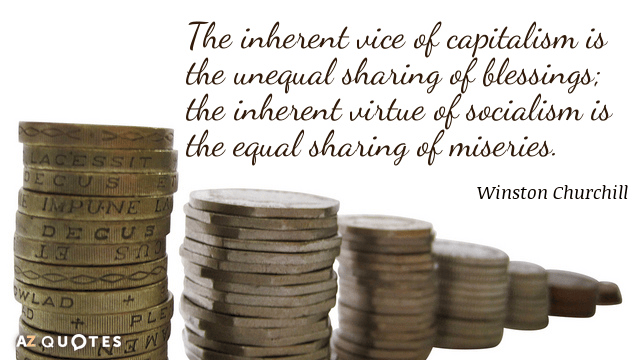
Going to the roots of our philosophical case, let me explain what Churchill meant: Capitalism creates wealth and good things (“blessings”) but distributes them unequally, so some people get a lot and others get very little. However, on the other side, socialism is totally lost in trying to do the opposite: It tries to make everyone fair and equal, and in the process, it only shares poverty and hardship (“miseries”) equally among everyone. With this general introduction, we expect our readers to understand what is happening with current e-commerce distribution channels being applied across all economic sectors and industries. Meritocracy, the highest achievement for economic reward, has been smashed by digital technologies, in which all the intellectual property of the knowledge economy is stolen and used as a commodity by open artificial intelligence efforts such as ChatGPT, DeepSeek, Google Gemini, Anthropic Claude, Microsoft Copilot, Perplexity AI, XAI Grok, Qwen Chat, Meta AI, etc. What is happening then?
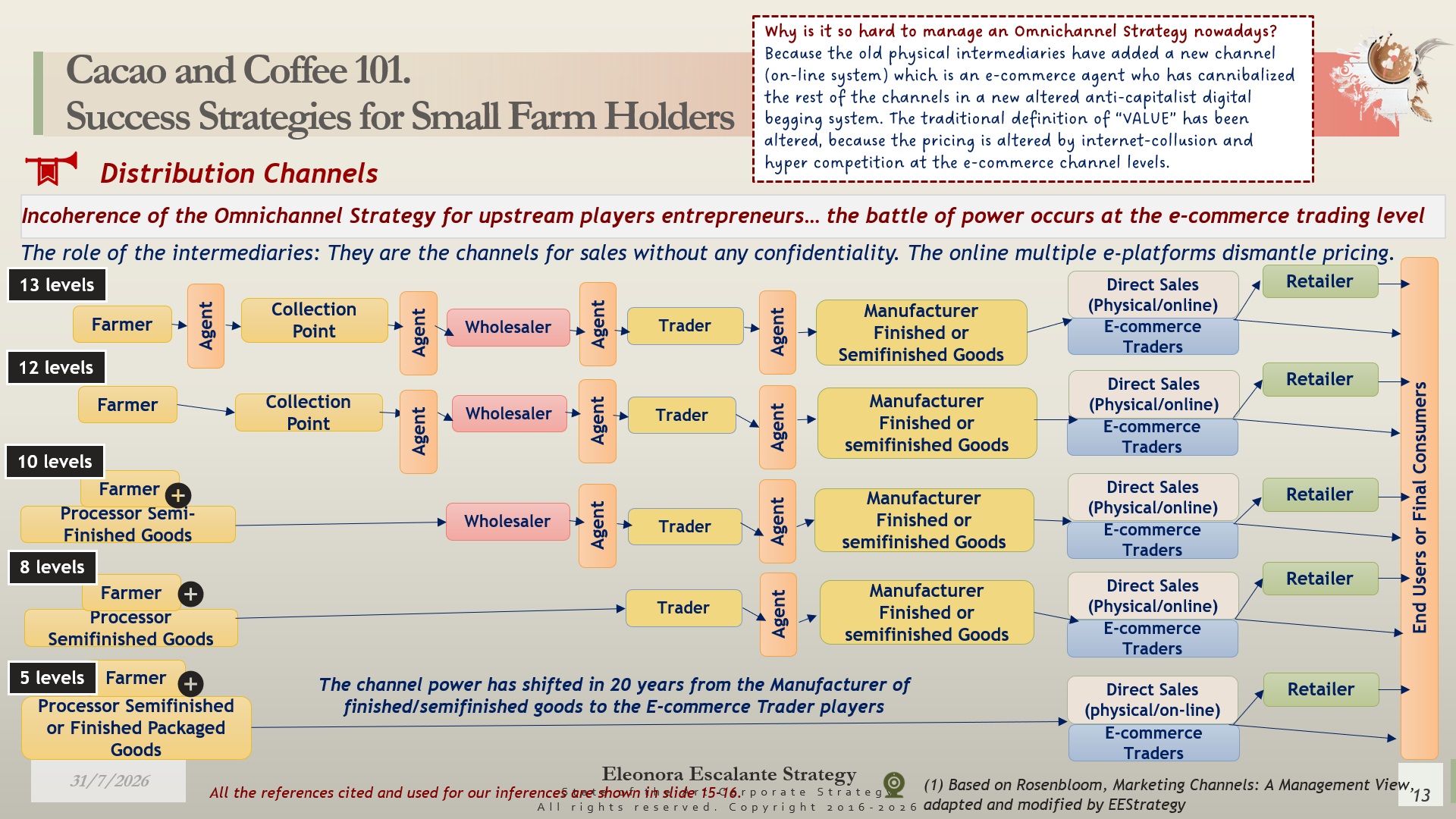
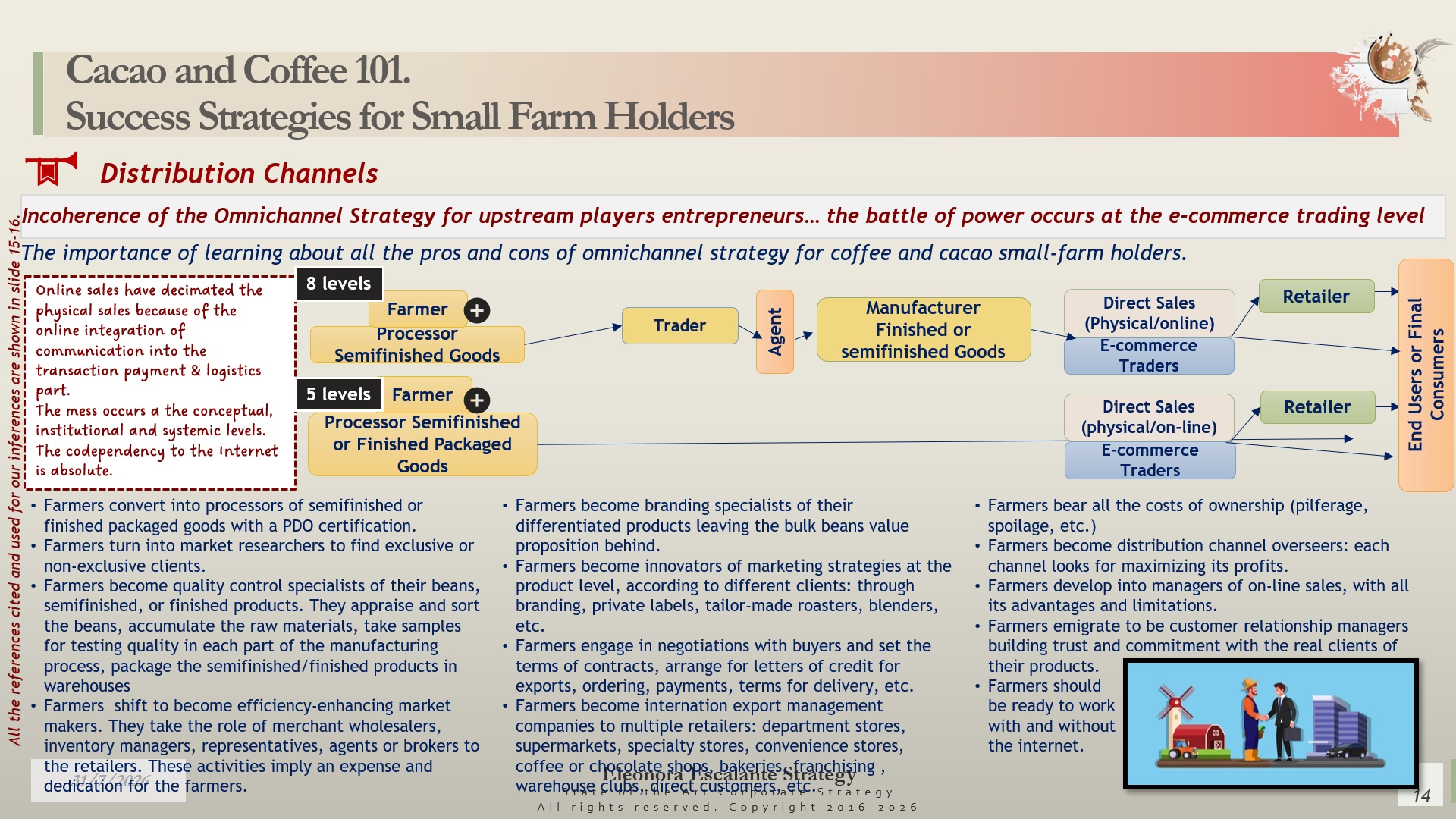
When former human agents are replaced by AI agents. Slides 11-14.
These four slides are the essence of this publication. Through them, we have shown you how the value chain of coffee-cacao has been changing over time. We have not added all the agents or intermediaries that existed between the midstream and downstream sections during the 20th century; however, we analyzed in extreme detail what occurred between the upstream (the farmers) and the midstream players (the first round of processors of the beans). If you notice carefully, we show the level of intermediaries, in progression of time, from the past to the present. From 13 levels of layovers, we can see that each intermediary player held an agent, or point of contact, a representative who was in charge of completing the transaction from one party to the next one. In each shift, each agent charged a commission or an agreed fee, sometimes to both players of the transaction. The value of the raw materials from the farmers (the beans) added a consecutive series of economic fees until it arrived at the midstream processor positioned in Europe or North America. These are called transaction costs. These expenses represent the financial friction of making an exchange through a third party rather than directly (1). Transaction costs are normally defined as search costs, quote costs, negotiation costs, and costs incurred from having a sales contract approved, including costs of monitoring, validation, registration, and enforcement of the contract (2). The advent of the internet reduced transaction costs by replacing human agents. And the growth of numerous types of e-commerce platforms, including integrated transaction processing providers, took place paired with social media. The mobile transactional payment system has also dramatically reduced transaction costs. However, the issue here is not the convenience, efficiency, or effectiveness of the online-transactional design. Our discussion is about the coffee and cacao global value chains, in which the upstream players (farmers) have not profited from the reduction of transaction costs. On the contrary, nowadays, if farmers wish to sell their beans through different online platforms, they are obliged to pay fees to the different e-commerce players tied to the transaction (including commissions to financial institutions), adding operational costs (these are not called transaction costs by the farmers) which were not there before. In consequence, today, farmers are incurring more expenses than before, and the value of the beans still remains the same.
The beast of the online distribution channels is concentrated in so few.
The idea of e-commerce as a distribution channel began in the 1990s. It gave a good impression and promising returns to those pioneers who embraced it. It has been a while since then. However, over time, all the physical flaws of capitalism have been transferred to the “internet”. While the physical agents of intermediation disappeared, new agents of intermediation have been invited, and the consolidation of these new mega-monsters has created a new concentration of power that is paid for by billions of people who are connected to the Internet through their mobiles, laptops, or tablets. The concentration of power of the leading tech companies (by market capitalization) is clustered in 11 corporations: Nvidia, Alphabet (Owner of Google, YouTube, and WhatsApp), Apple, Microsoft, Amazon, Taiwan Semiconductor Manufacturing Company (TSMC), SpaceX, Broadcom, Tesla, META (Owner of Facebook & Instagram), and Samsung. On July 1st of 2026, the aggregated market cap of these 11 enterprises was around 29,490 billion USD, which is almost the equivalent to the nominal GDP of the United States (32 trillion USD). Look at the graph below:
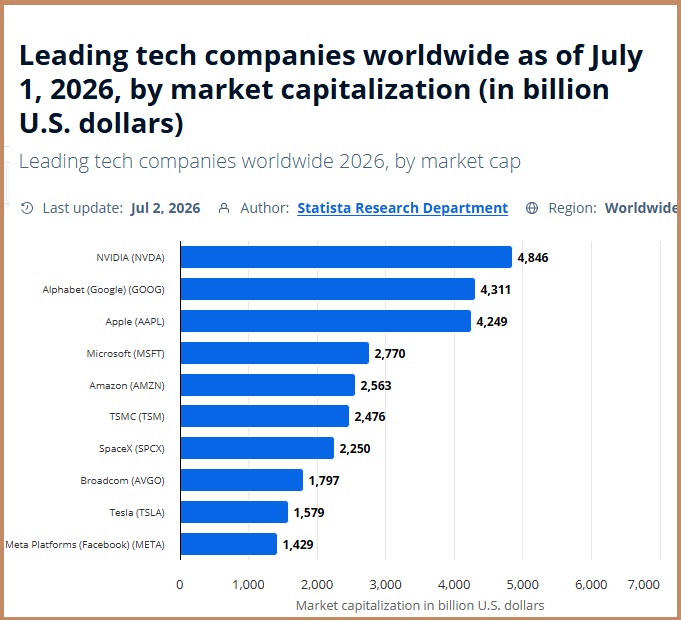
The imbalance of the concentration of power in the world is explained in the last graph. Only 3 non-tech corporations are distinguished in this pool of leading technological corporations: Saudi Aramco (Oil and Gas) with $1,685 billion; Eli-Lilly (Pharma) with $1,101 billion; and Berkshire Hathaway (Financial services) with $1,087 billion. There is a colossal oligopoly leading us towards their philosophical conception of artificial intelligence, automation, and digitalization. Not even Walmart has the power to catapult its negotiation power against big tech. And the ones who lead are always the ones who pay the party.
The big tech leading companies are paid by all of us.
The more each of us utilizes the products and services of these corporations, the more these companies grow. The more we use Instagram, Facebook, Amazon, the Internet service providers, the e-clouds, the AI applications, the online-payment systems, the mobiles, laptops or tablets, the more these leading companies are expanding and enlarging endlessly as investors in other corporations from the real world. The reason why we mention several times in our slides that we are not living in capitalism anymore is related to the panorama that we have displayed above. We are heading not to socialism (or communism) but to a “je ne sais quoi digital begging system”, that has similar characteristics to the antique feudalism, but this time the rental fee to the feudal lord is not for exploiting the land to harvest wheat, potatoes or corn; but for using the online transactional platforms and social media to sell our products, including the lovely coffee and cacao beans. Eleonora Escalante Strategy has detected an extreme justification: nowadays the hardware is useless without internet. Can you believe what level of codependency we have attained? And this codependency is ubiquitous. It is happening everywhere. Not just at the transactional operational section of the value chain. We can also observe it in the classrooms, teenagers and university students with zero memory, who can´t perform an oral presentation without reading from a smartphone, or who can’t take an exam on paper with questions that require handwriting, but only by using internet platforms of multiple-choice questions… That is the height of absurdity.
Finally, the incoherence of the omnichannel strategy is instituted in its essence.
When Steve Jobs released the iPhone in the year 2008, he assembled the communications domain and the transactional domain into a unique funnel under the format 24/7. The rest of Androids followed. Before then, people couldn´t do it, because laptops were expensive, and most of us only used fixed desktops at the office and at home. And this fact was a huge barrier that kept life balanced. After the disaster of Steve Jobs’ invention, the utilization of e-commerce platforms to buy and sell products using Smartphones began, and everyone was able to communicate and make deals when they wanted or needed it. The situation got worse with the advent of social media. Since we live in a capitalist world where the flaws of this system still exist and have passed from the physical to the virtual world, the affliction among top capitalist economists to fix it through efforts of private sector charity sponsorship or public social welfare is not working anymore. Why? Because the principles of capitalism have been disrupted at the core, and the flaws of capitalism are now evident for all of us, or at least for those who are interested in thinking about it. And the risk of moving ahead with this imbalance is that once the future crisis occurs (because it will happen, sooner or later, the market correction will come), there won´t be any other alternative capable of cushioning the “global fall”, as it happened in previous crises. It is not injudicious what some well-instructed economists have mentioned when evangelizing that we are going to return to the 1930s or way back beyond that.
Our attention for the small farmers of cacao and coffee is: Do not put all your hopes in online sales.
If you concentrate the distribution channel of your lovely products only on the e-commerce kit, your efforts will be wasted depending on the approach of your pursuit. Since roasted coffee and cacao semi-finished products are mainly used by other businesses, it is wise to build a more traditional channel for international sales. The more you diversify using physical channels, or using direct contact with the end-user and final retailers, the better off you will be when the market correction of the current tech imbalance materializes. It is also wise to prepare an alternative system to work without the internet. For example, companies should keep their fixed phone lines, probably a fax, and try to be ready in case the Internet or electricity is gone.
Announcement.
What is the point of building an omnichannel strategy for coffee-cacao small farmers who will also invest in the improvement of their plantations using a sustainable farming system that will grant them a Protected Denomination of Origin (PDO)? We have analyzed the issue of upstream-midstream-downstream players in relation to their respective distribution channels and/or sales intermediaries. Next week, we will continue to cover all the certifications available for the upstream players. We will use several examples of African nations.
Musical Section.
This saga is committed to elevating traditional musical instruments and their respective musicians over digitally produced sounds. This saga is dedicated to chamber orchestras.
Today, we have chosen the Mahler Chamber Orchestra, based in Berlin, Germany. You can find this orchestra by clicking here: https://mahlerchamber.com/about. The concert we have chosen was the final one of the Season 2018 at the Heidelberger Frühling Musikfestival. The artwork interpreted is from Ludwig van Beethoven: Symphony No. 7 in A Major, op. 92. Directed by conductor Daniele Gatti.
Enjoy!
Thank you for reading http://www.eleonoraescalantestrategy.com. It is a privilege to learn. Blessings.

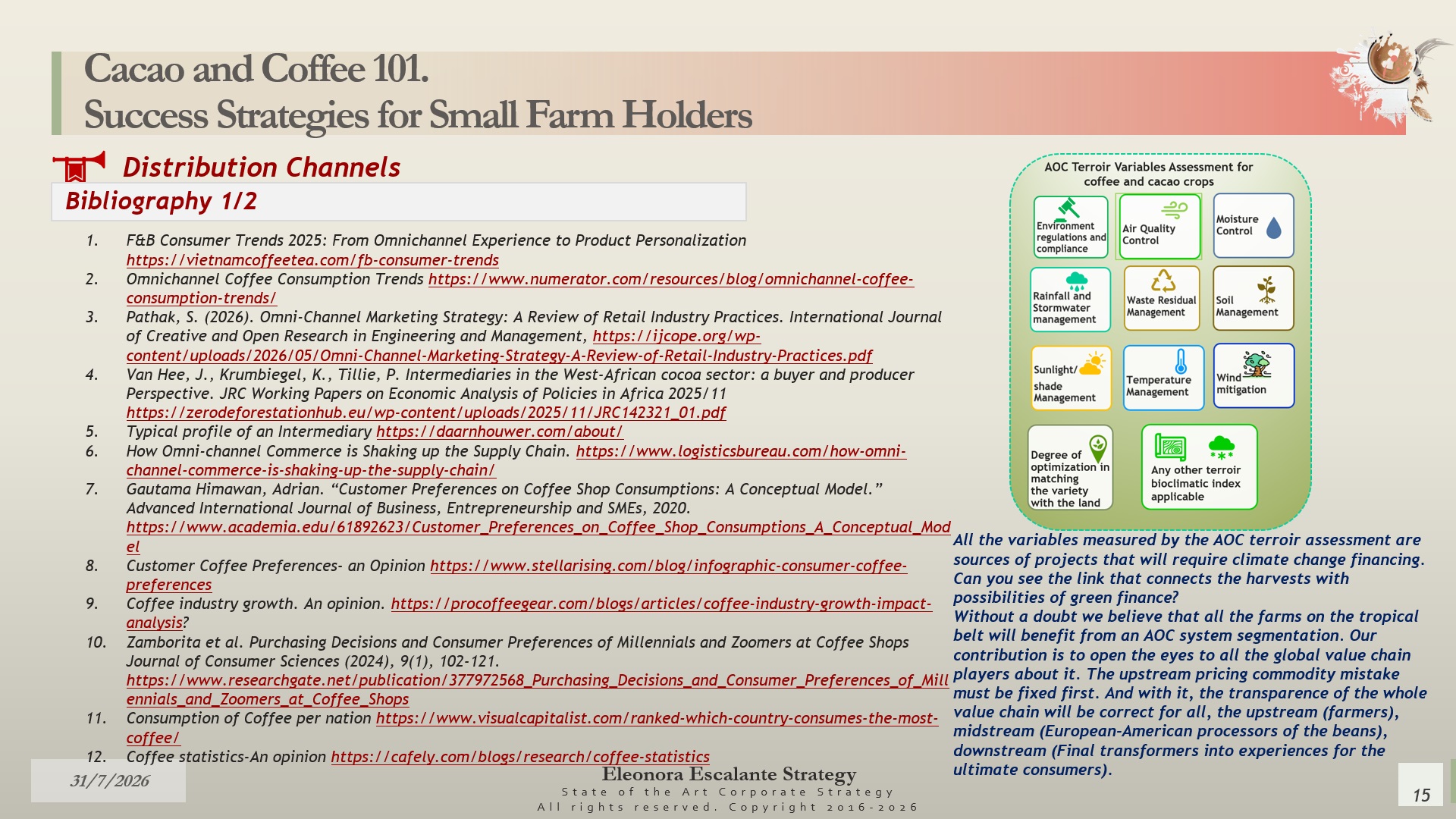
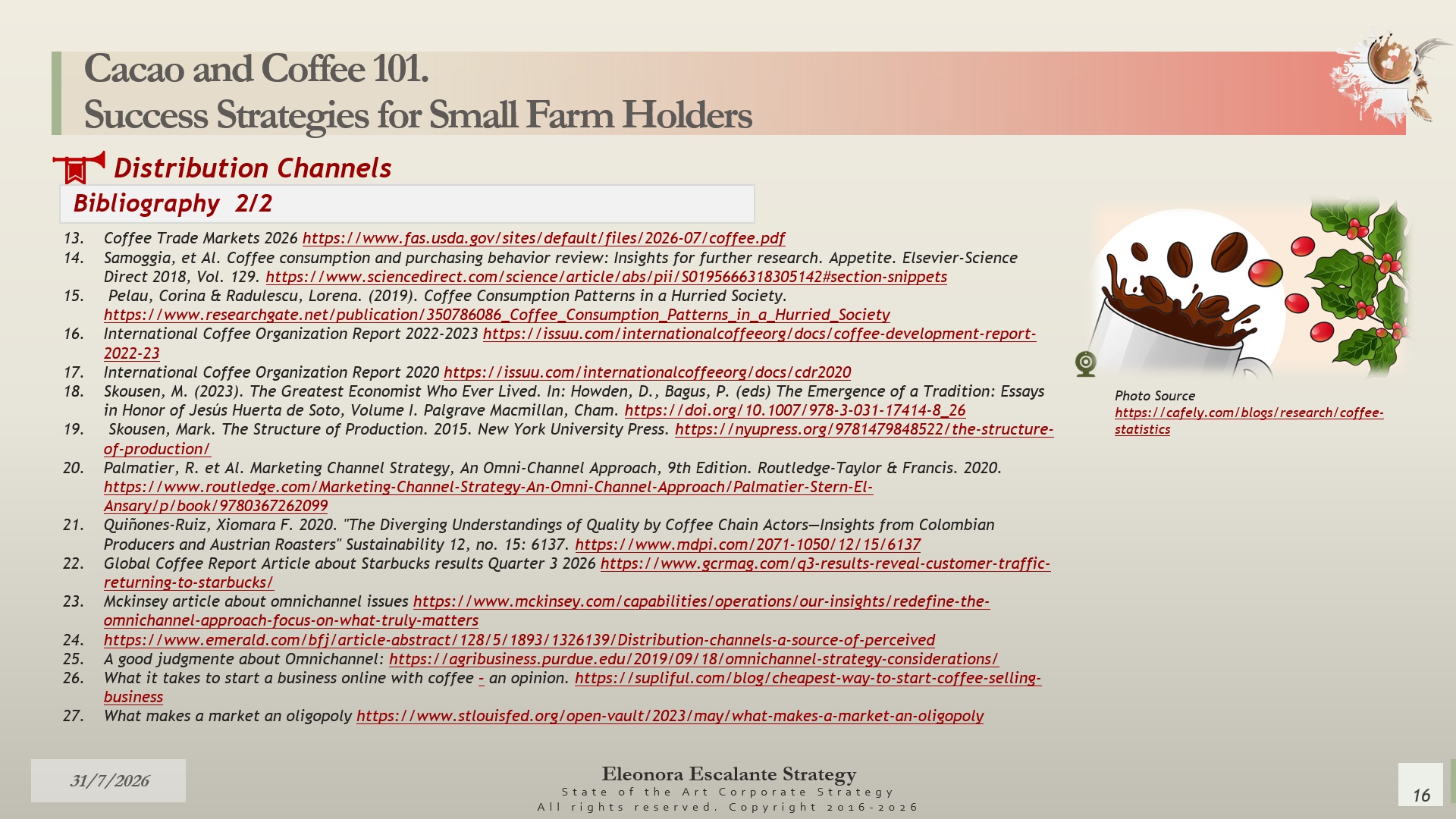
Sources of reference and bibliography utilized for today´s inferences. The bibliography is listed on the last slide of the reference reading material. Click the respective URL to trace them.
Bibliography in this post: This will be added accordingly with the strategic reflections.
- https://www.investopedia.com/terms/t/transactioncosts.asp
- Suematsu, C. Transaction Costs Economics. Strategies and Practices for a Global Open Economy. Chapter 7. Springer, 2021. https://link.springer.com/chapter/10.1007/978-3-319-06889-3_7
Disclaimer: Eleonora Escalante paints Illustrations in Watercolor. Other types of illustrations or videos (which are not mine) are used for educational purposes ONLY. All are used as Illustrative and non-commercial images. Utilized only informatively for the public good. Unless otherwise stated, I do not own any lovely photos or images.
 Eleonora Escalante Strategy Strategic Reflections Think Tank