
Cacao and Coffee 101. Success Strategies for Small Farm Holders. Episode 10. Certifications
Dear fantastic readers and students:
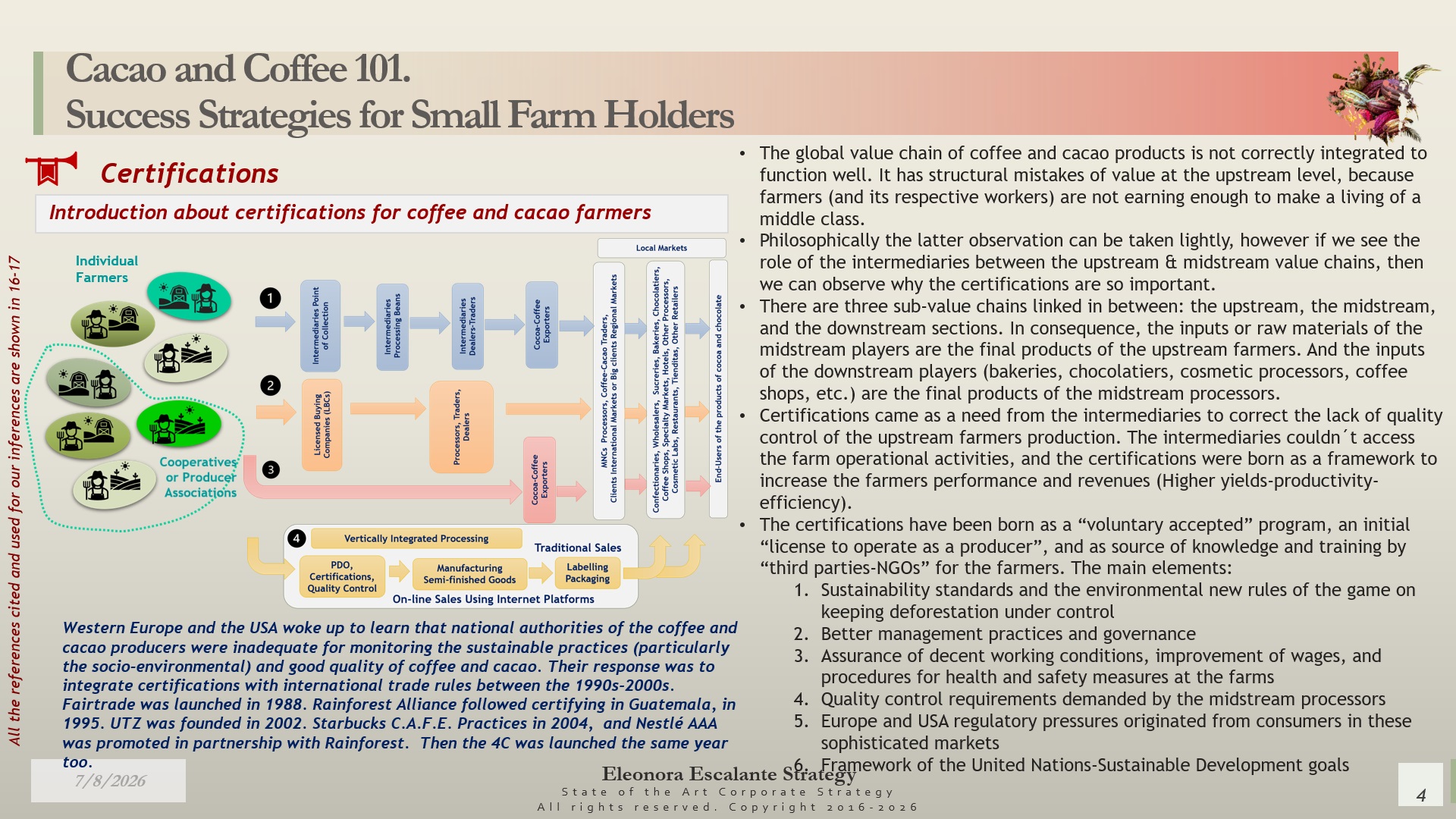
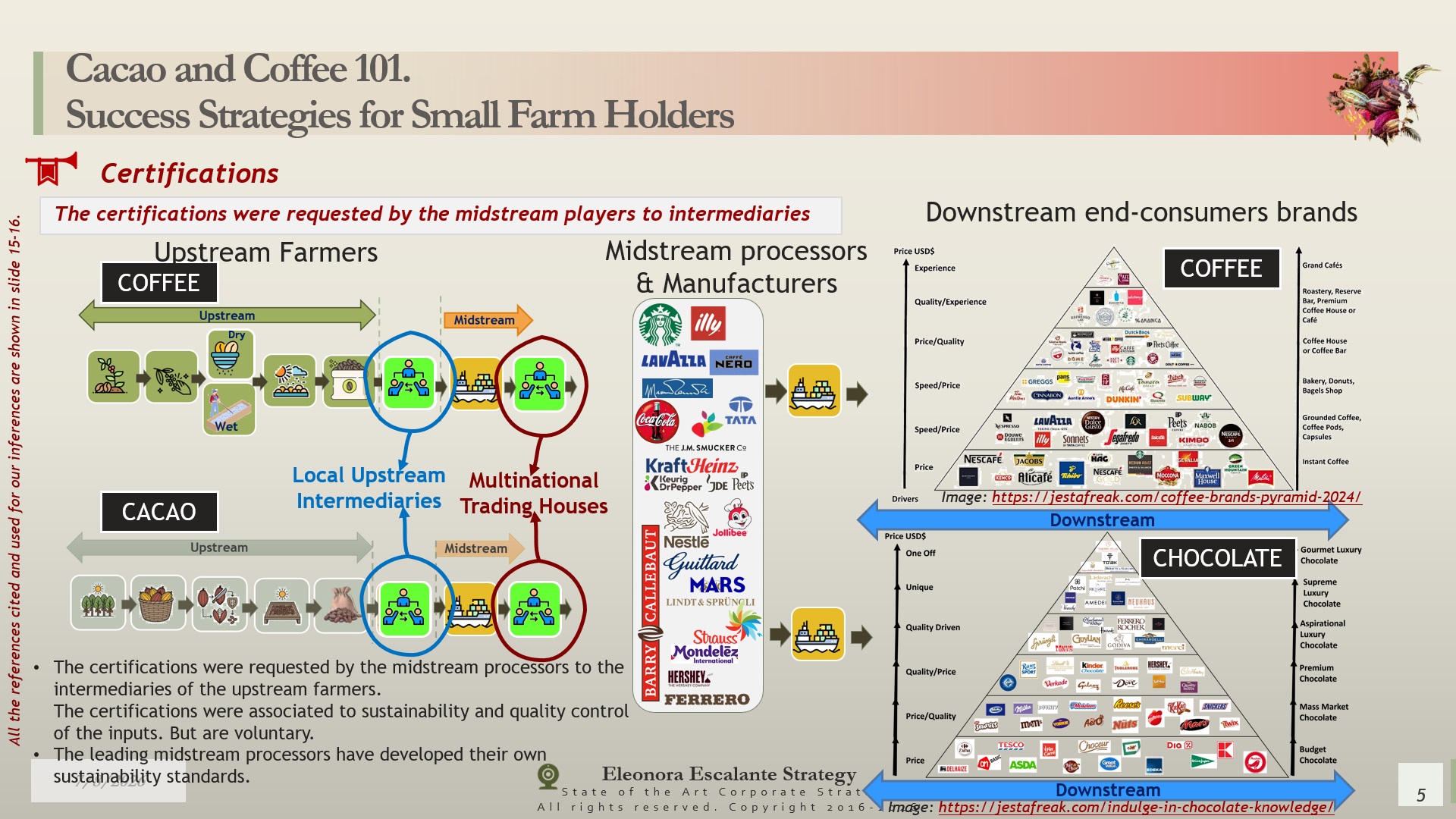
Our master class today is about certifications. We were perplexed to realize that producers on upstream farms had been trading coffee or cacao beans without the formal requirements of the importing nations for more than a century. It wasn´t until the 1990s that certifications of the upstream farmers started.
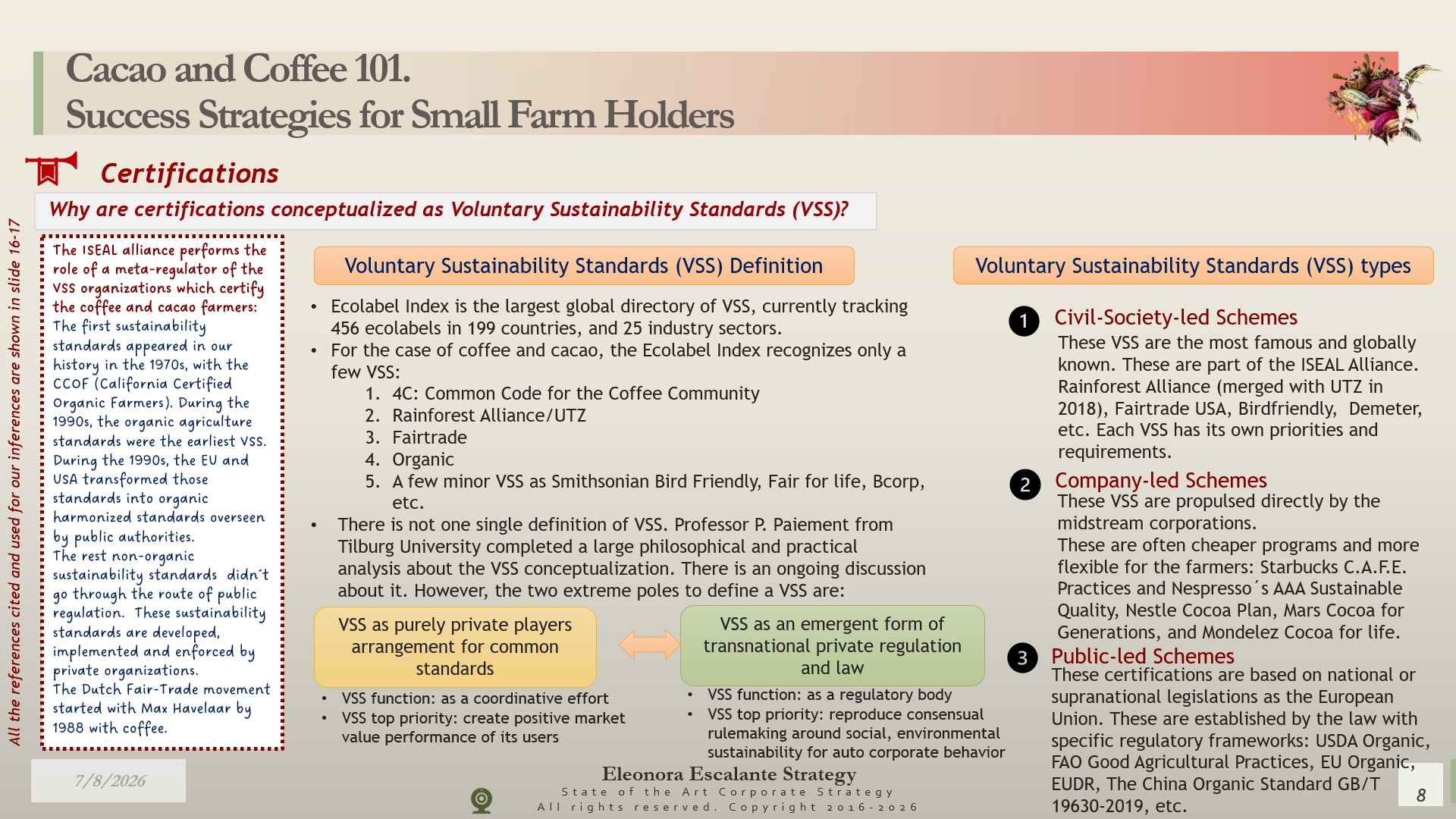
Although it seems to us that trading of these precious commodities was based on faith between the upstream and midstream players, it is well possible that the whole global supply chain was so entangled among companies who comprehended each other very well that certifications were not needed. Before the 1990s, it looks like all the proprietors of companies producing, intermediating, manufacturing, and trading coffee and cacao were incumbents; probably sufficiently well known to each other. Multiple people managed the whole process through agents and intermediaries at the service of the coffee and cacao group’s dominant positions. The intermediaries (traders) of the beans were the agents of compliance. However, since the 1990s, it looks like new challengers arrived to take certain dominant spots in the global value chain, and with these new aspirants or contenders (from Asia and Africa), the commodities marketplace changed. It is during this decade that the new sustainability topics about caring for the land took a spotlight place. Suddenly, 30 years ago, the environmental theme was a priority because planet Earth started to show signs of sickness. In the agricultural sector, coffee and cacao markets of Western Europe and the USA woke up to see that the beans were produced in nations that suffered from a lack of environmental, social, and labor regulations. So, the solution to this issue was through farmers´ certifications, under the figure of voluntary sustainability standards (VSS).
The VSS were the tool used to improve what was missing at the upstream part of the procurement of raw inputs, and also to understand how the new producers of coffee and cacao were going to join the sector and comply with the bare minimum. At the same time, the certifications opened the door to these new aspirants of market share who couldn´t enter to sell the beans without a stamp of approval that could satisfy the demanding quality of the midstream and downstream players. The certifications were an instrument to establish the new minimum standards of quality, socio-environmental, and economic factors of the farmers (and their respective workers). More than thirty years have passed since then, and there are still outstanding issues that certifications have not yet solved in relation to the farmers’ quality of life, because there is a structural problem at the upstream level, and we have discussed it in previous chapters.
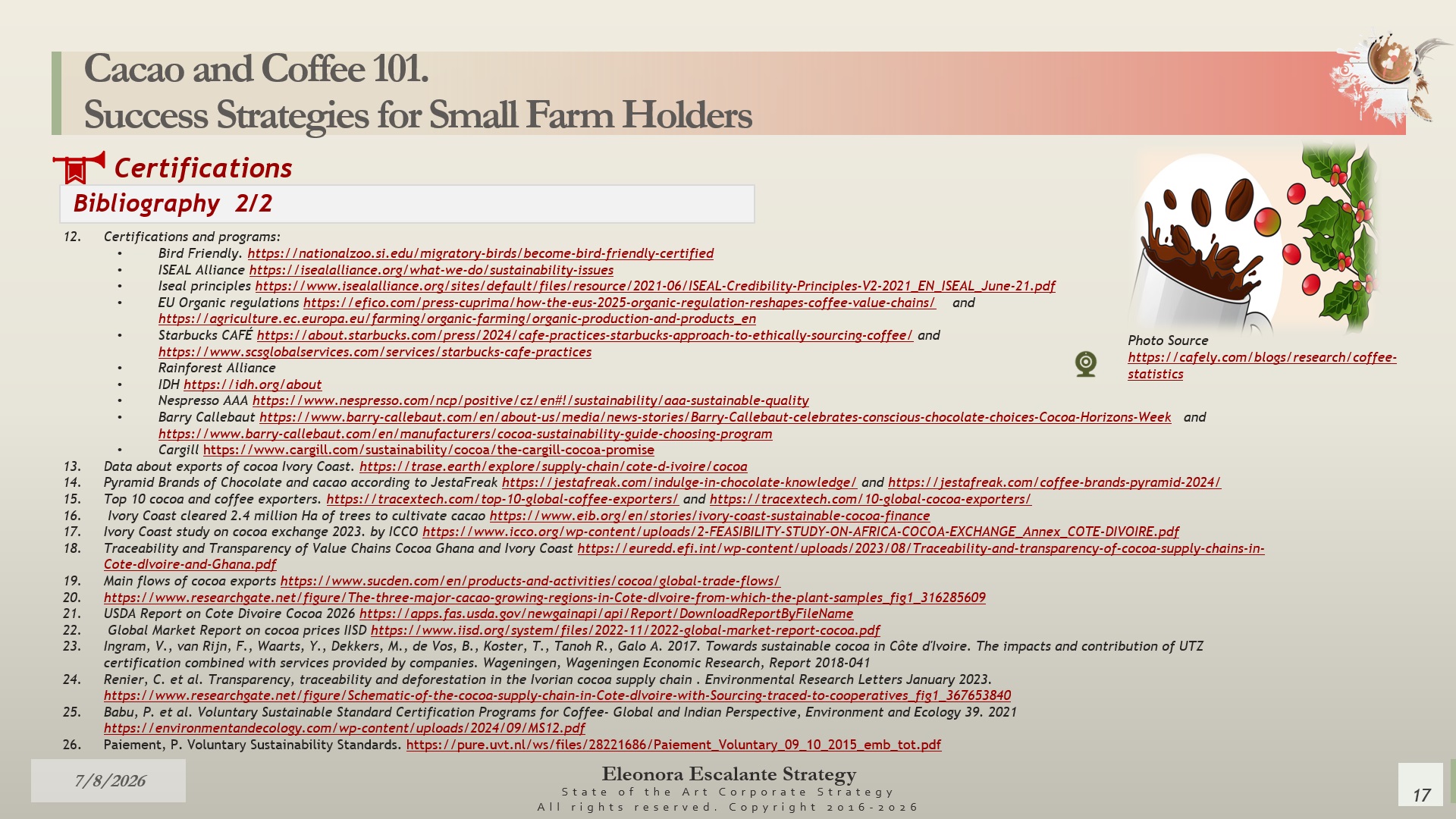
Let´s find out about the certification subject with our reference material prepared in advance for your study during the weekend. Feel free to share it with others and discuss it with your family and friends. Download the PDF file of the slides, read them, print them, write notes, and study them over the weekend.

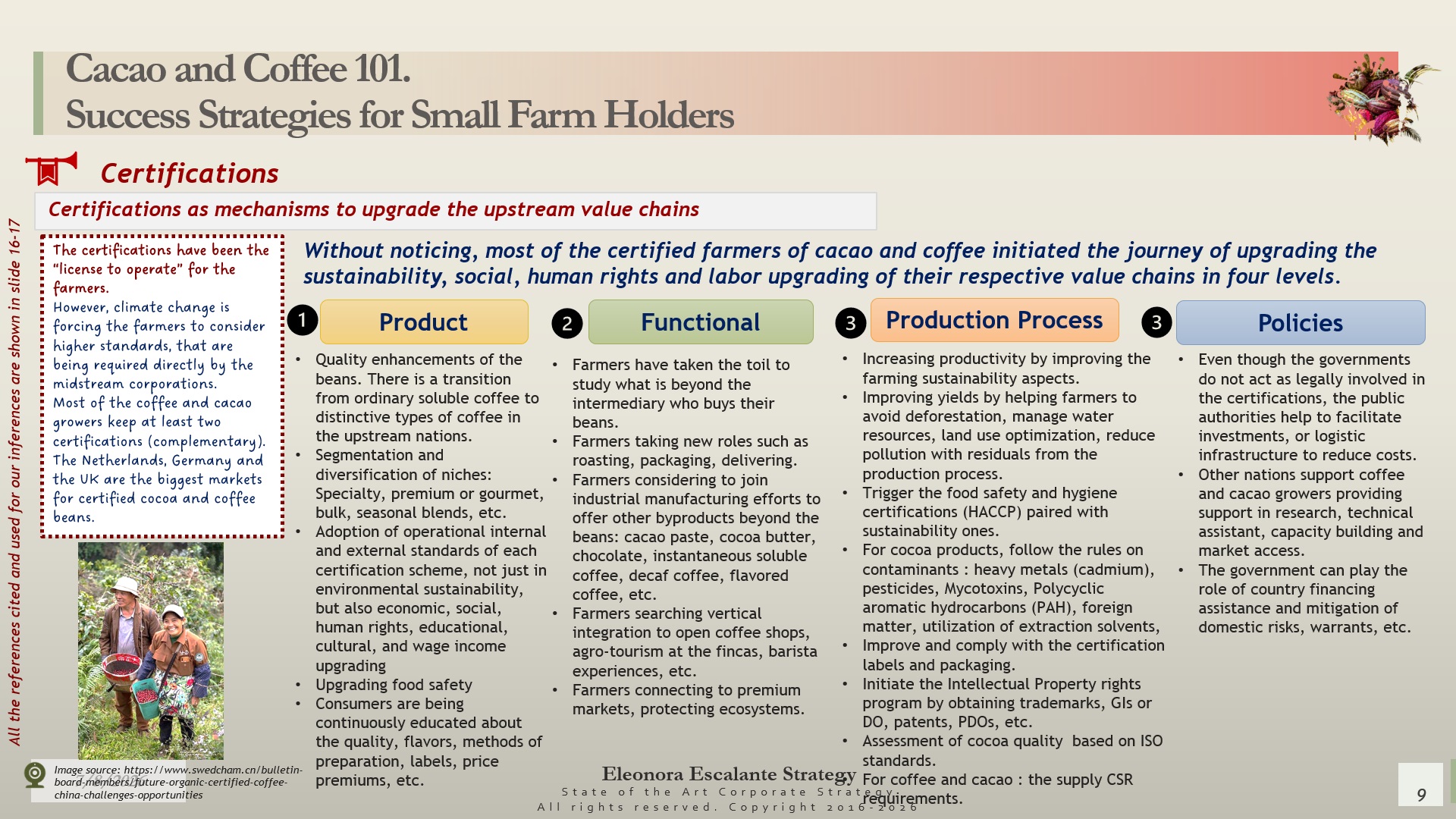
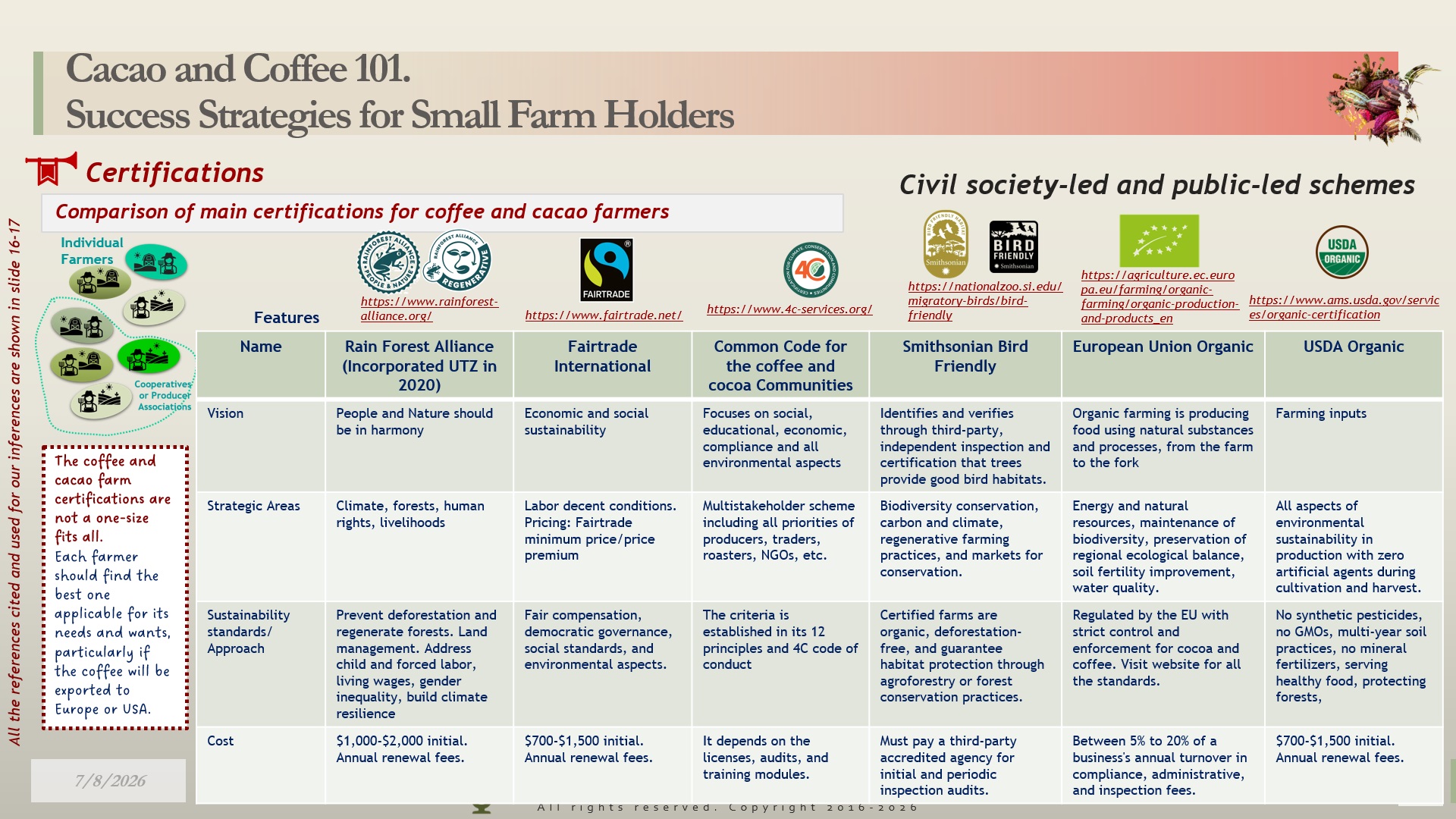
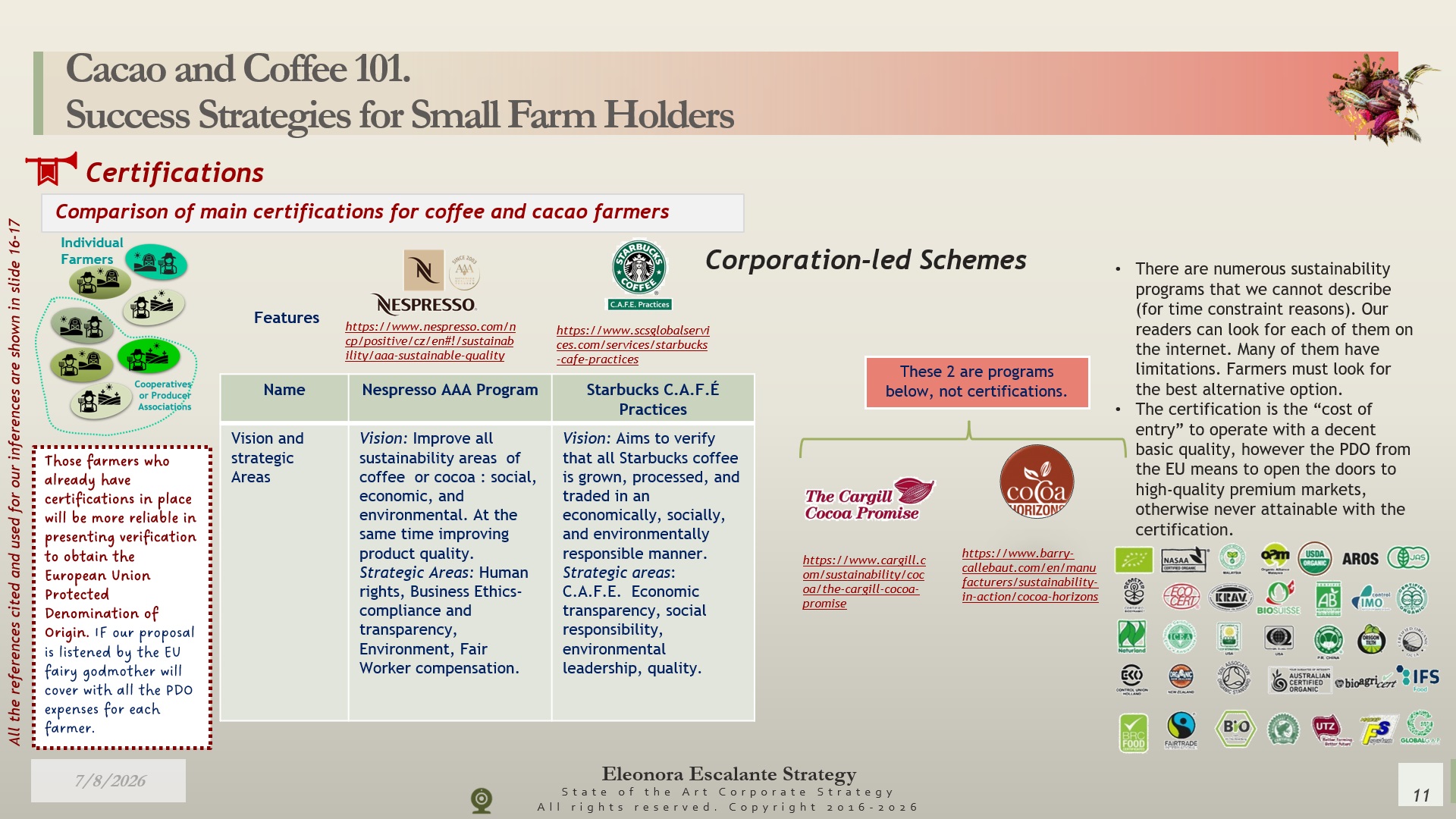
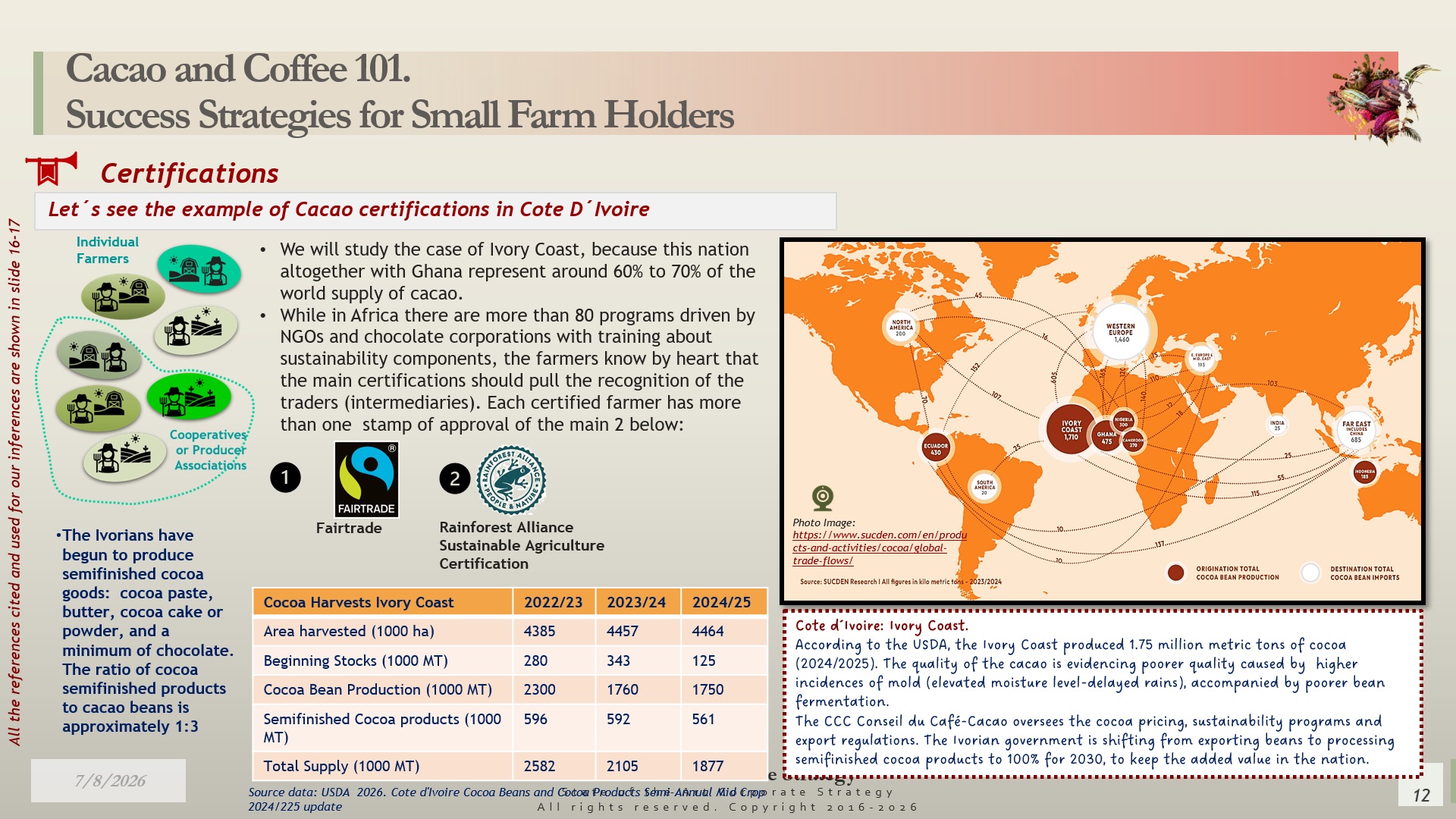
We kindly ask that you return next Monday, the 10th of August, to review our strategic reflections on this chapter.
We encourage our readers to familiarize themselves with our Friday master class by reviewing the slides over the weekend. We expect you to create ideas that are or are not strategic reflections. Every Monday, we upload our strategic inferences below. These will be discussed in the next paragraph. Only then will you be able to compare your own reflections with our introspection. We always give our students a couple of days to prepare well before our final reflection.
Strategic reflections on this episode.
These will be in the section below on Monday, the 10th of August of 2026.

Cacao and Coffee 101. Success Strategies for Small Farm Holders. Episode 10. Certifications.
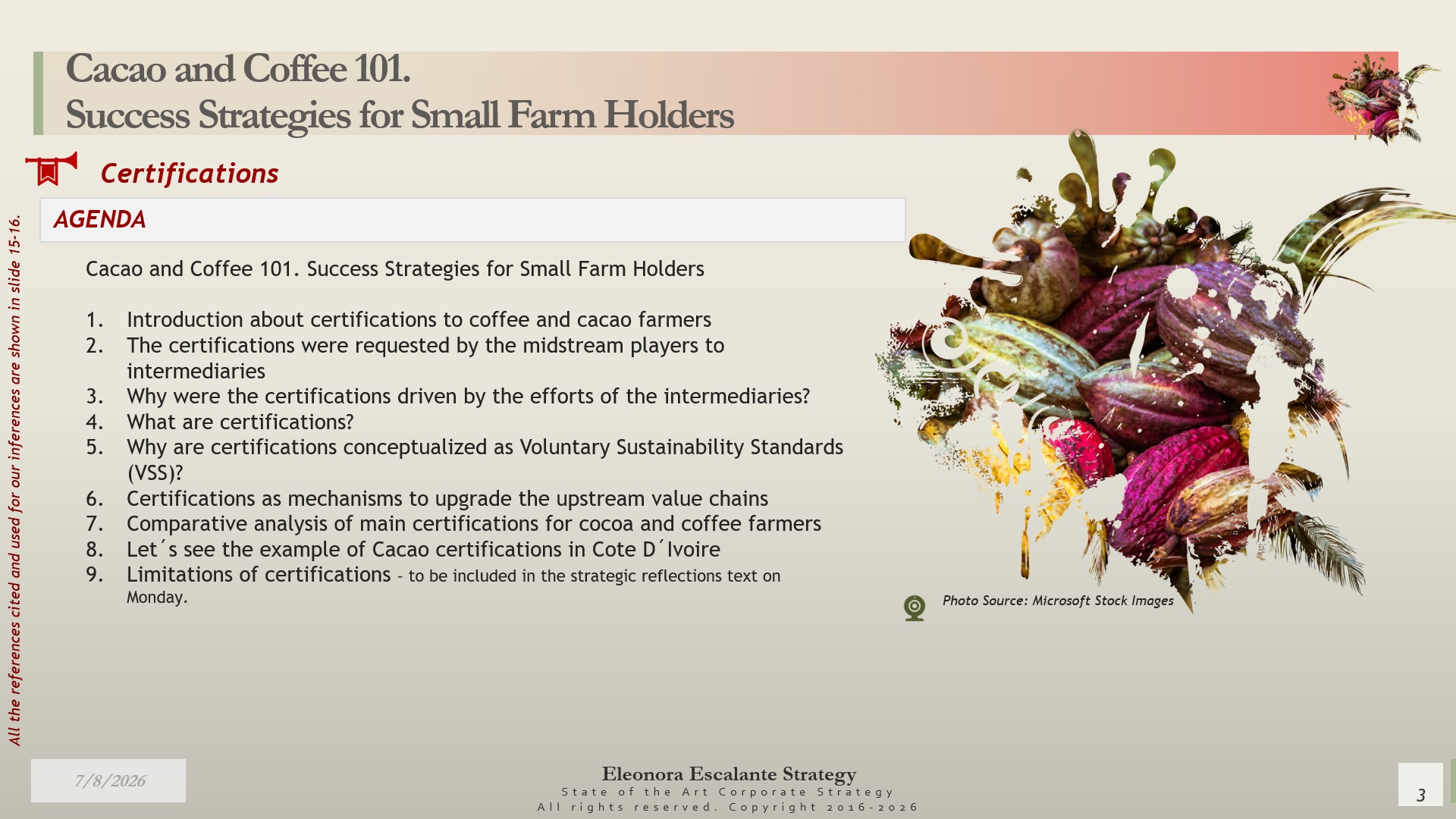
Once a year, the capital citizens of El Salvador are given one holiday week to celebrate and honor Jesus Christ, the patron of San Salvador, the Divine Holy Saviour of the World. Our strategy house has worked during the whole vacation, sorting data, classifying and printing academic papers, reading here and there, and we have built a package of slides that are probably enough, solid, and self-explanatory. We practically explained everything in the slides. So, this publication will be short. We will focus more on the last 2 subjects of the agenda (see slide 3): the role of the VSS ( Voluntary Sustainability Standards or Certifications) of Cacao Small-Holders in Cote D´Ivoire; and the last topic, the limitations of the certifications. Before proceeding with our strategic reflections, please read the package of slides again. Thank you.
Cote D´Ivoire as the top global producer nation of cacao. Slides 12-15
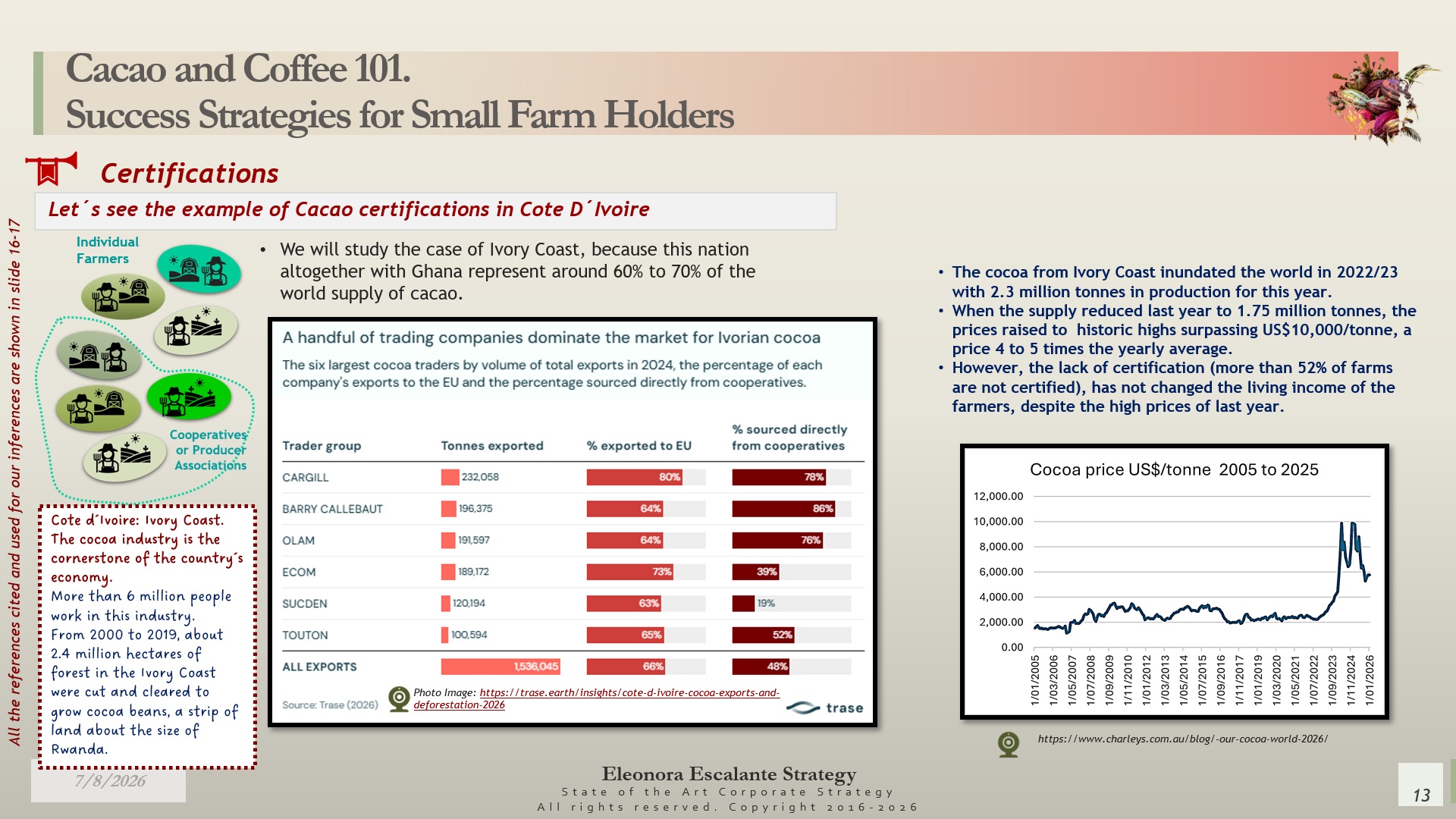
Our strategy house carried this nation into the spotlight for this specific episode, not just because this African territory is the top producer of cacao, an industry that was established in less than 30 years there. It brought to our attention that the Ivorians, having consolidated themselves as the number one cacao crop country of the world, it is still perpetuating poverty among the farmers, which ironically are certified. What is happening? If certification is the “license to operate,” because it is providing good quality of the beans, why is it that Côte d´Ivoire still shows deprivation among the farmers, who can´t make a living as middle-class? If good-quality cacao is the most important raw material to fabricate chocolate, why have the Ivorians not yet left poverty behind? According to our investigation, citing several researchers, more than 6 million Ivorians, about 1/5 of its total population, work in the cocoa industry. This nation took the decision to harvest cacao, and they truly invested in it with all their heart. Côte d´Ivoire, Ghana, Ecuador, Cameroon, and Nigeria are the top-producing exporters of cacao. However, Côte d´Ivoire accounts for around 40% of global exports.
According to Anker Research Institute and Fairtrade, the living income salary for a worker in Côte d´Ivoire should be French CFA 301,239 per month (USD $531.00). However, the SMAG (Salaire Minimum Agricole Garanti) is at the moment of this publication CFA 39,960 (USD $70.44) per month. It has been reported that farm cacao workers in Côte d´Ivoire earn between USD 70 and USD 135 per month (gross salary). Additionally, cacao workers should work 48 hours per week (6 days). With these numbers, it is clear that farm workers can´t make a decent living under this scheme. So, even if half the Ivorian farmers are certified, there is still multidimensional poverty there.
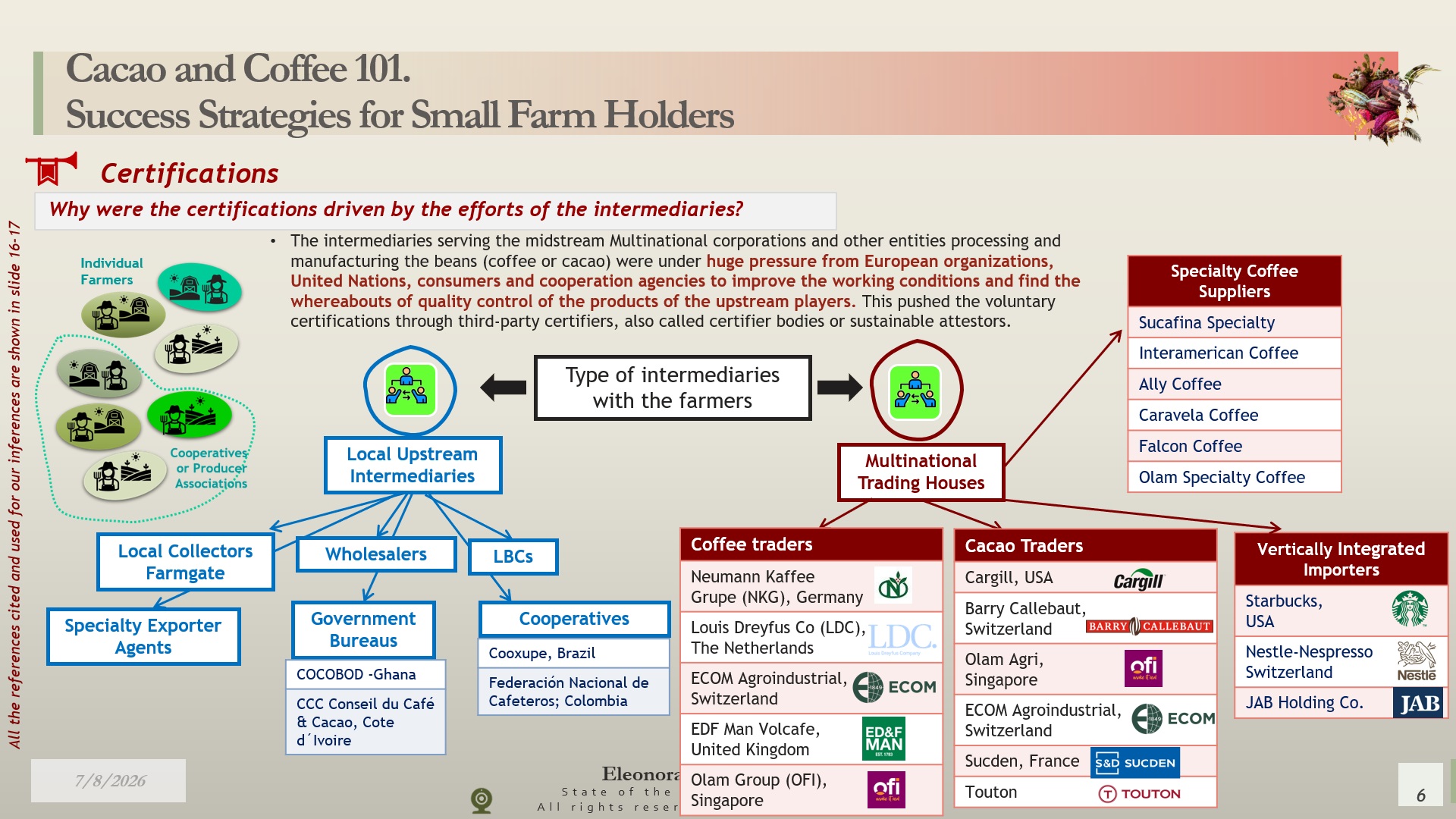
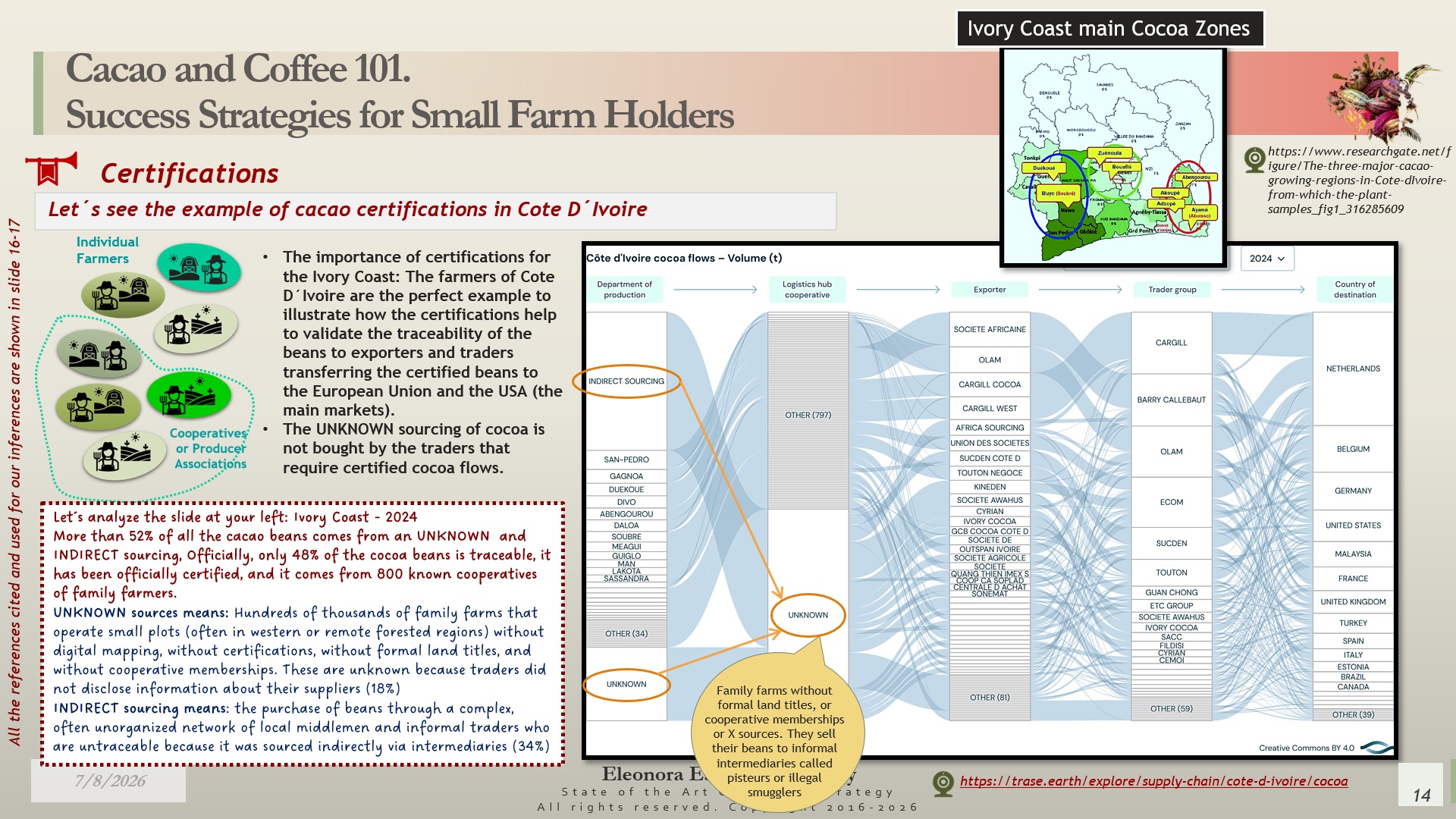
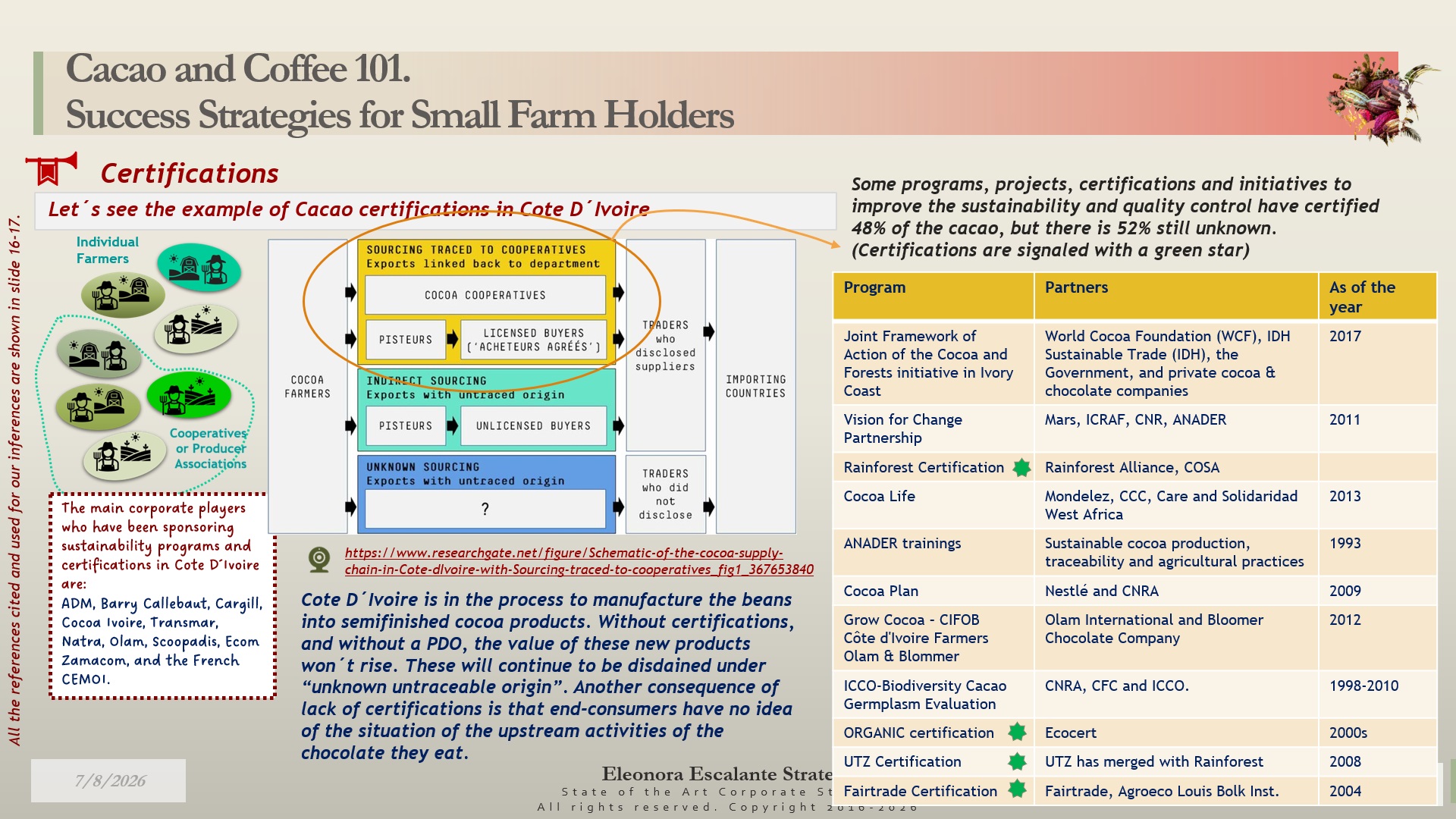
The certifications of UTZ, Rainforest Alliance, Fairtrade, and others have played the role for which these Voluntary Sustainability Standards were created: “a sustainable stamp of approval” for the product quality. The priority was to increase the yields while caring for the land with bare minimum standards. That was it. The harvested certified cocoa beans are sold to multiple intermediaries (see slide 14). Most of the beans are sold at the “farm-gate” of the smallholders, at a price that is arranged one year in advance using forward contracts. The certification as a VSS accomplished its purpose: to provide a standard of basic quality (and yields) for the farmers. But these standards did not fix the trouble of the workers´ income.
Despite the efforts to certify all the cacao smallholders as of the 2010s, we have understood that Côte d´Ivoire has not been able to elevate the quality of life of the farm workers. And this is a remarkable sign that certifications were conceived for elevating the quality of the land and the quality of the products (beans) but did not touch the quality of life of Ivorian people by elevating the SMAG. Although workers are paid per kilogram of collected cacao, the improvement in salary is not that much if we compare it with the numbers explained above.
The role of UTZ in certifying a great number of farmers was epic, particularly because these smallholders obtained VSS compliance approval in less than 8 years, until UTZ merged into Rainforest Alliance in 2018. However, it is reported that just 48% of the farmers have a valid outstanding certification (2024). The certifications allow the cacao traders to trace the origin of the cacao beans, but it seems half of the cacao is not traceable. 52% of the cacao of Côte d´Ivoire is reported as coming from an unknown source, or an indirect source. This is a serious situation, particularly for those picky markets such as Europeans, Americans, or other wealthy, sophisticated customers who are interested in knowing what traceable source of chocolate they are eating.
The cacao industry of Côte d´Ivoire is only between 7% and 11% of the GDP. Despite the fact that Ivorian production slumped to 1.8 million tons in 2023, this year it is expected to grow to more than 2 million tons again. We ask ourselves, if the cacao beans are certified through a VSS mechanism, why is it that Ivorian cacao workers have not improved their income? It is a sad reality.
The answer is the same one that we have been proving to you since the beginning of this academic saga. There is a structural problem at the Upstream level of the cacao and coffee value chains, and this issue is historical. Farmers (owners and workers) are not being paid enough by the midstream intermediaries (local and multinational trading houses) or midstream manufacturers (if they supply directly, as in the case of Nestlé and Starbucks). And the issue is in the pricing system that doesn´t allocate any surplus to the beans at the origin source (tropical belt nations). Without that surplus, there is no way to raise the living income of the farmers, their families, and respective workers. One thing is to raise the quality value of the product or to invest in the sustainability of the land. Another is to raise the wages of the workers, in such a way that they can make a decent living to catapult them to be middle-class citizens. This is a problem that needs to be solved by reviewing the whole global value chain from the upstream section to the downstream section. A need to reallocate the revenues in such a way that wages in the tropical belt territories, at the points of collection of the beans (owners and workers), can increase.
If the beans are not raised in value by aggregating elements of quality, workers of the sector will never attain a better living income. And without this action, workers will not continue working in the sector. It will be hard for the coffee and cacao owners to operate. This has happened in Central America for a quarter of a century. Agricultural workers migrate to other rich nations, or they actively move to other industries (such as construction, etc.), where they can earn double or more.
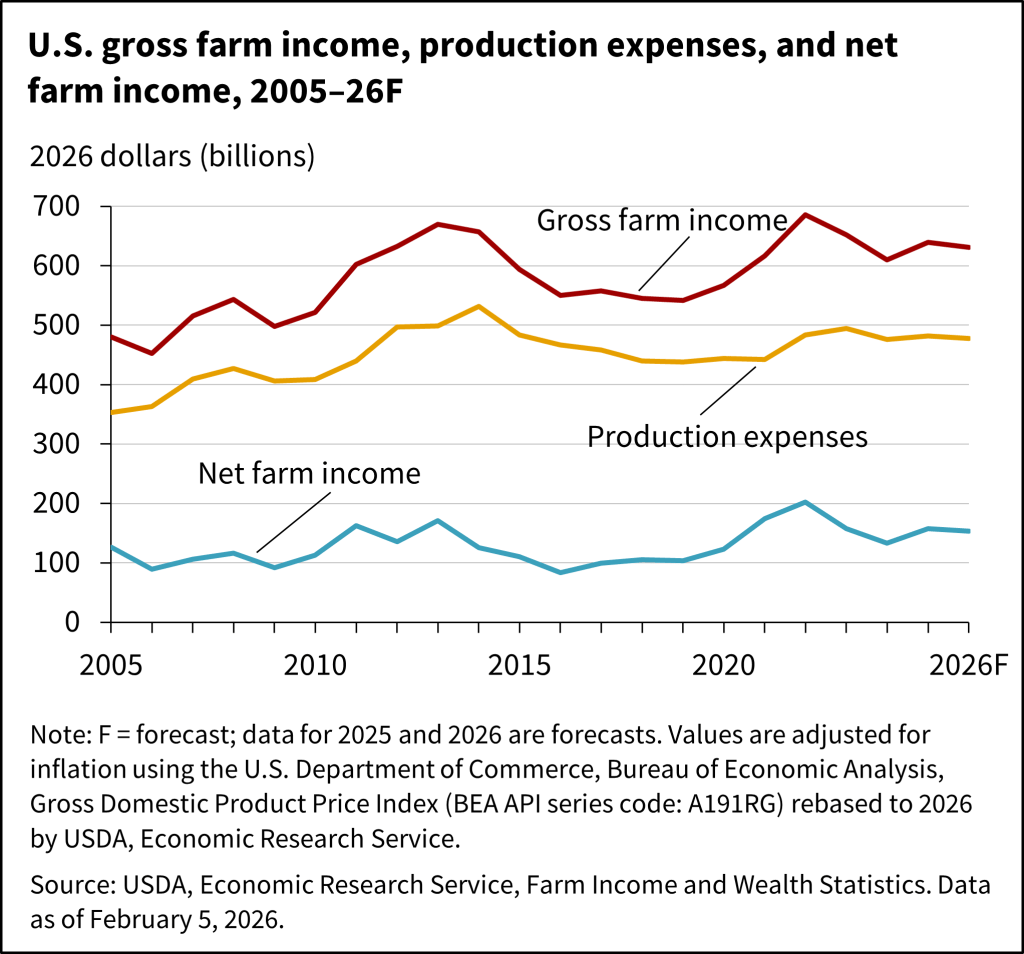
It is not good to continue living in misery in the agricultural sector. The mentality of the farmers of the tropical nations should shift from “supplying the cocoa beans to the intermediaries” to becoming agricultural entrepreneurs who can build the entire system that turns farming into a profitable venture. When farmers and their respective workers see themselves as working so much without obtaining enough profits, the disenchantment is general (big, medium, and small farms). The mentality of a farmer in the tropical belt region should shift to be what Americans and Europeans understood since the 18th century, about the essence of being a farmer. Look at the graph below: in the USA, there is enough profit on the farms, not just to cover the operational expenses of the owners, but the net income is enough to keep the sector moving ahead, prospering, reinvesting, hiring people, and making things well for everyone involved in the production of any type of commodity.
Limitations of the Certifications.
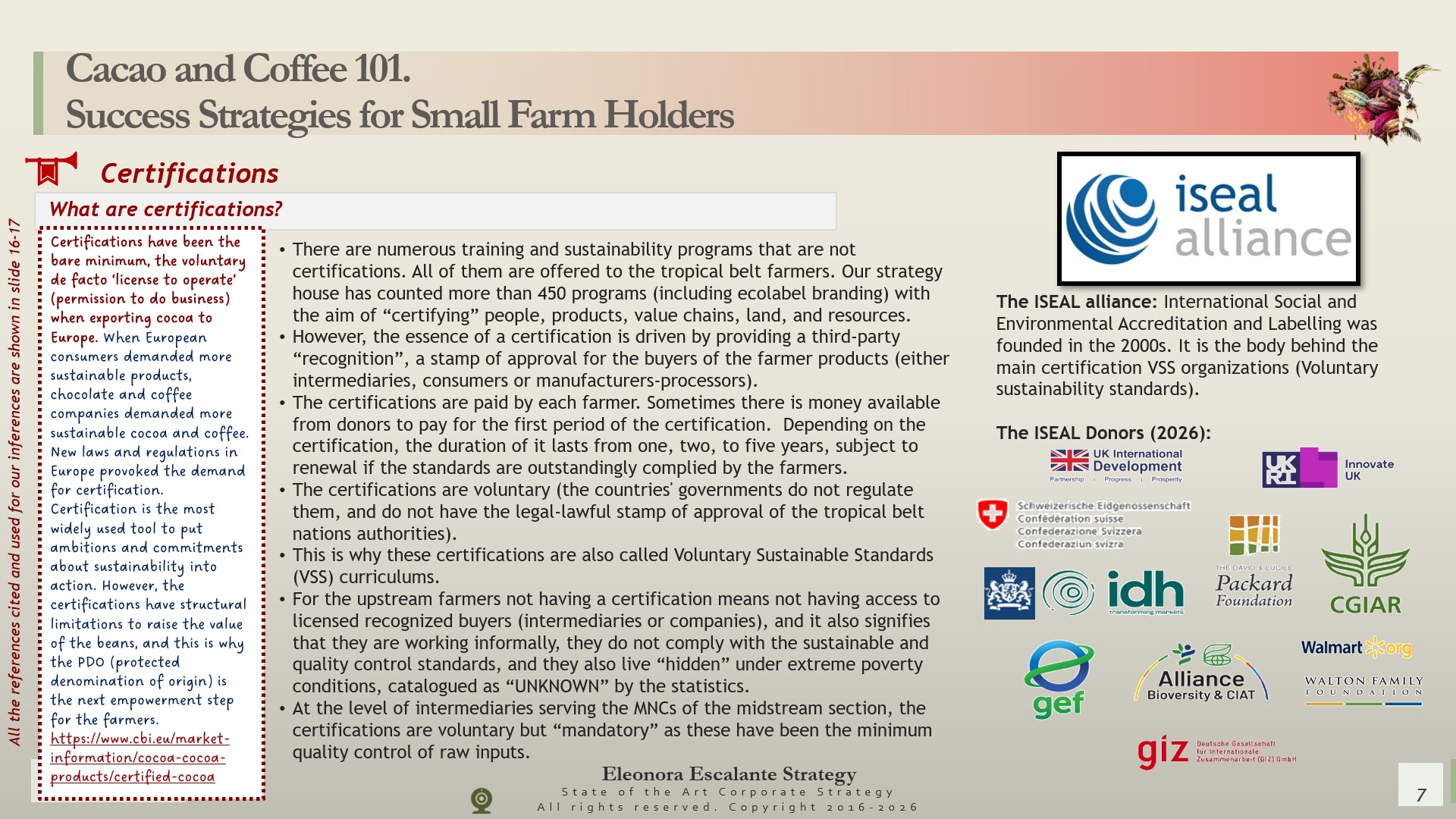
The certifications have been of good help to anyone involved in the midstream and downstream sections of the global value chain of coffee and cacao products. However, the certifications have not elevated the quality of life of the upstream farmers to a level of the middle class. The certification system was designed to benefit the activities of the midstream-downstream players. At the farmgates, all farmers have felt that certifications are the consolation spirit of what we define in Spanish as “Peor es nada”, translating it to English would be “Something is better than nothing”. The certifications have fulfilled the role for which they were created: to elevate the quality of the production (plantations) of cacao and coffee green beans at the farmgate. The certifications are a “peor es nada” voluntary sustainability standard. The certifications have been in place and used since the 1990s, as the mechanism of a “stamp of approval to operate”. The farmers adapted to them and embraced them, not just as a license to “pouvoir vendre le cacao aux pisteurs”, but because there was no better option. The certifications have been the farmers´ right to operate under a “Pay one’s dues” soul.
Don´t take me the wrong way, the certifications have helped thousands of farmers to at least cover basic expenses, and do not perish in the process. However, certifications are expensive too. Farmers probably get indebted (working capital increases) to pay them year after year, because it is the only pathway by which they can obtain a surplus from the local intermediaries who also belong to the international traders’ networks. In the case of Côte d’Ivoire, certifications have helped farmers to comply with the bare minimum, while facing the intermediaries, so these quality beans are not questionable at the farm gate. Additionally, farmers have raised their yields because they do things right as they were trained. However, if we truly want to elevate the income statements of the farmers (and their respective workers’ salaries), the problem is not to blame the upstream farm-holders; it is the structural design of the whole pricing system, in which the upstream section has been sacrificed in value since the times of the libertarian independence movements from Bourbon Spain (1820s). It is a historic debt ingrained in the design of the value given to the farmers that has not been changed since then.
The best alternative option to certifications is the protection of designation of origin (PDO). Each farmer can obtain higher value for his product, and the wages should be paid accordingly. If the pricing goes up (because the beans are valued with higher standards, not just at the product level, but also at the functional, operational, environmental, regulatory, and people wages levels), then there is enough income for the coffee or cacao proprietors to distribute to the workers, by raising the standards of the salaries too. Our proposal has been to choose the fairy godmother of the European Union to pay for the PDO licenses of the small farmers. However, if the EU refuses our project, or it is not interested in helping us, we believe that it is worthy to knock the doors of other non-EU nations to obtain their donations. Sometimes, one single billionaire donor can make a difference. The PDO licensing pursuit is expensive, and the farmers should be compensated for it. It is an historical debt. And the expenses should be reimbursed fully. With the PDO, the farmers will be able to be free from intermediaries. Look at the two slides below. With these additional slides, we will open our next episode: Key Resources.
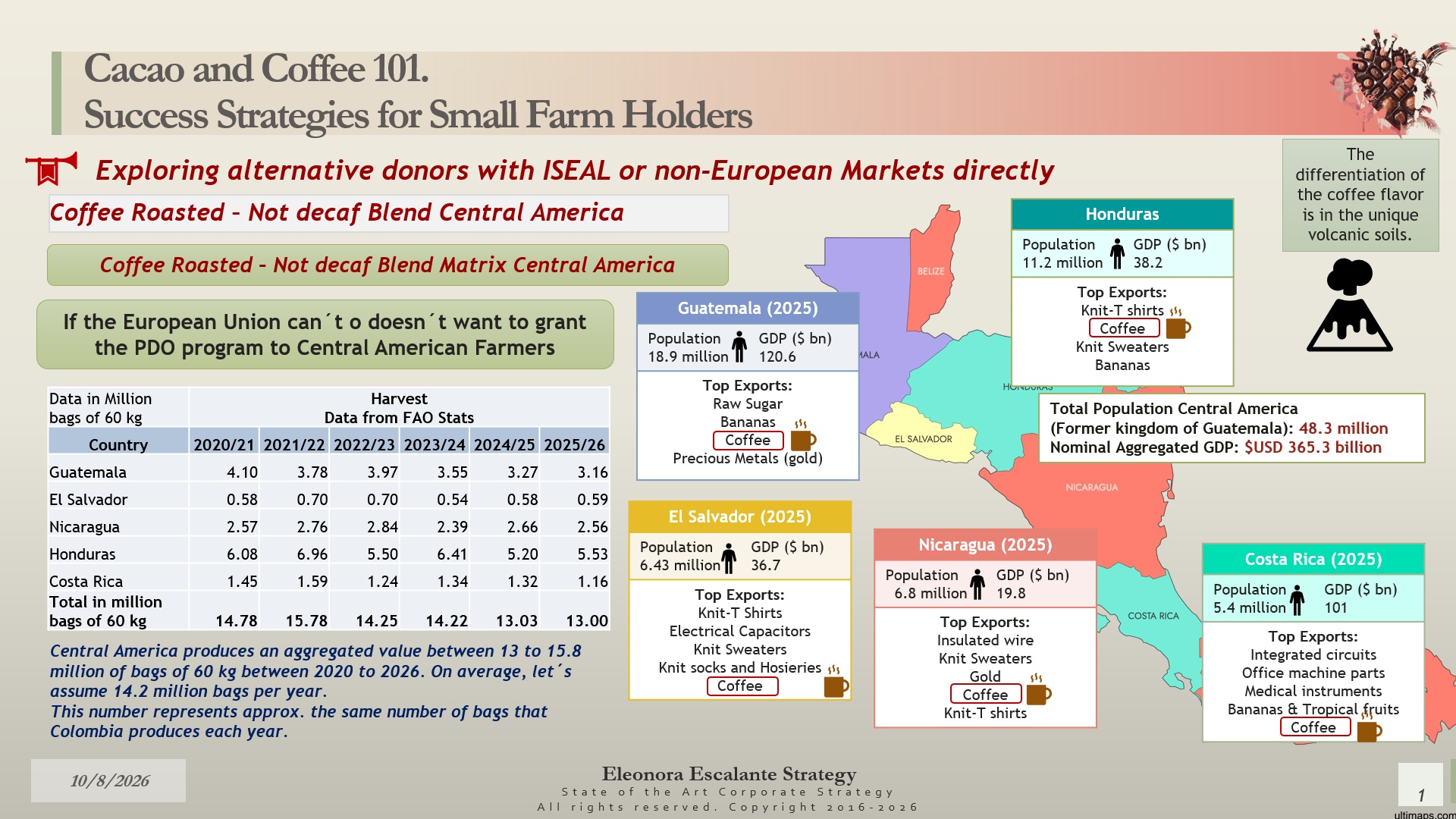
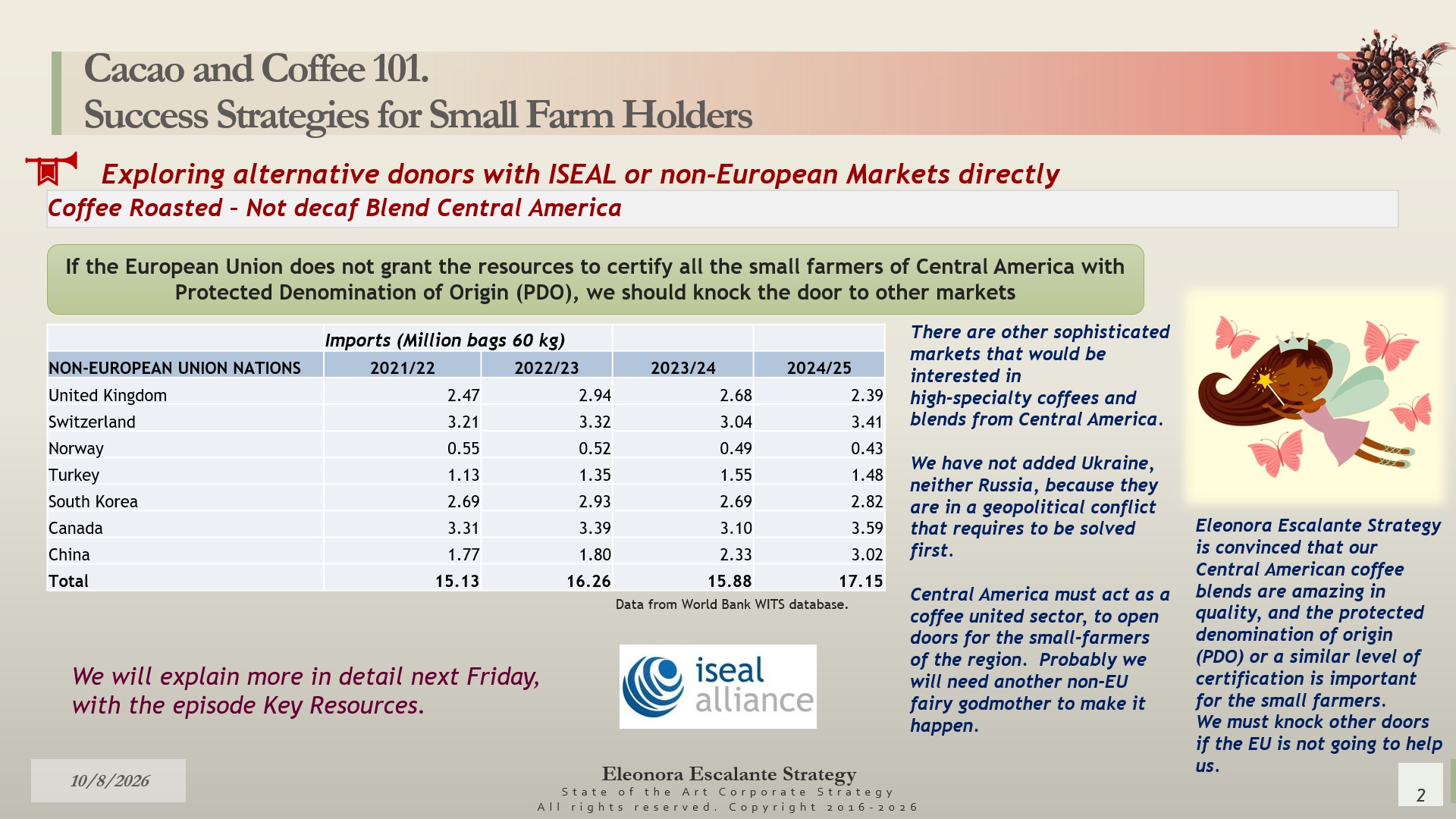
Announcement. Our next episode is about “key resources” for small farmers. We will continue using new examples for Ethiopian coffee and Indonesian Cacao.
Musical Section.
This saga is committed to raising the traditional musical instruments and their respective musicians over the digitally produced sounds. This saga is dedicated to the chamber orchestras.
Today, we have chosen the Chamber Orchestra of New York, https://chamberorchestraofnewyork.org/. The orchestra is directed by Salvatore di Vittorio, conducting the piece Bolero by the French composer Maurice Ravel. Ravel wrote the Spanish-flavoured ballet piece for his friend, the Russian dancer and actress Ida Rubinstein (1885-1960). The video below is from the German debut at Hamburg’s Elbphilharmonie, June 25, 2026.
Enjoy!
Thank you for reading http://www.eleonoraescalantestrategy.com. It is a privilege to learn. Blessings.

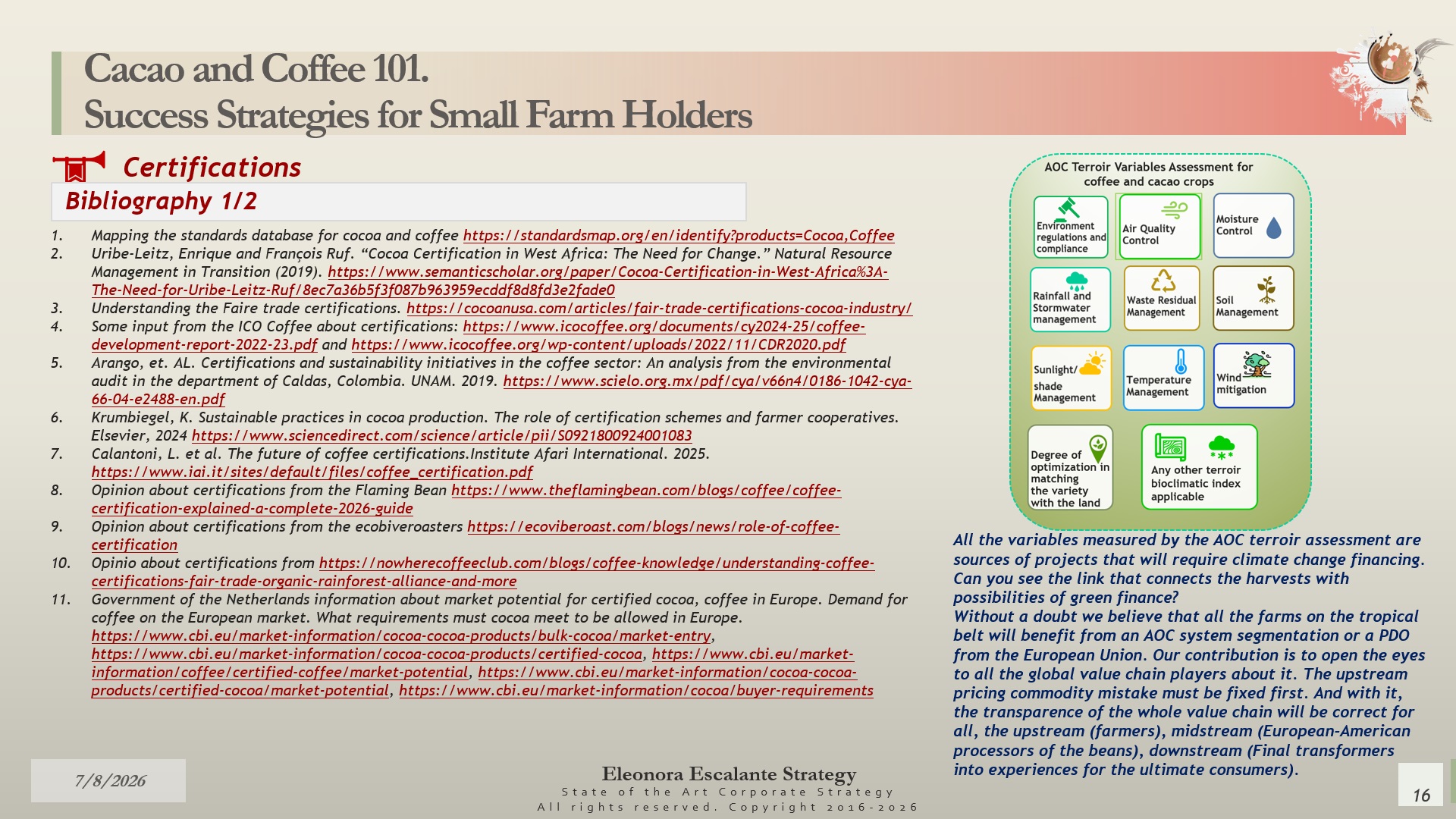
Sources of reference and bibliography utilized for today´s inferences. The bibliography is listed on the last slide of the reference reading material. Click the respective URL to trace them.
Bibliography in this post: This will be added accordingly with the strategic reflections.
Disclaimer: Eleonora Escalante paints Illustrations in Watercolor. Other types of illustrations or videos (which are not mine) are used for educational purposes ONLY. All are used as Illustrative and non-commercial images. Utilized only informatively for the public good. Unless otherwise stated, I do not own any lovely photos or images.
 Eleonora Escalante Strategy Strategic Reflections Think Tank