
Cacao and Coffee 101. Success Strategies for Small Farm Holders. Episode 6. Customer Segments Version 2.0. Second loop.
Dear amazing students of my heart:
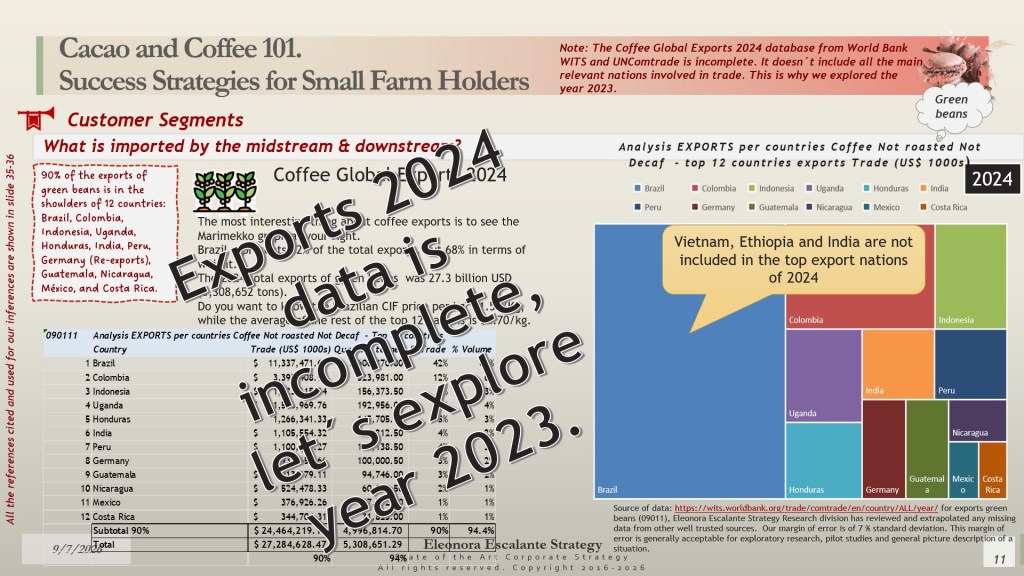
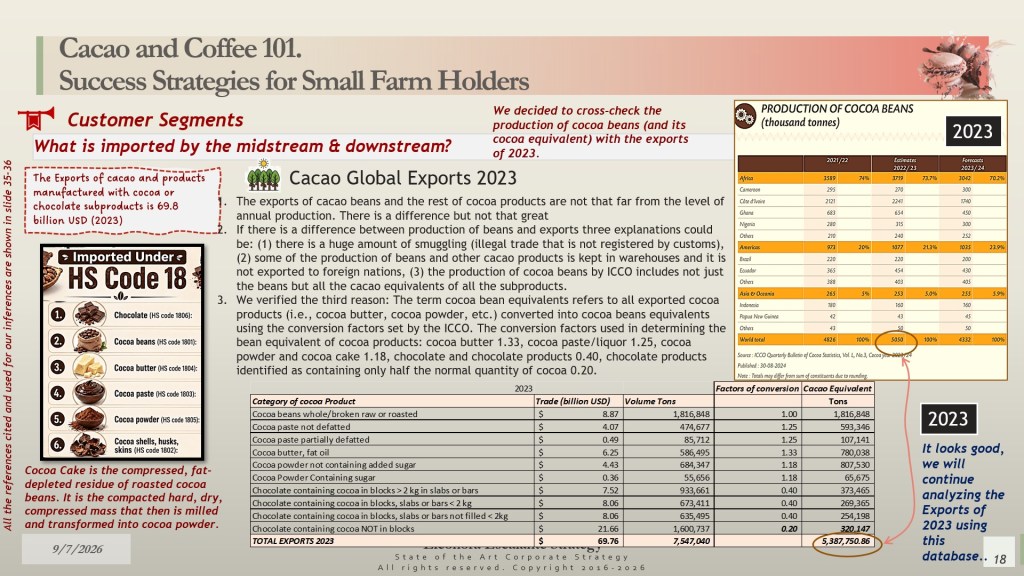
Today, we are convening to show you what reality is when we are committed to problem-solving. Solving issues at the commercial, financial, or strategic level should be as humanly responsible as possible. We can´t just invent or suggest premises about industries or economic sectors without substantial “real, revised, authentic” data gathering. We have already discussed this issue in the past. The point is not to be masters while studying databases, reviewing mistakes when pulling information, or redrafting if the information source (or its respective data intermediary managers) is incorrect. Last week, our strategy house oversaw certain lacking aspects of the export data-gathering phase. When we found that we were using the wrong year (2024) for our analysis, it was Friday, and I was exhausted after a long week of cleaning data, so we decided to show you what was happening instead of hiding it. For us, it is more important to acknowledge the mistake and correct it properly. For us, it is important that you learn from our experience rather than fulfill the deadline. We couldn´t proceed any further without rectifying the mishap. We comprehended the error in the United Nations and World Bank databases, and we promised to get back to you once we found a way to repair it. When we perform an industry analysis in several phases, we can´t just gather data without taking our time to review it. Now, just imagine what could happen with young professionals who use AI data and consider it as valid, and they pull data out from AI models such as ChatGPT, Gemini, DeepSeek, or similar. Of course, the results will be wrong for those who rely on AI. We always use our Excel spreadsheets, we design and write the formulas, and we use dynamic tables only when necessary. We do not trust the AI models for our work. Not one centimeter on it. The OpenAI models are garbage if the information they drag from the Internet is rubbish or incomplete. Our Strategy house doesn´t use those AI models at all. Nevertheless, even by doing the analysis as it was taught to me at ABB Structured Finance in the 2000s, when filling my spreadsheets with the exports 2024 data from the World Bank and the United Nations, we found that it was incomplete. If the database of coffee and cacao trade from 2024 was incomplete, that was a gigantic mishap, or a symbol of something else. And we decided to pause and find out.
During these days, we have corrected last week’s analysis. Our framework for building assertive foundations when finding customer segments is shown below. We use the problem-solving cycle in our brains. We search for customer segments from the point of view of problem-solving. We asked ourselves who the new clients could be for the small farmers if we proceed with an AOC or a PDO (Protected Designation of Origin). How can we draft three or four correct customer segments that could raise the value of the beans? And, should we advise the small farmers to experiment with semi-finished products? Dear pupils, if we don´t choose the right customer segments, the next phase (while using the Osterwalder Value Proposition methodology) will be a rubbish waste of time. This is why this episode and the last one are the most important ones of our saga. We are entitled to apply the problem-solving cycle in several loops. And that is how it is. Better we fix it here than ruin your learning experience.
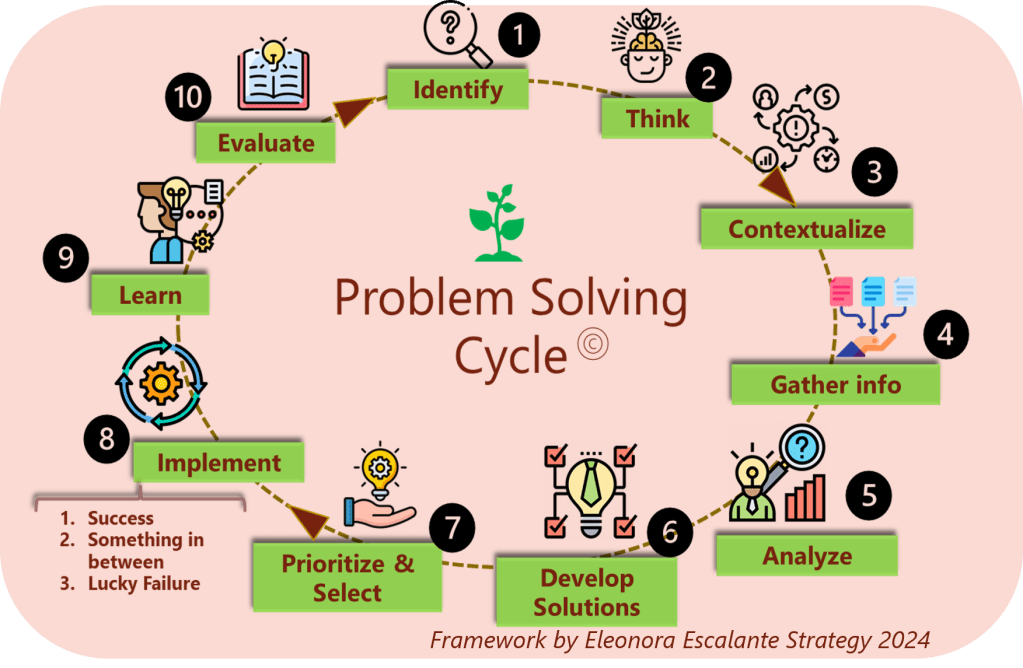
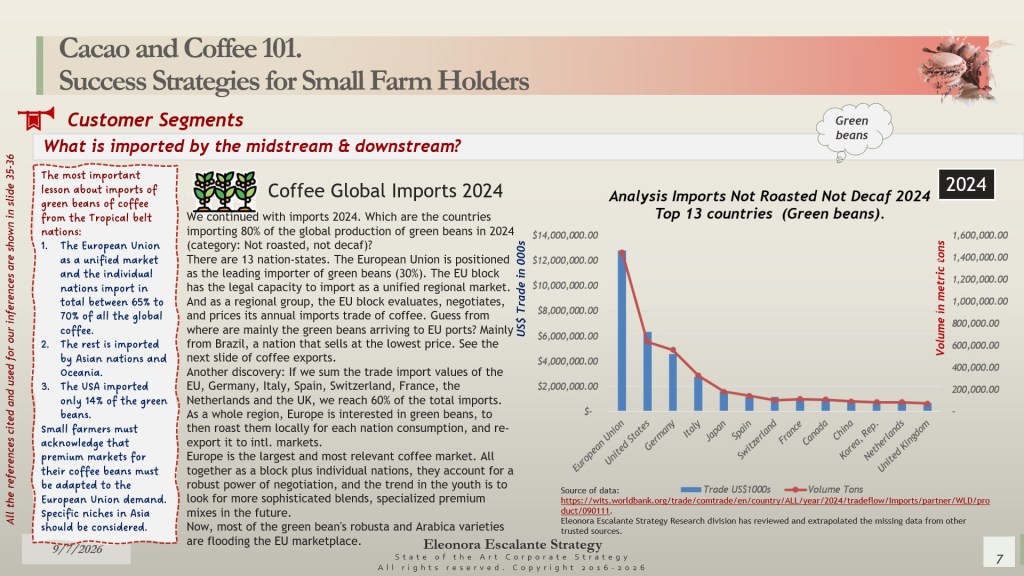
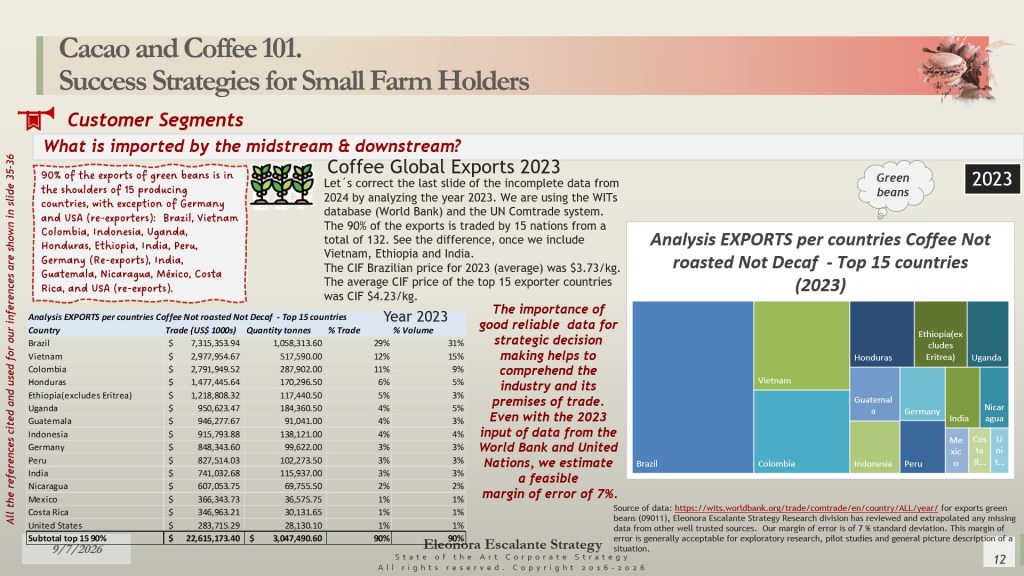
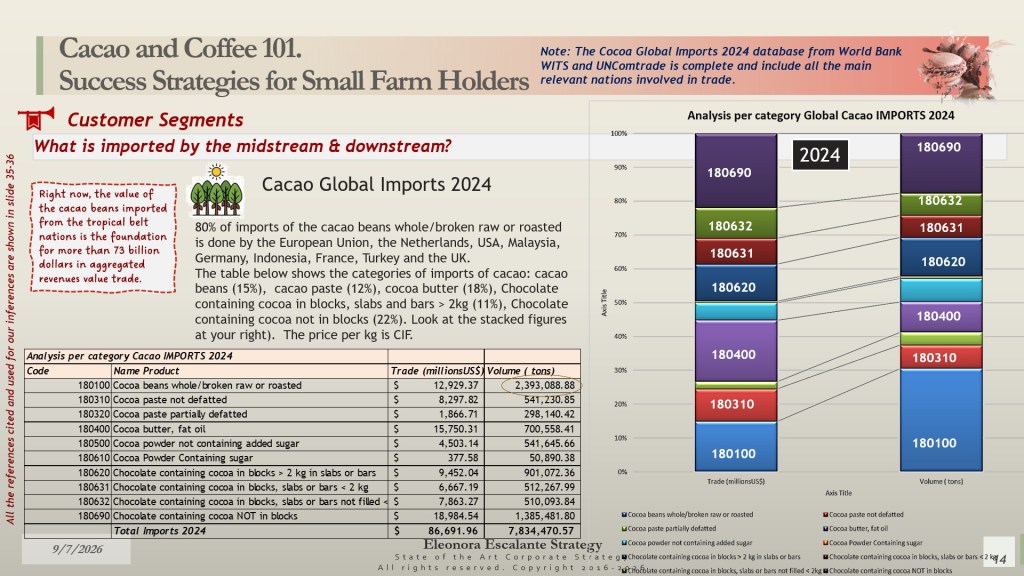
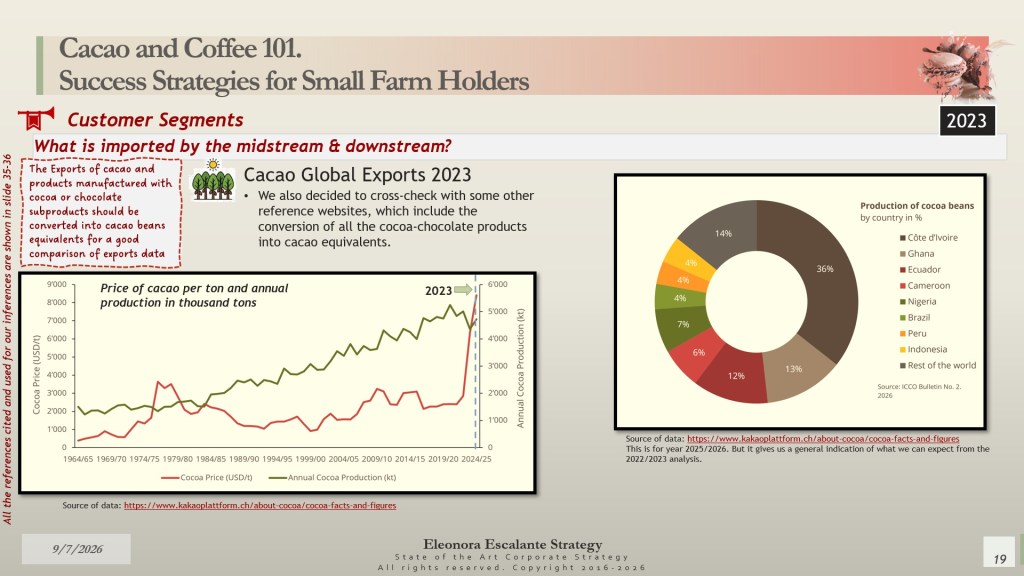
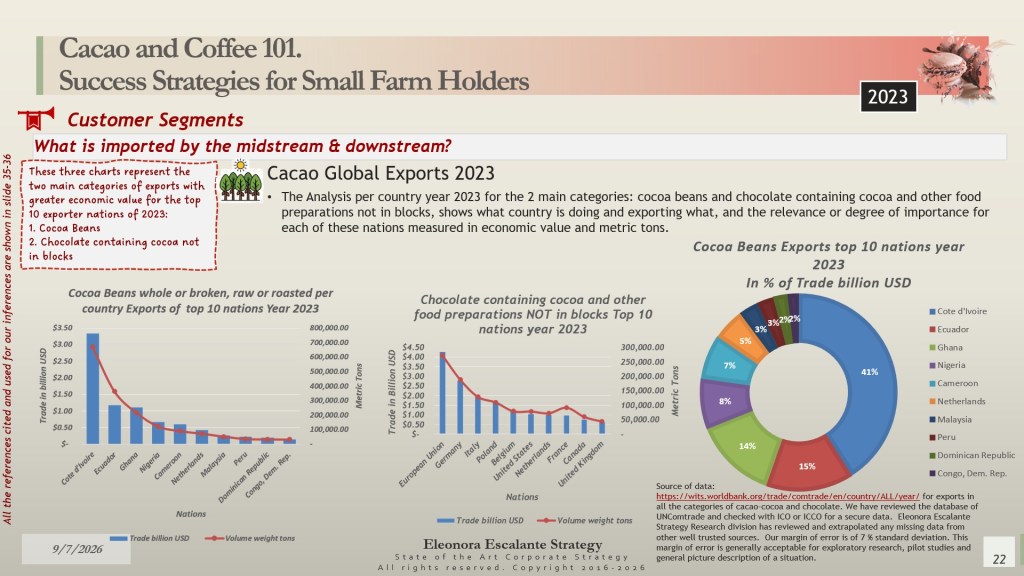
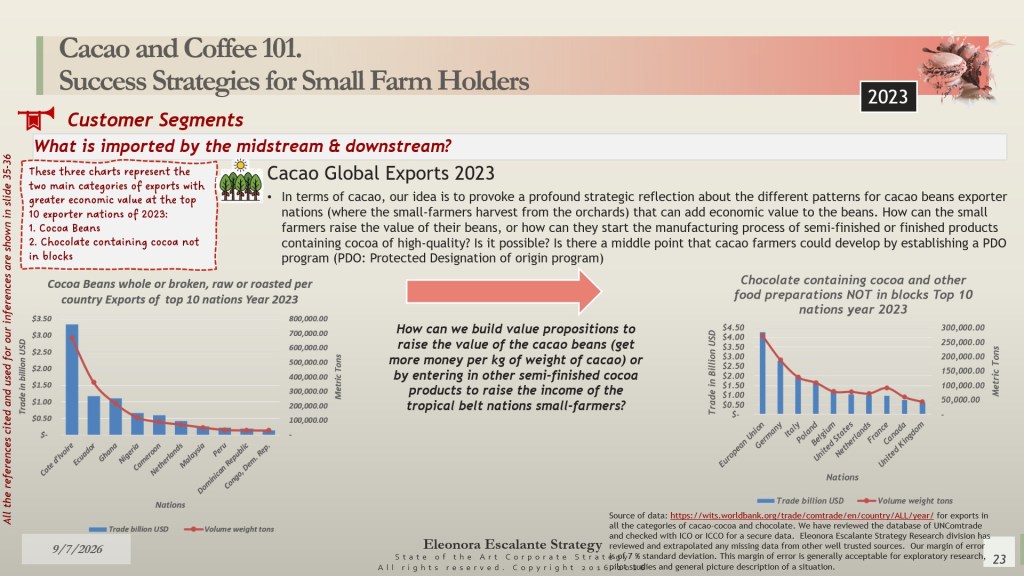
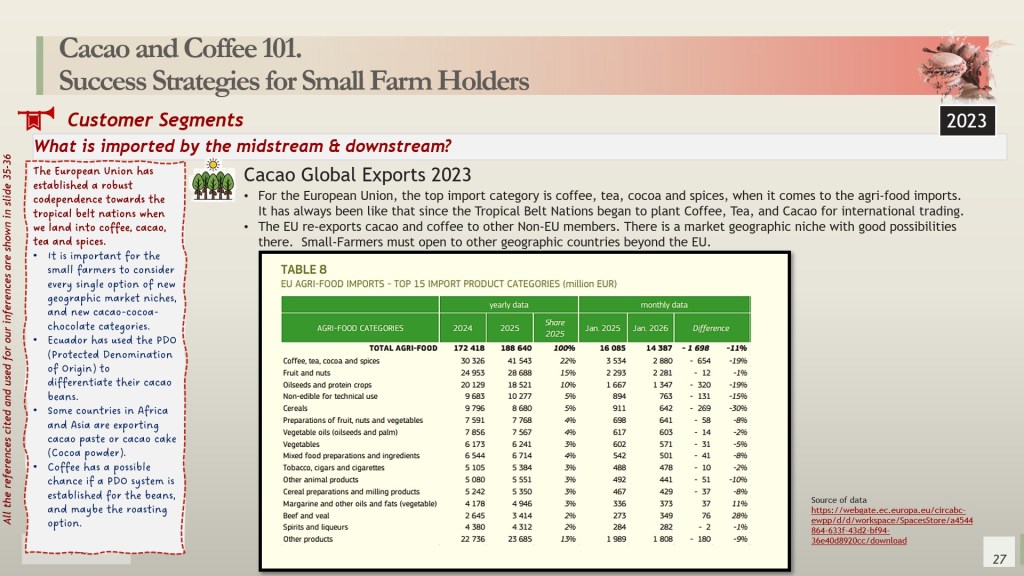
As we mentioned above, we were on step 5 of the “problem-solving cycle” while defining the customer segments, and then we found out the mistake in the 2024 Export trade databases for coffee and cacao. So we stopped our work and redid it again, but this time for the year 2023. Our findings are shown in this new material. We encourage you to read it thoroughly, please. Only then will you respect the importance of applying the problem-solving cycle “humanly”. It doesn´t matter if the analysis takes one additional week or more, but it is not possible to continue drafting proposals or developing solutions for small coffee-cacao farmers without considering fair, exemplary, reliable data we can lean on. As usual, please download the file below, print it, write notes, and ask yourself questions. You are entitled to explore the data that we have collected from 2 websites: https://wits.worldbank.org/trade/country-byhs6product.aspx?lang=en and https://comtradeplus.un.org/TradeFlow. When numbers are missed, we calculate CIF pricing averages of the top nations and search for complementary trusted information from researchers all over the world. Finally, just at the end, we cross-checked with the data coming out of the International Coffee Organization (ICO) and the International Cacao Organization (ICCO). If there is a margin of error, we have estimated it at 7.5%. However, if there is illicit smuggling in certain nations, in any of the logistic points of delivery or entrance of the flow of trade, this could be a cause of mismatch of data coming from the intermediaries or traders who buy from the humble small producers of coffee, cocoa beans, or cacao paste. Those illegal blunders are not in our remediation scope.
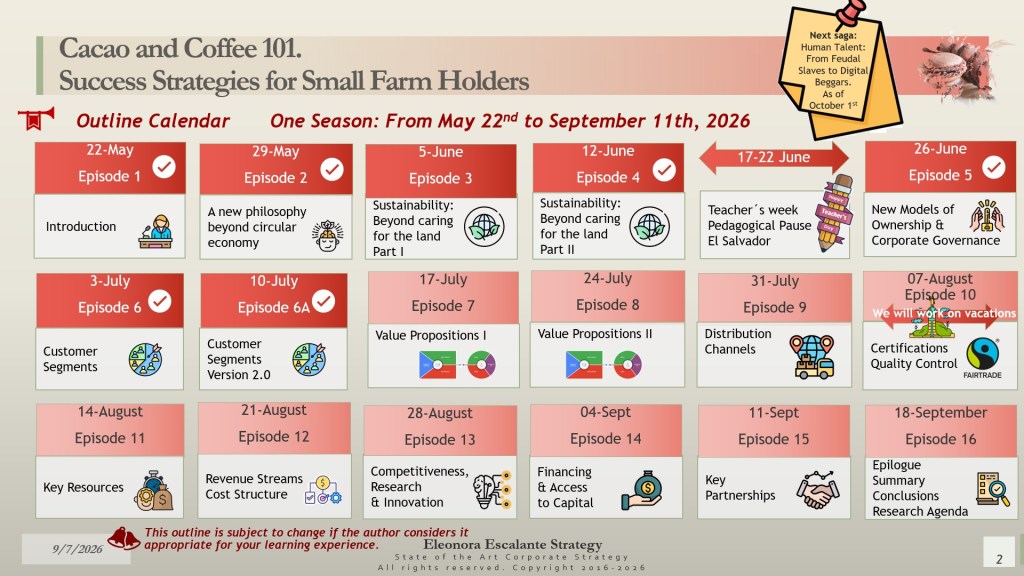















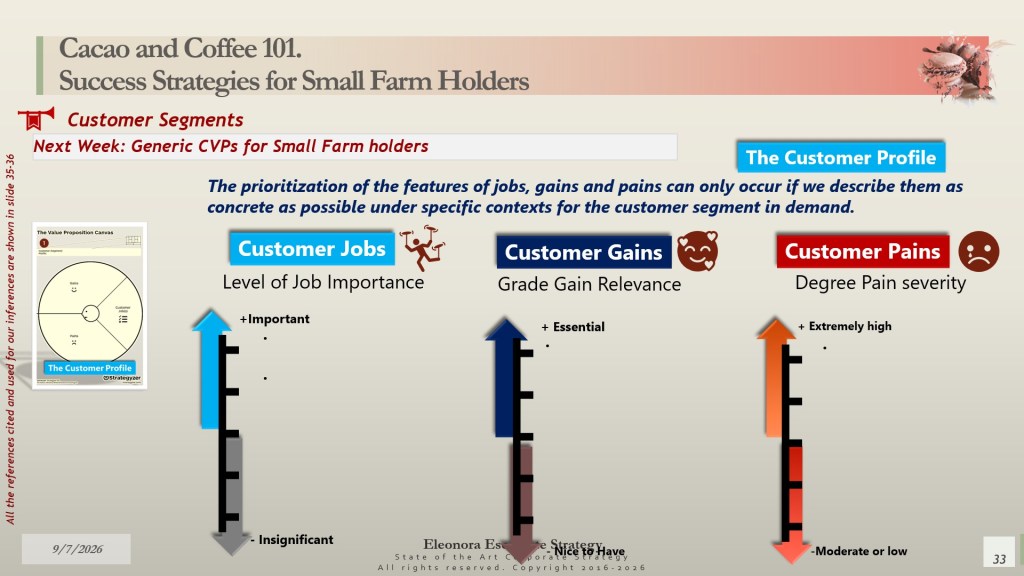


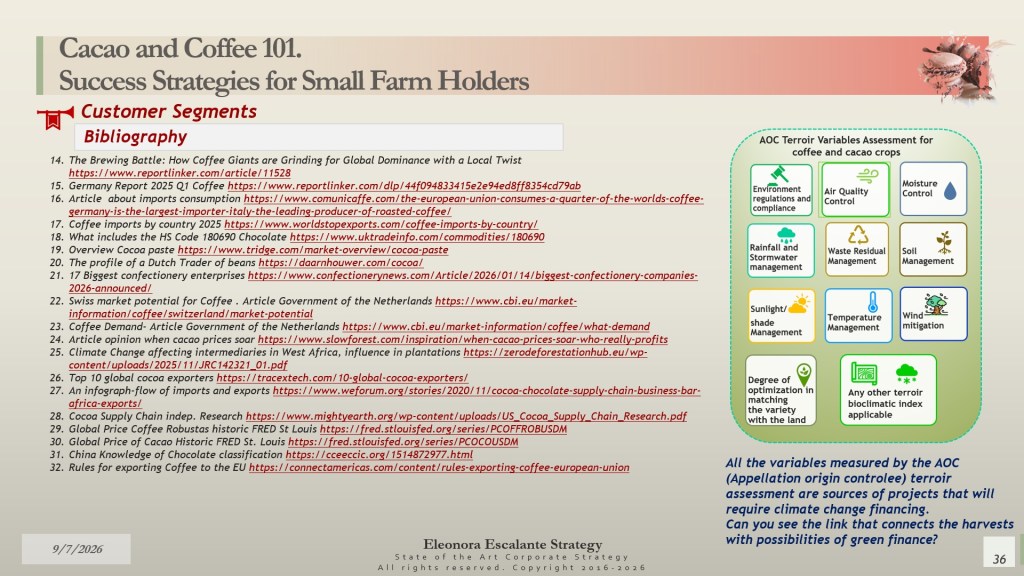
We kindly ask that you return next Monday, the 13th of July 2026, to review our strategic reflections on this chapter.
We encourage our readers to familiarize themselves with our Friday master class by reviewing the slides over the weekend. We expect you to create ideas that are or are not strategic reflections. Every Monday, we upload our strategic inferences below. These will be discussed in the next paragraph. Only then will you be able to compare your own reflections with our introspection. We always give our students a couple of days to prepare well before our final reflection.
Strategic reflections on this episode.
These will be in the section below on Monday, the 13th of July of 2026.

Illustrative and non-commercial GIF image. Used for educational purposes. Utilized only informatively for the public good. Source: Public Domain
Cacao and Coffee 101. Success Strategies for Small Farm Holders. Episode 6A. Customer Segments Version 2.0 (Second loop).
The ultimate purpose of the saga. How can we raise the quality of life of small farmers who plant coffee and cacao in the tropical belt of the world?
The decisive proof of fire in this saga is to provide judicious new elements to solve the last question. We are not an oracle to solve such behemothic historical issues that were designed when Europe was in transition to capitalism during the 17th -18th centuries. However, in the case of coffee and cacao, finding a solution for one segment of a global value chain, the upstream part, where the production of the inputs (dry coffee green beans or raw-roasted cacao beans) for the midstream and downstream happens, can´t be in isolation. The small farmers of our devotion (those with less than 10 hectares of land) hold an equivalent area of less than half of the size of Grand Central Station in NYC or no more three times the size of the Lincoln Reflective Pool in Washington D.C. These landholders are the petit ones in the initial segment of the largest global supply chain that involves multiple stakeholders not just for coffee but also for cacao. I would like you to refresh the two global supply chains. Add the intermediaries in between the Upstream and the Midstream.


So, our interest is to help these agriculturalists to find successful formulas for their next generations to come. To help them to rise from poverty and become middle-class citizens, implies a steady process to provide an income of at least US$28,800 per year for a household of 4 people, in which each of them is earning $20 pppd, or two members earning each (mom and dad) $14,400 per year. These figures are net after paying taxes. It is not an easy task to raise a family’s salary income from $3 to $ 20 pppd for the coffee/cacao workers if the farm-owners do not sell enough (tons, and dollars) to cover those wages at the upstream section of the global supply value chain. Honestly, in order to move forward with this plan, it requires a core transformation of the global value chain, and it requires seeing the problem as part of a global experiment to reduce inequality, one of the sustainable development goals of the United Nations. Moreover, this is a process that requires several loops when grinding the elements for the solution. And as we mentioned previously, if you touch the upstream side of the supply chain, the rest of the sections will require adjustments.
There is not only one solution. But many of them, in different formats and configurations. Some of these soluitons have already been rolled out. Let me brainstorm the situation as follows:
- Follow a tested role model: To follow the example of what Ecuador has done with the cacao upstream value chain: In this particular case, we have understood that Ecuador started a basic PDO or AOC system in 2007, and right now, 20 years later, this country has transformed itself into the second exporter of cacao after Côte d’Ivoire.
- An strategic alliance with a nation, an MNC or several midstream-downstream players: An association of two to three tropical belt nations which decide to work together to engage in a strategic roadmap, a process on several stages, to negotiate with specific midstream and downstream players (or with a specific nation, or one big size multinational corporation importer) through an arbiter’s authority, an entity created as a facilitator, advisor and supervisor, that accompany them to overcome all the different problems causing conflicts of interests in the process. This is like following the Starbucks or Nestlé existing business model with the upstream farmers, in which the small farmers do not sell through a trader but are qualified enough to knock on the door of a specific multinational corporation like Starbucks or Nestlé, without using the ICE price.
- A Tropical State-to-North State Venture: In this option, it is the Government of one tropical belt nation, for example, Ghana, which initiates a contract in which all the small farmers sell their beans to a specific Government bureau, and the federal Northern importer nation acts as intermediary to sell it directly to private entities or to re-export it. These formulas have already been proved.
- A new Venture: This is the case in which a conglomerate of small farmers (it can be a cooperative or an association) has profiled new market niches with new specific markets that have never been served by this nation. For example, let´s conceive that 300 small farmers of El Salvador convene to export all their beans at a good contract price with South Korean clients for the following 10 years.
- A godly fairy-tale miracle: These are the three customer profiles of our saga.
The utilization of an AOC system (or PDO) is the most organic idea that has come to our mind. In our quest to transform a global supply chain of coffee or cacao with safeguards for every player involved, we will build a robust organization that is aiding proactively to comply with all the aspects of the SDGs, including their own contribution to planet recovery when facing global warming. If you see it from this point of view, and you add the element of green financing factors from the side of structuring financing deals, then there is a fit between trying to fix the conditions of the land of the small farmers, and our quest to raise the value of the beans to produce optimally using a differentiation strategy. Moreover, this is not new. There are several top large farmers in the world who started their certifications and internal AOC for specialty coffee production as a private initiative, without any intervention of the State, and have been extremely successful in their endeavors. Nevertheless, if they have fixed the dimension of sustaining the land for their private interests, there are still several factors in relation to environmental regulations and compliance that have not been faced by any of the planters of coffee and cacao in the world because they don´t see the risks in their daily lives.
It is not easy to invest in protecting and caring for the land if you don´t see a positive return on the investment. Dear readers, our philosophy of living is to obtain results immediately. No one wants to invest in the future if we are not sure whether our kids and grandchildren, or the second generation of stakeholders, will continue in the business. Many farmers without long-term vision will immediately reject our proposals. Why? No farmer will engage in spending money for an AOC or PDO for his or her coffee or cacao plantation if they don´t see the economic benefit soon. Since the investment will pay off in 5 to 10 years after the AOC is in place, approved, and regulated by the State, then the farmers must be conscious about the process and having to wait. So, what to do in the meantime? This is where the green structured finance creates the cushion for survival, which is included in the budget of capital investments (CAPEX) for each farmer. The donation of funds will also be included. Additionally, the midstream and downstream players must value the new AOC quality beans in advance of the timing at which the AOC will be fully operational. To wait a few years to see ROE and ROIC as higher positive or a bit above the average of the industry is not something that many farmers will want. Only those who genuinely love the coffee and cacao industries, beyond their interest to cash in quickly, will engage in a complex system of AOC. Without a long-term vision, our saga is merely a curious opinion from a Salvadoran consulting house. It requires a long-term vision of 2 consecutive generations to fix the situation that we have detected in the global supply chain of these two plantations, and it necessitates a global champion-empowered team in each of the crops (Coffee and cacao) to take the baton and provoke several rounds of discussion at the table. Once the roadmap is decided, the commitment is to continue the effort over time for at least two generations ahead. Without this degree of dedication, good things for the small farmers won´t succeed.
We want to explain the things as they will be. In advance. To change the imbalanced roots of a global value chain that still operates with the philosophical principles of 200 years ago, in the 21st century, is a historic necessity, but it will demand commitment, a profound conscience that changes are required, for the self-preservation of the industry at each level of the global chain: upstream, midstream, and downstream.
What to do with a mentality to cash in quickly? Let´s go to the basic financial ratios that matter the most when trying to raise the value of our small coffee farmers through a new system of AOC or PDO, mingled with multilateral green financing schemes.
First: To invest in an AOC system requires money. The investment to obtain an AOC system is greater than what a farmer pays for a Fairtrade certification. Each small farmer has to invest in learning about his or her land properly and fix the environmental issues related to water, soil, waste-residual management, and wind/temperature mitigation when facing the compliance of their property.
Second: Each farmer must require shifting their immediate realization of profits and think that their return on invested capital will not be solitary or immediate. Investing in an AOC system per nation of the tropical belt zones implies that there will be some years of waiting ahead, and there will be healthy, transparent competition. It is a whole economic sector that will be measured, and according to the quality of terroir, there will be certain farms with greater profitability than others, simply because of the land and each small farmer’s degree of care. This is why there will be cases with two small farms next to each other, in which one will earn a greater return on invested capital than the other one, and this has to be acknowledged from the start.
Landing into financial reality: Four ratios are important at this point of our discussion: ROE, ROIC, Reinvestment Rate, and Expected Growth. There is more financial analysis involved, but for the time being, let´s just consider the basic definitions:
| Ratio | Definition |
| ROE: Return on Equity | = Profit margin x asset turnover x net financial leverage = Net Income / Book value of Common Equity |
| ROIC: Return on Invested Capital | = NOPAT/Invested Capital NOPAT = EBIT – taxes on EBIT + Change in Deferred Income Taxes Invested Capital = Operating Current Assets – Operating Current Liabilities + Net PPE EBIT: Earnings before Interest and Taxes PPE: Property, Plant, and Equipment NOPAT: Net Operating Profits After Taxes |
| Reinvestment Rate | Capital Expenditure – Depreciation + ∆ Non Cash Working Capital/ EBIT (1-Tax rate) |
| Expected Growth | Reinvested Rate x ROIC |
Why analyze the coffee and cacao trade databases?
Our aim with this master class is to show you the degree of complexity of these two value chains, and how important it is to estimate or detect existing and potential sources of growth, and how both industries have been performing in the last 20 years or so. The coffee and cacao industries are intertwined and measured by two highly seasoned organizations: The ICO (International Coffee Organization) and the ICCO (International Cacao Organization). A good estimation of the market, at least from the point of view of supply and demand, is mandatory for us. A good valuation of the big picture will help us to be realistic enough to help with our potential customer profiles and value maps. Since the upstream section of both value chains (coffee and cacao) is functional and is historically driven by exporting green beans or cocoa beans to Europe and the USA, we were required to comprehend which countries and what market share we are talking about (in terms of products and geography). Remember, we are going to design three customer profiles that will not pass through the ICE. These will be direct contracts in which the value of the beans will be determined by the new characteristics measured with the new AOC system in place.
We have explained everything in the 37 slides of the document. All is self-explanatory.
Closing Words.
The power of the integrity of a database. This episode is about the importance of getting good and reliable data on time. There is not one chance of good analysis if we have no access to reality. Good numbers matter.
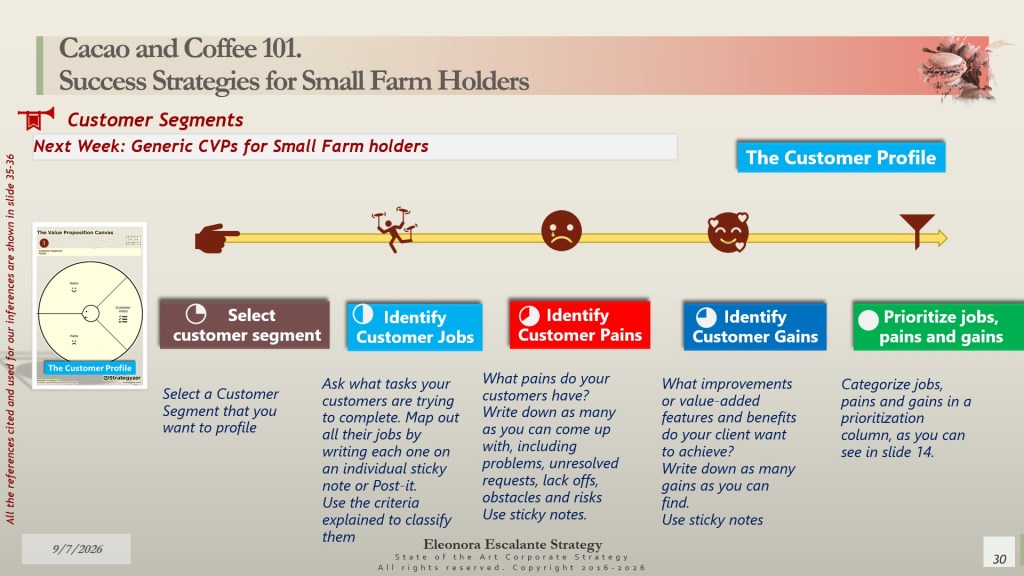
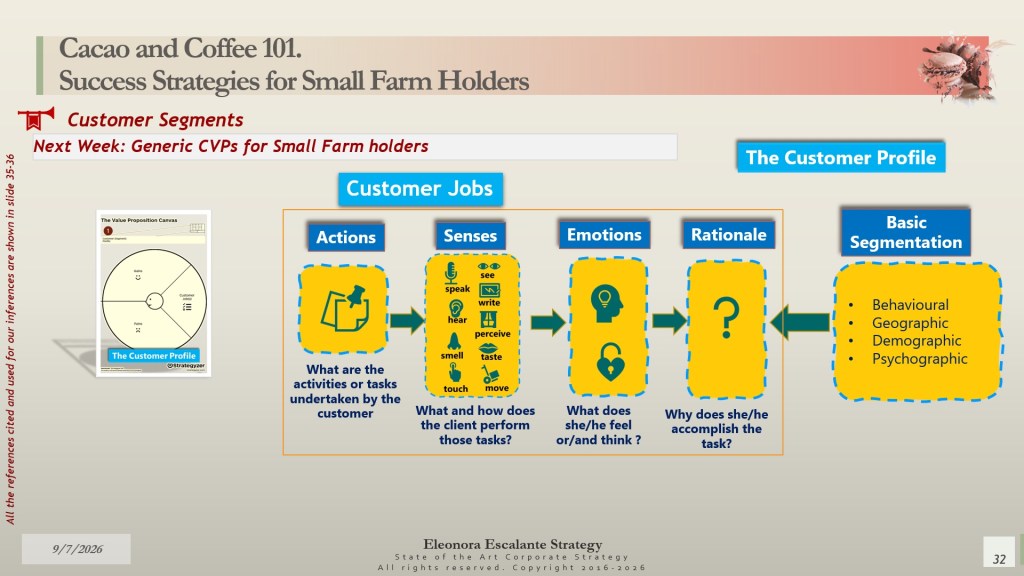
Announcement. Dear readers, we always fulfill our promises to you. No matter if it takes longer or if we postpone our publications, be sure that there is a reason beyond the reason. Every day, we are always thinking about how we can help you to become good strategic thinkers, and nothing seems better than to teach you how it happens in reality. Since we had to remake all our data analysis from last week, our next episode will finally be about constructing three customer profiles: two for cacao and one for coffee. If we have time, we will add an additional customer profile about coffee. Our aim with the small farmers is to figure out how we can support them appropriately, in such a way that all the players of the global supply chain (coffee and cacao) could be satisfied enough with a good-sounding proposal. We are promoters of fair and balanced solutions, and we do not want to harm others in the intent. Though we are convinced that the upstream small farmers require a substantial shift in how they are operating. We will offer several new feasible value propositions, so small farmers can nourish a foundation for new business models that can help them to leave poverty behind. This work is not easy. It is not a task to ask for an AI model. It requires a lot of experience, human observation, and thoughtful analysis of reliable data. Without the truth coming from the small farmers’ testimonies, be sure that no solution is correct.
In our next episode, you will see how different it is to sell these precious beans once the Appellation d’Origine Contrôlée or Protected Designation of Origin is in place.
Musical Section.
This saga is committed to elevating traditional musical instruments and their respective musicians over digitally produced sounds. This saga is dedicated to the chamber orchestras.
Today, we have chosen the Norwegian Chamber Orchestra (NCO). For this episode, the NCO is interpreting one composition of Fanny Hensel-Mendelssohn (1805-1847), a German pianist and composer, who was the eldest sister of Felix Mendelssohn. Her musical talent was fantastic, most of the time, even better than her brother’s. Over her lifetime, there were certain famous compositions written by Fanny but unfairly attributed to Felix. The director of the Orchestra is Pekka Kuusisto; however, for the current video below, Malin Broman, a guest concertmaster, was leading the performance. https://www.kammerorkesteret.no/nco.
Enjoy!
Thank you for reading http://www.eleonoraescalantestrategy.com. It is a privilege to learn. Blessings.

Sources of reference and bibliography utilized for today´s inferences. The bibliography is listed on the last slide of the reference reading material. Click the respective URL to trace them.
Bibliography in this post: This will be added accordingly with the strategic reflections on Monday.
Disclaimer: Eleonora Escalante paints Illustrations in Watercolor. Other types of illustrations or videos (which are not mine) are used for educational purposes ONLY. All are used as Illustrative and non-commercial images. Utilized only informatively for the public good. Unless otherwise stated, I do not own any lovely photos or images.
 Eleonora Escalante Strategy Strategic Reflections Think Tank