
Cacao and Coffee 101. Success Strategies for Small Farm Holders. Episode 5. New Models of Ownership and Corporate Governance.
Dear adorable coffee-chocolate lovers:
After some days of stay-working recess for the occasion to celebrate “Teacher´s Day”, we have returned with our material for this weekend. We have been bold and courageous to consider the whole picture that we have been describing for a month. For us, the primacy of any financing structure is tied to the ownership of the deal-making. Moreover, our priority is to keep the land of the small landholders intact. That means we do not want the farmers to lose their land if they have access to credit. Our proposals of today are guided by the immense desire to provoke a thoughtful reflection about all the risks related to farming cacao and coffee in the context of global warming and climate change. Properly. But we have also acknowledged that without proper technical assistance, without the correction of the upstream part of the global value chain (from the generic commodity to differentiation of the beans using AOC), and without proper access to capital, the farmers will never be able to raise their conditions of living, and the cycle of poverty will continue. Coffee and Cacao are meant to provide good conditions of living to all the participants of the global value chain: upstream production farmers, midstream processors, and downstream retailers. All of them are on the same boat while facing climate change. All of them depend on the good quality and flow of the beans from the upstream production section, too. We envision that solidarity, donor or low-pricing capital support for the tropical belt nations, and goodwill could become the philosophy behind the financing facilities that will be required for small farmers to grow.
Find the material for your masterclass this weekend. Do not forget to follow the link URLs provided in slides 18 and 19. Proceed to read each of our slides thoroughly and think about all the issues involved in climate green finance for small farmers of the tropical belt. It is a long way to go to change their quality of life. However, with the correct guidelines, right financing structuring, proper risk management tools, with the aid of agri-finance companions, I am sure that it will help enormously to all the participants of the upstream section of the global value chain of cocoa and coffee. For us, the correction of the value proposition of the farmers from a generic bean to a value-added differentiation terroir based on an AOC or Appellation d’Origine Contrôlée (Protected Designation of Origin) is the only path left in commercial terms to raise the value of the beans.
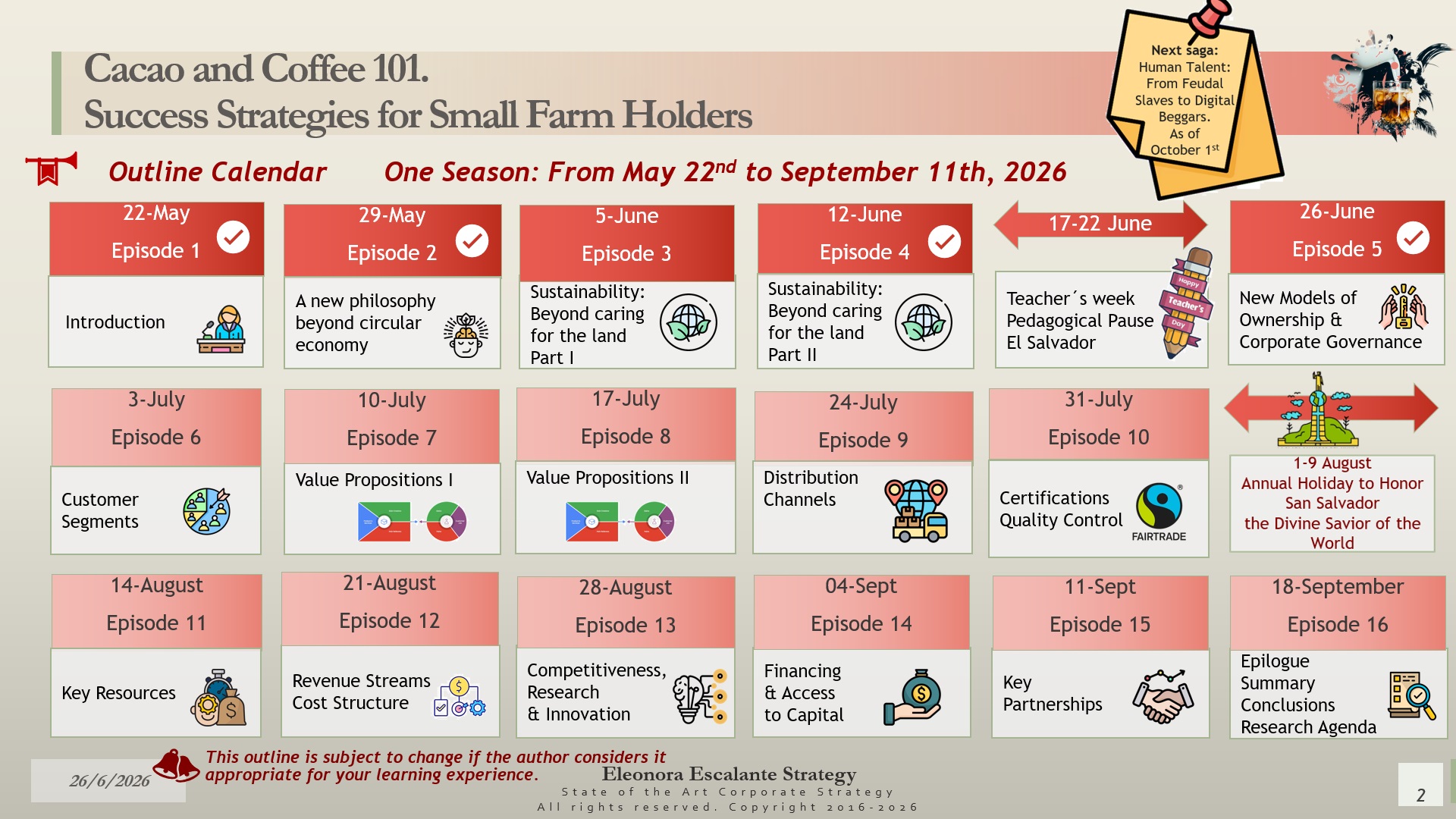
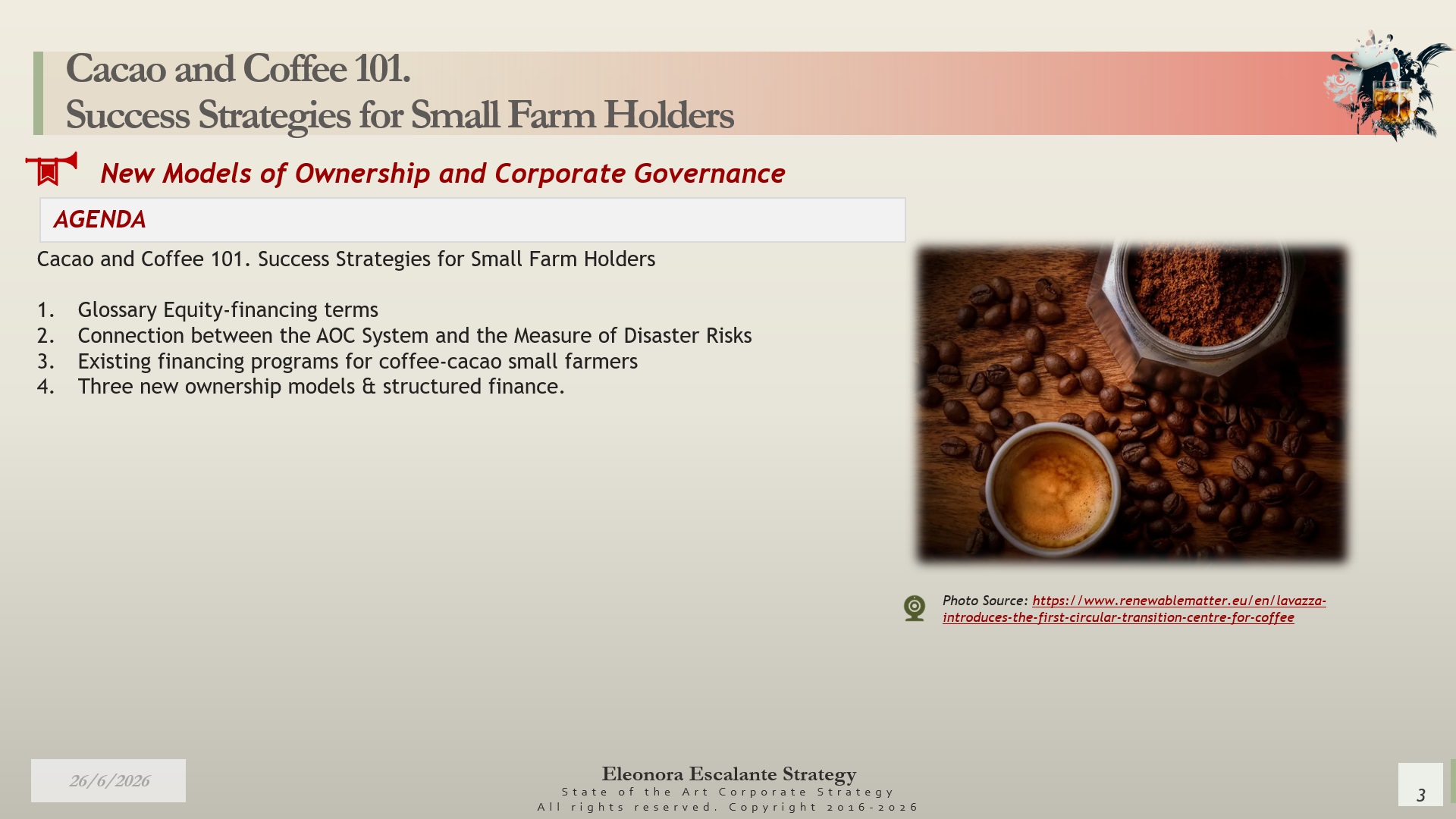
We kindly ask that you return next Monday, the 29th of June 2026, to review our strategic reflections on this chapter.
We encourage our readers to familiarize themselves with our Friday master class by reviewing the slides over the weekend. We expect you to create ideas that are or are not strategic reflections. Every Monday, we upload our strategic inferences below. These will be discussed in the next paragraph. Only then will you be able to compare your own reflections with our introspection. We always give our students a couple of days to prepare well before our final reflection.
Strategic reflections on this episode.
These will be in the section below on Monday, the 29th of June.

Cacao and Coffee 101. Success Strategies for Small Farm Holders. Episode 5. New Ownership Models and Corporate Governance.
No matter what may occur in the future, the farmers’ land should remain safeguarded. Getting credit without secure future cash flows to pay the due installments to the lender is a recipe for disaster. No one with a rational mind wants to splash into debt if there won’t be enough operational cash flows to pay later. To use debt blindly is something we are totally against. We know it by heart and by personal experience. And, to become a productive slave to compensate the banks without having enough profits is awful. On the other hand, if there are enough operational cash flows, it is also healthy to have a certain degree of debt because it leverages our strategic plans into actions that improve profits.
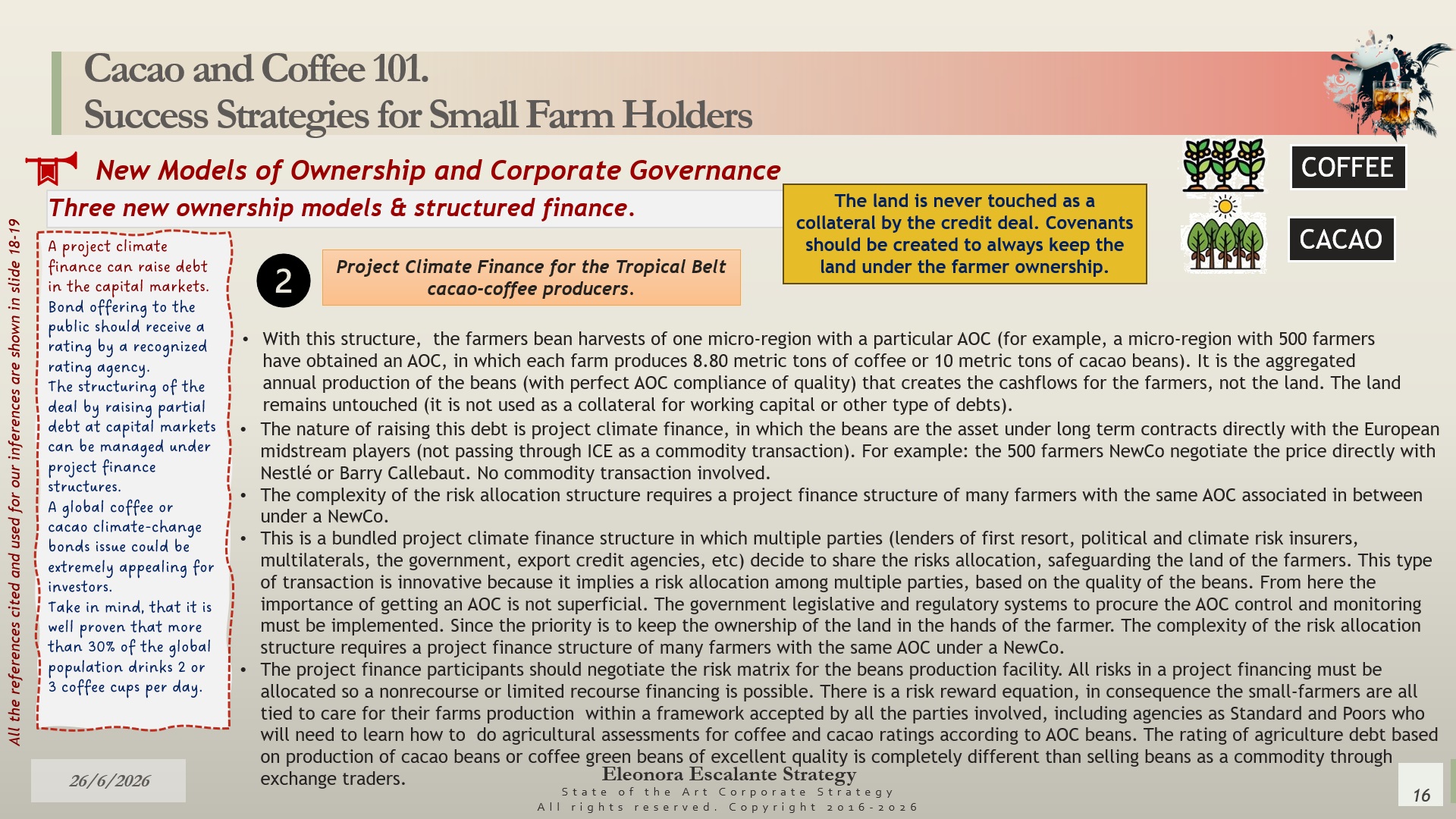
All over the world, there are thousands of sour stories about small coffee or cacao farmers who got into debt and, in the end, lost their acreages, because they were not ready to oversee all the risks associated with the financing decision of using credit. Their crops were hit by a disease, or by a flood, or by mismanagement, or by low bean prices, and after a few years, the bank took possession of the farmer’s assets because the land was stipulated as collateral in the contract. And we do not want that. We truly do not wish the farmers to lose their land. The land is their core asset, probably where they also inhabit. Our proposal today is to kick off the structure of a financing pitch with the core philosophy of not using the small farmer´s land as collateral. Our rationale is not to put the farmer´s land as collateral for the transaction. This is the essential notion driving our masterclass today. In consequence, if we want to structure a deal in which the land of the farmers is not going to be the collateral, we need to find different financing formats that have already been proven and do not use the land as a collateral guarantee during the financial assessment.
But first, let´s ask ourselves: Why do farmers need some credit? Let me explain it: farmers need some credit because this planet is selfish. Those who do not have cash in hand are not able to do anything with their lives. And this is a fact. There is no free lunch, and no one comes to rescue the farmers with a cash gift to rise from poverty. Otherwise, they wouldn´t be facing salaries of $3 dollars pppd (per person per day) and below.
We live on a planet where there is massive money to fund millions of internet satellites, which will hurt the electromagnetic rotation of Earth, but there is no cash to help the smallholders to leave poverty. And we need to acknowledge this is the situation where we stand. The philosophical values of our civilization are doomed, and without true love for the needy, these values are not going to change automatically.
Accepting this situation is not something that we like to do, but it is the way it is. However, we need to design financing deals that keep the farmer´s land safe. In consequence, if we wish to obtain some debt without using the land as collateral, but the consecutive cycles of bean harvests, then the situation changes. This structure will not hurt the farmers at their core, even in the event of a force majeure or a total loss of the annual endeavor. Why? Because certain financing formulas manage to allocate each of the risks among different parties, and if managed properly, the financial scaffolding could be well structured for the farmer interests.
From our last episode, we are betting on the attractiveness of owning a small farm that produces excellent coffee-cacao products (with an AOC system in place) in parallel to other coffee and cacao varieties, which are positioned at the low-cost niche level. If the AOC system (Appellation d’Origine Contrôlée) is consistent and properly managed, it can help farmers to grow and at least procure an income above the current extreme poverty line, because farmers will be able to produce better quality, with a higher value, and more. Despite that, our strategy house is aware of the mix of risks that could hit the small farmers, which is undoubtedly true; it is worse to do nothing to improve how they currently operate. To see them bleeding harvest after harvest, pleading for working capital at high interest rates, just to barely earn enough to pay for the farm inputs and labor, sometimes without making any profit, it is just an intolerable agony.
Bear in mind that there are medium-to-big-ticket farms that are producing perfectly well and have been served by commercial banks for decades. If this is happening in Brazil or certain regions of Africa, we are not reinventing the wheel. What we are proposing for the small farmers is a different allocation of risks, in which the small farmer can grow out of poverty with aid from the lenders and guarantors using a non-recourse or limited recourse financing structure.
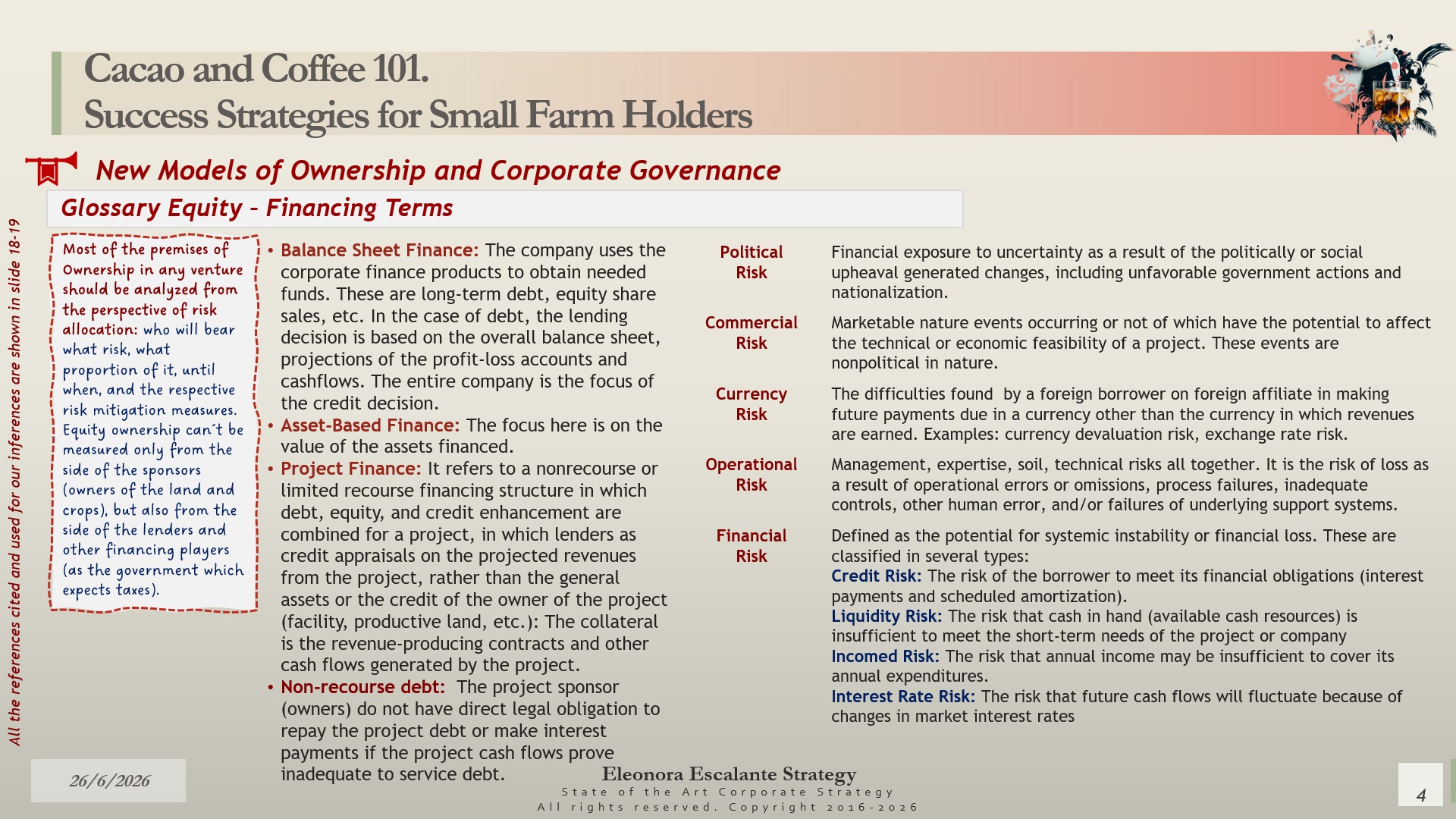
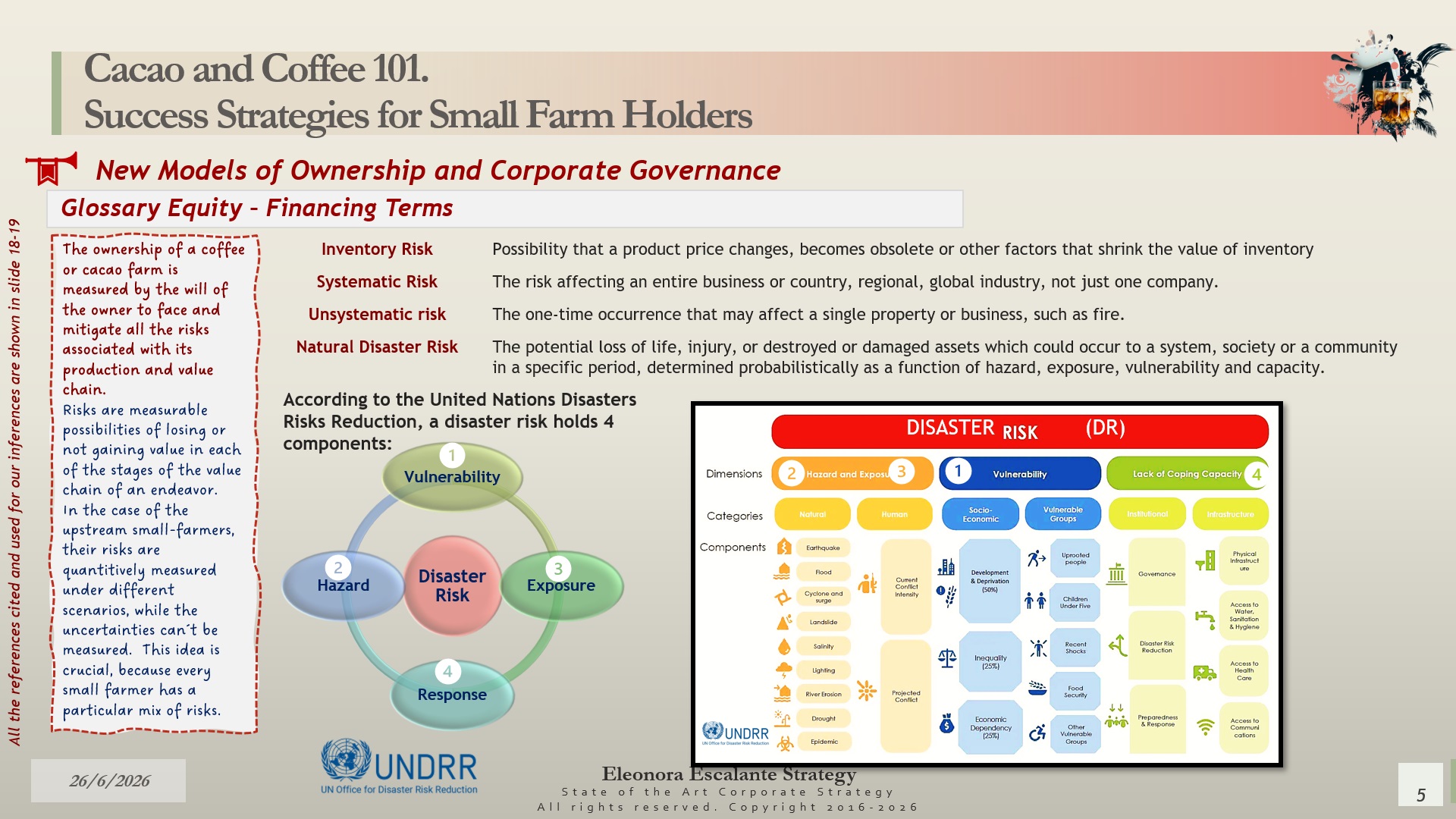
Risk management for coffee and cacao farms located in the tropical belt. Slides 4 and 5.
All small farmers need to be trained in risk management while facing environmental disasters. Why? Only by learning about each of the risks and how each of the financing players assumes it, will the farmers grow in their comprehension and perception of how complicated it is to structure financing using the adequate vision from the eyes of “developing poor nations.” Without that philosophy, there is no chance for the farmers to leave poverty behind. The reason we need “compassionate and merciful” bankers is not based on pity or charity, but on solidarity and kindheartedness, something that is missing in the bankers for the impoverished nations of the tropical belt. Let´s refresh our audience about this. There are two types of bankers: Those who serve the top tycoons of each industry on earth, and those who serve the poorest of the poor. The philosophical roots of each type of financier are different. It should be as such. The second group of bankers is the one that the tropical nations require. The most vulnerable people on earth who can´t afford the commercial characteristics of a loan designed for medium-high-income countries need to be supported differently to leave deprivation and hardship. If we lend money in poor nations based on risk management inputs designed by the bankers who serve the top tycoons of the rich nations, we are missing the point.
Given the latter explanation, risk management for coffee and cacao small farms in poor nations should start by defining each of these risks. We have done it on slides 4 and 5. The definition of the risks is the same for any type of banker (those who cover the well-established developed industries, and those who cover the poor nations). But in the case of bankers for the poor, the way to manage the risks and its corresponding mitigation should be different. This is why the credit rating agencies (such as Moody´s, Fitch Ratings, or Standard & Poor’s) are required to design a new system of credit ratings for the low-income nations, and particularly for the small- and medium-sized players of the Tropical Belt countries. Otherwise, there is an unfair extra penalty for deals in impoverished regions that is prejudicial and discriminatory. Coffee and Cacao are beverages ingested daily (almost as water); consequently, if water systems are able to be measured in credit rating, coffee and cacao upstream companies can be rated accordingly. And it is mandatory to have a different system for producers located in poor nations. We can´t charge higher interest rates to the poor nations in comparison to high-income nations. It is irrational. The model must not operate as such. Let me explain with a simple example: the system of lending using credit ratings should be similar to what some universities apply in their differentiated tuition schemes: the families in which the parents earn a lot pay the highest levels of yearly tuition for their kids, while low-income parents pay less or nothing for their kids´ tuition.
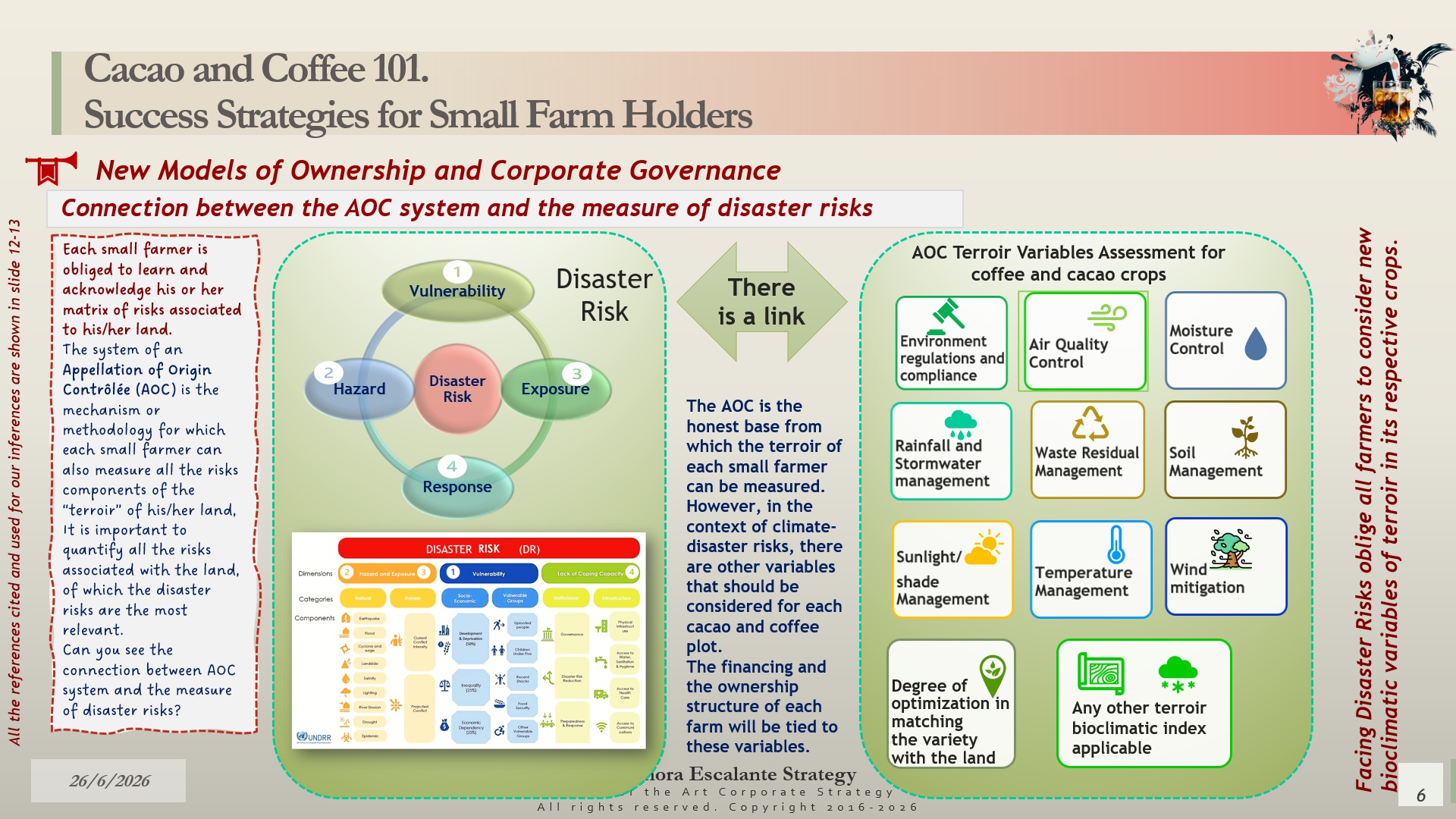
Connection between the AOC system and the measure of disaster risks. Slide 6.
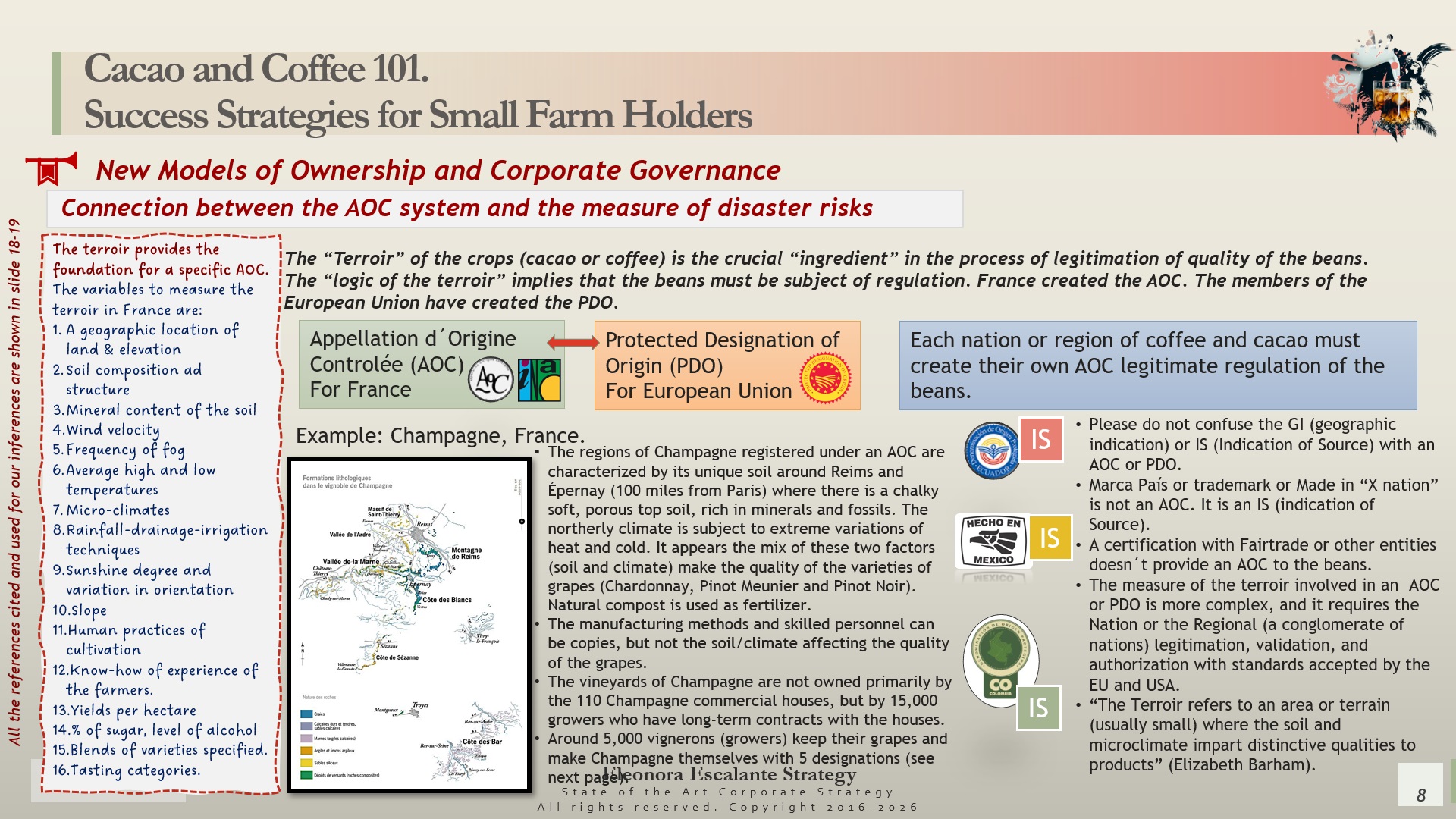
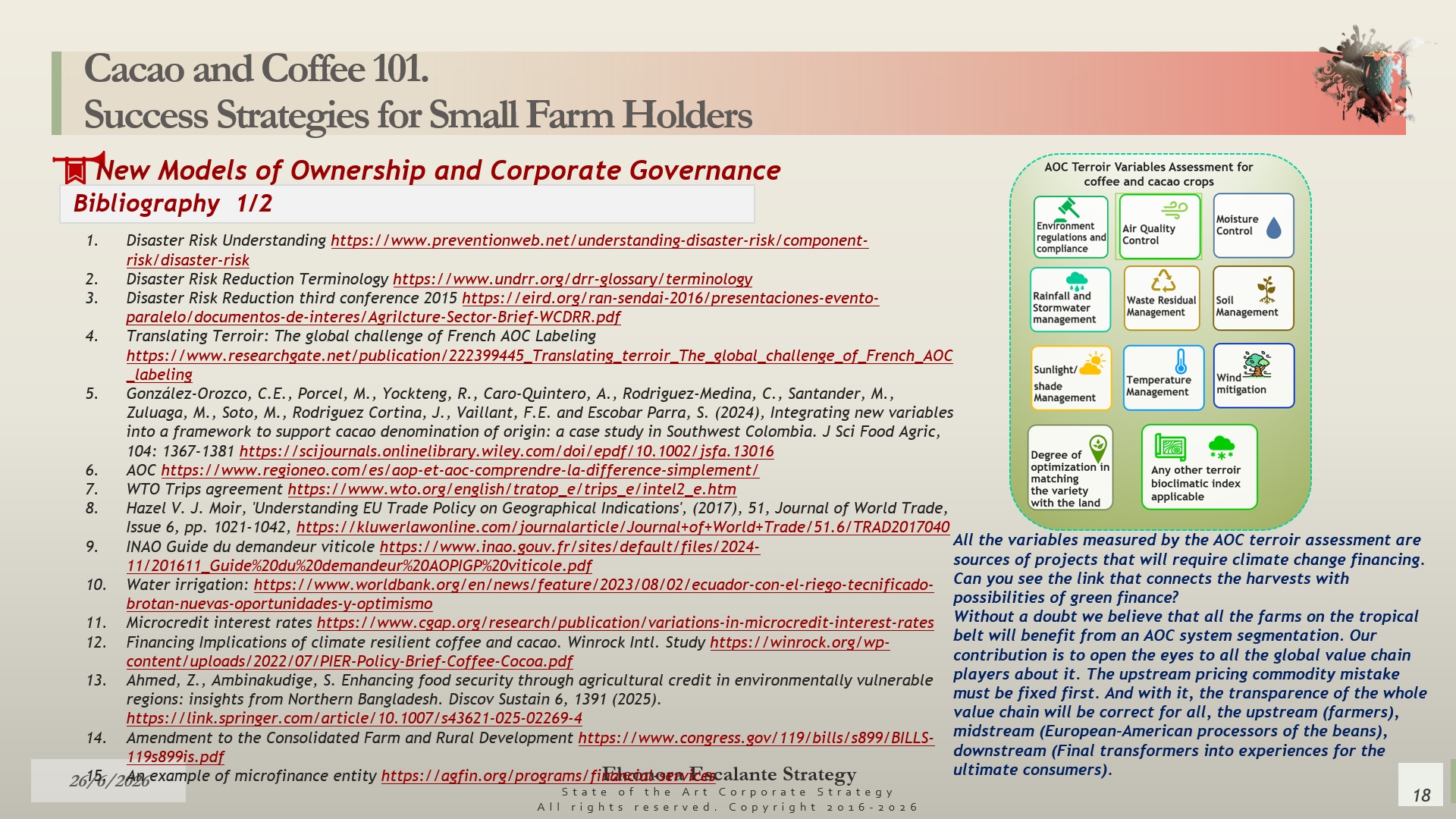
Let´s continue. We tried to gather in one shot the most important risks that any financier must consider: political, commercial, currency, operational, financial (several types: credit, liquidity, income, interest rate, etc.), inventory, insurance, systematic, and natural disaster risks. In the case of agriculture, the natural disaster risks are nowadays more relevant than the sum of the other risks. The UN Office for Disaster Risk Reduction (UNDRR) has defined disaster risks as a function of hazard, exposure, vulnerability, and response capacity. These 4 dimensions have dissimilar categories and components. Yet, slide 5 shows us the clairvoyant relationship between the measure matrix of Disaster Risks and the variables of the Protected Designation of Origin or Appellation d´origine Contrôlée (AOC). Can you perceive the connection? Most of the environmental variables measured as components of hazard and disaster exposure are the same variables used to categorize the terroir of a productive microregion. What an inscrutable coincidence? Accidentally or not, just acknowledge that the matrix of variables used to classify the terroir of a specific land contains or includes all the variables required to understand most of the environmental risks in which the farmer is operating. See slide 6, please. The utilization of regulatory frameworks is crucial for the enforcement of the truth of the land and the quality promise when using AOC categories. The utilization of regulatory frameworks is also crucial when measuring the environmental risks of the parcels of the farmers. Since the coffee and cacao farms could be in the process of defining their own variables (which are different from the French wine industry), we suggest defining the most complete environmental matrix of AOC variables that could help with the risk assessment. In that way, we feed two birds with one scone. Green financing or climate change financing is a new business line in “banking for the poor nations” that can help small farmers to rise out of the deprivation that has been inherited historically since the discovery of the New World. It is a fair-minded door to procure equitable and reasonable access to capital for those who have been waiting for it for centuries.
Who will benefit from the design of a good AOC system in the tropical belt nations? First, the small farmers. There is nothing worse than resting in a plot of land that we do not know. Each business owner must be competent enough to know about all the details of their land, at the technical, environmental, and product level. For example, what a mistake it is for a farmer to grow a robusta variety in a soil that could yield another specialty variety that has a value of 10 times the robusta? It is a tragedy. Another example, what a mistake it is for a farmer not to manage the wind properly, and every year, half of the flowers fall down the orchards, losing a considerable amount of beans? Another example, what a huge mistake it is not to know that you can increase the value of your beans by blending different varieties of coffee or cacao by planting them on your land? And so on. We can name hundreds of valuable AOC factors that are being missed at the farm gate when farmers do not know what they might rise from their acreages. And we can name another environmental set of factors that are not mitigated, which are associated with the natural hazards happening during their annual production. Other beneficiaries of the AOC system are the midstream and downstream players. The quality control established in the upstream tropical nations will reduce their costs of sorting out the beans. The multiplier effect of knowing the terroir of each micro-region will be spread out in the populations, who will also benefit from having their coffee or cacao (with distinct categories) in their societies. The proper allocation of risks will also erode the weight of the intermediaries or middlemen merchants who are well positioned in the global value chain, carrying commissions that shouldn´t exist by now. The business model of the upstream value chain requires an essential modification, and with it, there will be certain intermediaries who will not like what I am writing at the moment. However, there are always solutions to problems, and an all-encompassing new business model will crack what to do with those intermediaries too. For an idea on how much the bean producer loses when selling their beans with the intermediaries (coffee or cocoa traders): a range between 20% and 70% of the value per kg that the midstream buyer-processor pays. This amount of money is the sum of aggregated commissions between the upstream farmgate point of collection and the midstream gate processor in Europe or the USA. Incredible!
In Ghana or Côte d´Ivoire, farmers sell their beans to the cooperative they belong to, to pisteurs (intermediary individuals), to other cooperative delegates, and to purchasing clerks. If farm producers are illiterate or have only basic education (they have not finished primary and secondary K-12), they are subject to fraud by a consecutive series of intermediaries when weighing the beans, when moving the beans to warehouses, when negotiating with traders who deal directly with ICE, etc. As a rule of thumb, if the pricing of the commodity (cacao or coffee) is regulated by the government, as in the case of cacao in Ghana or Côte d´Ivoire, then there are different pricing points at which each intermediary party (buyer-reseller) has a different price than the international price estimated by the ICE exchange. For Ghana, the government establishes the domestic price called projected Gross Free on-Board Price (GFOB). This price is the reference one for Ghana, calculated as a forecast of 3 variables: (1) crop size in tons, (2) a negotiated composite Ghana cocoa bean price per ton in USD, and (3) the projected exchange rate for 12 months. The GFOB is always lower than the average of daily quotations of the CCfutures of ICE (https://www.ice.com/products/7/Cocoa-Futures/data?marketId=7835258&span=2). In Ghana, the pricing points between the farmgate and the buyer warehouse processor in Europe have at least 4 steps, meaning that there are at least three intermediaries charging their own commission. The ICE CC price often trades significantly higher than the farmgate rate due to added export margins, intermediary commissions, port fees, shipping costs, and global demand premiums. However, if the international price falls, the decision to adjust (reduce) the farmgate price is managed by the government. In Ghana, “per working rules, a minimum of 60% and a maximum of 70% of the GFOB is allocated to farmers (1).
If small farmers are not trained properly (or are quasi-illiterate) in relation to pricing their beans, or are not learning about the premium they could charge if improving the conditions of their beans, then they lack the proper motivation to understand all the factors of their terroir. At the end of the day, the farmers all over the world sometimes receive less than 30% of the price that the American or European Midstream processor buyer pays to the intermediary traders. And this is why technical assistance and education are required to accompany our proposed solution of today. In the paragraph above, we have explained the situation for Ghana, but each tropical belt nation has its own particularities from the farmgate to the midstream buyer. There are different transaction parties involved, different pricing processes, and different working rules in each nation. All of these factors should be transparently acknowledged before making a judicious verdict on each nation’s situation.
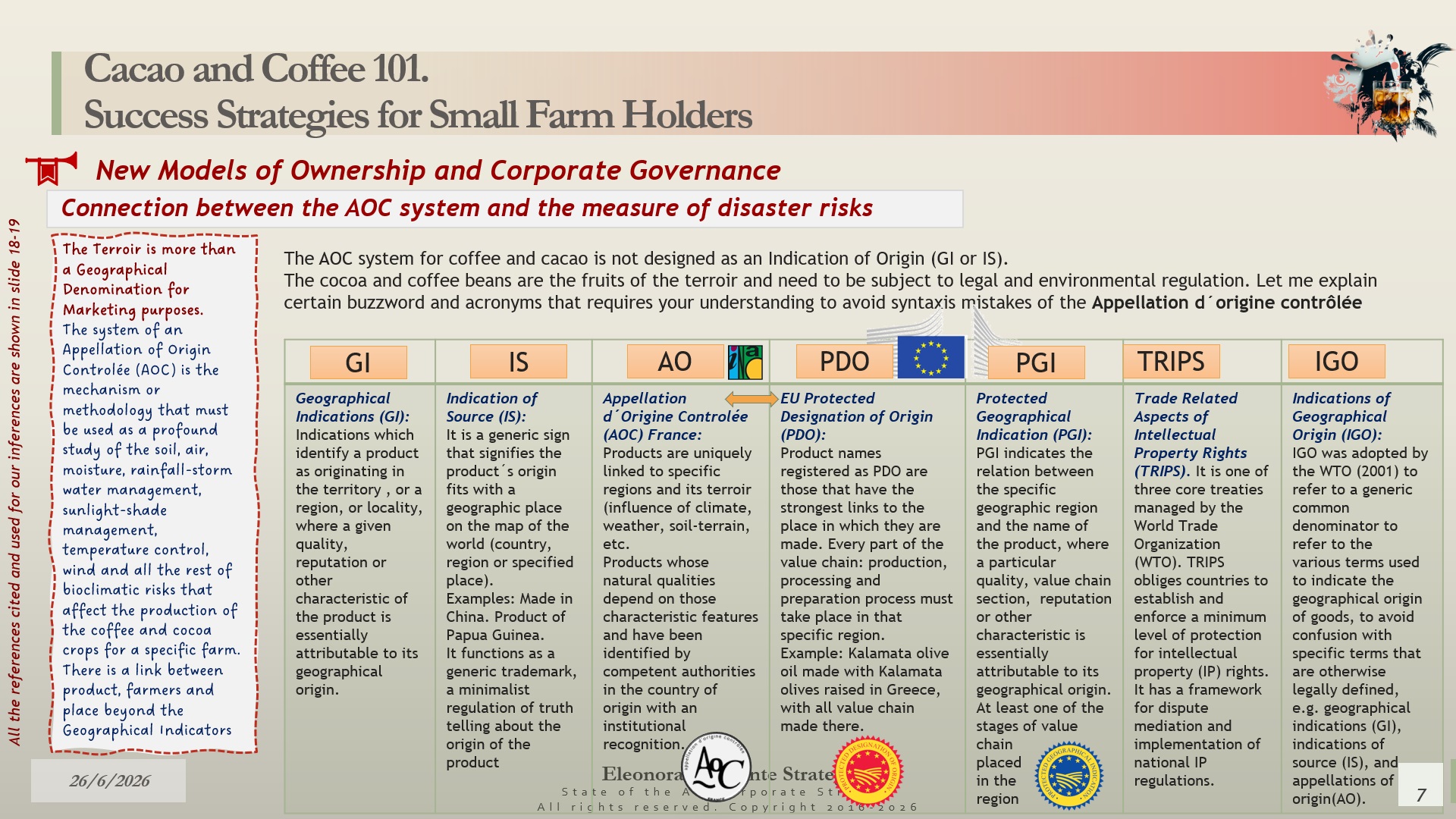
Finally, it is important to remark that tropical belt nations producing coffee and cacao do not have a proper AOC (Appellation d´Origine Contrôlée) in place. They have some indicators in place, but not a matrix of all the categories. Slide 7 shows you the definitions of each of these terms. Some countries (including México, Ecuador, or Colombia) only have legal figures about Geographical Indications (GI) or Indication of Source (IS). For example: Made in México, or Product of Kenya. These are generic trademarks, not a protected designation of origin.
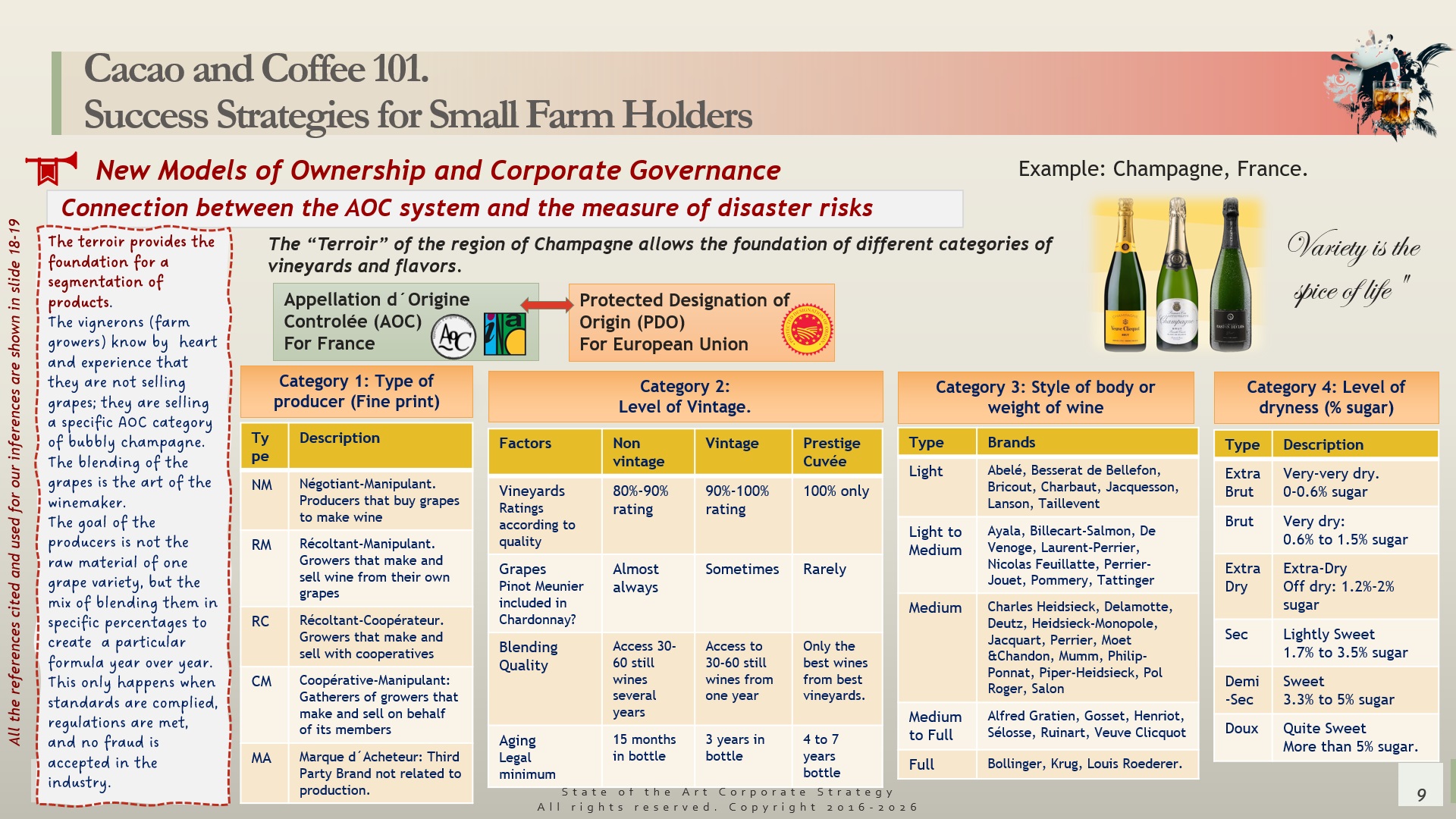
The example of Champagne, France, when it comes to AOC or protected designation of origin. We prepared slides 7 and 8 in our effort to welcome what are the relevant categories when we land to describe the terroir of a micro-region. The champagne is registered under an AOC, and everyone knows that Champagne has a celebratory status quo that no other wine has. It is drunk for joyous reasons when we are invited to a wedding, when a child is born, when we graduate after numerous years of studies, when a new company is established, when we reach financial closing after 3 years of negotiations between the lenders, or when we land the job of our dreams. It is a bubbly sparkling wine made of blends of several varietal grapes (between 30 and 60 separate still wine varieties). The region of Champagne was mapped out by the Institut National des Appellations d´Origine (INAO) in 1927. This region is divided into 5 main vineyard areas: The Montagne de Reims, the Côte des Blancs, the Vallée de la Marne, the Côte de Sézanne, and the Aube. Making Champagne is an art in its own class. The terroir of each of these 5 micro-regions has been measured and studied with an amplification lens over the last 100 years. This is why we prepared slide 8. You can see the 4 main categories of Champagne, by type of producer, by level of vintage, by style or body weight of the wine, and by the % of sugar in its content. We didn´t show you the taste-flavor classification on purpose, because we want you to discover the great spectrum of flavors that you can find when it comes to coffee or chocolate: for example, some of these flavors are: “flowery bouquet warm honey”, or “chocolate strawberry aroma”, or “light sugary sprinkled berries”, or “dark roasted nutty palate”. There are so many flavors related to coffee and cacao that the tropical nations can build from scratch as many as the constellations in the sky.
Existing Financing Programs for Coffee and Cacao Small Farmers. Slides 10 to 14.
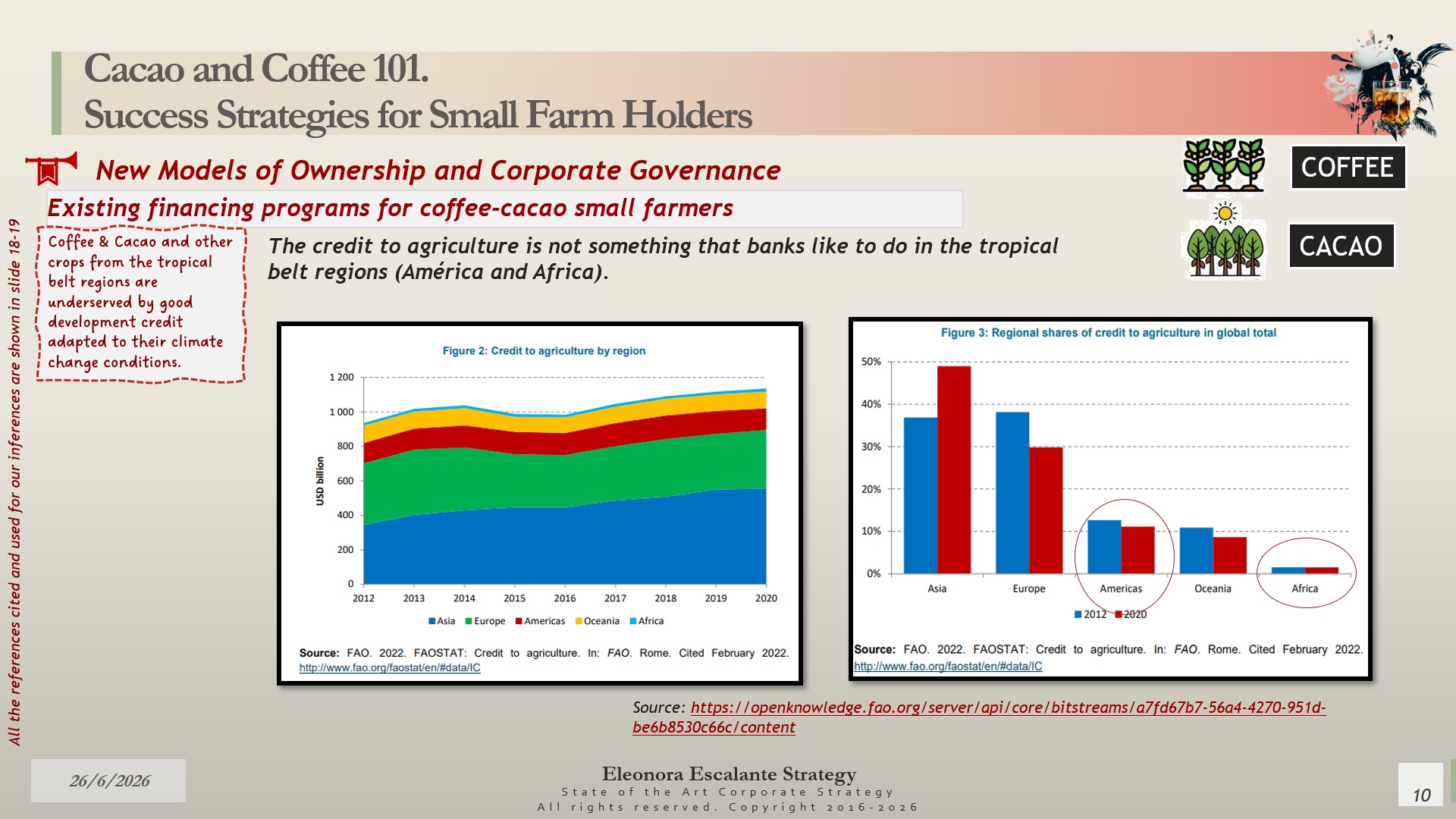
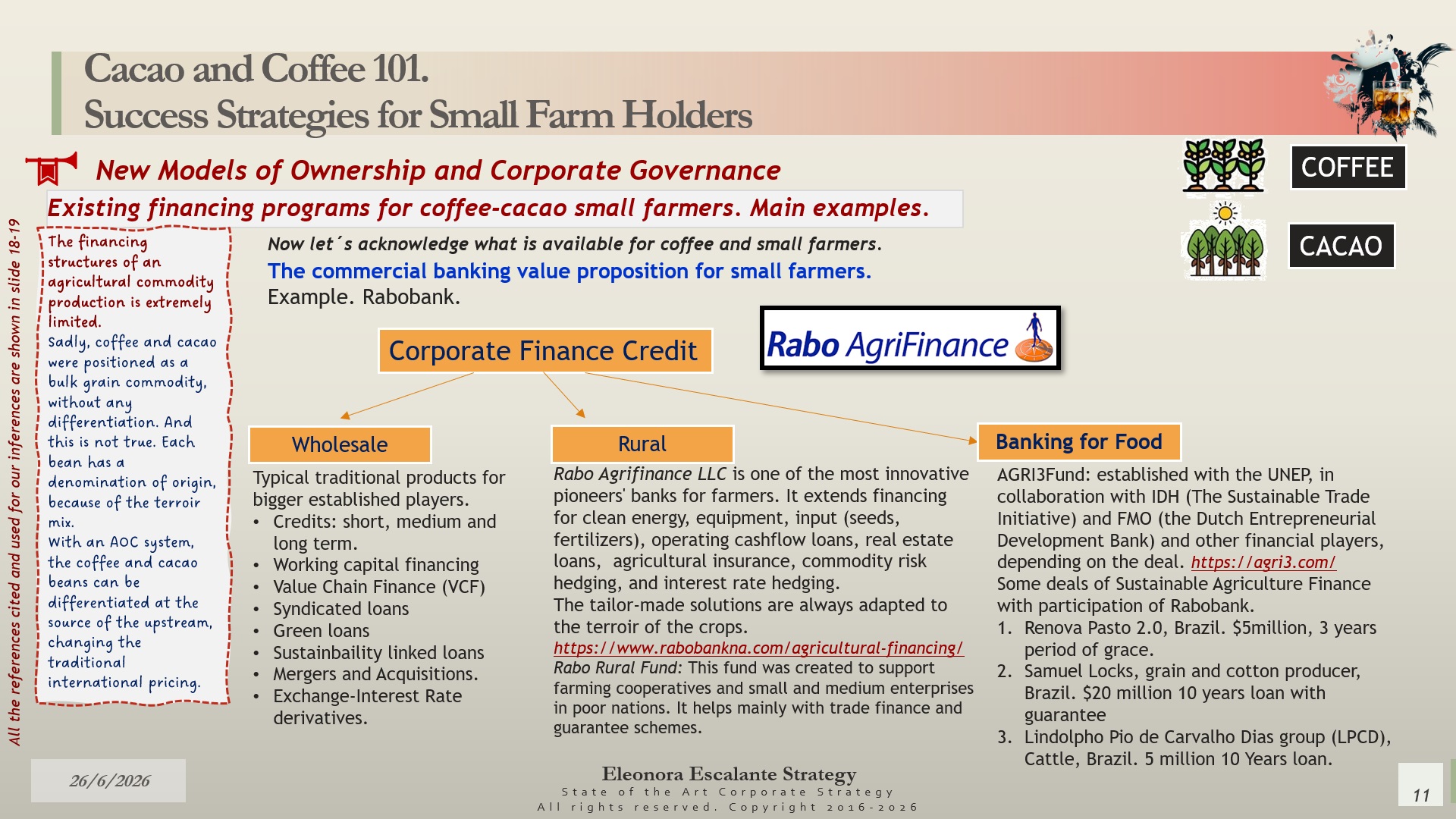
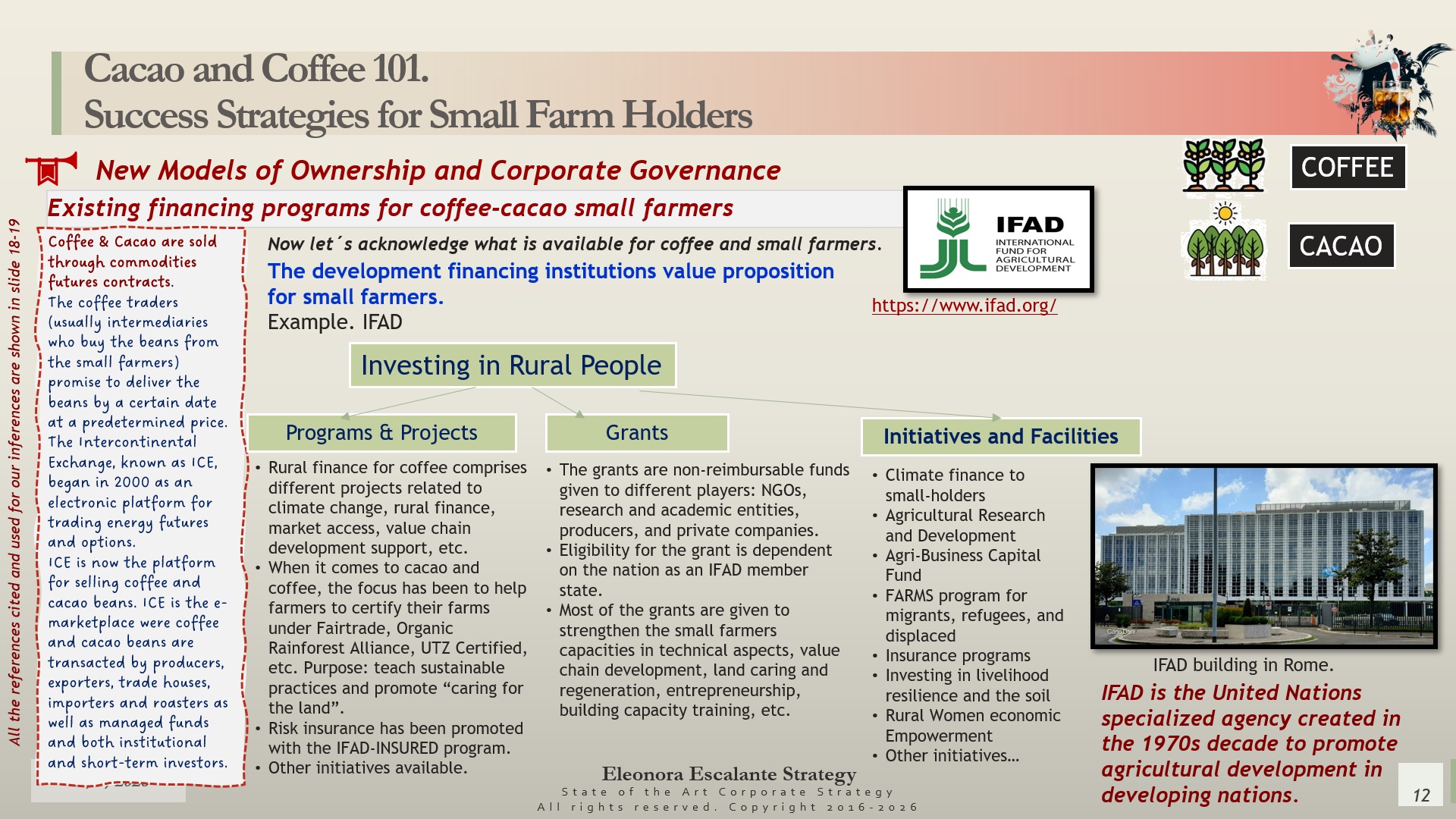
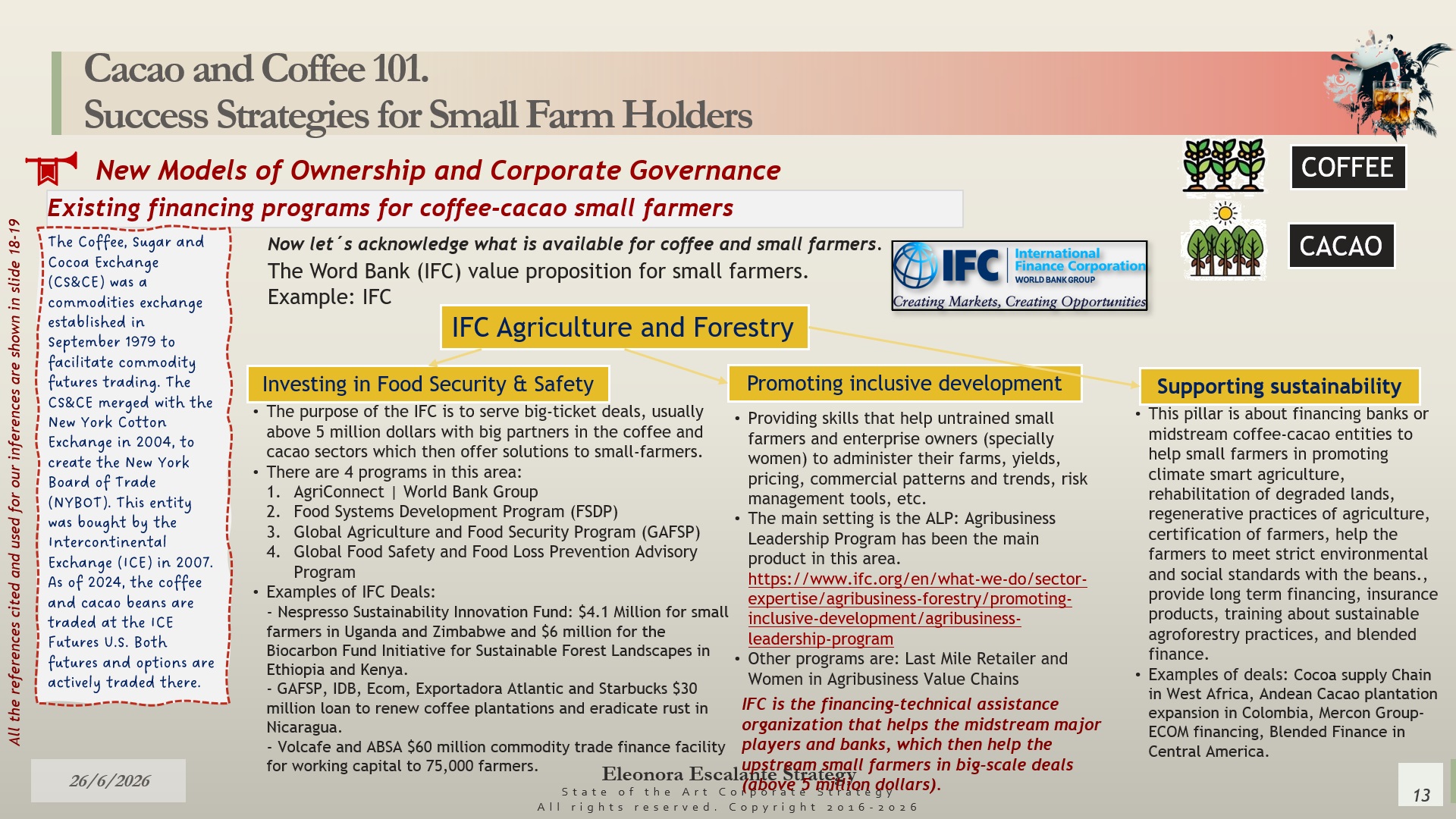
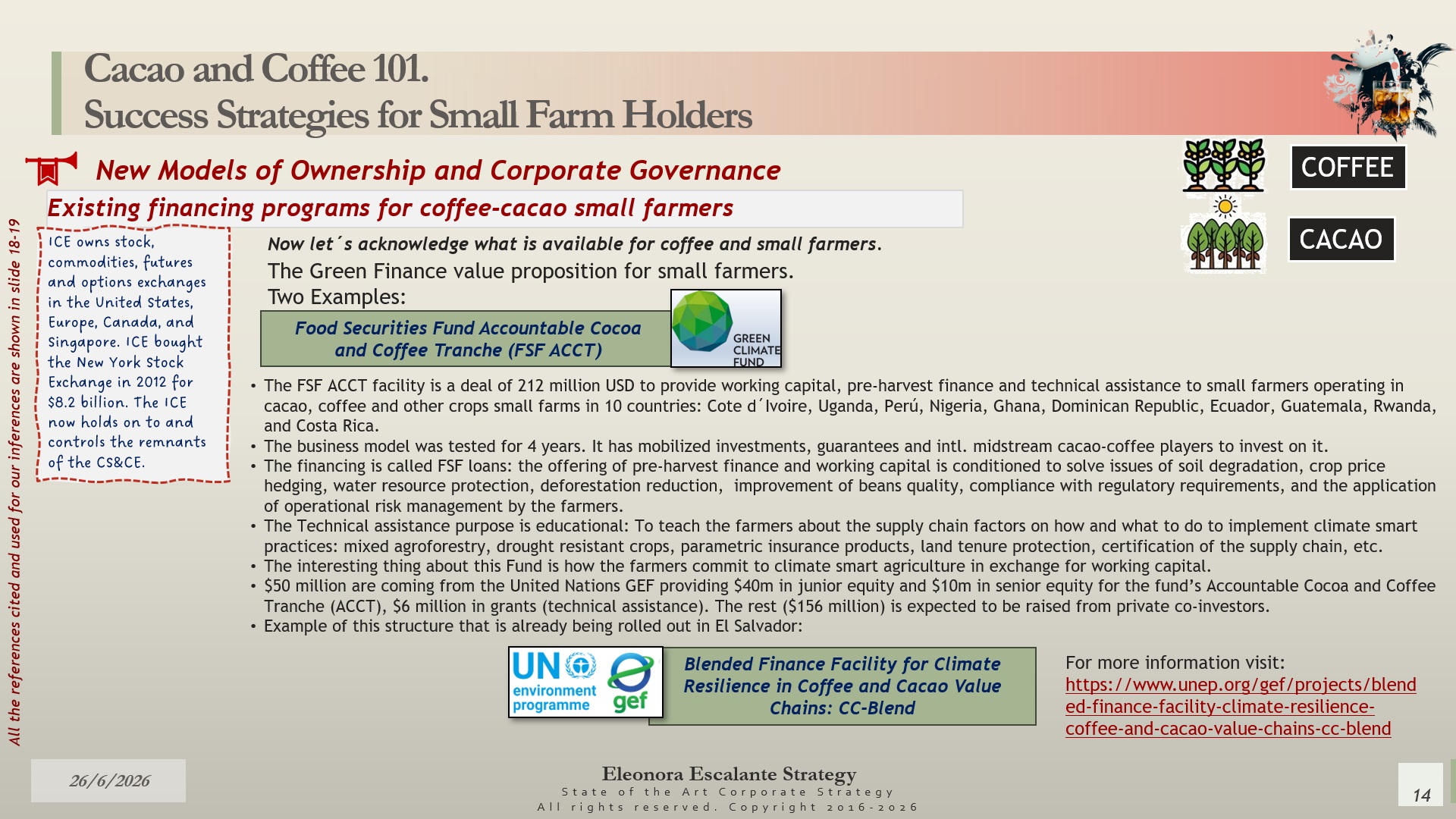
These slides are self-explanatory. We simply gathered the main products and relevant deals of each of the main representative bank for the sector, with some elements of each respective value proposition: the case of Rabobank (a commercial bank), the case of IFAD (International Fund for Agricultural Development), the case of IFC-World Bank, and finally a Green Finance value proposition for small farmers called FSF ACCT (Food Securities Fund Accountable Cocoa and Coffee Tranche). Each of these examples complies with the rules of the traditional industrial banking system. For the tropical belt nations, all these value propositions require a separate banking standard for small farmers. We believe that a new banking system designed for the poor nations on earth must be measured by the new system of credit rating for developing nations that Standard & Poor’s, Fitch Ratings, or Moody´s are entitled to provide for the development financing deals of the future.
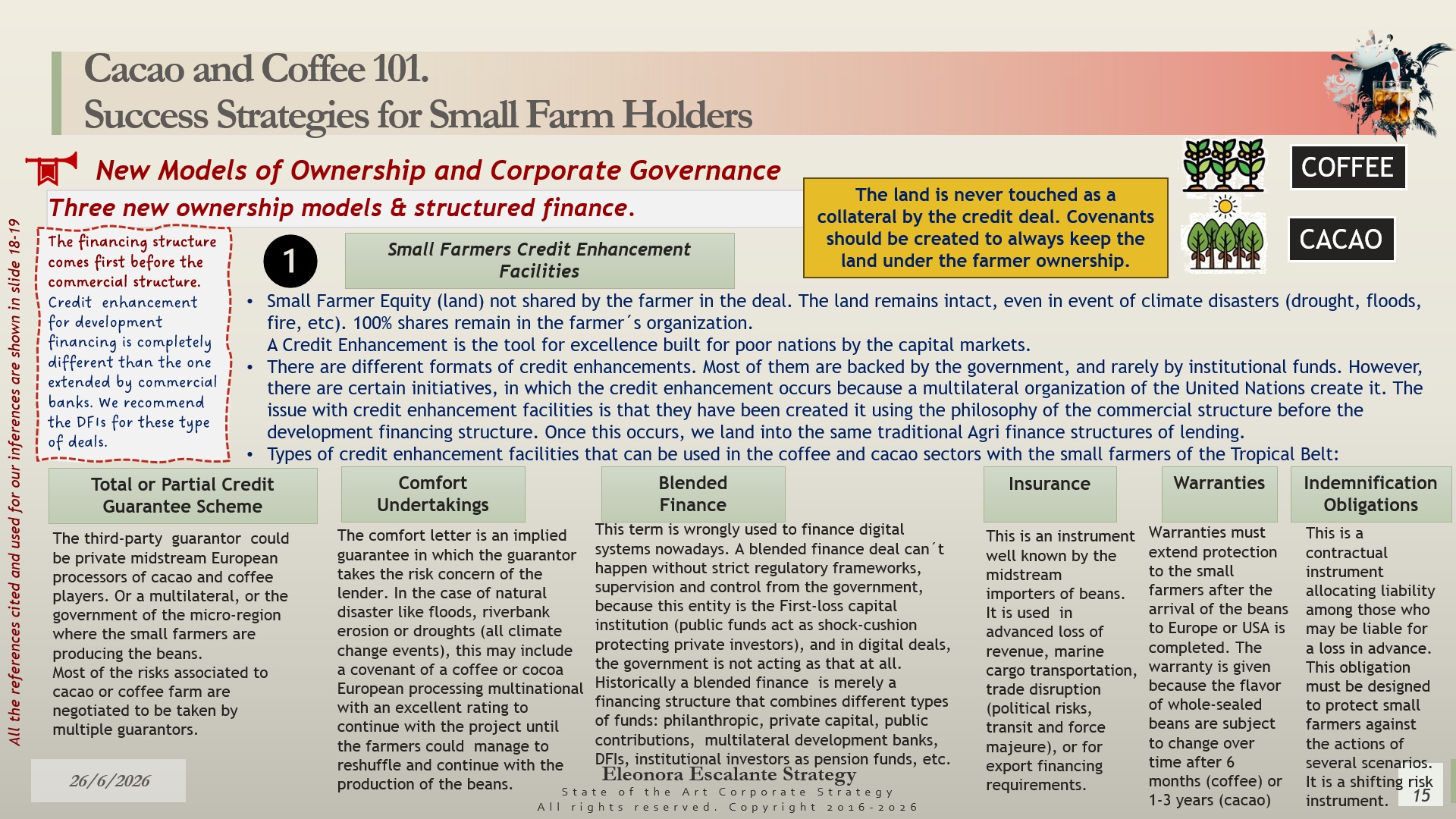
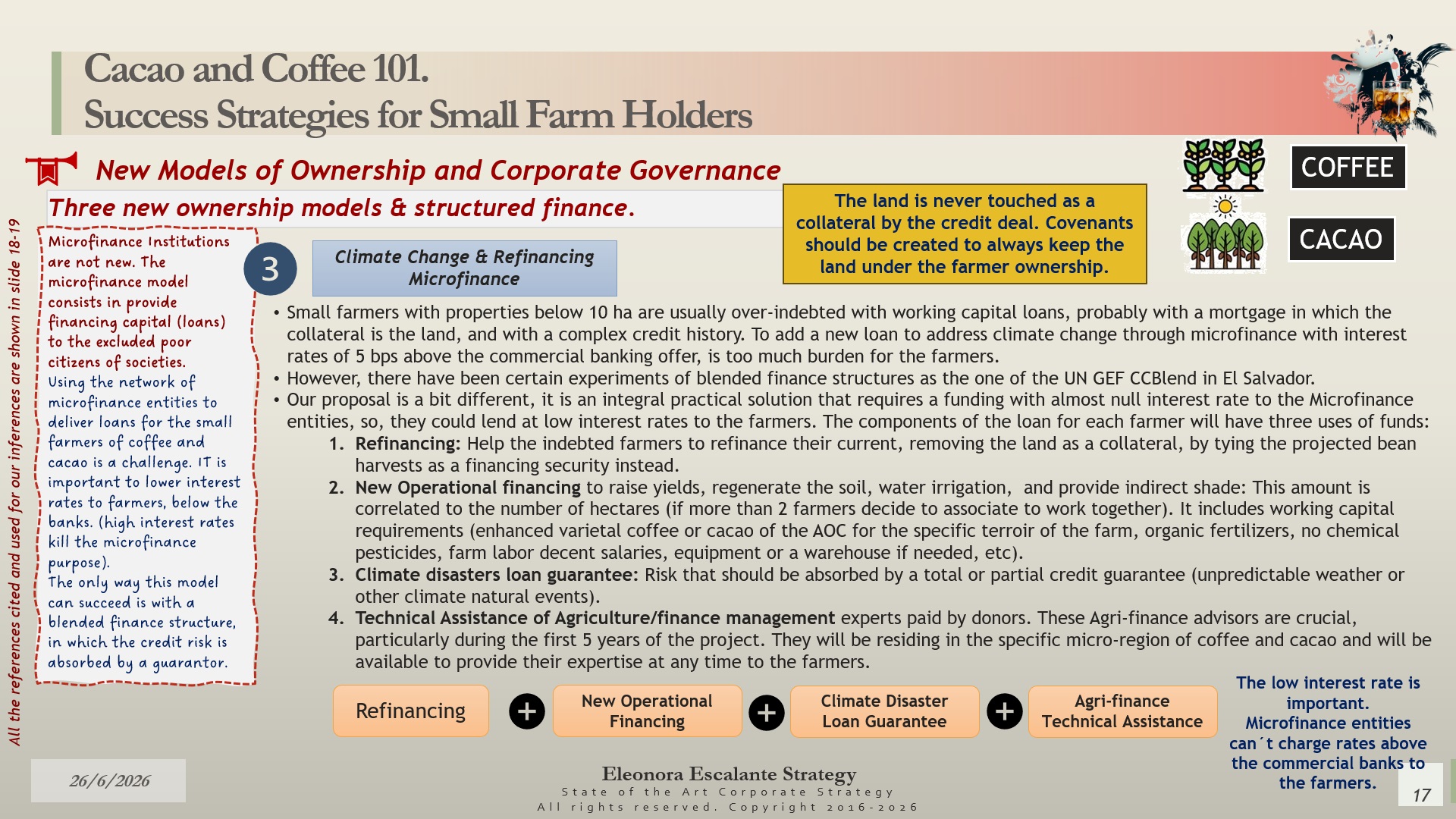
Three new ownership models of Structured Finance for Coffee and Cacao Small Farmers. Slides 15 to 17. Finally, we land on the topic of ownership or equity. Again, our aim is to protect the land of the farmers and keep it out of any financing or credit deal. With this in mind, the collateral is in the quality beans, but not in the land. Once this essential rationale is disclosed, the three alternatives that we have proposed here do respect that working rule. We will perform a SWAT analysis of each proposal on episode 14. We are trying to build financial structures that build wealth for the farmers. For the time being, let´s stop here.
Closing words.
No model of business ownership (and its respective governance) is solely focused on the sponsors. Once a company invites a bank or a lender, the patrons are not the small farmers anymore. The invitation to service from debt into an endeavor dilutes the authority of the enterprise because the working rules of the operation are guided by the requirements of those who provide the funds. In consequence, before considering knocking on any type of lender (microfinance, commercial, or development financing), it is crucial to change what is not functioning for the upstream farmers, who are producing in poor nations in the tropical belt. Today, we have acknowledged four specific matters that require an innovative design, according to the impoverished conditions of the nations. This is not only crucial, but it is a matter of urgent attention before proceeding further. The purpose of the bankers for the poor is to raise them out of poverty and convert them into middle-class citizens.
- The creation of new working rules of banking for the poor tropical nations. If people are earning $1.50 pppd in a farm, that nation is extremely poor. If people are earning below $10 pppd in a farm, that society is poor, low-income class. In consequence, the rules of thumb in banking should be different from those of the rich nations or mid-income-class societies and above. The sources of funds to the banks of the poor nations must be cheap, so they can lend at low-interest rates. Banks from poor nations are entitled to gather non-reimbursable donations or grants, so they can offer these products to the small farmers as part of the financial structure. Technical assistance and education are obligatory for small farmers. And finally, the periods of grace, tenors, super low interest rates, refinancing, and other characteristics of credit (guarantees, credit enhancements, etc) should be available. The land of the farmers can´t be considered as collateral. Never is never, at least if they are extremely poor or from a low-income class.
- Credit ratings for development financing in agriculture should be created by Standard and Poor’s, Fitch Ratings, and Moody’s. The line for farmers should be under climate change, or green financing initiatives for the poorest of the poor on earth. And the ultimate goal should be to take the farmers out of poverty.
- The AOC system (categories of beans by terroir classification) holds measurement variables that are similar to the disaster risk reduction variables designed by the United Nations. By coincidence or not, we are compelled to settle into a new class of climate change financing, green finance, or global warming mitigation finance. The path for these types of deals has been in a phase of experimentation and learning from mistakes during the last 15 years.
- Regardless of the type of green climate financing structure, small farmers residing in the tropical belt are required to know their properties and measure all the environmental variables for a risk management program and an AOC system of their crop terroir assets. The support of the government in this program is critical.
Announcement. Our next episode will be about the new customer segments that the upstream small farmers should consider when facing their lovely beans with an AOC ( protected designation of origin ). You will see the shift of potential consumers under different scenarios. The diversification of new niches is expected.
Musical Section.
This saga is committed to elevating traditional musical instruments and their respective musicians over digitally produced sounds. This saga is dedicated to the chamber orchestras.
Today, we have chosen the Grammy Award-winning Kremerata Baltica https://kremeratabaltica.com/orchestra. This orchestra was founded by Gidon Kremer in 1997, and it is considered to be one of Europe’s most prominent international ensembles. Enjoy!
Thank you for reading http://www.eleonoraescalantestrategy.com. It is a privilege to learn. Blessings.

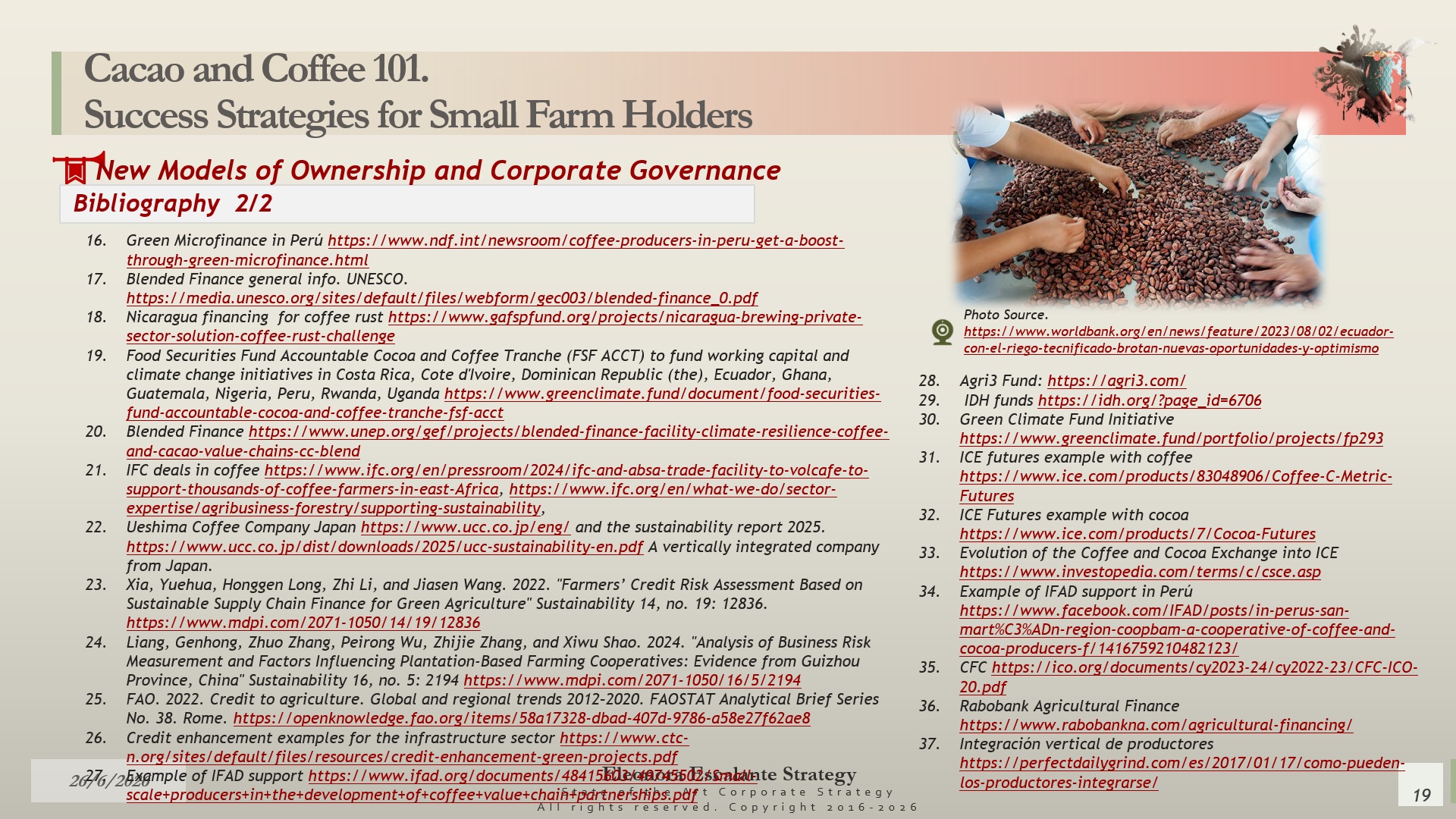
Sources of reference and bibliography utilized for today´s inferences. The bibliography is listed on the last slide of the reference reading material. Click the respective URL to trace them.
(1). Van Huellen, S. et Al. The political economy of pricing and Ghana’s cocoa marketing system. Sage Competition & Change 2026. Vol. 0 (0) 1-24. https://journals.sagepub.com/doi/10.1177/10245294261464704
Disclaimer: Eleonora Escalante paints Illustrations in Watercolor. Other types of illustrations or videos (which are not mine) are used for educational purposes ONLY. All are used as Illustrative and non-commercial images. Utilized only informatively for the public good. Unless otherwise stated, I do not own any lovely photos or images.
 Eleonora Escalante Strategy Strategic Reflections Think Tank