
Cacao and Coffee 101. Success Strategies for Small Farm Holders. Episode 12. Key Resources Part 2. Indonesian Cacao
Dear lovely readers and students:
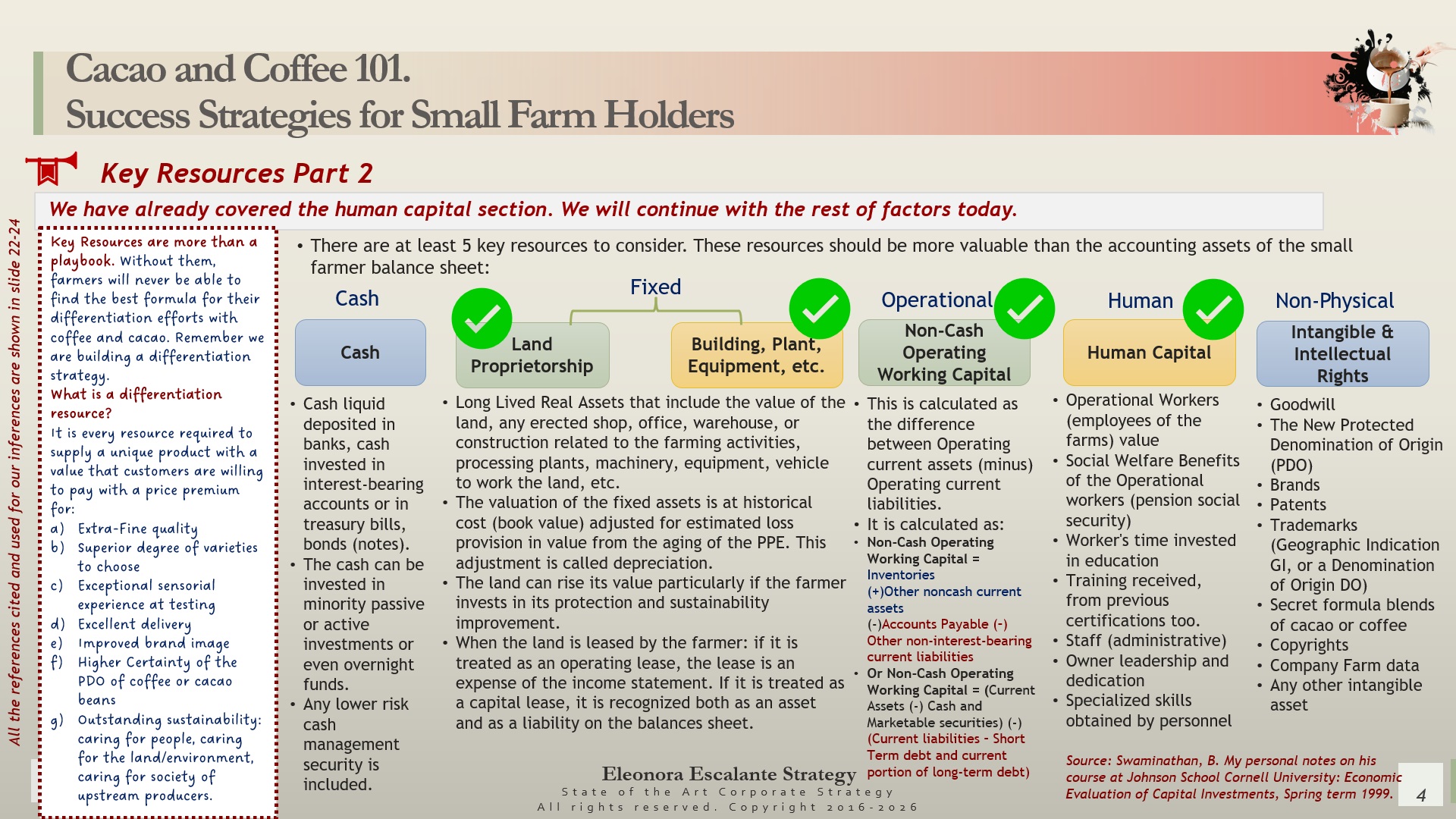
Our masterclass is the continuation of our last episode, using the case of Indonesian cacao. Please remember that our approach is from the point of view of a corporate strategist; consequently, our analysis is focused on the things that matter at that level. Our first priority as corporate strategists is to define what products or services are not only appropriate, but will add value to our business essence, society, and the environment. The allocation of resources also pertains to us, and this chapter is dedicated to it.
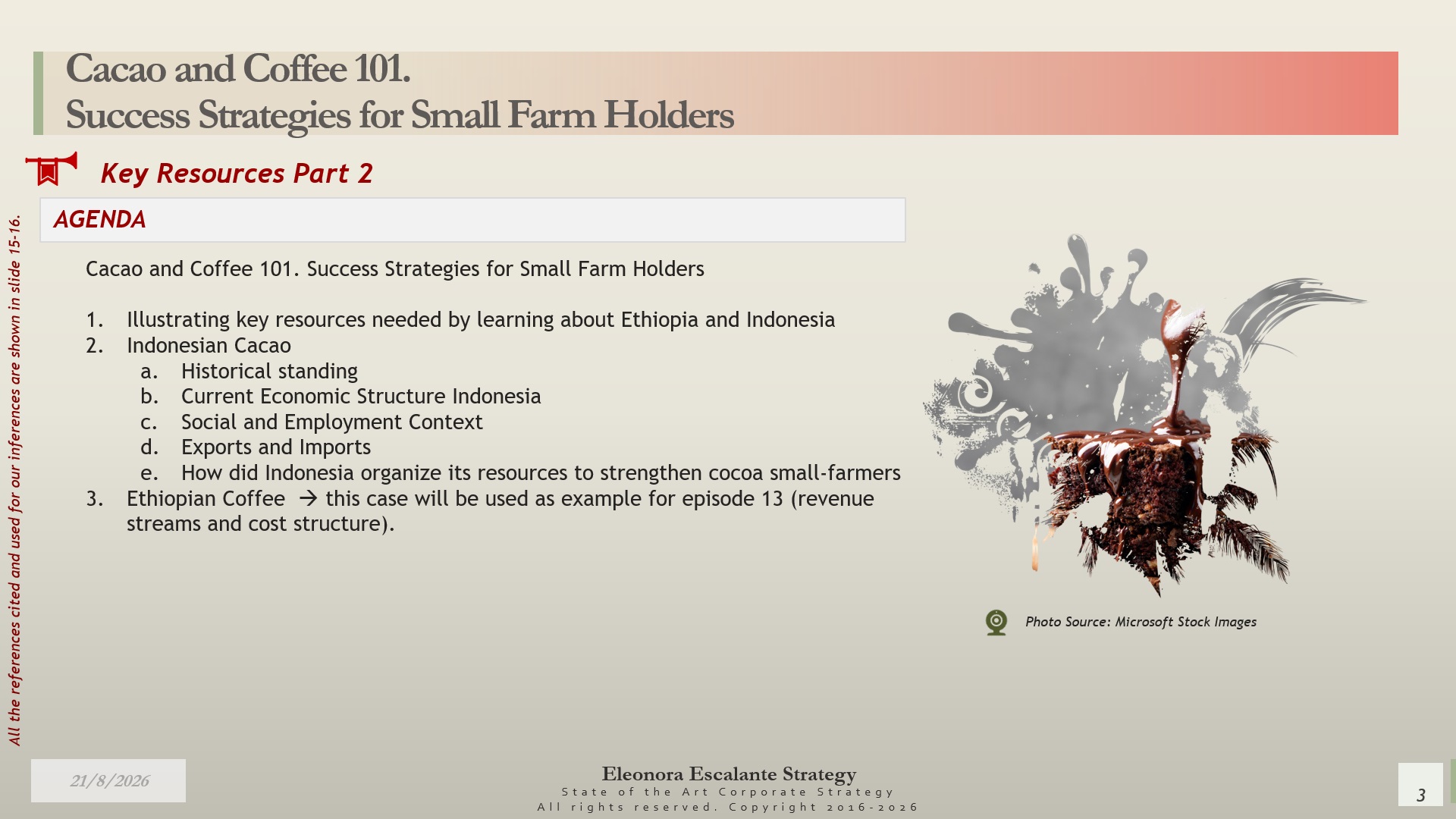
Our agenda is simple: we asked ourselves, why is Indonesia producing cacao today? Why does it matter? And we were on duty to visit the past, when Indonesia was the Dutch East Indies. From there, we are going to guide you on the rationale of the cultuurstelsels, and how all the Indonesian complexities of the 20th century shaped the modus operandi of agricultural plantations in this part of South Asia. Additionally, in the present, we will explore the economic structure of Indonesia and how agricultural commodities are a relevant sector under resource-based industrialization (RBI). Finally, when landing on cacao, how small farmers (most of them owners of their plots) are facing all the main challenges resiliently. Including climate change.
This example is extremely illustrative because it shows the balanced GDP matrix of the economy of Indonesia, and how this economy has been resilient in reshaping its structure while adding value and facing greater competitors. It is in the art of allocating resources that we will discover what they need to do to recover their cacao economic park for the future. The EUDR (EU Deforestation Regulation) will impose certain pressure to Indonesia, as much as the rest of the nations harvesting cacao in the tropical belt zones.
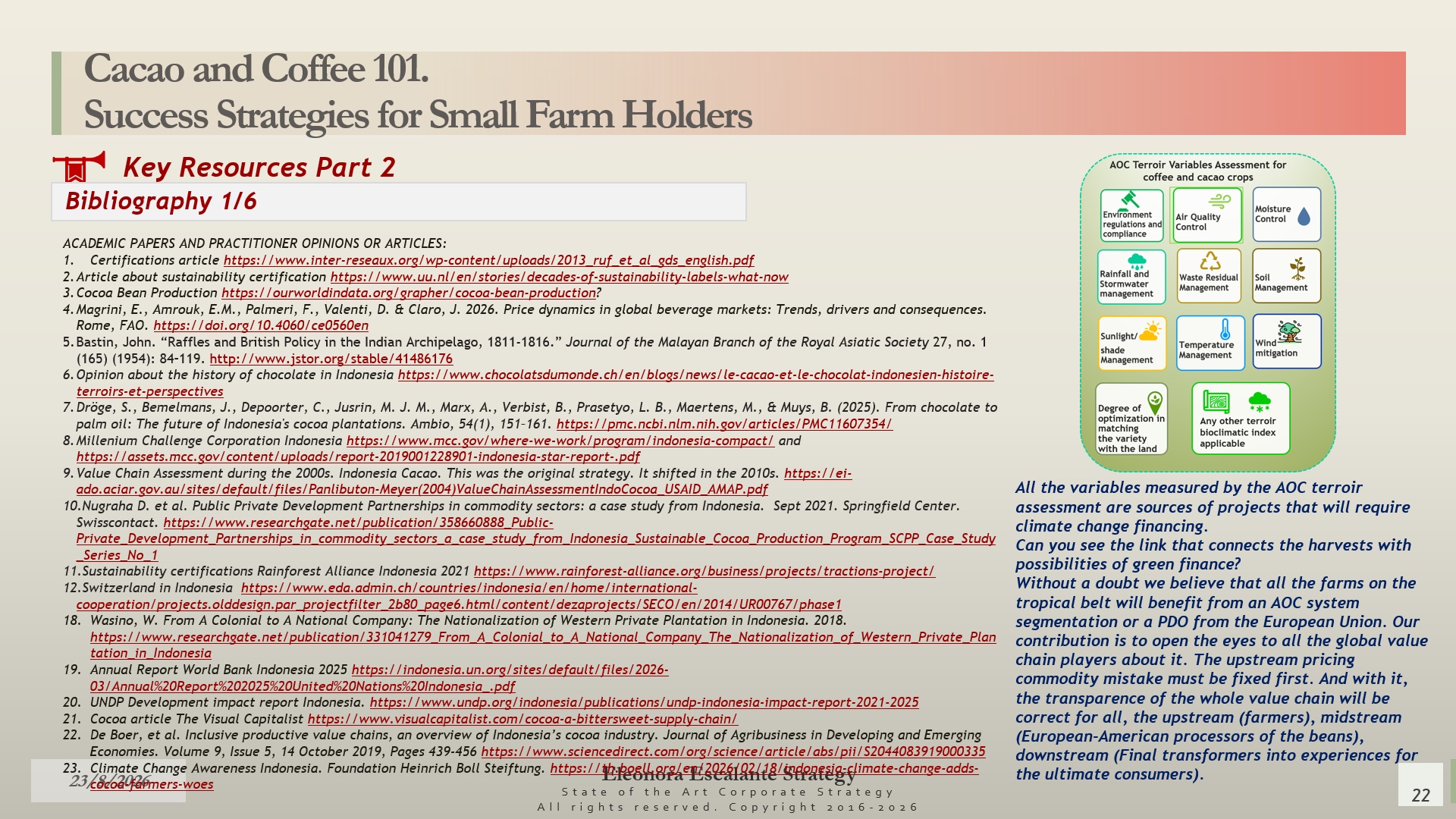
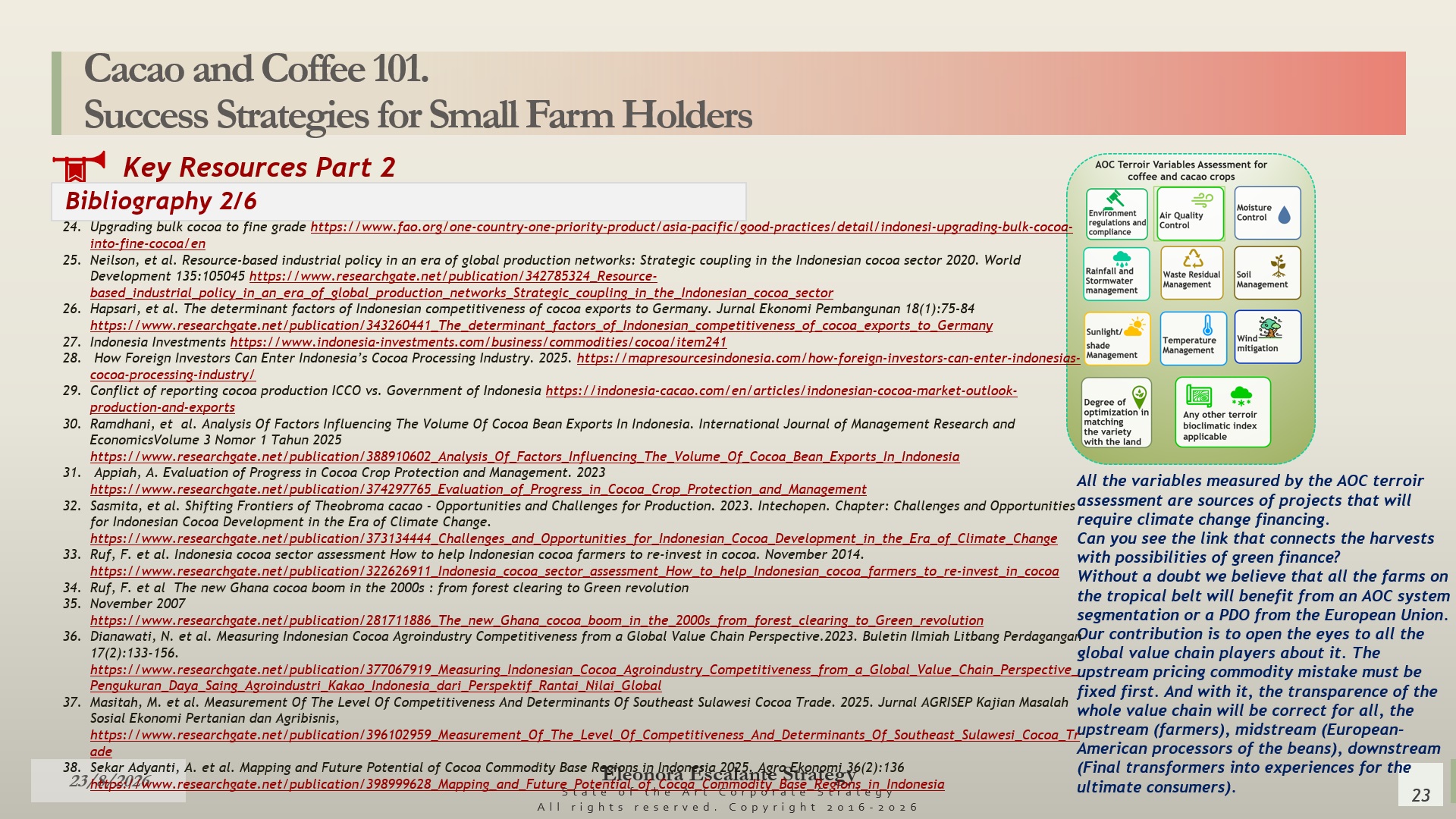
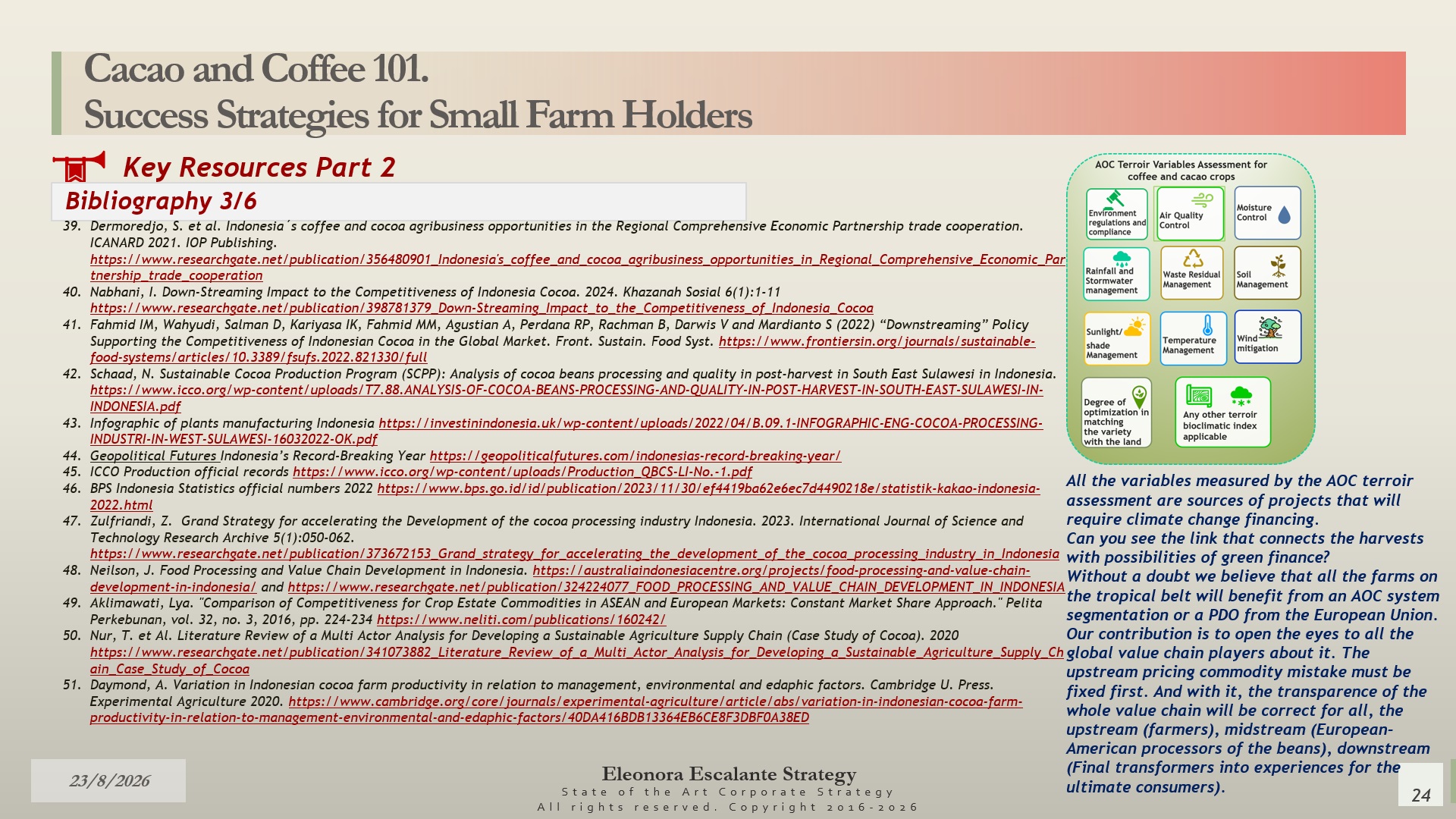
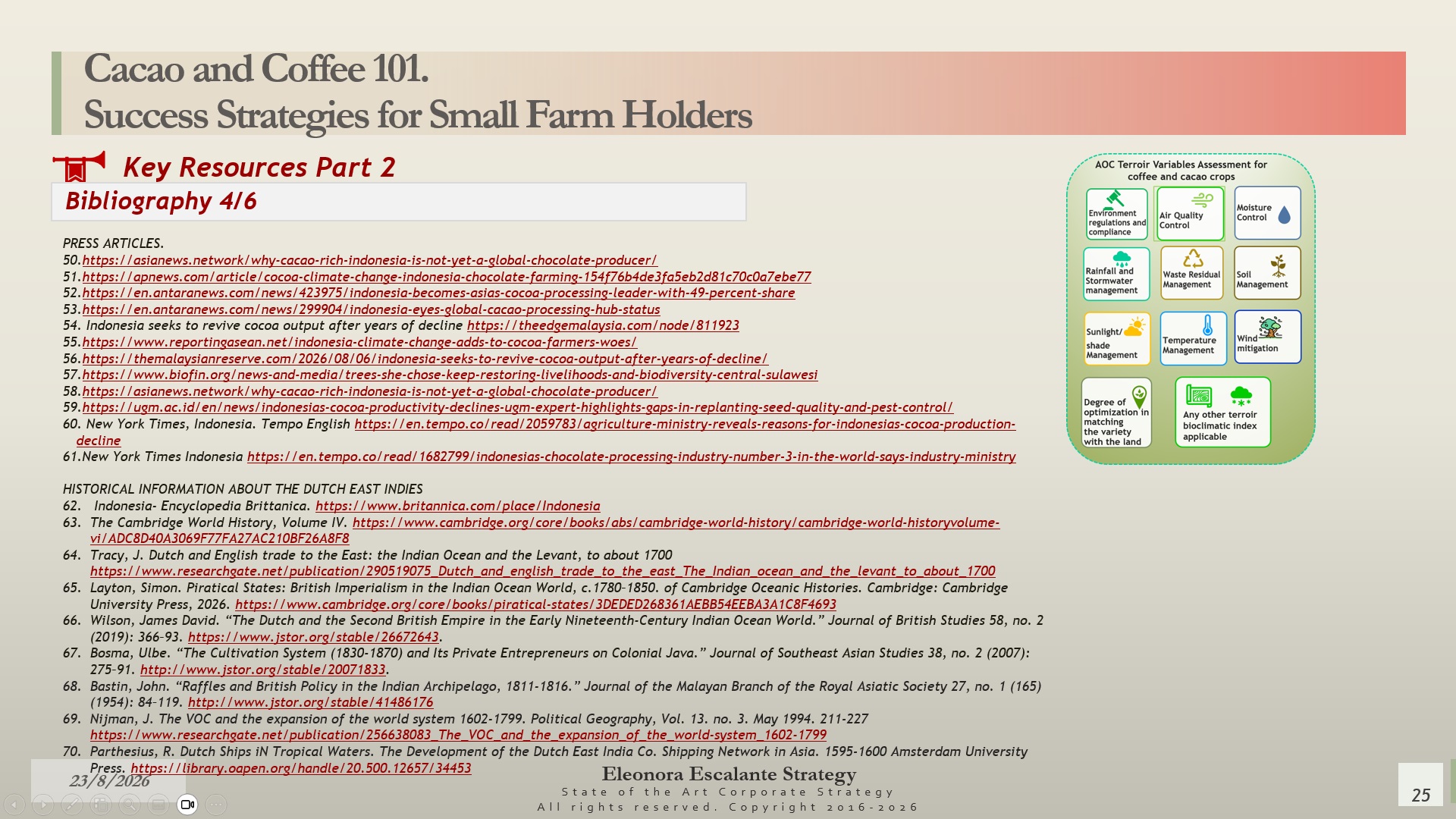
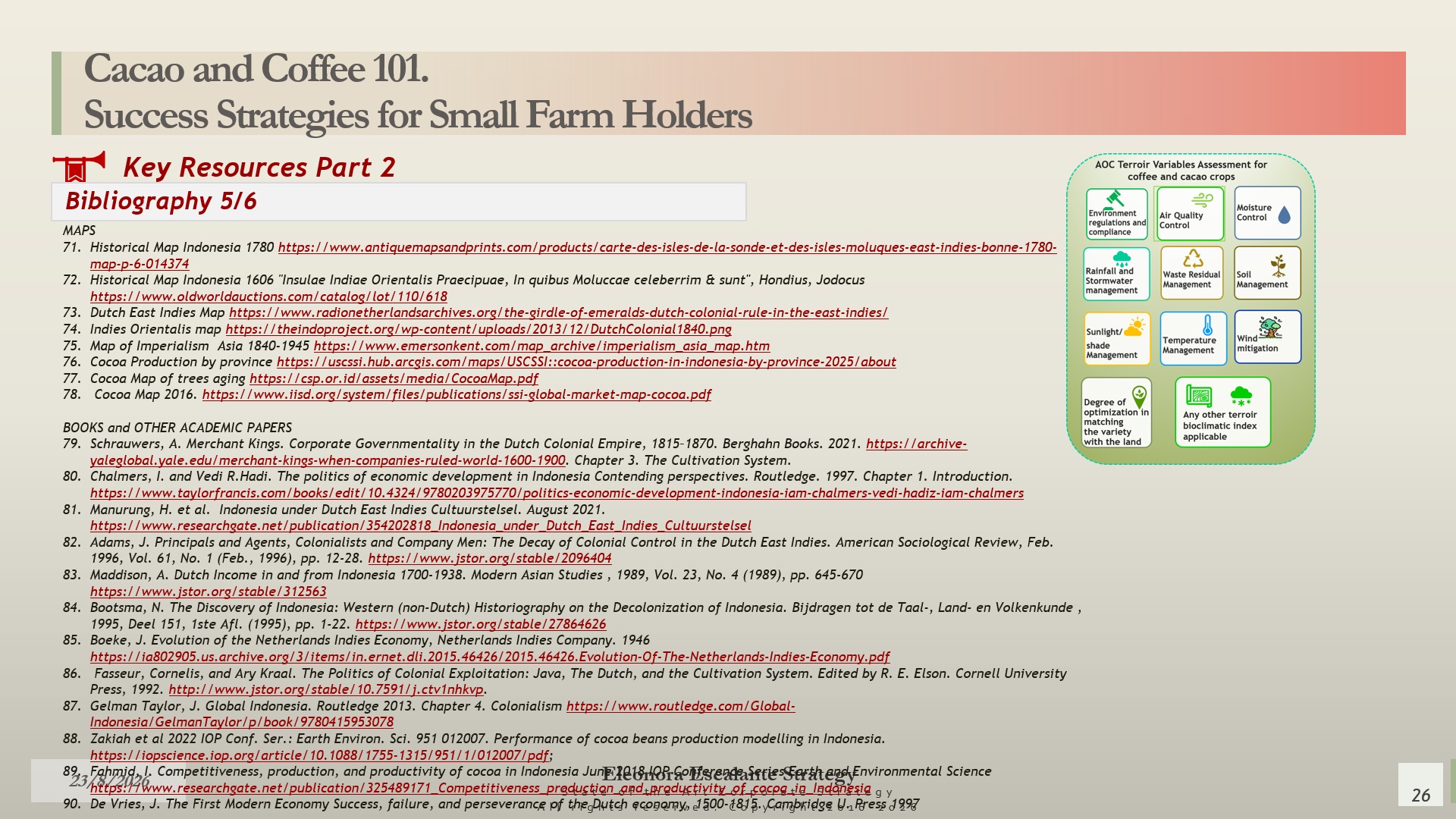
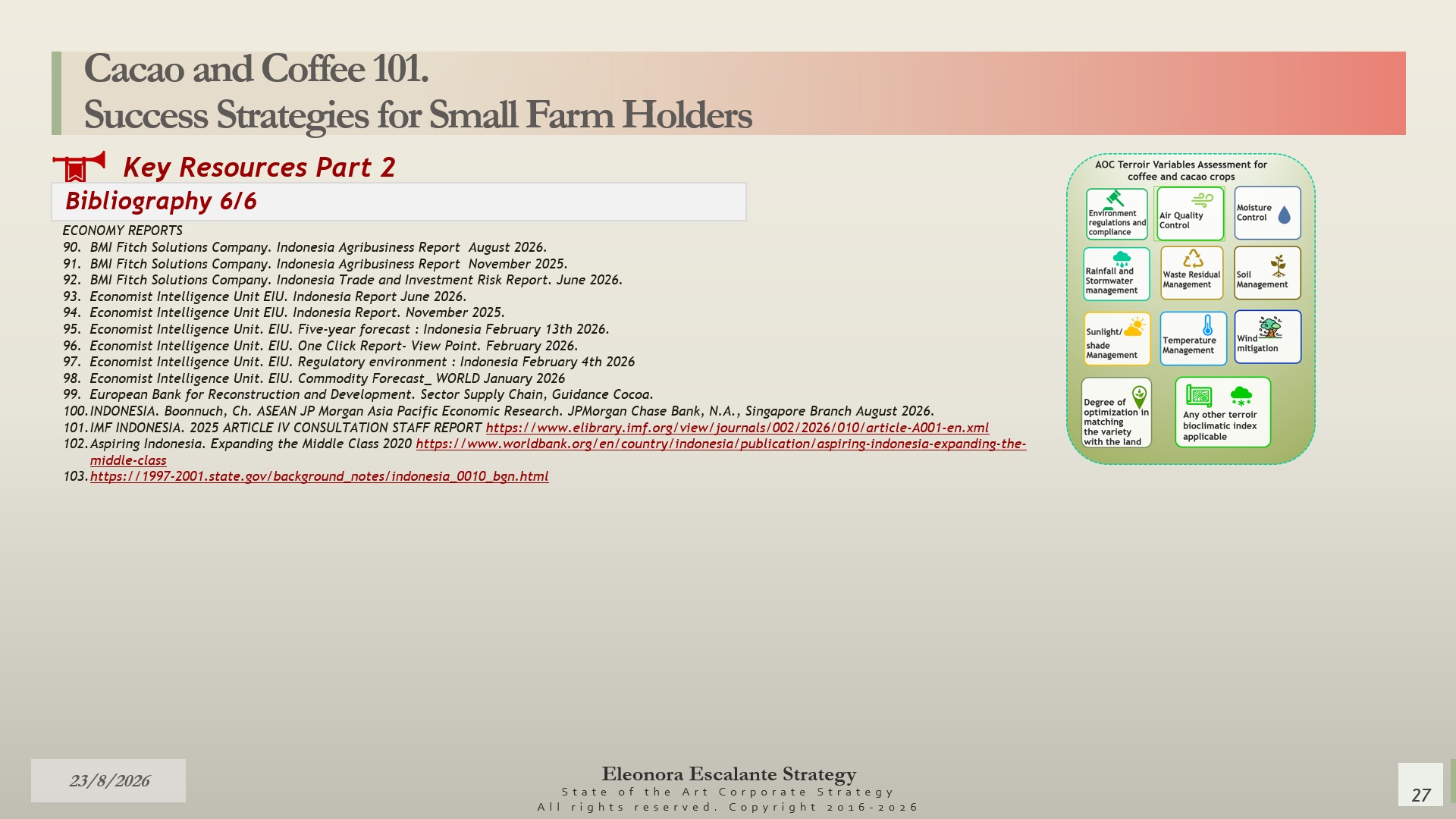
Your reference material is ready. You can print it on paper, download it, and read it over the weekend. The bibliography has been added at the end of this document. We expect you to read it too. It is the most extensive reading I have done for this saga. Feel free to share your thoughts with your colleagues, friends, and students.
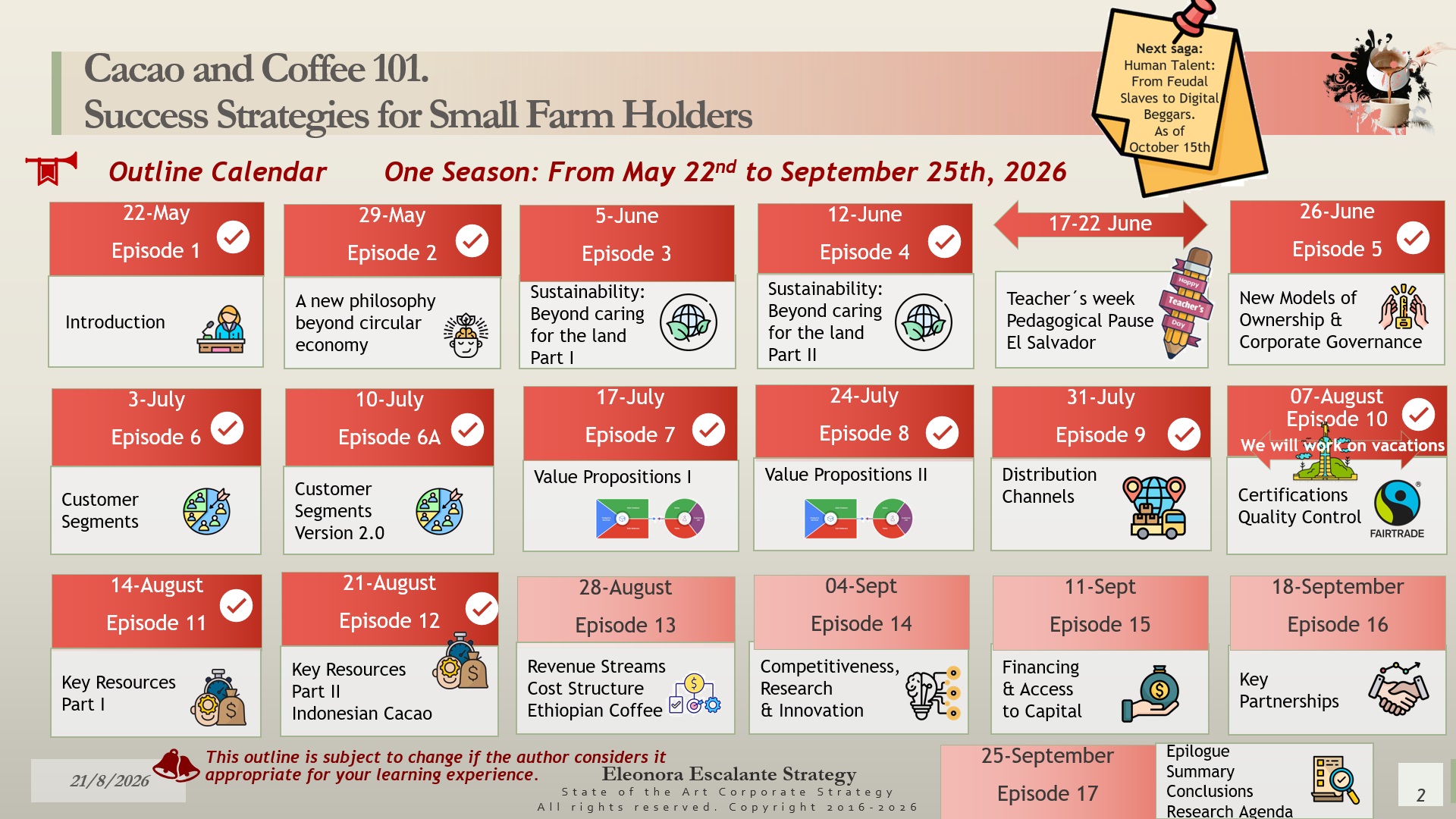
We kindly ask that you return next Monday, the 24th of August, to review our strategic reflections on this chapter.
We encourage our readers to familiarize themselves with our Friday master class by reviewing the slides over the weekend. We expect you to create ideas that are or are not strategic reflections. Every Monday, we upload our strategic inferences below. These will be discussed in the next paragraph. Only then will you be able to compare your own reflections with our introspection. We always give our students a couple of days to prepare well before our final reflection.
Strategic reflections on this episode.
These will be in the section below on Monday, the 24th of August of 2026.

Cacao and Coffee 101. Success Strategies for Small Farm Holders. Episode 12. Key Resources Part 2. Indonesian Cacao.
Indonesia. Historical standing. Slides 6-11
This chapter covers Indonesia’s history, including the Europeans’ emerging establishment in Asia. This is a required stopover before moving on to the key resources needed in the cacao industry.
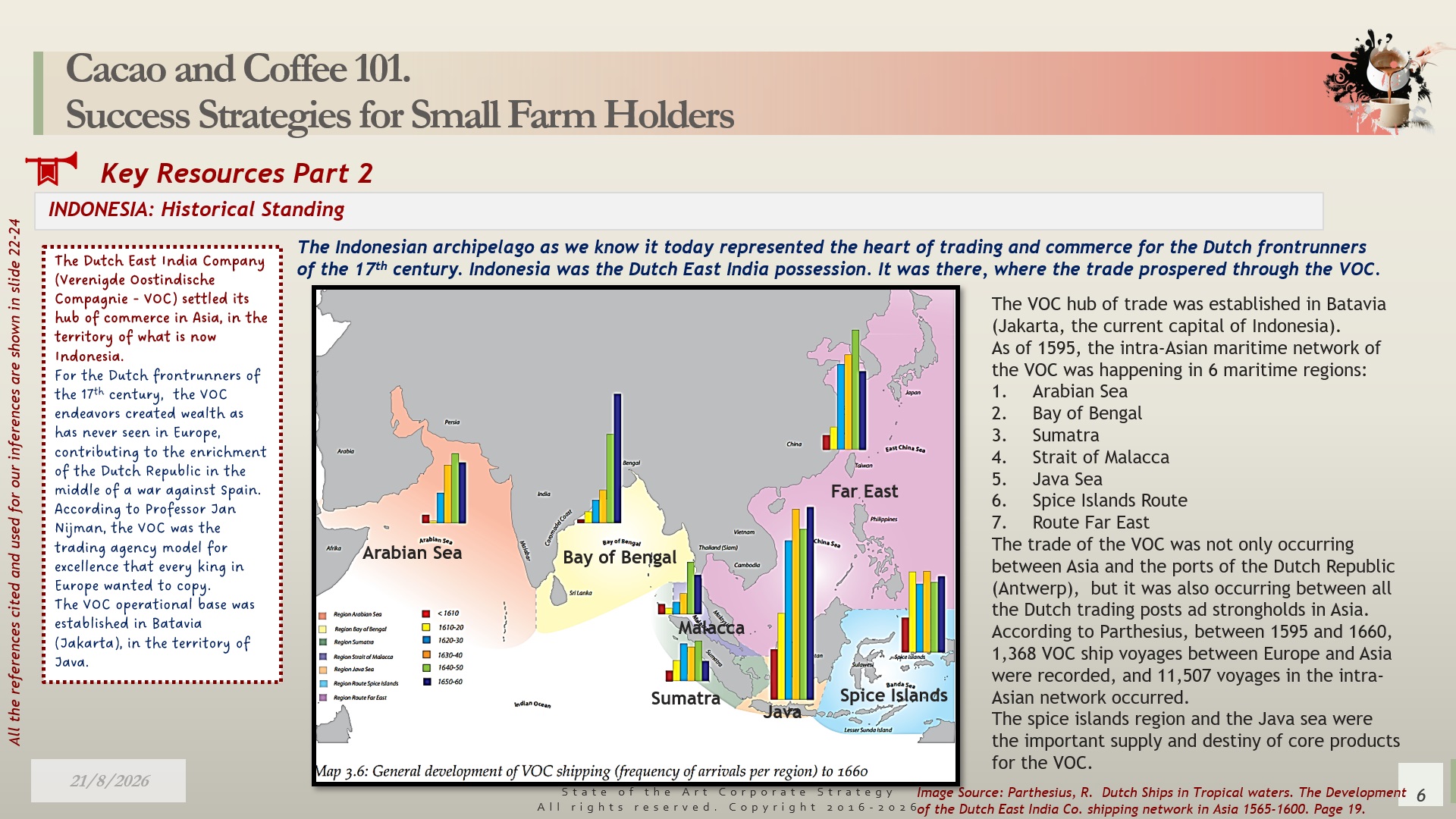
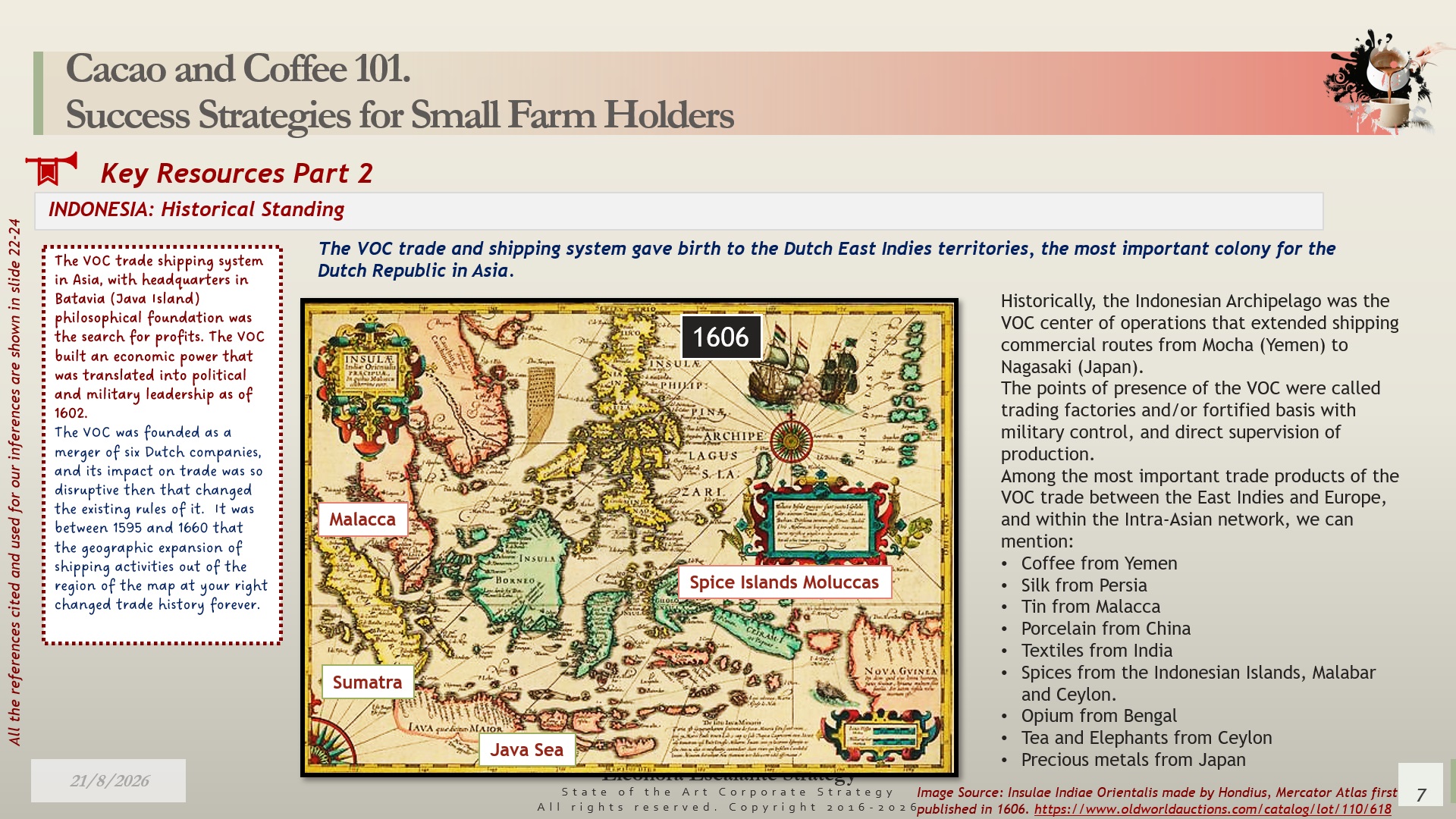
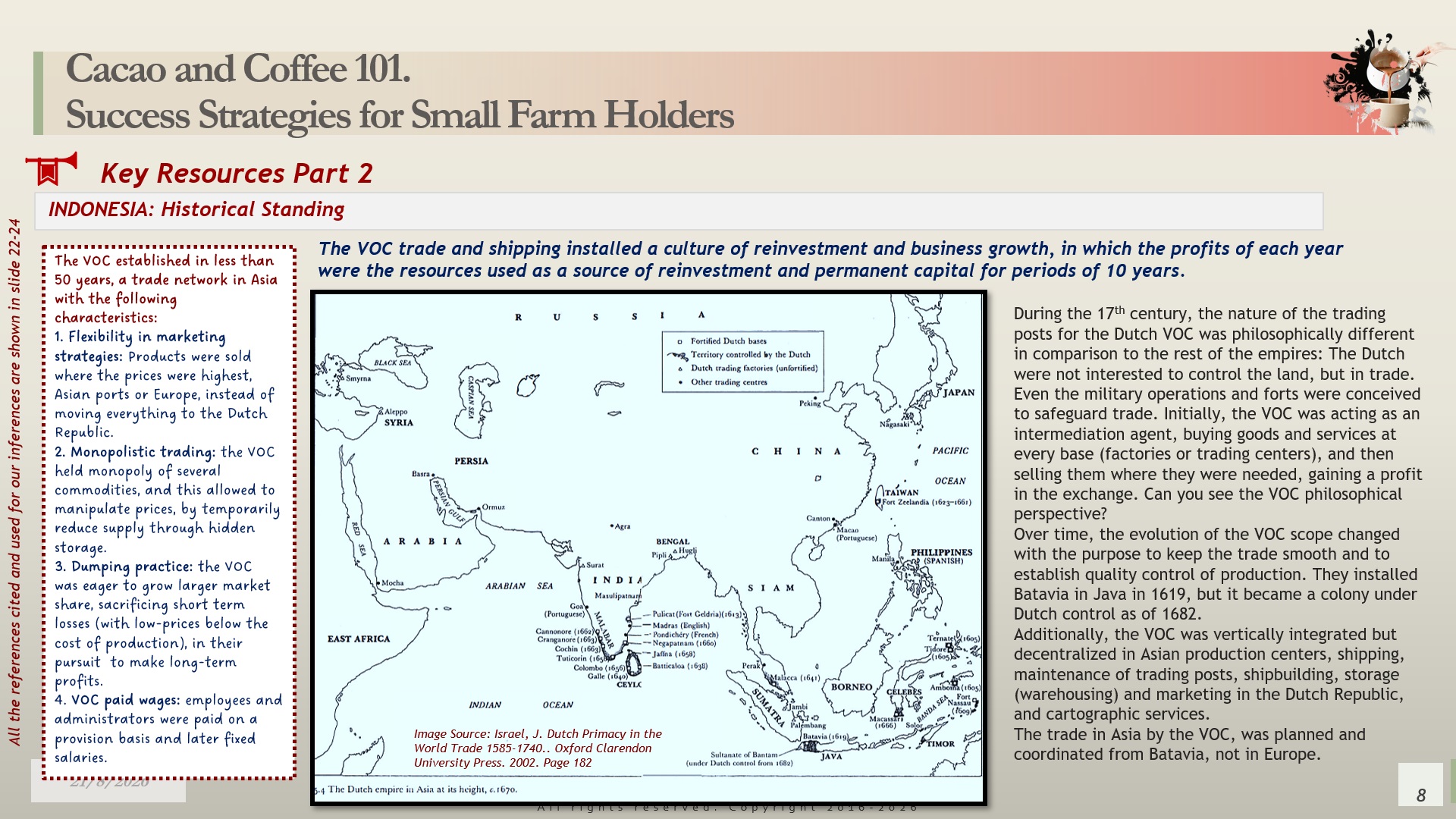
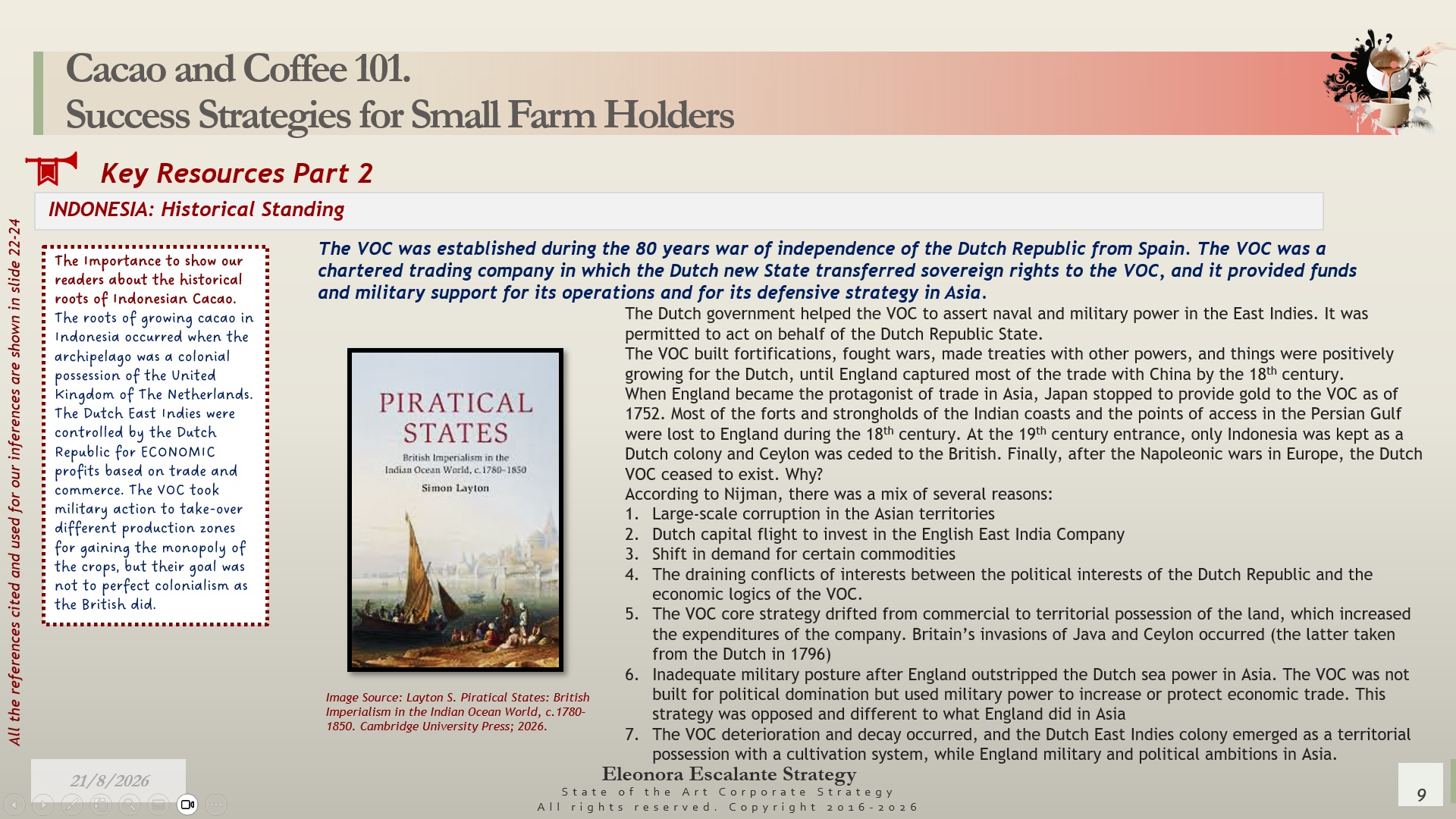
The history of Indonesia´s economy, as we know it, starts with the history of the VOC, the “Vereenigde Oostindische Compagnie”. The Dutch United East India Company gave birth to the economic life of Indonesia as a territorial sphere for trading. This system was later replicated in the world. This narrative about the VOC rooting in Indonesia is so mind-blowing because it was a commercial maritime endeavor of 7 petit provinces in the north of Europe that provoked the foundation and formation of a trading commerce system in which the local South-Asian communities were part of the exchange. It wasn´t the conquest of the nation to show off the extension of land. It was a domination of 7 seas in the Middle East, India, and Southern Asia, up to the north to Japan and Beijing. It was a trade power shipping machine under an assembly of philosophical premises to facilitate the actions of buying and selling goods, creating a new market of exchange. Suddenly, the priority was not to make business between Batavia and Northern Europe. It was to build an exchange network along the existing coastline and sea ports between Mocha-Yemen and Nagasaki-Japan. The VOC established a structure of numerous international maritime routes in the seven main seas of that regional organization. Can you see the fantastic parable behind it? When I was preparing your reference material for today, my mind flew to try to understand the rationale of the heads of the leaders of the Union of Utrecht: Holland, Zeeland, Utrecht, Gelderland, Over-Ijssel, Friesland and Groningen? According to official history, these lords were fighting against Spain to keep their land out of the Habsburg-Aviz domains; and at the same time, their fervent desire to stand economically out of the territories of Spanish America made them turn their regards to the East. They went to look for the place that Christopher Columbus was originally searching for, and they got the trophy of the East Indies. The Dutch East Indies. While Spain under the Habsburgs was busy colonizing America, the Dutch were infiltrating and building forts, warehouses, ports, and factories on the West. The coastline between Mocha, Yemen; and Beijing, China could be measured between 20,000 km and 25,000 Km. The VOC pulled Dutch people from Europe and established them along this shoreline to make strategic alliances with the leaders of these communities, to make deals with the locals (without knowing any dialect). The objective: to trade for a profit. The Dutch created and expanded a shipping network of monumental volume between 1602 and the mid-18th century. Guess from which Oriental hub? From Batavia (today Jakarta, Indonesia).
The Dutch installed commerce through their differentiated, efficient ships, through accurate access to “excellent confidential and detailed information”, disciplined management, knowledge of the most profitable products, prices, and a prompt logistic administration (1). While in the West Indies, the Spanish were traveling in heavy galleons; in the Oriental Indies, the Dutch optimized different sizes of ships connecting the supply of cargoes in an intra-Asian web of locations, and intercontinental Europe. According to Parthesius, 1,368 voyages occurred between Europe and the Dutch Asian ports, while 11,607 voyages took place in the Arabian Sea, the Bay of Bengal region, the Malacca and Sumatra seas, the Java Sea, the Spice Islands sea territories, and the ocean up to Nagasaki, Japan. While the Dutch were building the South-Asian East Indies trade system, the Eighty Years’ War was taking place in Europe until the Westphalia agreement took place (year 1648). Spain got the Southern part (where Belgium is at the moment), and the northern Dutch region was proclaimed as the Dutch Republic, with its absolute independence from the Habsburg branch of Spain. By 1677, the prince stadtholder of the Dutch Republic, Willhelm Orange-Nassau/Stuart-Bourbon, got married to Mary II Stuart-Bourbon/Hyde-Aylesbury, his cousin. With the marriage arrangement of this ultra-powerful couple, William III Orange and Mary II Stuart, the priorities for the Dutch Republic started to change. The Dutch East Indies system was gradually dissipating because Britain under the Stuarts, and later under the German Hannovers (Guelph or Welf of Brunswick Luneburg-Wittelsbach), was going to take the Oscar red carpet in Asia.
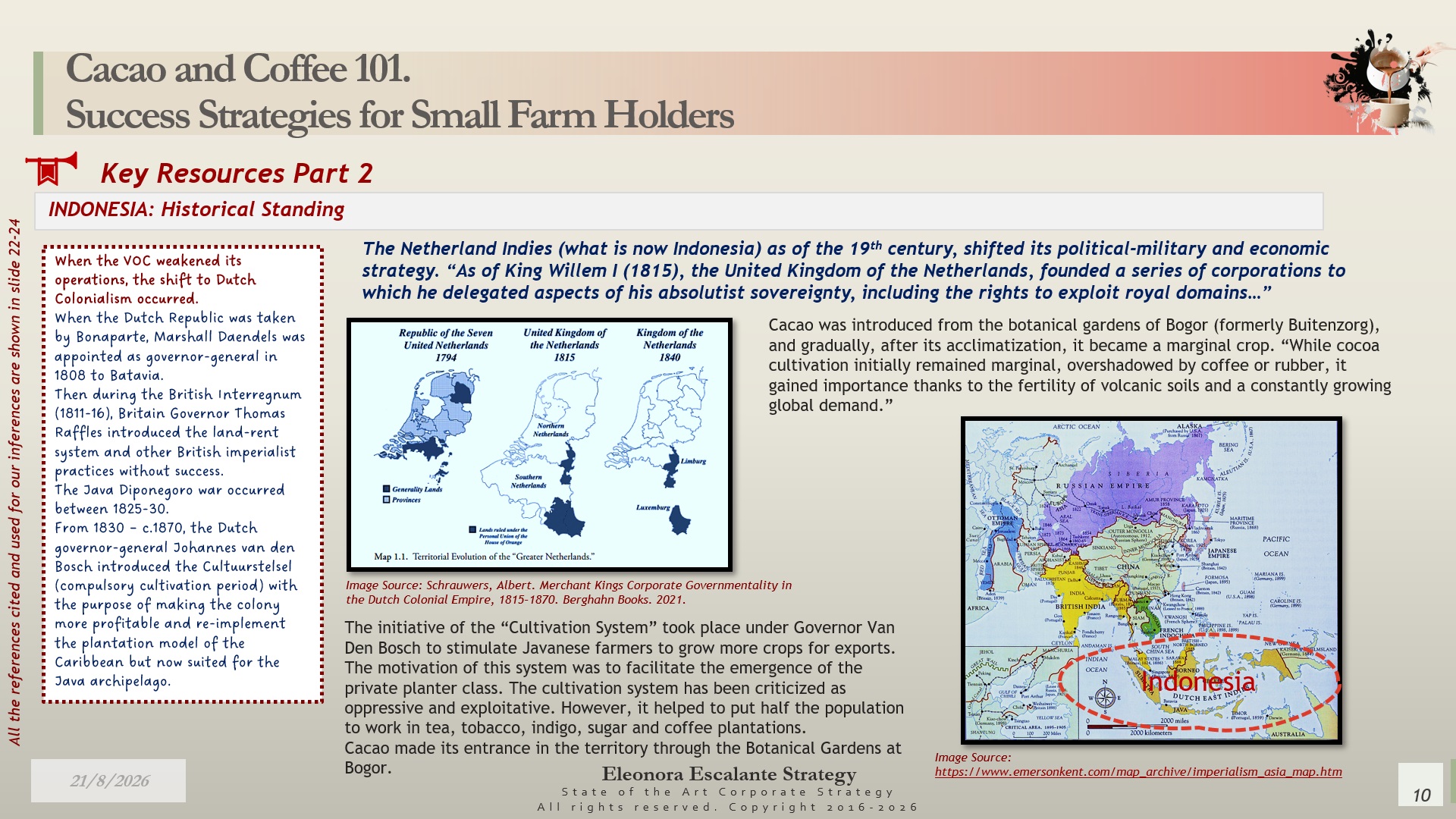
After the French Revolution and the failure of the Bonapartes in France, the Dutch switched their strategy from traders on the coastlines of the Middle East, India, and Southern Asia to establish the first resident colonies with Joannes van Der Bosch (1780-1844).

It is important to note that slavery was used by the Dutch, and despite the bankruptcy of the VOC in 1798, slavery continued during the period of the United Kingdom of the Netherlands. Slavery continued in the Dutch East Indies, and it wasn´t abolished until 1860.
The Cultivation System (Cultursteelsel) 1830-1870.
When the Dutch began their official colonial domination in the Netherlands Indies Archipelago, the plantation system design comprised indigo, sugar, coffee, and cotton. The introduction of the “cultursteelsel” was the solution to make these tropical lands profitable, while facing the problem of local labor. Van den Bosch, the Dutch governor-general located in Batavia, installed the policy that obliged every village to allocate 20% of its land to be planted with export commodities (coffee, tea, sugar cane) to be transported to Europe. Cacao was still not that relevant then. The enforced local farmers´ crops were sold to the colonial government agents at a fixed price. The landless local residents were on duty to work a year (75 days) partially on state lands. This was the secret of the following economic success of the plantations in the archipelago: to separate the growing of crops, paying the farmers a fixed low price, from the processing of them. It was here that the chattel slavery unfree-old system used during the VOC times was replaced by indentured labor. It became coerced labor. The growing of crops was left in the hands of the locals, or local landless contractors, while the processing was in the hands of the Dutch manufacturers. Any similitude with the current conflict of interest between the tropical belt upstream farmers and midstream manufacturers of cocoa and coffee is not a coincidence. The system was designed as such during the 19th century. Despite that, the culturesteelsel was banned in 1870; the model of free forced/indentured labor was then replicated in Cuba and other plantations in Central and South America.
Who was trading between Europe and the Netherlands Indies during this period? At the time of Van den Bosch, the VOC was already smashed. It was replaced by the NHM (Netherlands Trading Society). By 1840, the NHM bought 90% of the tropical export products from Indonesia in exchange for cotton clothes produced in the Netherlands. A new commercial trading system was taking place, in which forced labor and other patterns of indebted labor were imposed in Dutch territories (2). In summary, according to our research, it is important to remark that the VOC used chattel slavery during the whole 17th– 18th centuries. During the 19th century, the NHM used coerced labor and indebted labor. Where? In the Netherlands Indies territories, which grew in size to what is now Indonesia.
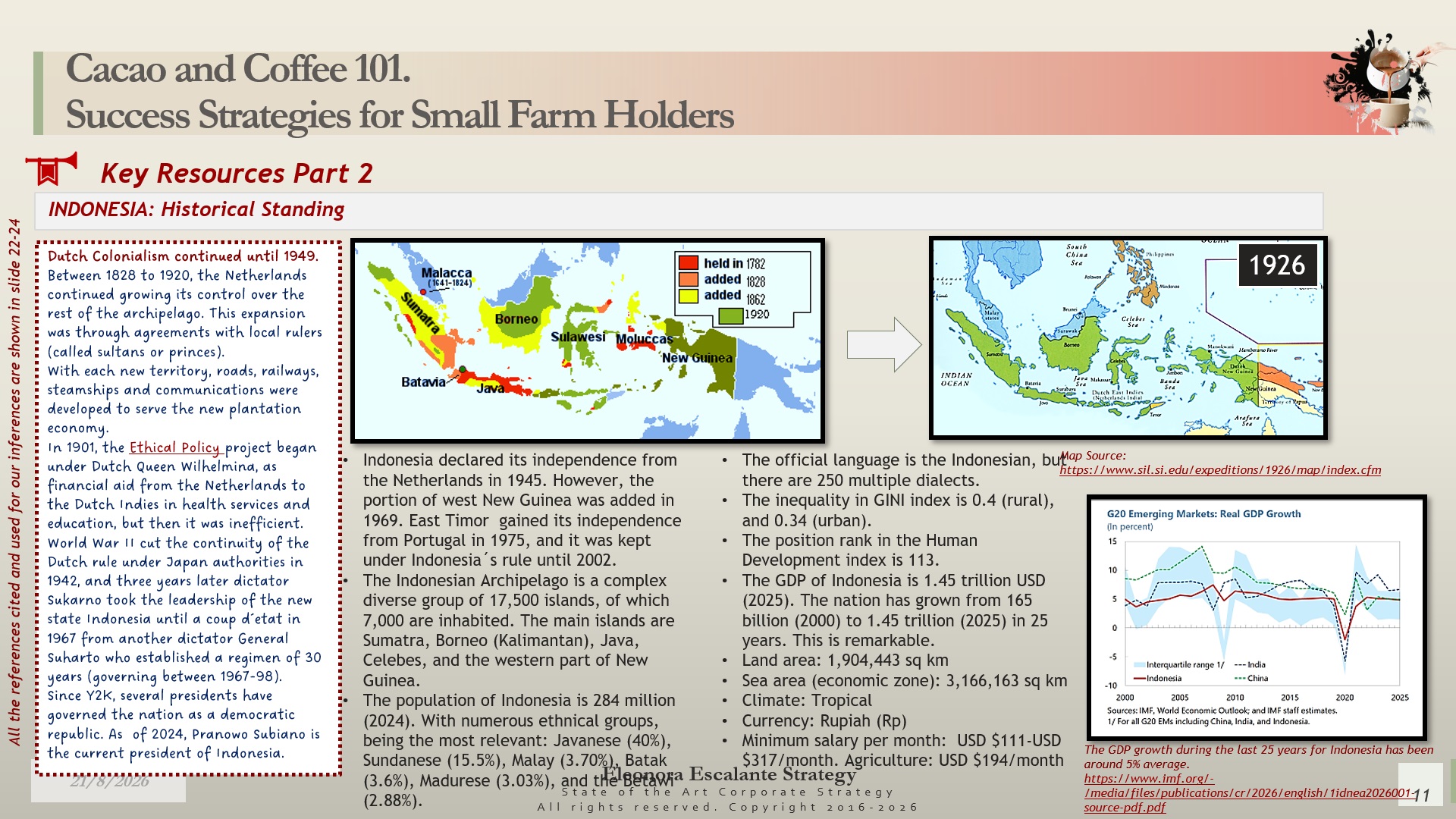
The 20th century was the time of twilight for the Netherlands. It lost its precious archipelago to Japan (temporarily between 1942-45), and then two dictators took the baton of the new independent nation Indonesia: Sukarno (ruled from 1945 to 1967), and Suharto (ruled from 1967 to 1998). Since the 2000s, several presidents have governed under a democratic republic. At this moment, Prabowo Subianto is the current president of Indonesia.
Indonesia’s Economic Structure and social-employment context. Slide 12-13
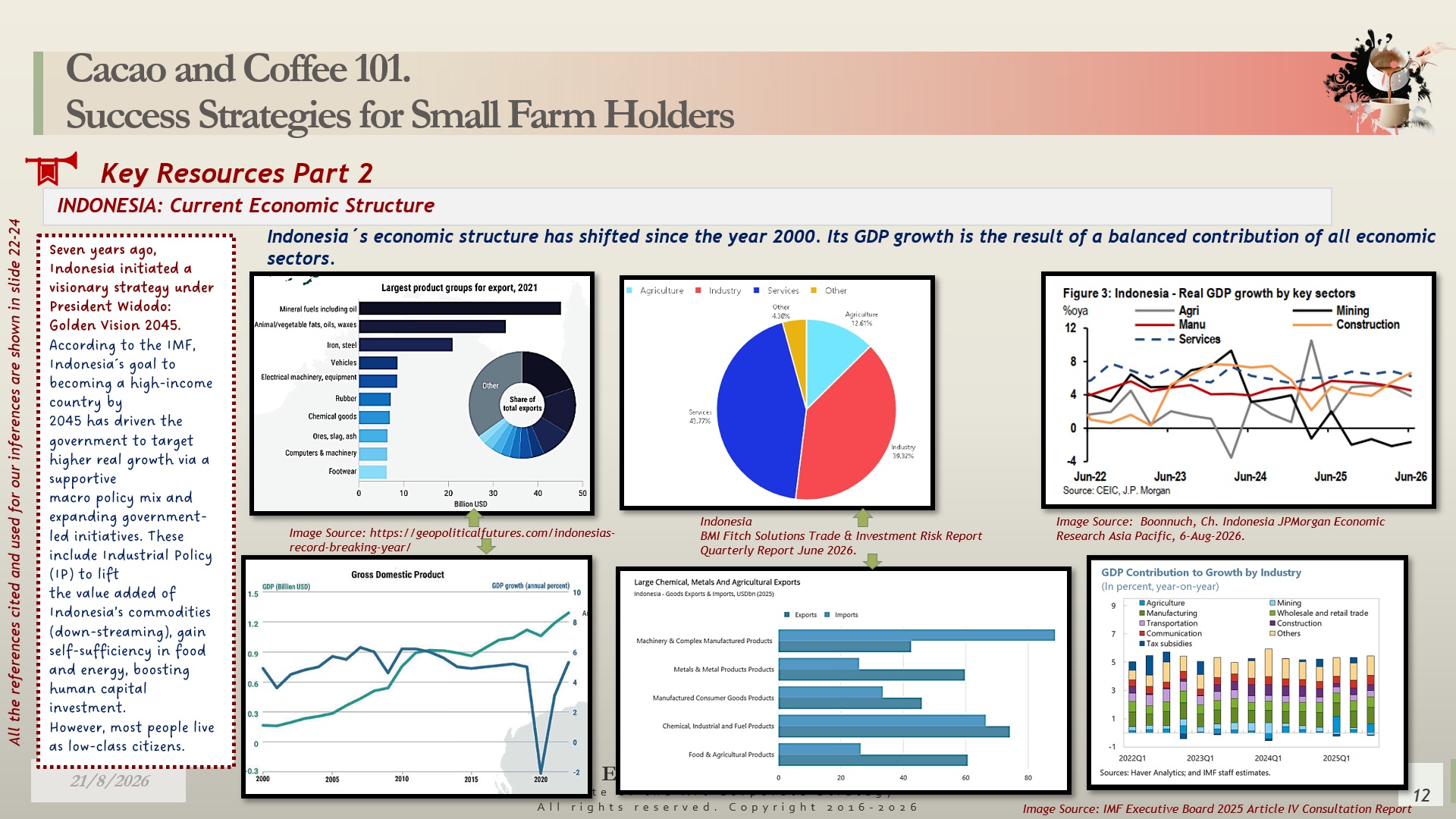
This slide describes the balanced structure of the economy of Indonesia. Today. It has been designed to equilibrate inflation, after suffering from what the economists have defined as Dutch Disease. When one prominent sector goes up, the rest diminish to null or low contribution to GDP growth. But when the prominent sector falls, the others are moved up to act as a cushion that helps to keep inflation on point. Indonesia holds 17,500 islands, a total land area of 1,904,443 sq km. The population of Indonesia is 284 million inhabitants, and most of them are Muslim. I would like to remark that 25 years ago, Indonesia´s GDP was 165 billion USD, and its steady growth of 5% per year has taken the nation to raise its GDP to 1.45 trillion USD (2025).
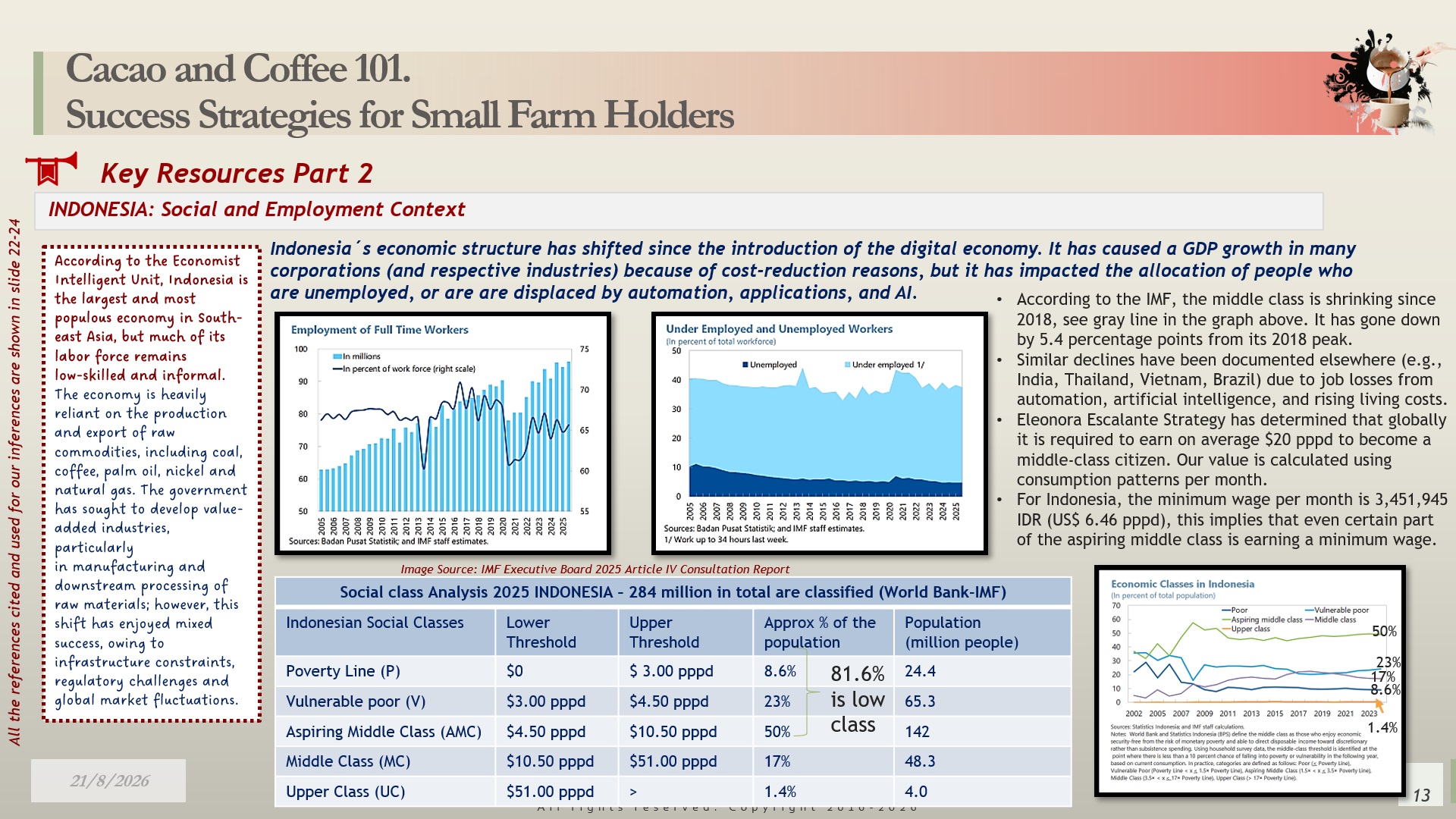
Indonesia is not a rich nation. Most of the population is low-class, earning less than US$10.50 pppd. Only 17 % is Middle-Class (with earnings between $10.50 and $51 pppd), while the Upper-Class is just 1.4% of the population. See slide 13. We used the poverty line of $3 pppd established by the World Bank this year, and from there we calculated the data using the proportions of the International Monetary Fund’s last report 10/26 on Indonesia. On average, 40% of the population is underemployed, most of them in the informal sector (that means these individuals do not enjoy government welfare benefits, such as social security, paid vacations, and pension savings).
Indonesia Exports and Imports (Slide 14).
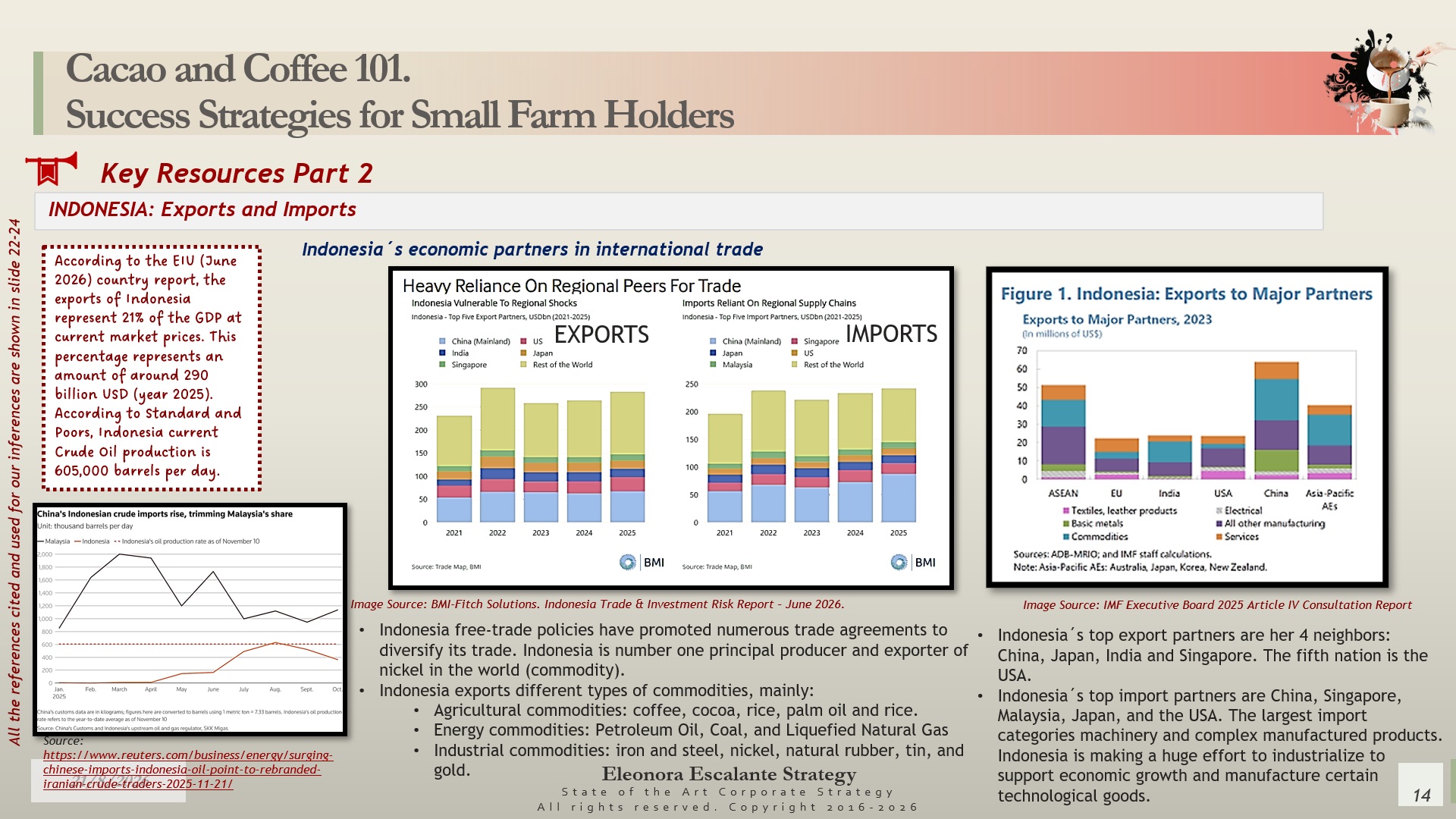
The importance of this slide is to show you who the reciprocal partners of international trade of this nation are: its neighbors. It is the same regional intra-Asian network that existed during the times of the VOC and the NHM. China, Japan, India, and Singapore are the top export partners. In terms of imports, the top partners are China, Singapore, Japan, and Malaysia. The USA is the fifth-largest trading partner with Indonesia. In both directions, China is the main commercial partner or protagonist with Indonesia. Commodities and other manufacturing goods are the main sources of trade. The commodities pertain to agriculture, energy, minerals, and industry: coffee, cocoa, rice, palm oil, petroleum, Coal, Liquefied Natural Gas, iron and steel, nickel, natural rubber, tin, and gold.
How Indonesia organizes its resources to strengthen cocoa small-farmers (slides 15-21).
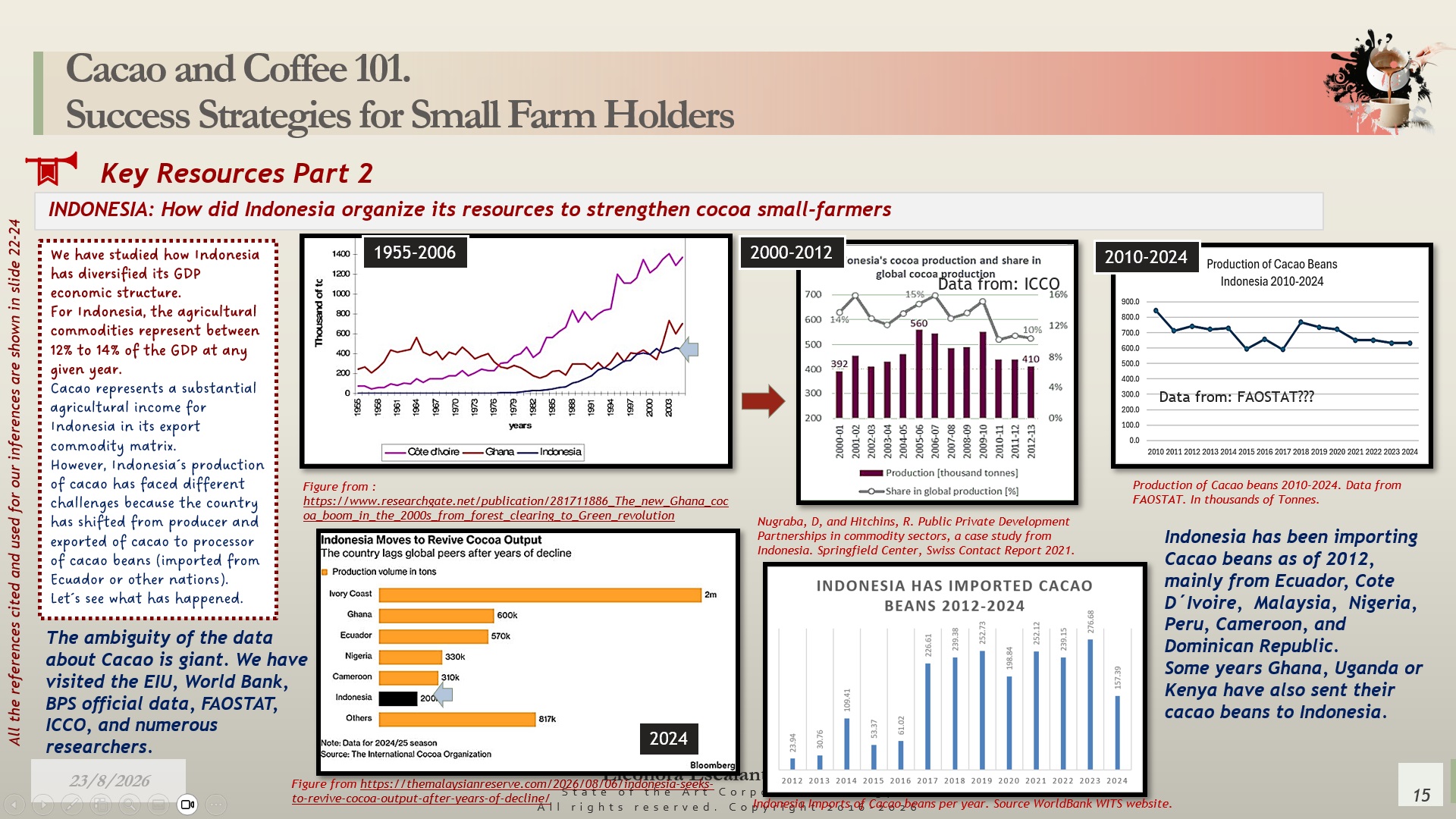
First, we explored what the size of cocoa exports was and its global market share, in terms of cacao beans. We found discrepancies in the data. However, that did not stop us. It made us dig deeper into the national cacao strategy of Indonesia. And then we found out a possible why. At the beginning (before the 2000s), Indonesia was fighting for every inch of market share in the segment of cocoa bean exports against Côte d´Ivoire and Ghana. However, something happened in the 2000s: Indonesia´s cacao orchard park (understood as the total amount of living cacao trees in the territory) got sick. When the cacao trees got sick from diseases and age, there was a huge effort made by international certification agents to train the small farmers to recover their trees while fighting against the diseases. Their interest was to maintain the same old strategy of producing cacao beans for exports.
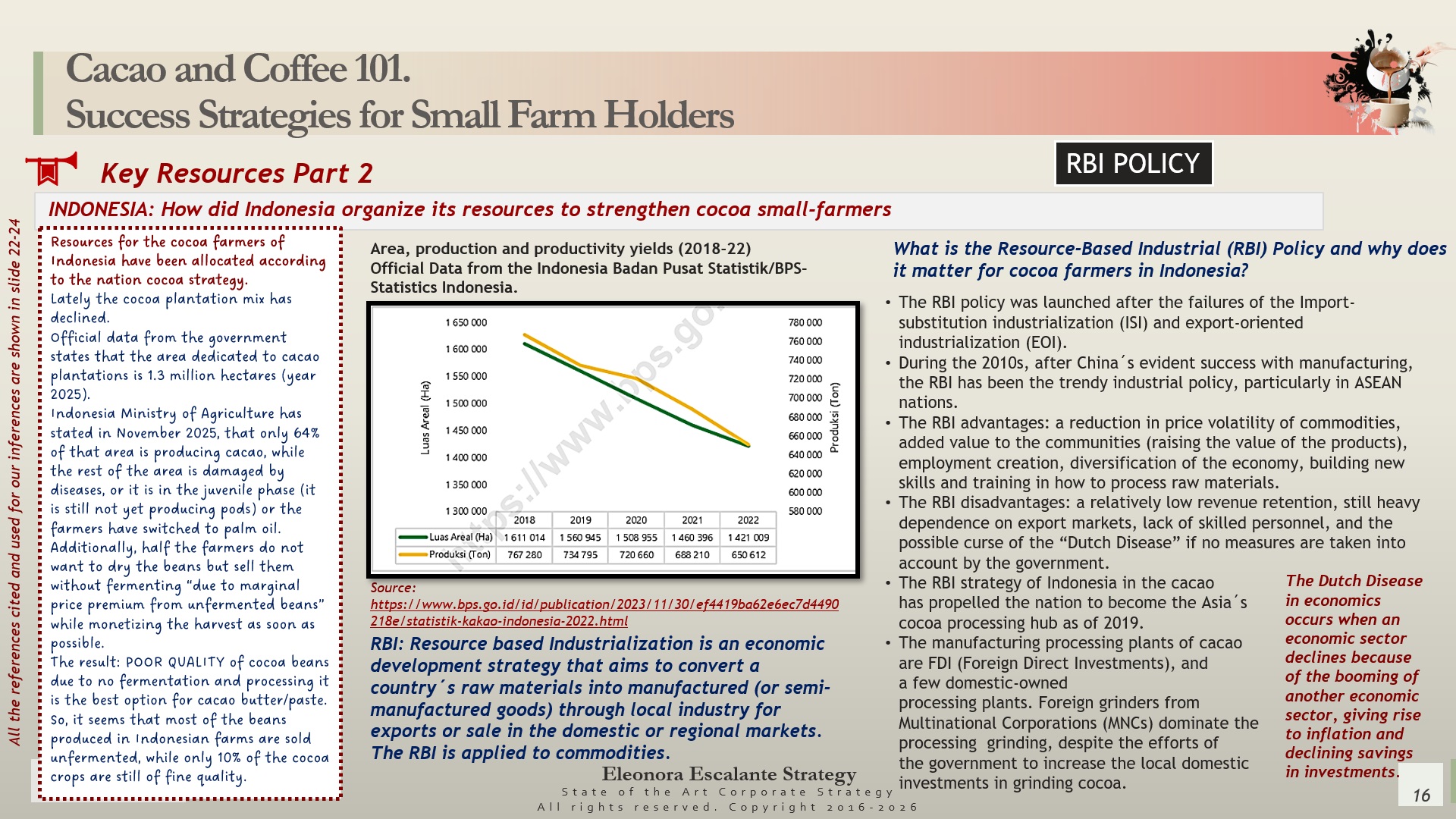
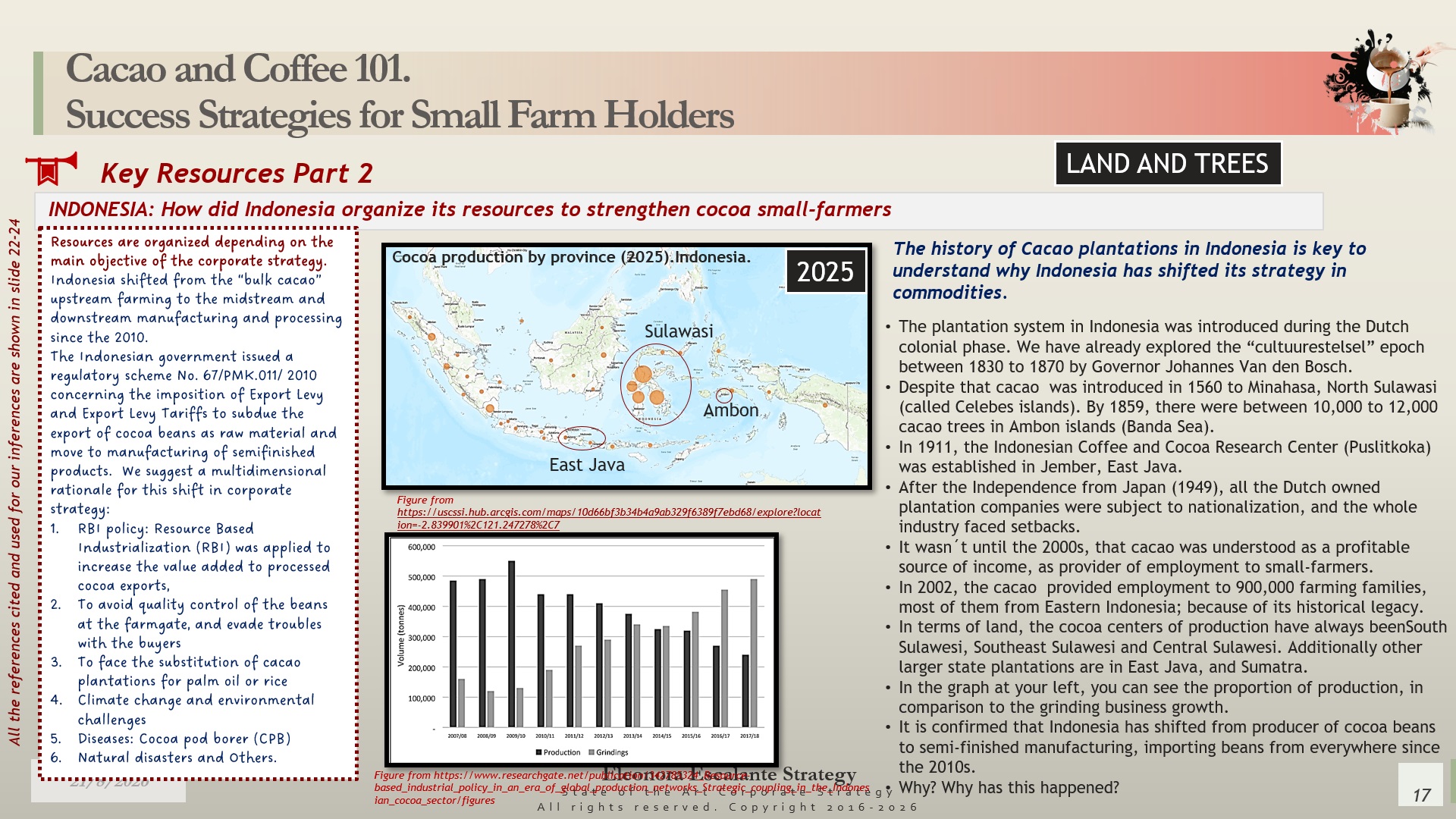
However, Indonesia´s position in the archipelago has been observing China´s growth to the north. And Indonesia decided to turn the rules of the game. Indonesia considered a new strategy: Resource-Based Industrialization (RBI). See slide 16. And by choosing the RBI, the nature of the products changed, and the national cacao production strategy also shifted. RBI was applied to the cacao industry, and by determining to convert the cacao beans into manufactured (semi-finished goods), the whole value proposition changed, including its markets. While promoting domestic-regional consumption of these new products, Indonesia changed its “national corporate strategy” since the 2010s. By domestically manufacturing cocoa paste, cocoa butter and other oils, cocoa cake, and cocoa powder, the Indonesian cacao farmers were no longer in the hands of the old system of intermediaries. All the new manufacturing plants have been built to produce cocoa butter, not just to grind the beans. And cocoa butter doesn´t require compliance with standards to produce high-quality cocoa for fine chocolate in Europe. A switch of standards created a new industry that has grown exponentially, with higher export prices in comparison to the cacao beans. Take a look at an infographic document from the Ministry of Investment of Indonesia about the regional investment promotion prepared in 2020 to attract investors for building the processing industry of cocoa butter and cocoa powder in the Polewali Mandar plantation, West Sulawesi. Click below:
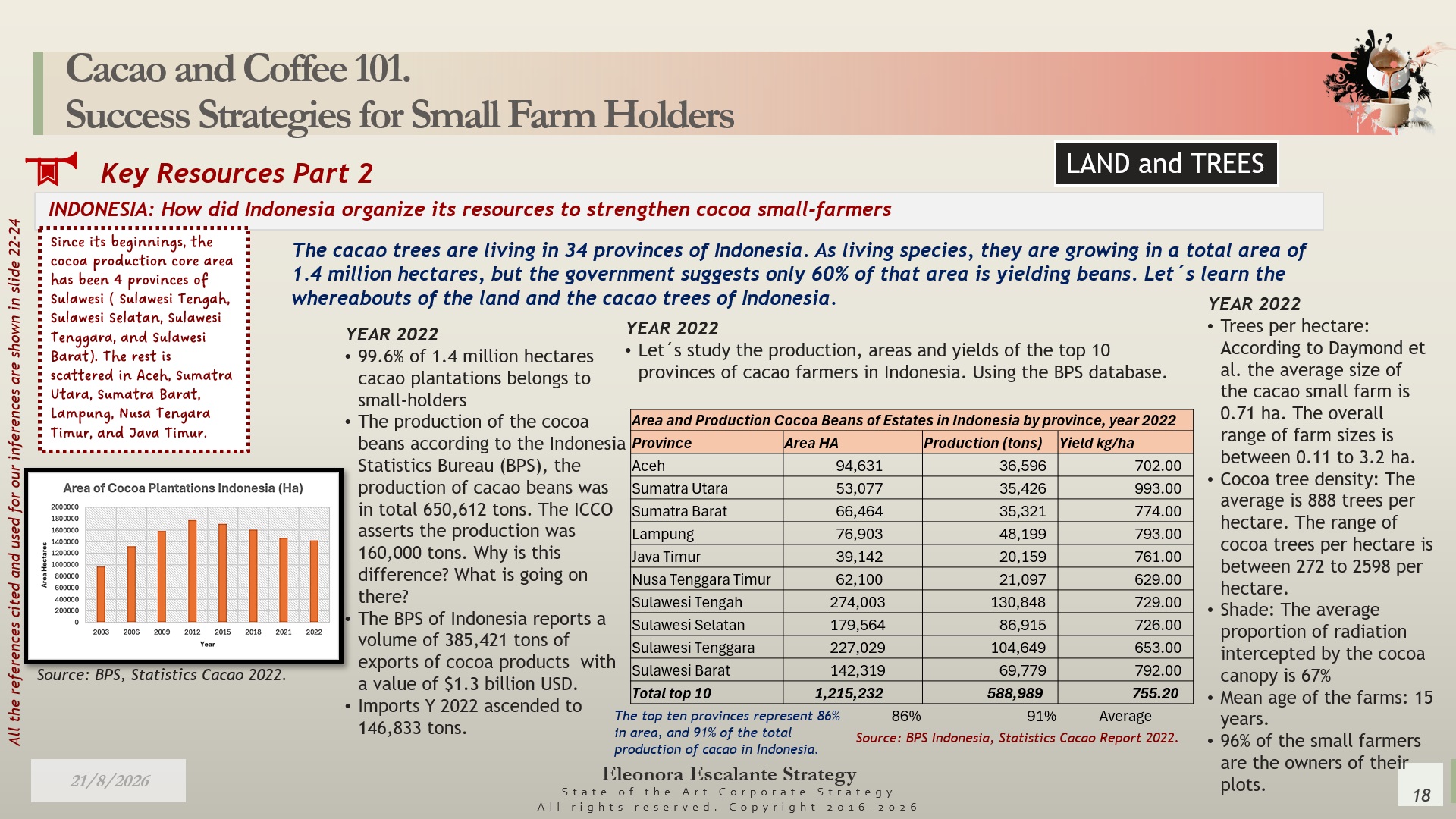
The International Cocoa Organization (ICCO) registers cacao bean exports with marketable value for the midstream chocolatiers. This has been their hereditary objective since colonial times. And the Government of Indonesia, through its Bureau of Statistics (BPS), records the total amount of production of cacao (in all the possible formats, regardless of whether these numbers are going to be processed domestically in multiple products or will be exported in beans). That is the discrepancy between the databases found in our research. Consequently, we kept using the official data from the Indonesian Badan Pusat Statistik bureau (BPS), which matches with the FAO-Stat and the available data of the World Bank (WITS database). Since the 2010s, Indonesia has been importing cacao from other nations because it is operating with 64% of the total area dedicated to cacao harvests (1.3 million hectares). We suggest that the huge plants belonging to multinational corporations with grinding facilities are committed to the standards of Europe, so their quest for raw materials has pushed the limits to search for them mainly in Ecuador, Perú, Ghana, Côte d’Ivoire, Nigeria, Cameroon, Malaysia, Dominican Republic, Uganda, and Kenya.
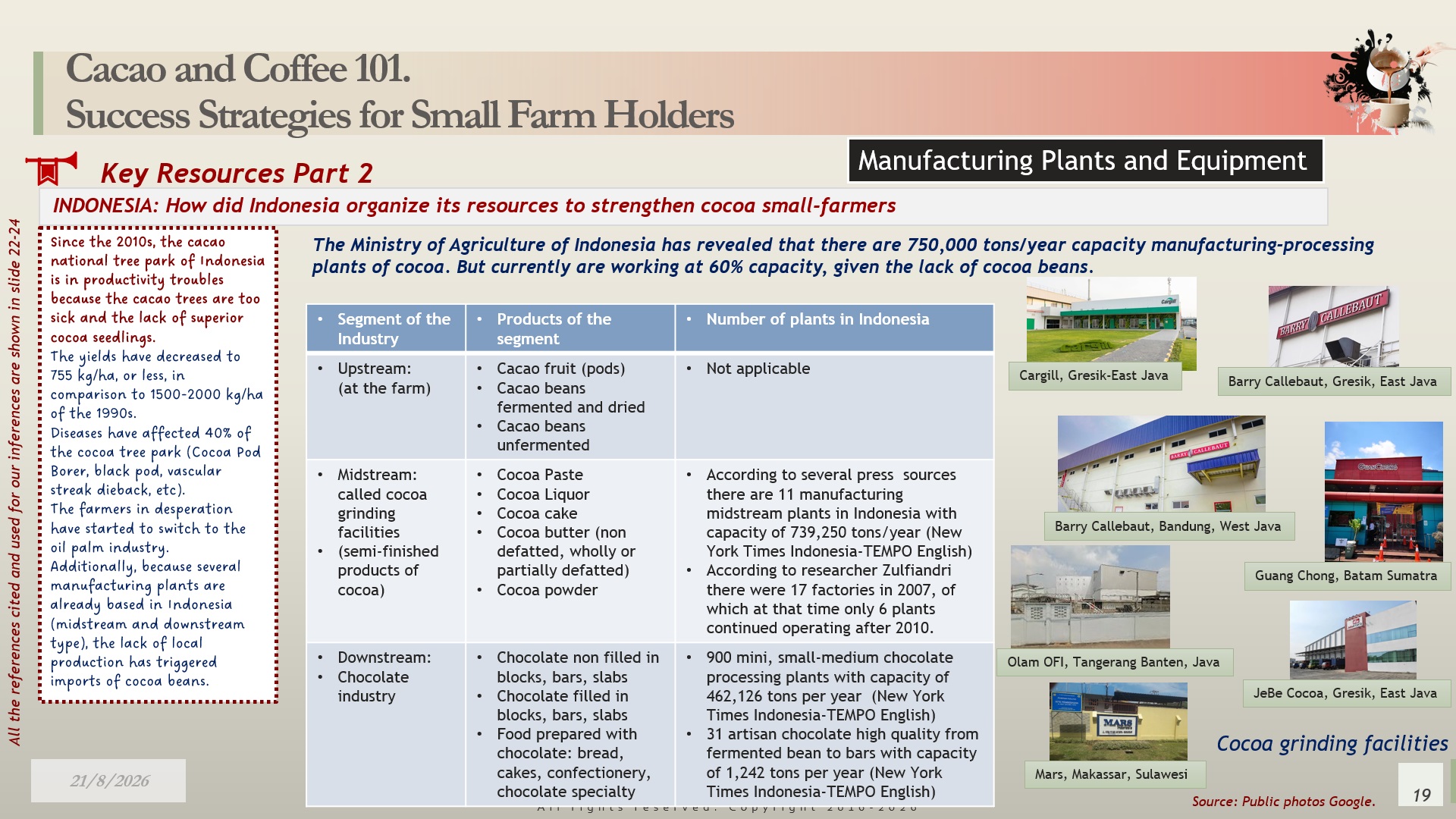
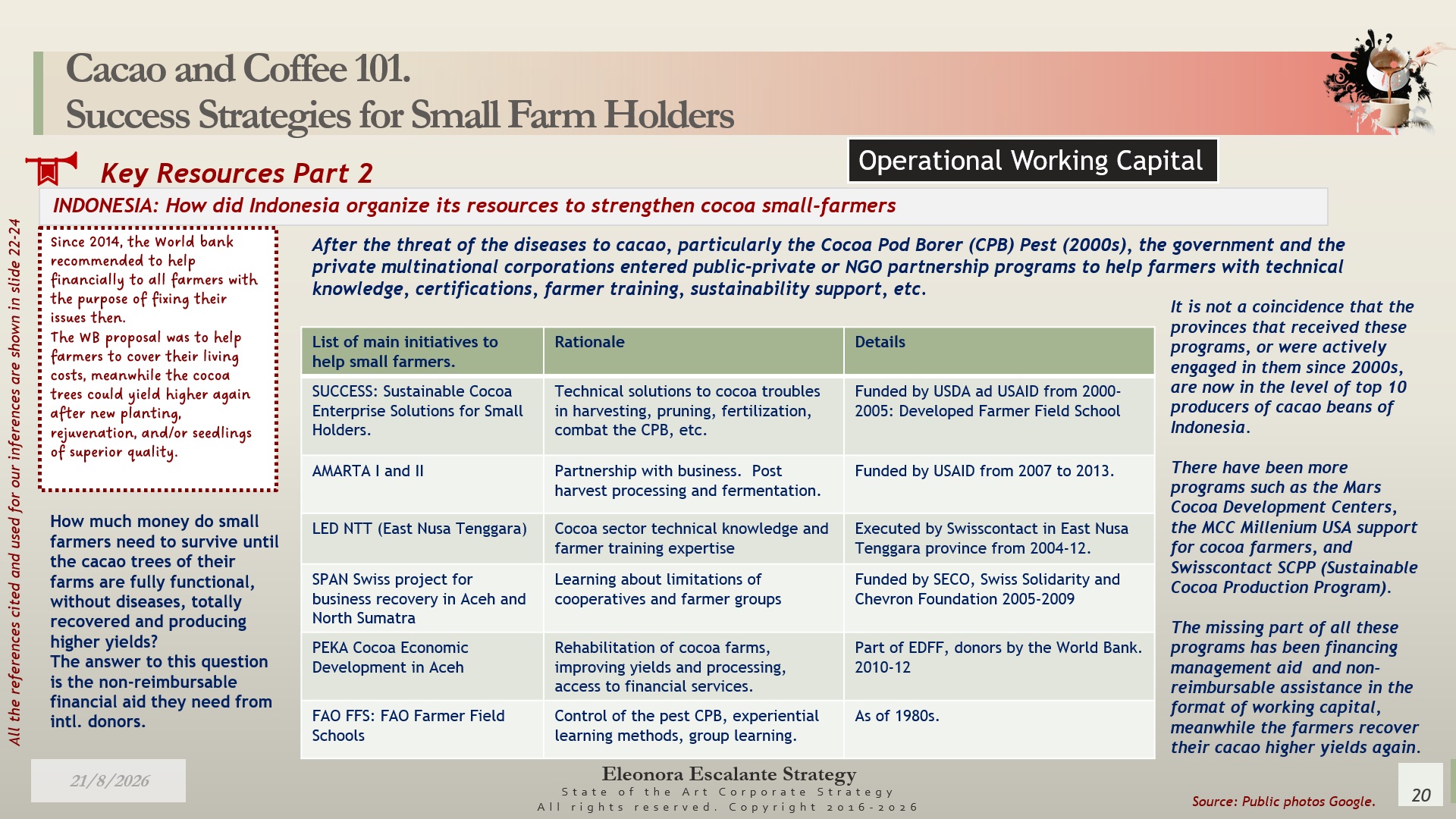
We also performed an analysis of the land and trees, the manufacturing plants (multinational corporations), the equipment, and the programs that have trained the cacao smallholders during the last 20 years. Slides 17 to 20 are self-explanatory.
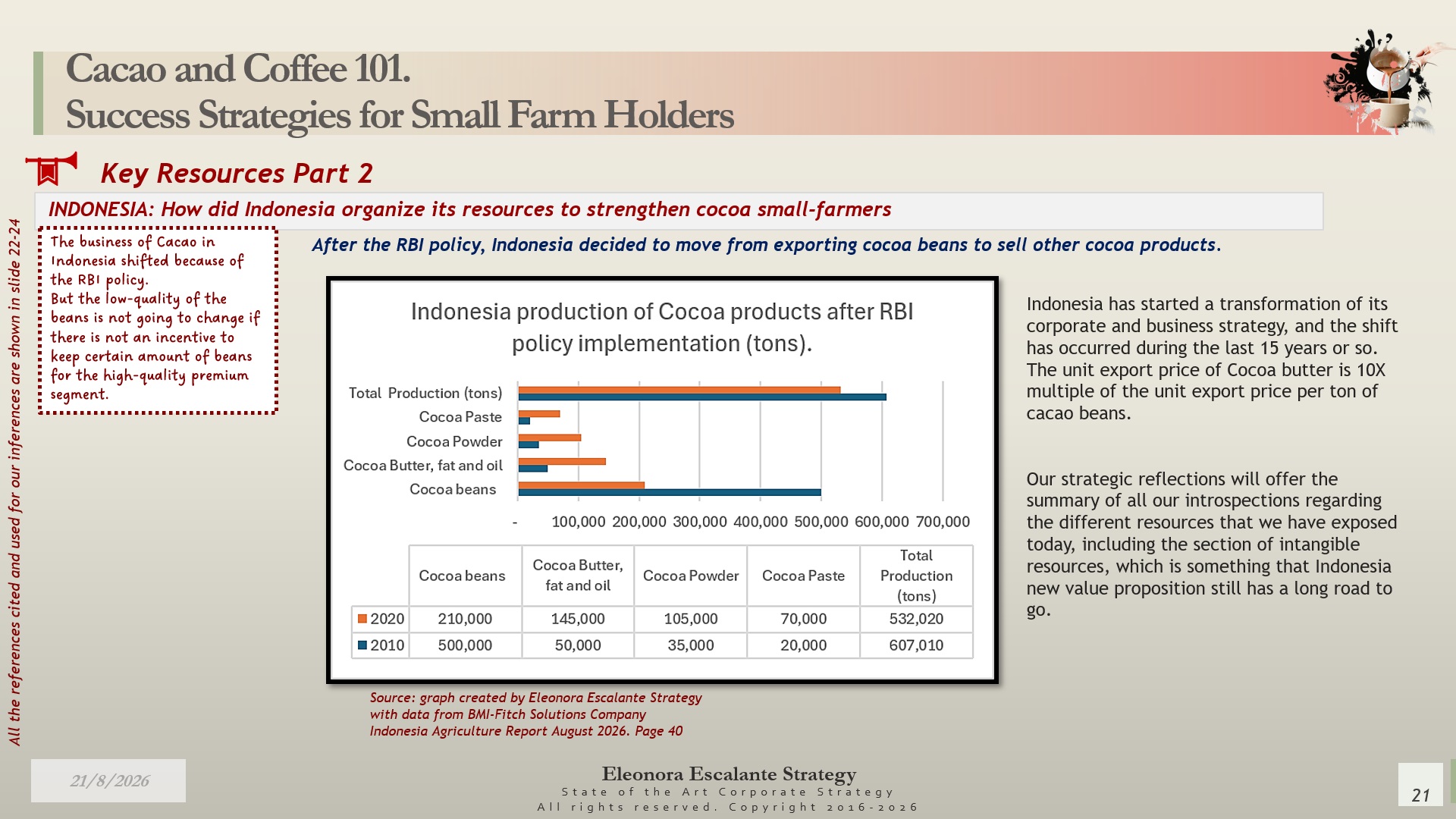
It is in the cocoa products mix where we find the source of profit. Slide 21
The value added to the cacao beans in the case of Indonesia was not in the terroir, using a European Union Protected Denomination of Origin or a French “Appellation d´Origine Contrôlée-AOC.” This nation decided to move from the upstream product (cacao beans) to the midstream semi-finished products. The Indonesian Cacao Industry has a record of resilience after a tragedy. Is this the right strategy?
The diseases and ageing of the Indonesian cacao park affected the production of cacao beans. It was unthinkable to continue selling high-quality beans if there was a market for cocoa butter in the USA and the Netherlands, at a higher price than the kilogram of cocoa beans. Since the annual local production was reduced almost in half in less than 15 years, it was important for the sector to switch to manufacturing cocoa butter (and cocoa powder). Following the RBI policy, the Indonesian local manufacturers (not the huge, big MNCs´ grinding facilities) have begun to invest in machinery and started to build their own plants (at a small-to-medium scale). The value proposition of Indonesian cacao shifted from the high-flavor quality beans to other products with lower quality standards of the beans, such as cocoa butter, cocoa powder, and cocoa paste. These are semifinished products. The domestic and regional consumption of these products has restarted. The matrix of cocoa goods has diversified. Indonesia still exports marketable, high-quality cacao beans (at the levels reported by the ICCO: 200,000 tons per year), but the rest of the local production is kept inside to produce cocoa butter (mainly), in which the rigorous high-quality for fine flavor standards do not matter at all. We perceive that the cacao imports to Indonesia are filling the gap in high-quality that is required by the MNCs’ grinding facilities, such as Barry Callebaut, Mars, and others.
What will happen in the future for the small-scale cacao farmers of Indonesia?
It would be a mistake to move all small farmers into manufacturing cocoa butter, cocoa paste, and powder. When one industry puts all its eggs in one basket, it lacks a survival cushion when economic cycles or trade disasters occur. Additionally, the high-flavor cacao beans should be kept in good proportion to continue the downstreaming of the industry. At the moment, success has occurred at the level of semi-finished products (midstream), but it is in the downstream retailing where cocoa earns miracles. Are we observing the birth of high-quality downstream Indonesian chocolatiers, who will compete against the top Swiss ones? To build high-quality chocolate in Indonesia, by Indonesians, will require enormous support from the Government. For this to happen, the Ministry of Agriculture of Indonesia is obliged to accompany them to build an economic ecosystem that could sustain them for some time; meanwhile, the intangible value (branding, reputation, recipe patents, PDOs for certain Indonesian zones where high quality will increase its value) would be cemented at the core of their chocolate positioning. Can you see the importance of a good value proposition? Indonesia shifted it. Will Indonesia become a high-quality competitive chocolatier nation disrupting the Swiss, Belgian, or French chocolatiers? Only time will tell…
Announcement.
Our next episode is about numbers. Revenue streams and Cost structure. We will use an example from the start. The Ethiopian Coffee, and we will directly jump to show you how to structure different revenue streams under a lean cost structure for small farmers who are aspiring to find opportunities to become middle-class.
Musical Section.
This saga is committed to raising the traditional musical instruments and their respective musicians over the digitally produced sounds. This saga is dedicated to the chamber orchestras.
Today, we have chosen the Amsterdam Sinfonietta. With 23 members in total, under the direction of the master violinist Candida Thompson.The Amsterdam Sinfonietta is one of the most remarkable string chamber orchestras in the world. For this occasion, the Sinfonietta interprets the CPE Bach Symphony in E major. For more information about this orchestra, click here: https://www.sinfonietta.nl/en/discover-the-orchestra/
Enjoy!
Thank you for reading http://www.eleonoraescalantestrategy.com. It is a privilege to learn. Blessings.

Sources of reference and bibliography utilized for today´s inferences. The bibliography is listed on the last slide of the reference reading material. Click the respective URL to trace them.
Bibliography in this post: This will be added accordingly with the strategic reflections.
- Parthesius, R. Dutch Ships in tropical waters. The development of the Dutch East India Company. Shipping Network in Asia 1595-1660. Amsterdam University Press.
- Bosma, Ulbe. Labour mobility and Colonial and Forced Labour Regimes in Indonesia: A Long Term View. Journal of Agrarian Change, 2025. Wiley
Disclaimer: Eleonora Escalante paints Illustrations in Watercolor. Other types of illustrations or videos (which are not mine) are used for educational purposes ONLY. All are used as Illustrative and non-commercial images. Utilized only informatively for the public good. Unless otherwise stated, I do not own any lovely photos or images.
 Eleonora Escalante Strategy Strategic Reflections Think Tank